Jail Bookings Down Significantly during COVID-19

In the midst of the coronavirus pandemic, California has sought to reduce county jail populations through a range of actions, including a “zero bail” emergency measure. This means that most misdemeanor and lower-level felonies currently have no bail amount associated with them, and that suspects are more likely to be cited and released instead of booked into jail. This new practice, along with decreases in crime and local directives to reduce arrests and bookings, appear to have drastically reduced the number of people sent to jail at this time.

A number of offenses—including felony burglary, driving under the influence, and the most serious sexual and violent crimes—can still receive a bail amount above zero.  And law enforcement can still book someone into jail even for a so-called zero bail offense—but the arresting law enforcement agency (or the district attorney) has to request to a judge to set a bail amount. If the court denies the request then the suspect has to be released.

To get a sense of the magnitude of zero bail’s effect on releases and bookings, we looked at data from the Monthly Arrest and Citations Register (from 2016, the most recent available). These data do not perfectly identify zero bail offenses or the offenses excluded from the zero bail list. But they do allow us to identify an upper bound of the impact on jail bookings.

Of the roughly 1,140,000 arrests that we analyzed, about 791,000 were booked into jail (about 69% of arrests). About 317,000 of these bookings (or 40%) were for offenses in which bail is still is an option today. The remaining 474,000 bookings (or 60%) were for zero bail offenses.

This suggests that today, if the arrest offense distribution is currently the same as it was in 2016 and there are practically no requests to set bail for zero bail offenses, then only about 28% of arrests in California would lead to a booking into jail.

In 2016, misdemeanors made up the majority of arrests booked into jail (about 77%) for what are now zero bail crimes. Of these, the most common offenses were drugs (almost 28%), failure to appear in court on a misdemeanor offense (about 21%), drunk and disorderly conduct (12%), and traffic and petty theft (each about 5%). The most common felony offense bookings now set at zero bail were drug offenses (almost 30%), theft (22%), and vehicle theft (roughly 14%).

While crime appears to be down since the COVID-19 outbreak, and the type of crimes committed during the pandemic almost surely have changed, our examination of 2016 arrest data suggests that the implementation of zero bail—in addition to the effects of local directives and fewer crimes—means that far fewer people are being booked into jail at this time.

Recent statewide data from the Board of State and Community Corrections supports this conclusion, as it reveals that weekly jail bookings have dropped from 17,140 the week of February 23 to 6,880 the week of April 12 (a decrease of about 60%, consistent with our data analysis).

These findings suggest that the zero bail measure is playing a significant role in reducing crowding in California’s county jails and helping to make social distancing more achievable. Going forward, it will be important to monitor other possible impacts this reduction in jail bookings might have, including on homelessness, public safety, and access to health care.


How Will COVID-19 Affect Arrests in California?

The arrest rate in California is at its lowest level in decades, and as the COVID-19 crisis sends regions into economic and social disruption, further changes may emerge. Local law enforcement agencies are already adopting new arrest strategies to ensure public safety, to protect officers as well as to minimize jail crowding.

With some police departments starting to issue warnings or citations rather than make arrests, the number of misdemeanor arrests may fall. Departments are also delaying planned arrests unless doing so increases any risk to public safety, issuing summonses in the field rather than bringing detainees into a station for booking, and directing officers to take police reports online or over the phone instead of in person.

Measured as the incidence of arrests made per 100,000 in the population, the arrest rate in California had reached a peak of over 8,000 in 1989, and has since fallen fairly steadily, to under 3,500 in 2016. That 58% decline applies to rates of arrests made for felonies as well as for misdemeanors. This number reflects, in part, a parallel drop in crime rates, which are also at historic lows.

But it also reflects changes in legislation–in particular, the 2014 implementation of Proposition 47, which reclassified many lower-level property and drug offenses from felonies to misdemeanors, and the corresponding changes in law enforcement agencies’ priorities regarding the mix of offenses likely to be prosecuted.

Recommendations around arrests during the COVID-19 pandemic apply only to nonviolent misdemeanors and other lesser infractions. For instance, departments are advising officers to issue a ticket or citation for such crimes as vandalism, or low-level theft, rather than apprehend the perpetrator. Therefore, large-scale adoption of these recommendations would lead, all things being equal, to a larger share of arrests made for felonies, even if felony arrests themselves remained unchanged.

The share of arrests for felony offenses had been increasing gradually for decades, but fell dramatically after Proposition 47 was implemented. Felony offenses typically involve situations requiring immediate response, and officers have less discretion in deciding whether to make an arrest or take some other action. For example, an officer stopping a person for drug possession could issue a citation rather than make an arrest, but an officer responding to an aggravated assault is often obligated to take a suspect in for booking.

In these unprecedented times, however, all things are not likely to remain equal, and as the COVID-19 crisis evolves, changing social and economic circumstances will affect individual behavior, community responses, and law enforcement reactions.

Preliminary reports from four major California cities suggest that incidences of crime—property as well as violent—have dropped considerably since shelter-in-place orders went into effect. However, there is early evidence of an uptick in domestic violence. Monitoring the new approaches law enforcement is taking, and the outcomes of these interactions, will be key to determining which approaches are best suited to maintaining public health and safety.

Video: Key Factors in Arrest Trends and Differences in California’s Counties

Police officers make more than a million arrests per year in California. Arrests to enforce laws and protect public safety can have wide-ranging consequences for individuals and communities, and there have long been concerns about racial disparities. But little is known about the factors that contribute to arrest trends across the state. At a recent event in Sacramento, PPIC researcher Brandon Martin outlined major findings from a new report on arrests, and a panel of experts offered state and local perspectives.

Martin pointed out that arrest rates have fallen significantly over the past few decades, largely in tandem with declining crime rates. He also noted that arrest rates are higher in relatively poor counties, while racial disparities are largest in more affluent counties. These and other findings add up to a broad view of arrests that can inform efforts to reduce overall rates and racial disparities.

Shirley Weber, who represents California’s 79th Assembly District, said that the racial disparity findings are not new to the African American community. She noted that African Americans who commit offenses are “more likely to be arrested and incarcerated . . . rather than just being picked up and talked to,” and that confrontations that lead to uses of force are also more likely. These disparities have significant effects on employment and family stability, among other things.

Edgar Boyd, pastor of First African Methodist Episcopal Church in Los Angeles, emphasized the need for police and communities to reduce disparities: “When you look at . . . the conflict that exists between communities and law enforcement across the state, you’ll find that there’s a possibility of less negative impact, if it’s worked on.” Tod Sockman, chief of police for the city of Galt, agreed: “Law enforcement spends a lot of time doing community outreach. I think that’s key to everything we’re doing.”

The panelists also agreed that while local efforts are critical, the state has an important role to play in monitoring disparities. Weber—who championed Assembly Bill (AB) 392, a measure that sets statewide standards for police use of force—said that it would be irresponsible for state lawmakers to view criminal justice challenges as local matters. After AB 392 passed, a number of police officers told her that they were pleased because “they had ideas of working to de-escalate . . . and now this bill says we gotta do it, and so they can blame it on me. And that’s OK! Because sometimes there are things at the local level that prevent you from moving in a direction.”

Recent criminal justice reforms have led to further reductions in arrest rates, seemingly without a major impact on public safety. But there is still room for improvement. Sockman pointed to increases in theft and the continuing challenge of addressing addiction and mental illness, and Weber noted the difficulty of changing course after decades of reliance on incarceration.

Boyd, who serves on the state’s Racial and Identity Profiling Advisory Board, made the case for ongoing dialogue: “Our work on this, our dialogue together . . . is all important. Every one of us has a role and a responsibility in that.”

A Closer Look at Women’s Arrest Rates

Historically, men have been arrested at much higher rates than women in California. However, a recent PPIC report found that while arrest rates declined for both men and women, they dropped significantly more for men than for women (57% and 13%, respectively) between 1980 and 2016. A closer look at gender breakdowns underscores some differences in arrest offenses of men and women—and suggests that they may be differently affected by criminal justice reforms.

Women are still arrested at significantly lower rates than men (1,603 arrests per 100,000 female residents in 2016, compared to 5,270 arrests per 100,000 male residents), but they now represent a larger share of total arrests statewide than they did in 1980, up from about 13% to almost 24%. A closer look reveals they also tend to be arrested for different types of offenses. Relative to their overall share of arrests, women represented a disproportionate share of arrests for property offenses (32%), compared to 23% of arrests for violent offenses and 22% for drug offenses. In stark contrast, women only make up about 7% of felony weapons arrests.

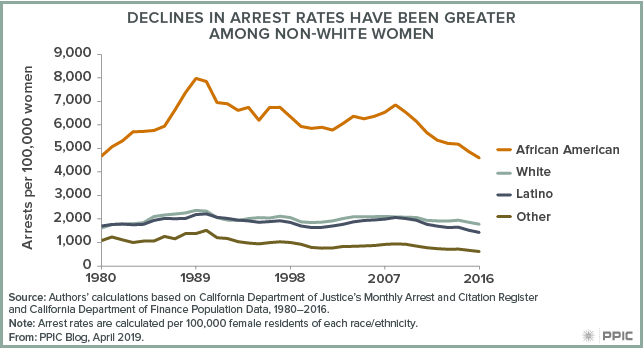
A look at trends in female arrest rates by race/ethnicity shows a decline for women of all races, with greater declines among non-white women. Between 1989—when overall arrest rates peaked—and 2016, arrest rates fell more dramatically for men than for women across all races/ethnicities, but the size of the gender gap varied:

  • Arrest rates for white women fell 25%, while arrest rates for white men fell 55%.
  • Arrest rates among Latino women declined by 35%, while rates for Latino men fell 68%.
  • Rates for African American women fell 42%, while rates for African American men fell 58%.

figure - Declines in Arrest Rates Have Been Greater Among Non-white Women

These differing trends are mostly driven by misdemeanor arrest rates, which have declined much more dramatically among men than among women. In 1980, women represented 14% of misdemeanor arrests, but in 2016 this share jumped to 25%, in part due to an increase in female arrest rates for misdemeanor assault and battery offenses. The female share of felony arrests also increased, up from roughly 12% in 1980 to almost 20% in 2016.

While many factors likely contribute to these trends, California’s criminal justice reforms—which have largely focused on property and drug offenses—are likely to have played a role, with different effects on arrests of men and women. Not surprisingly, given gender differences in arrest offenses, the data supports this. For instance, after Proposition 47 reclassified several drug and property offenses from felonies to misdemeanors in November 2014, the female arrest rate for drug offenses declined by 14% and the rate for property offenses fell by 22%, compared to 7% and 10% declines among men. Policymakers would do well to monitor arrest rates for men and women and keep them in mind when considering the impact of criminal justice reforms.

Video: New Insights into California Arrests

Crime, policing, and community relations are subject to heated debate, but little is known about the first step in the criminal justice process: arrests. Who is arrested in California and what are they arrested for? How have arrest patterns changed over time and how do they differ across the state? Last week in Sacramento, PPIC researcher Magnus Lofstrom outlined findings from a new report and Brandon Martin—a PPIC research associate—moderated a panel discussion that put these trends in the context of state legislation and local police-community relations.

The PPIC report finds that overall arrest rates have dropped dramatically over the past few decades, largely due to declines in misdemeanor arrests. While there have been significant declines in arrests among juveniles and young adults, men, and African Americans, arrestees still tend to be younger, male, and nonwhite. After presenting these and other key findings, Lofstrom stressed that “this report raises more questions than it answers.” Future research, he said, will explore the factors that contribute to trends and differences in arrest rates across demographic groups and jurisdictions across the state. It will also look at the impact of recent criminal justice reforms.

The panelists focused on the importance of addressing the larger issue of long-term trust between law enforcement and the communities it serves. Gabriel Caswell, counsel to the California Senate Public Safety Committee, said that recent reforms such as the Racial and Identity Profiling Act have tried to strike a balance between officer safety and community transparency: “If the community has at least somewhat more access than they’ve been given historically, I think that will go a long way toward rebuilding trust.”

Marisa Arrona, local safety solutions project director for Californians for Safety and Justice, highlighted efforts to shift from reactive policing to the Blueprint for Shared Safety: “Shared safety is more than the absence of crime; it’s got to be the presence of well-being.” Instead of assessing safety only through crime rates, communities can also use other measures, such as harm reduction among vulnerable populations, access to victim services, or the number of former offenders who have access to jobs.

Daniel Hahn, Sacramento police chief, also cautioned against relying exclusively on crime numbers: “You’ve got to be very careful of what’s behind the numbers and make sure it’s actually meaningful to the community.” He stressed the need to look beyond simple solutions. In order to build trust between police and the communities, he added, “We gotta change the way we hire, change the way we train, include the community in the police department and the police department in the community.”

Toward Understanding Racial Disparities in Arrests

With tensions between law enforcement and minority communities continuing to make headlines, media outlets and academic researchers both report stark racial and ethnic differences in criminal justice experiences, including sentencing and incarceration. The disparity between African Americans and whites is especially striking. For example, the prison incarceration rate in California is 4,180 per 100,000 residents for African American men, compared with 420 for white men. It is likely that this inequality is significantly affected by the first step in the criminal justice process—arrests.

California’s various law enforcement agencies make a substantial number of arrests each year—1.35 million in 2016. While this is a staggering number, it’s also the lowest number of arrests since 1980 and marks a dramatic decline of more than one million arrests (64%) since a peak in 1990.

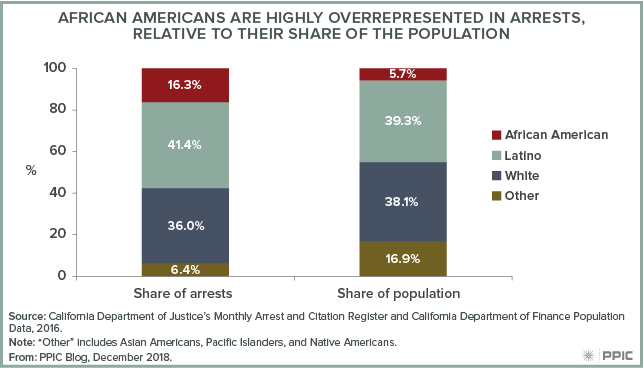
Looking at racial disparities, we find that African Americans are significantly overrepresented among those arrested in California. In 2016, African Americans made up less than 6% of the population but more than 16% of arrests. Latinos were slightly overrepresented in arrests as well, representing 39% of the population but 41% of arrests.

Though much of the penal code is determined by the state legislature, the state does not closely monitor how arrest decisions change over time or vary across jurisdictions, nor how these decisions may affect demographic groups differently. Two efforts—one implemented by the state legislature and one by PPIC—seek to fill this knowledge gap and will bring data-driven information into the broader discussion about policing and community relations.

In 2015, California’s legislature passed the Racial and Identity Profiling Act (AB 953). This legislation requires law enforcement agencies to begin collecting data in 2018 on all initial police interactions with the public, including reason, location, race/ethnicity, gender, and age. While this will provide an opportunity to learn more about law enforcement interactions, the data will not be available for statewide analysis until 2023 or later.

In the meantime, PPIC has launched a project to begin identifying areas in need of attention in California arrests and to frame the conversation for sustainable solutions at the state and local level. In our first report, we examine trends over time and provide a descriptive profile of arrestees, including patterns in race/ethnicity, gender, age, offense type, and the county where the arrest took place. Our interactive tool allows for deeper exploration of arrest rates across California counties.

Over the next two years, we will further examine whether arrestees were booked into jail or cited and released in the field. We will also seek to understand possible contributing factors to these arrest patterns—such as crime rates, law enforcement and correctional resources, economic conditions and expenditures, and demographics. This project uses unique data from the California Department of Justice’s Monthly Arrest and Citation Register (MACR).

As the state and local jurisdictions continue their data collection efforts on police interactions, PPIC’s research will provide a better understanding of long-term trends in arrests and differences throughout the state. Stay tuned for more insights on this critical but understudied aspect of California’s criminal justice system.

New Laws Expand Criminal Justice Reforms

Governor Jerry Brown recently signed a number of bills that extend the state’s efforts to reform California’s adult and juvenile criminal justice system. This legislative package supplements previous reforms; several of the new laws could further reduce the state’s prison population, which remains subject to a court-ordered population target. The bills cover issues at all levels, including arrest, conviction, incarceration, and parole.

Arrest and conviction

  • SB 395 strengthens protections for arrested minors under the age of 16 by requiring that they confer with an attorney prior to waiving their Miranda rights and being interrogated by police. AB 529 allows juveniles to have their records sealed if they are not convicted. SB 312 allows juvenile offenders convicted of serious or violent offenses committed after the age of 14 to have their records sealed.
  • SB 393 allows adults to request that the court seal their records if they are arrested but not convicted.

Sentence enhancements

  • Sentence enhancements allow prosecutors to seek additional prison time in certain circumstances—such as the use of a firearm or gang involvement. The number of enhancements has increased dramatically over the past 30 years. SB 180 eliminates the three-year sentence enhancement for certain circumstances related to selling drugs, though it leaves in place the enhancement for using minors in the sale of illegal drugs. SB 620 allows judges the discretion to dismiss or strike sentence enhancements for offenders who are in possession of a firearm while committing a crime.

Parole

  • AB 1308 and SB 394 raise the age limit for youth parole from 23 to 25, and grant the possibility of parole for juvenile offenders serving life sentences after they serve at least 25 years.
  • AB 1448 allows certain offenders older than 60 who have been incarcerated for more than 25 years to be released to parole. It is worth noting that AB 1448 codifies a practice that has been helping the state reduce overcrowding: a total of 557 offenders were released under this program between February 2014 and August 2017.

Impact of supervision on juveniles and families

  • SB 625 reinstates honorable discharges for juvenile offenders who have “proven their ability to desist from criminal behavior.” An honorable discharge removes long-term penalties, such as the ban on juvenile offenders working as police officers.
  • SB 190 limits the financial liability of families for the housing, transport, or supervision of juvenile offenders.

The goal of these laws is to improve offender outcomes by emphasizing rehabilitation and reentry to the community—and possibly reducing pressure on the state budget. State lawmakers believe these bills are grounded in evidence-based practices. For example, the reduction of long-term penalties for juveniles and young adults is grounded in neuroscientific evidence that decision-making ability does not mature fully until the mid-20s.

Two bills that aim to reform the state’s bail system, AB 42 and SB 10, did not reach the governor’s desk this legislative year. However, the debate over bail reform will most likely continue in 2018. Advocates for reform believe that evidence-based practices that base pre-trial release decisions on an offender’s likelihood of appearing in court or reoffending—not his or her financial means—could significantly reduce the number of pre-trial offenders held in county jails. Opponents believe that the current bail system is the best way to make pre-trial release decisions while protecting public safety.

California’s Arrest Rate Reaches a 50-Year Low

Recently released arrest and crime data from the California Attorney General’s Office reveal some noticeable recent changes. Until last year, California’s felony arrest rate trend had closely mirrored the state’s crime rate trend for 20 years. We would expect the two trends to move in similar ways, since most of the crimes reported and used to calculate the crime rate are felonies. But the trends diverged in 2015 after passage of Proposition 47, which reclassified a number of drug and property crimes from felonies to misdemeanors. The felony arrest rate dropped dramatically in 2015, by 30%, while crime rates went up—the violent crime rate rose by 8.4% and the property crime rate by 6.6%. The drop in felony arrests was partly offset by a very noticeable increase in misdemeanor arrests. Still, the total number of arrests dropped by almost 52,000.

California’s total arrest rate—which has been declining over the past two decades—is now at a historic low of 2,944 per 100,000 residents; this is less than half the peak rate of 6,765 reached in 1989. What is arguably more noteworthy is the even greater drop in the felony arrest rate, which, at 806 per 100,000 residents, is about a third of the 1989 peak rate of 2,052. The 30% drop in the felony arrest rate in just one year, 2014 to 2015, accounts for more than a quarter of the peak-to-bottom decline. Misdemeanor arrests, by contrast, increased from 1,979 to 2,138, or 8%.

The data strongly indicate that Proposition 47 is a major factor in these changes. First, monthly arrest data show abrupt changes in drug and property arrests in November 2014, the month Proposition 47 went into effect. Second, the drop in felony arrests was almost exclusively for drug and property offenses, while the increase in misdemeanor arrests was almost entirely for drug and property offenses. Arrests for motor vehicle theft, which continues to be a felony after Proposition 47, is the only area of increase. Possibly in response to the 13% increase in auto thefts in 2015, motor vehicle theft arrests went up by 26%.

Although the total number of property crime arrests dropped, the decrease in arrests for drug offenses was more significant. Felony drug arrests declined by about 92,000, while misdemeanor drug arrests went up by more than 70,000. The net drop of about 22,000 drug arrests accounts for more than 40% of the total decline.

The new data raise many questions, including whether the recent changes to our criminal justice system are affecting public safety. Also, does the decline in drug arrests mean that drug use has declined or that fewer offenders with substance abuse problems are receiving necessary and effective treatment? Future research needs to address the role of reforms like Proposition 47 on crime, offenders, law enforcement, and counties’ ability to provide necessary treatment and programming.