Video: Californians and Their Government

In California’s March 3 primary, the state ballot will feature several initiatives—including a $15 billion bond for the construction and modernization of public education facilities. Slightly more than half of likely voters approve, while 42% are opposed and 8% are undecided. PPIC researcher Dean Bonner outlined this and other key findings from the latest PPIC Statewide Survey at a briefing in Sacramento last Friday.

In November, Californians may be asked to vote on a constitutional amendment that would require state and local governments to provide housing or shelter beds to all homeless residents. About six in ten adults and 55% of likely voters say they would vote yes on such an amendment. Majorities of adults and likely voters also support Governor Newsom’s proposal to allocate $1 billion to address homelessness.

Other survey highlights:

  • More than six in ten Californians say housing affordability is a big problem in their part of the state, and the cost of living is causing many to consider moving out of California.
  • A majority of Californians (53%) approve of the way Governor Newsom is handling his job; this is the governor’s highest approval rating to date.
  • Views on the governor’s plan to scale back the high-speed rail project are mixed, while most approve of his proposal to build only one tunnel under the Sacramento–San Joaquin Delta.
  • Bernie Sanders leads all other Democratic presidential candidates with 32% support among Democratic primary likely voters. Joe Biden has 14% support, 13% support Elizabeth Warren, and Pete Buttigieg and Michael Bloomberg were tied at 12%.

Electability Matters in the Democratic Primary

Californians will head to the polls next Tuesday for the Democratic primary—and over 2 million have already returned their mail-in ballots. As Democratic and independent (also known as no party preference) voters prepare to choose their presidential nominee, the question arises: do they care more about electability or a candidate’s position on the issues?

Electability seems to edge out issue position for likely voters. According to our February 2020 survey, choosing the candidate most likely to defeat Donald Trump is more important to nearly six in ten Democratic primary likely voters (57%), while one in three (33%) say nominating a candidate whose positions on the issues come closest to theirs is more important. Findings were similar in our November 2019 survey (55% electability, 36% issue positions).

This view is widely held among Democratic primary likely voters, with at least half across nearly all demographic groups saying electability is more important. Among the lone outlier group—likely voters age 18 to 44—half think the candidates’ positions on the issues is more important.

figure - What’s More Important to Likely Voters in a Democratic Nominee?

There is a connection between a likely voter’s priorities and support for specific candidates. Among those who rank candidate positions on issues as more important, 43% support Bernie Sanders; fewer support Pete Buttigieg (13%), Elizabeth Warren (11%), Joe Biden (9%), or Michael Bloomberg (7%). For those who rank electability as more important, Sanders is also the top choice with 24% support, but he is followed closely by Biden (16%), Bloomberg (16%), Warren (15%), and Buttigieg (12%).

As Californians prepare to cast their votes at the polls—and continue to send in mail ballots—electability will be on the minds of many, and it could play a role in deciding who the Democratic Party nominates to run in the fall.

Californians Are Grappling with Homelessness

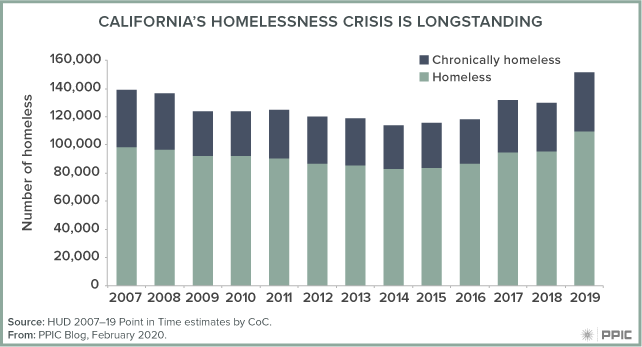
In his State of the State address last week, Gavin Newsom focused almost exclusively on homelessness—a significant long-term problem and major concern for state residents. In 2019, 150,000 Californians—more than a quarter of the US homeless population—were counted as homeless. California’s rate of homelessness rose to 38 per 10,000 residents, the third highest in the nation.

What is more, 72% of California’s homeless residents are unsheltered, living on the street or in parks and other makeshift spaces. And nearly three in ten self-report as chronically homeless—having been on the streets for more than a year.

Figure: California's Homelessness Crisis is Longstanding
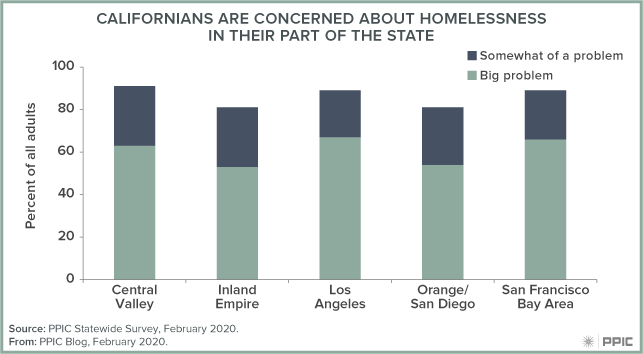
Californians across the state are feeling the gravity of this issue. The latest PPIC Statewide Survey finds that more than 8 in 10 Californians see homelessness as a problem in their part of the state (86% adults, 89% likely voters).

figure -

Considering these numbers, it does not come as surprise that Governor Newsom has made homelessness a major focus. Citing the connection between chronic homelessness, mental health, and behavioral health, Newsom has underlined the importance of policies and investments that allow for “whole person” care. By linking current funding sources and asking lawmakers to expand the use of funds for services provided to the homeless population—especially those involved with the criminal justice system and at-risk foster youth—the governor hopes to improve and integrate these services.

The PPIC Statewide Survey finds that a full 70% of Californians—and 64% of likely voters—favor the governor’s proposed $1 billion budget expenditure to address homelessness. State leadership and investment are key, but there is only so much that can be done at the statewide level. Finding solutions to homelessness requires coordination between the federal, state, and local levels, as well as collaboration across sectors—including housing, health, and social services.

Testimony: California Is on Track to Close the Degree Gap

[vc_row][vc_column][vc_column_text]Hans Johnson, director and senior fellow at the PPIC Higher Education Center, testified February 25, 2020, before the Assembly Budget Subcommittee (No. 2) on Education Finance, chaired by Assemblymember Kevin McCarty. Here are his prepared remarks.

At the PPIC Higher Education Policy Center, we have long been concerned about the future of California’s workforce. Would the state have enough college graduates to meet evolving economic demands? We have produced a series of reports addressing the dynamics of this issue.

Five years ago, we projected a shortage of highly educated workers in California. Specifically, our economic projections to 2030 showed that about two in five jobs would require at least a bachelor’s degree, while demographic projections suggested that only about one in three Californians would attain this level of education. This shortfall amounts to 1.1 million bachelor’s degrees.

PPIC noted that to fill this shortfall, the state and its higher education systems would need to act—increasing access, transfer, and completion especially among groups historically underrepresented in higher education, including low-income students, first-generation college students, Latinos, and African Americans.

We identified ambitious targets that—if met—would close the degree gap. Those targets included large increases in access to the University of California (UC) and California State University (CSU), both for first-time freshmen and for transfer students. They also included substantial increases in graduation rates. At the request of the legislature, UC and CSU both issued reports on how they might meet those targets.

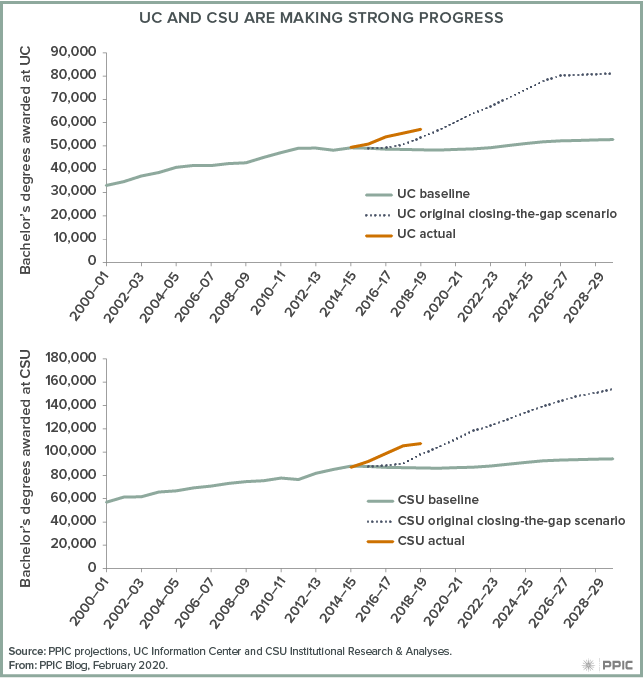
Today, I’m pleased to say that California is currently on track to close the gap. The concerted efforts of policymakers, higher education officials—including staff and faculty—and, of course, students have led to these early gains.

State General Fund allocations for each system have increased substantially since the Great Recession, allowing for increased enrollment and renewed efforts to improve student persistence and completion. Both UC and CSU have exceeded PPIC’s closing-the-gap targets. These early gains have reduced the degree gap by almost 80,000.

figure - UC and CSU Are Making Strong Progress

Two primary actions have led to these gains.

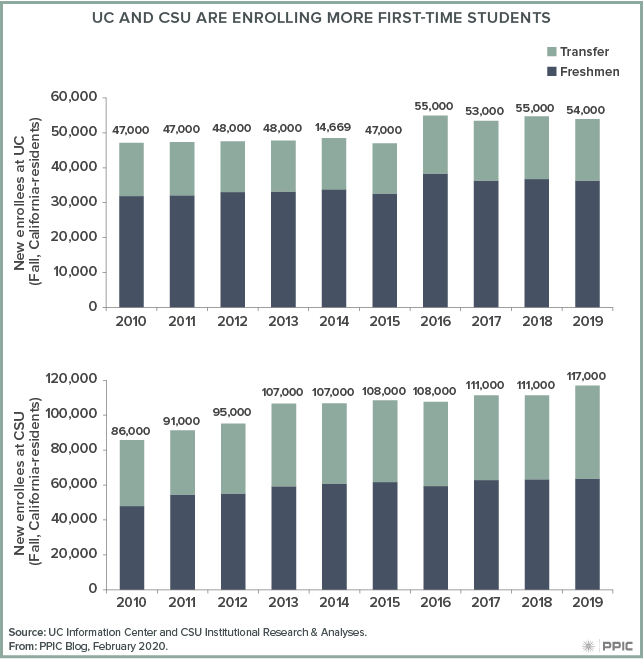
First, increases in state funding have allowed UC and CSU to enroll substantially more first-time students from California—both freshmen and transfer students. At UC, enrollment of transfer students went up 16% between fall 2010 and fall 2019. Enrollment of freshmen grew 14%. At CSU, enrollment increased 41% for transfer students and 33% among freshmen over the same time period. Notably, UC’s gains occurred primarily in one year, from 2015 to 2016, when the legislature and governor tied a $25 million allocation to increasing enrollment by 5,000 students. In that single year, total first-time enrollment of freshmen and transfer students went up 10%, with gains concentrated among African Americans (36%) and Latinos (25%).

figure - UC and CSU Are Enrolling More First-Time Students

Second, programs to improve student persistence and graduation rates have also paid off—and contributed to enrollment growth. These gains have been especially sharp at CSU, which has received substantial funding from the state to support its graduation initiative. At CSU, six-year graduation rates for California-residency students have increased from 57% for 2009 entering freshmen to 67% for the 2013 cohort. At UC, four-year graduation rates for California-residency students have increased from 62% for 2010 entering freshmen to 68% for the 2014 cohort. (Six-year graduation rates at UC remain very high, around 85%). Graduation rates for transfer students have also increased at both systems.

These early successes are very promising. Still, California needs to build on them if it is to close the degree gap fully. The demand for college remains high. PPIC’s statewide surveys show that the vast majority of parents (79%) want their child to earn at least a bachelor’s degree. College preparation among high school graduates has increased, with the share of students completing the college preparatory requirements of UC and CSU now at an all-time high. And while applications to UC and CSU have levelled off or even declined a bit recently, application levels are still near record highs. All but one UC campus and many CSU campuses already do not have room to admit all eligible applicants.

Looking ahead, strong demand for UC and CSU is likely to continue as college preparation improves and the transfer pathway becomes more efficient and effective. New initiatives, including reforms in remedial education at the community colleges and CSU, have the potential to substantially improve student success rates and boost transfer. New articulation agreements, such as the Associate Degree for Transfer, have streamlined the pathway from community colleges to four-year colleges, especially CSU. (PPIC will be issuing a report on transfer trends later this year.) And an increased focus on improving student outcomes has led to multiple substantive reforms designed to increase persistence and completion at UC and CSU.

Finding ways to accommodate all eligible students is a pressing challenge, but one that must be met in order to ensure a better future for all Californians. Through thoughtful planning—and yes, additional funding—closing the degree gap is possible. Improving access and completion is a necessary and critical component to ensuring that more low-income, first-generation, and underrepresented students enjoy the benefits of a college degree. The early progress I’ve highlighted here has led to greater access and success for underrepresented students, creating momentum to improve the wellbeing of all Californians.[/vc_column_text][/vc_column][/vc_row]

Medi-Cal Expansion for Undocumented Seniors

Under the proposed expansion of Medi-Cal to undocumented seniors, vulnerable Californians would gain comprehensive health insurance. The policy improves access to care for individual seniors and could alleviate the financial burden on counties that serve undocumented immigrants in indigent care programs, increasing resources for other low-income groups.

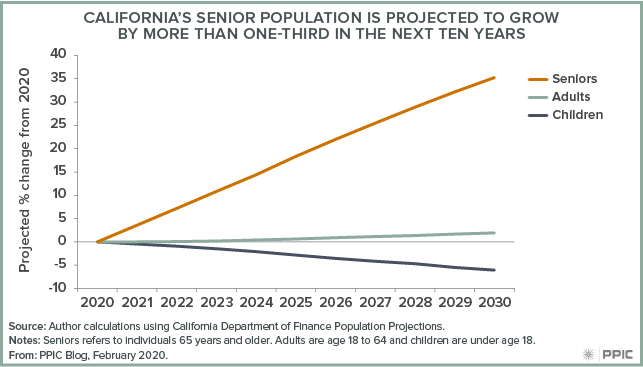
The senior population in California is projected to increase by over 2 million in the next decade, dramatically outpacing growth of younger groups in a demographic shift known as the Silver Tsunami. This increase, in particular among those in older age groups (75 to 84), will test California’s health care delivery and financing systems, because seniors are more likely to be disabled and to have complex or multiple health conditions than younger groups.

Figure - California’s Senior Population Is Projected to Grow by More than One-Third in the Next Ten Years

While most California seniors have health insurance—with Medicare being the most common—not all seniors have coverage. Many uninsured seniors are likely to be undocumented, making them ineligible for Medicare or to purchase coverage through Covered California, the state’s health insurance marketplace. These same seniors may have limited finances and therefore also are likely to struggle to access and afford health care.

Currently, most uninsured, undocumented seniors rely on safety net providers and a limited form of Medi-Cal that covers only emergencies, along with indigent care programs in certain counties that choose to cover undocumented immigrants. Under the expansion, these seniors would gain access to full-scope Medi-Cal, connecting them to preventive care and to programs to improve their disease management. Some expansion funds would also apply to the In-Home Supportive Services (IHSS) program, which pays for a caregiver—often a relative—to provide support for a senior to continue living at home rather than entering a costly long-term care facility.

The budget estimates state costs of $320 million for the expansion, which would benefit 27,000 individuals. If enacted, the policy could have implications for local finances. Counties in California provide health care and mental health services to the medically indigent, with some areas—most notably Los Angeles—serving undocumented immigrants. These county programs, together with community clinics and emergency rooms, are essential access points to health care for undocumented, uninsured seniors. If undocumented seniors become eligible for full-scope Medi-Cal, the state would finance their care instead of the county, where applicable. This shift could free up funding that could then be invested in other health-related county responsibilities, such as disaster preparedness, prevention activities, and substance use disorder treatment.

A complicated fiscal relationship between the state and counties, however, makes it difficult to estimate how much funding could be redirected if this group of seniors gain access to Medi-Cal. As state lawmakers consider the policy change, it will be important to consider how it may affect local and state finances.

California Agriculture in 2050: Still Feeding People, Maybe Fewer Acres and Cows

Water supply concerns, regulations, labor issues, tariffs, climate change, and other challenges have prompted some rather dire predictions about the future of California agriculture. We talked to Dan Sumner—director of the UC Davis Agricultural Issues Center and a member of the PPIC Water Policy Center research network—about his research on California agriculture in 2050.

PPIC: How do you think California agriculture will change in the next few decades?

DAN SUMNER: The value of farm production in California has been growing for a very long time and is likely to continue to grow. Farmers have been shifting land and water to crops that generate more revenue per acre and per acre-foot of water. Tree and vine crops have replaced annual crops. For example, cotton acreage collapsed from more than 1.2 million Central Valley acres 30 years ago to just 260,000 now. And these days Central Valley farms are getting twice as much revenue from pistachios as from hay. The pace of the shift to crops that bring higher revenue per unit of land and water will likely slow in the coming decades simply because much of the transition has already occurred.

For many years now, California’s most valuable agricultural industry by gross revenue has been dairy. But the dairy industry has stopped growing—partly because it is expensive to haul hay in from places that have adequate water.

California dairy is also under pressure from economic implications of state regulations on climate and other environmental issues. Californians demand attention to environmental concerns, labor market conditions, energy costs, and other issues that generate regulation, and such regulations can be costly for farms. The result is some commodities that had been important in California will be grown elsewhere.

PPIC: How will climate change affect the state’s farms?

DS: It will drive many adaptations, including shifts in locations as farms plant crops better suited to new climate and market conditions. We also expect different pest problems. But given the close attention of researchers and growers to these issues, I don’t see unmanageable challenges in the next few decades.

It is important to recognize that global markets and climates interact, and so what economists call “comparative advantage” remains crucial to economic success. Let’s say climate change makes table grapes more expensive to grow here or moves the season earlier. But if climate change affects Mexican growing conditions even more, climate change could cause grapes to become more profitable and therefore expand in California. The crucial issue looking forward is what will grow well in California compared to other places and compared to other crops.

PPIC: What are important policy or regulatory drivers that could help the farm sector adapt to changing conditions?

DS: We’ll need all sorts of innovations in every sector, from banking, government institutions, and science to farm management. California agriculture is already innovative and flexible, but we’ll keep moving rapidly to adapt to the economic and environmental changes on the horizon. Regulations are a part of what is changing and a part of what agriculture is adapting to.

Farm labor cost and availability remain crucial drivers of the future of California agriculture. We need innovations to reduce labor per unit of output, but we also need policy and regulations that allow immigrants to continue to work in California.

The climate-water nexus is probably where we can gain the most from innovative regulations and adaptations. Climate change and water regulations, including groundwater regulations, will reduce California irrigation water availability. We’ll need to consolidate water use to fewer acres, possibly convert some land to dryland farming, and even idle some land. Fortunately, the Sustainable Groundwater Management Act (SGMA) is encouraging people to value water that once was taken for granted.

With far-sighted regulations, California can find more effective ways to store more water underground, and use it most effectively. For example, markets are crucial to provide incentives for groundwater recharge in the winter. If regulations continue to limit transfer of water among farms and from one year to the next, we will severely restrict incentives to adjust to climate change.  I am confident that California will find a regulatory path to allow continued farm adaptation and flourishing.

Video: College Eligibility for the University of California

As the University of California (UC) and the California State University (CSU) consider changes to eligibility requirements, important questions are being raised about college admissions standards and educational equity. In Sacramento last Friday, PPIC researcher Niu Gao outlined the findings of a new report on the potential effect of an expanded science requirement on UC eligibility across the state, and a panel of experts addressed larger questions about college eligibility and access.

Gao explained that the potential impact of an expanded science requirement on college eligibility is tied to “the inequitable distribution of educational resources, and also opportunities both within and outside of schools.”

Varsha Sarveshwar, president of the UC Student Association, underlined the importance of institutional barriers that make it difficult for some students to take required courses. “When you’re a high school student you’ve got . . . a lot of things you have to worry about, particularly if you’re trying to apply to UC. And some of those institutional barriers, such as scheduling, or maybe not meeting all the prerequisites—those can have a really big impact on students.”

Yvette Gullatt, UC’s vice provost of diversity and engagement, said that “for UC, when we’re thinking about equity, we have to follow our land-grant mission, which is to ensure that every student in California has the opportunity to attend the university.” Instead of making top-down changes, “we need to consult, and we need to look at data, and we need to get feedback.” In short, she said, “we need to really understand, ground up, how these things actually work.” She added that this kind of consultation and analysis led UC to reject a change to its science requirement.

Improvements in course placement policies as well as course scheduling could lower barriers for many students. But teacher shortages make it challenging to provide access to courses, especially for schools in low-income areas. Blain Watson, principal of Dominguez High School in the Compton Unified School District, offered an example. At Dominguez—which has 1,800 students on campus and several hundred more in a continuation program—“the actual number of kids taking physics is limited to one teacher, and that one teacher teaches both physics and mathematics.”

More generally, Watson highlighted the need to keep kids in class and engaged, so that they can succeed in required courses and have access to a wide range of electives. For Watson, fostering this engagement involves helping teachers build relationships with students—“building capacity in teachers to teach from the heart.” Sarveshwar noted that helping students prepare for and get through college requires culturally competent counseling and support, starting as early as middle school. As she put it, “How much of college readiness is a matter of belonging?”

Video: Countdown to Census 2020

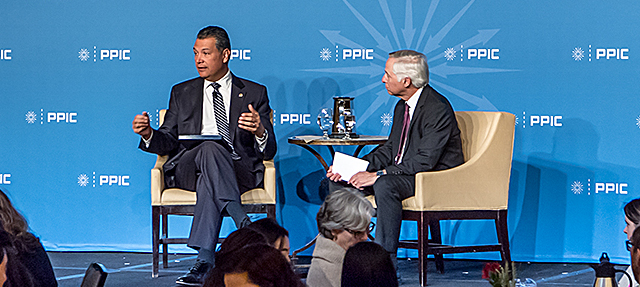
Census Day 2020 is fast approaching, and results from the population count will determine political representation and federal funding for California for the next 10 years. Speaking at a PPIC event in Sacramento last week, Alex Padilla, California secretary of state, joined Mark Baldassare, president and CEO of PPIC, to reflect on the importance of counting the country’s most populous state.

Padilla stressed that along with billions in funding for education, health care, and other critical areas, the count affects the state’s representation in Congress as well as lines drawn at all district levels. “It affects you regardless of the issues you care about, regardless of where you live,” Padilla said. He further emphasized that the census is a population count, not a citizen or adult count. In 2010, California undercounted children under five, which led to underfunded schools over the next 10 years. “Here is a way to make sure schools get the funding they deserve without raising taxes.”

Following the conversation with the secretary of state, Sarah Bohn, PPIC vice president of research and senior fellow, convened an expert panel that expanded on strategies at the frontlines for reaching hard-to-count communities.

Assemblymember Marc Berman discussed the investment by California— which has directed $187 million toward census infrastructure at state, regional, and local levels—that sets the groundwork for outreach and coordination. Partner organizations are now pushing a public awareness and information campaign. “Nobody has ever tried anything like this in a state of 40 million people at the level of specificity and detail that we really need to be successful,” Berman said.

Success depends on participation, however, and trust in government can influence participation in the census—especially among hard-to-count groups who may feel suspicion of the federal government. Apathy is another obstacle. Carolyn Coleman, executive director for the League of California Cities, described how the census returns funds to communities: “We send a lot of dollars to Washington, DC, every year via the tax code, and this is one of the most important ways we get those dollars reinvested back into our communities.”

It takes coordination by trusted messengers to reach hard-to-count groups and communicate this idea. Ditas Katague, director of California Complete Count, said, “We have amazing partners on all levels—whether we’ve contracted them, whether they are foundations, whether they’re state agencies.” Katague outlined efforts by a Sacramento organization mapping territory from the Oregon border to Yolo County, and San Diego ambassadors doing outreach in Arabic, Kurdish, Farsi, Vietnamese, and Somali. Regions are playing to their strengths: Silicon Valley is emphasizing tech; the San Joaquin Valley is partnering with faith-based organizations.

Californians can participate in the census starting in March, and assistance centers around the state will offer help through April. Katague emphasized the importance of motivating others to complete it, saying, “There are 9 questions on the census. It takes 10 minutes to secure the future for the next 10 years.”

Commentary: Newsom’s Water Framework Is Imperfect but Necessary. The Alternative Is Further Deterioration of the Delta

This commentary was published in CALmatters on February 10, 2020.

Gov. Gavin Newsom has put forward a framework for managing water and habitat in the Delta and its watershed. As far as we can tell, no one is very happy with the framework—and that may be a good sign.

The framework is the product of years of effort to negotiate an agreement among water users, other stakeholders, and regulatory agencies. Details are yet to be worked out, including firm commitments for water and funding, along with critical negotiations with the federal government on how to cooperatively manage upstream dams and the Delta pumps. Ultimately, the package has to be acceptable to state and federal regulators.

The scope of this effort is vast.

Over the next 15 years, the proposal is to spend more than $5 billion on new river and floodplain habitat to benefit salmon and other native fish species.

This funding will also pay for a mix of new water projects, water purchases, and fallowing of farmland will provide additional water for the environment. Additionally, new governance and science programs will manage the water and habitat in the Delta, as well as the rivers that flow into it.

For many years and in multiple publications by the Public Policy Institute of California, we have been calling for a negotiated agreement in the Delta and its watershed. This agreement needs robust management that includes shared governance, reliable funding, strong science support, and regulatory backstops if parties fail to live up to their obligations.

These must-haves are outlined in our recent report: A Path Forward for California’s Freshwater Ecosystems.

It is also time to shift away from the traditional approach to addressing environmental concerns in the Delta, which has overemphasized a handful of endangered fishes and a single management tool: the volume of water dedicated to these fishes.

Success will require a broad portfolio of actions to manage the connections between water, land, and the many species—including humans—who rely on healthy ecosystems. The proposed framework makes an earnest attempt to take this broader approach.

A negotiated agreement will, by necessity, be imperfect and controversial. That’s because it is just not possible to satisfy all interests in the Delta. The trade-offs are real, sometimes painful, and can only be resolved through compromise.

Many Delta combatants are dug in, committed to fighting the same battles with the same arguments that they have been using for decades.

We can appreciate why many parties would want to hold out for a better deal, and absent that, turn to the courts in the hopes of getting their way. But as seasoned veterans of the Delta know well, the delay-and-litigate strategy has inherent risks because the outcomes are hard to predict.

In the meantime, the Delta and its watershed are changing rapidly—faster than science and management can keep up.

Many factors are to blame, including current and historic land and water management, the introduction of innumerable non-native species, declining water quality, the inexorable rise of sea level, and the changing climate.

This important ecosystem needs attention now, before conditions deteriorate further.

An agreement, with all its imperfections, provides some measure of certainty to water users and the environment alike.

If a coalition of interests sign on, even if reluctantly, the likelihood of success goes up, because all parties will have an interest in making the agreement work.

Perhaps most importantly, an agreement is the only way to comprehensively address the Delta’s problems. Drawn-out legal battles over how much water is allocated to the environment ignore all the other factors that affect ecosystem health.

We are not endorsing the specific contents of the Newsom Administration’s proposed framework. But we believe it has the “bones” of an eventual agreement that can be durable and binding, avoiding lengthy delays in addressing the Delta’s many problems.

The many Delta interests should persevere and try to make this agreement happen.  This is an opportunity—the kind that comes along rarely—to shift from fighting about the Delta’s future to actually shaping it.

Pointing Eligible Students to Available CSU Campuses

Large numbers of students are turned away from their campus of choice each year because many California universities receive more freshman and transfer applications than they can admit. At the California State University (CSU), campuses with more applications than they can admit are called “impacted.” All but 2 of the 23 CSU campuses have at least one program of study impacted for the 2020–2021 school year; at 7 campuses every program is impacted.

For CSU, students can easily apply to more than one campus. One application covers all campuses, and students pay a $70 per-campus fee for each school they select (although about half receive fee waivers). First-time freshman applicants and transfer applicants both apply to around 3 CSU campuses on average (3.3 campuses for freshmen, 2.6 for transfers).

About 32,000 eligible freshmen and transfer applicants were denied admission to their preferred CSU campus due to capacity issues in 2018. In 2019, CSU started a program to redirect denied students, offering admission to one of ten campuses with space. In the first year, about 20,000 students were offered admission at an alternate campus, and about 900 enrolled (4.5%), according the CSU Chancellor’s Office. The program was most successful among redirected transfer students, who enrolled at an 8.2% rate compared to freshmen at 1.9%.

We don’t know what happened to the students who did not enroll, as the state has no way of tracking student records between institutions. Some may have ended up at a UC, a private college, or other institution. Freshmen applicants may have decided to attend a community college with plans to transfer later. A statewide longitudinal data system can help the state create better policy around capacity in higher education.

As the CSU redirection program continues and applicants understand the process better, interest in the program—and enrollment rates—may increase. However, a similar long-standing program at the University of California has had similar low rates of enrollment from redirected students. CSU is considering ways to improve program timing and delivery; using their excess capacity to put almost 900 extra students on the road to a bachelor’s degree in the first year of the policy is already an important step.