Video: College Eligibility for the University of California

As the University of California (UC) and the California State University (CSU) consider changes to eligibility requirements, important questions are being raised about college admissions standards and educational equity. In Sacramento last Friday, PPIC researcher Niu Gao outlined the findings of a new report on the potential effect of an expanded science requirement on UC eligibility across the state, and a panel of experts addressed larger questions about college eligibility and access.

Gao explained that the potential impact of an expanded science requirement on college eligibility is tied to “the inequitable distribution of educational resources, and also opportunities both within and outside of schools.”

Varsha Sarveshwar, president of the UC Student Association, underlined the importance of institutional barriers that make it difficult for some students to take required courses. “When you’re a high school student you’ve got . . . a lot of things you have to worry about, particularly if you’re trying to apply to UC. And some of those institutional barriers, such as scheduling, or maybe not meeting all the prerequisites—those can have a really big impact on students.”

Yvette Gullatt, UC’s vice provost of diversity and engagement, said that “for UC, when we’re thinking about equity, we have to follow our land-grant mission, which is to ensure that every student in California has the opportunity to attend the university.” Instead of making top-down changes, “we need to consult, and we need to look at data, and we need to get feedback.” In short, she said, “we need to really understand, ground up, how these things actually work.” She added that this kind of consultation and analysis led UC to reject a change to its science requirement.

Improvements in course placement policies as well as course scheduling could lower barriers for many students. But teacher shortages make it challenging to provide access to courses, especially for schools in low-income areas. Blain Watson, principal of Dominguez High School in the Compton Unified School District, offered an example. At Dominguez—which has 1,800 students on campus and several hundred more in a continuation program—“the actual number of kids taking physics is limited to one teacher, and that one teacher teaches both physics and mathematics.”

More generally, Watson highlighted the need to keep kids in class and engaged, so that they can succeed in required courses and have access to a wide range of electives. For Watson, fostering this engagement involves helping teachers build relationships with students—“building capacity in teachers to teach from the heart.” Sarveshwar noted that helping students prepare for and get through college requires culturally competent counseling and support, starting as early as middle school. As she put it, “How much of college readiness is a matter of belonging?”

Governor Newsom Proposes New Investments in Math and Science Teachers

The governor unveiled his proposed 2020-21 budget last week, which includes record-high levels of K-12 and community college funding—a $3.8 billion dollar increase over last year. This includes $900 million for K–12 educator recruitment and development, building on a nearly $150 million investment from last year’s budget.

These new investments are an attempt to address the statewide teacher shortage, which is most acute in the high-need subjects of math and science (special education is also a high-need area). The hope is that these investments will pay dividends in improving the size and the quality of the teaching force in these subjects, which are important for college success and for jobs in the 21st century economy.

Most notably, the proposed funding includes one-time increases to address teacher shortages in key ways:

  • $350 million in competitive grants for teacher professional development
  • $193 million to address teacher shortages in high-need subjects
  • $175 million for residency programs to prepare and retain teachers in high-need subjects
  • $100 million to fund $20,000 stipends for teachers in high-need subjects at a high-need school for at least four years

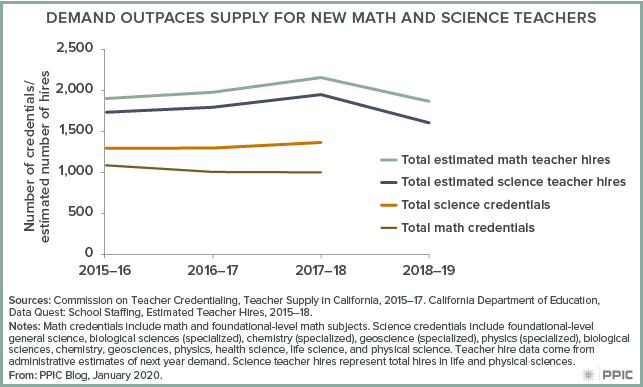
Schools across the state face critical teaching shortages in math and science, leading many schools to increase their reliance on less-credentialed and less-experienced educators. Difficulty in staffing these subjects also means that some schools must reduce course offerings, impeding student access to math and science coursework. Indeed, the number of new math and science teaching credentials has not matched demand for such teachers in recent years. In fact, the number of new math credentials has actually fallen over the past two years, constraining schools in both hiring and course offerings.

figure - Demand Outpaces Supply for New Math and Science Teachers

These continued shortages have important implications for student opportunities in STEM fields. For example, nearly one-third of high school graduates do not meet current UC and CSU requirements for science coursework, and many schools do not have the number of teachers required to offer three or four years of math and science to all interested students. Proposed increases to science eligibility requirements for UC admission—and for math requirements at CSU—mean that increasing the supply of qualified new math and science teachers is more essential than ever. Continued shortages will make it difficult to both accommodate this increased demand and to address equity gaps in the availability of high-quality math and science coursework.

In this light, the governor’s proposal provides reason for optimism. Increased funding for teacher recruitment and retention should help to encourage young adults to enter teaching and retain those who do. And more money for training and development should help to ensure that schools are able to choose among qualified teachers. Whether this will be enough to truly make a dent in the state’s teacher shortage remains to be seen; it depends crucially on whether these investments will be continued in future years or end up as one-time relics from a strong budget year.

New Admission Requirements at the University of California?

The University of California (UC) is considering revising its eligibility standards for admission, focusing on requirements for science education. California changed its K–12 standards in this area five years ago, when the State Board of Education adopted the Next Generation Science Standards (NGSS). UC must decide whether and how to align the NGSS with the a–g requirements—a set of courses students must complete in order to be considered eligible for admission to UC. A change in science requirements was proposed by the UC Board of Admissions and Relations with Schools and was approved by the UC Academic Senate earlier this year.

The NGSS has profound implications for science curriculum and instruction in high schools. Currently, to meet the a–g requirements, students must take two science courses from three core disciplines: biology, chemistry, and physics. But the NGSS includes four science categories: physical sciences; life sciences; earth and space sciences; and engineering, technology, and applications of science.

Changes approved by the UC Academic Senate include increasing the minimum science requirement from two to three years. UC would continue to require two years of work in at least two of three disciplines: biology, chemistry, and physics. Students may take a third course within these disciplines or in other science disciplines identified by the NGSS.

If the UC Regents vote on and approve the recommendations of the UC Academic Senate, the change will take effect in the fall of 2023—meaning that students entering high school in the 2019–20 school year will be subject to the new requirements. (CSU is in the process of updating its science requirements—which are currently similar to those of UC—and may follow UC’s guidelines.)

Some high schools would need to make changes to align their curriculum with the NGSS. One area of concern is the relatively low number of course-offerings in science among small and rural schools. PPIC’s work has shown that not every high school offered the entire a–g sequence in science in 2016–17; small and rural schools were much less likely to do so. Another area of concern is staffing, as a teacher shortage has left California schools struggling with large class sizes for years. Finally, ensuring awareness of these changes will be important. Parents and students should be informed of the new requirements with adequate time and detail to be able to plan accordingly.

Under NGSS, science course sequencing in high school may affect whether and how students meet the proposed a–g requirements. PPIC researchers are examining early implementation of the NGSS in the K-12 system and will discuss findings in an upcoming report. Moving forward, more research is needed to understand the implications of any new a–g requirements for high school graduates’ eligibility for UC and CSU.

California Needs More Math and Science Teachers

Recent reforms in educational standards—including the Common Core math standards and the Next Generation Science Standards—have altered the expectations placed on California’s teachers. Other changes, such as requiring college prep courses for high school graduation, will further increase the demand for math and science teachers. The state’s teacher workforce has already changed significantly in the past 15 years, but it will need to further evolve to meet the demands of the future.

These are a few of the challenges ahead:

  • Although the number of math and science teachers has increased in the state, there are fewer of them than in other core subjects. As a result, the average class size in math and science at all levels is larger in California than in other states. For instance, the average class size for high school science in California is 27, well above the national average (22). Similarly, average enrollment in high school math is 25, which is again higher than the national average (21).
  • The teacher workforce in math and science is aging rapidly. In 2016, the median age of the state’s math and science teachers was 44, three years older than the national average. In the next five years, California will need to replace at least 11% of these teachers due to retirement. About 12% of districts will need to replace at least 20% of their teachers.
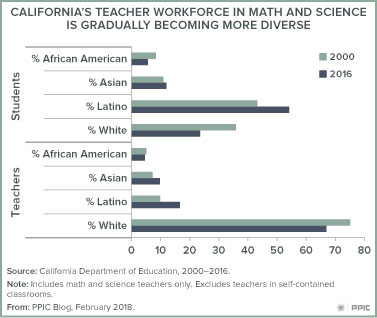
  • The composition of the teacher workforce in math and science has changed in recent years, yet it still does not reflect the diversity of California students. In the 2000–01 school year, only 10% of math and science teachers were Latino; today, 17% of them are (while 54% of the student body is Latino). The share of Asian teachers has increased slightly, while the share of African American teachers remains unchanged. Research shows that teachers of color play a critical role in helping students of color succeed.

As California’s schools continue to implement new math and science standards, the challenge of developing a larger and more diverse teacher workforce will loom large. There are examples of efforts both in California and in other states designed to address some of these challenges. For example, Call Me MISTER in South Carolina aims to recruit college students to increase the incoming teacher pool, while other programs—like Boston Public Schools’ High School to Teacher Program—reach out to students in high schools. In addition, some programs focus on recruiting members of the local community (e.g., Teach Tomorrow in Oakland, the San Francisco Teacher Residency program, and the Grow Your Own programs in Illinois).

These initiatives represent potential models, but they would need to scale up quickly to address the challenges ahead. PPIC’s ongoing research into the implementation of the Next Generation Science Standards suggests that the high demand for quality science teachers is an emerging implementation concern.