
The governor unveiled his proposed 2020-21 budget last week, which includes record-high levels of K-12 and community college funding—a $3.8 billion dollar increase over last year. This includes $900 million for K–12 educator recruitment and development, building on a nearly $150 million investment from last year’s budget.
These new investments are an attempt to address the statewide teacher shortage, which is most acute in the high-need subjects of math and science (special education is also a high-need area). The hope is that these investments will pay dividends in improving the size and the quality of the teaching force in these subjects, which are important for college success and for jobs in the 21st century economy.
Most notably, the proposed funding includes one-time increases to address teacher shortages in key ways:
- $350 million in competitive grants for teacher professional development
- $193 million to address teacher shortages in high-need subjects
- $175 million for residency programs to prepare and retain teachers in high-need subjects
- $100 million to fund $20,000 stipends for teachers in high-need subjects at a high-need school for at least four years
Schools across the state face critical teaching shortages in math and science, leading many schools to increase their reliance on less-credentialed and less-experienced educators. Difficulty in staffing these subjects also means that some schools must reduce course offerings, impeding student access to math and science coursework. Indeed, the number of new math and science teaching credentials has not matched demand for such teachers in recent years. In fact, the number of new math credentials has actually fallen over the past two years, constraining schools in both hiring and course offerings.
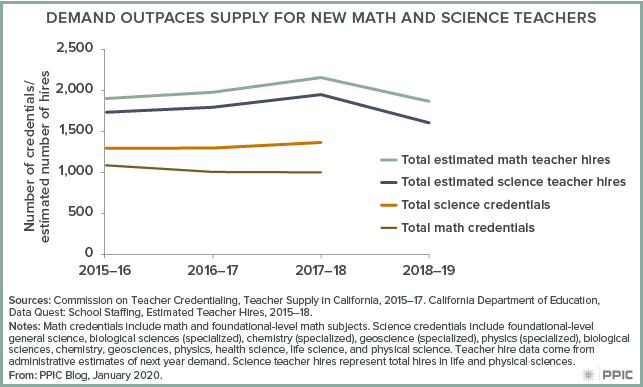
These continued shortages have important implications for student opportunities in STEM fields. For example, nearly one-third of high school graduates do not meet current UC and CSU requirements for science coursework, and many schools do not have the number of teachers required to offer three or four years of math and science to all interested students. Proposed increases to science eligibility requirements for UC admission—and for math requirements at CSU—mean that increasing the supply of qualified new math and science teachers is more essential than ever. Continued shortages will make it difficult to both accommodate this increased demand and to address equity gaps in the availability of high-quality math and science coursework.
In this light, the governor’s proposal provides reason for optimism. Increased funding for teacher recruitment and retention should help to encourage young adults to enter teaching and retain those who do. And more money for training and development should help to ensure that schools are able to choose among qualified teachers. Whether this will be enough to truly make a dent in the state’s teacher shortage remains to be seen; it depends crucially on whether these investments will be continued in future years or end up as one-time relics from a strong budget year.

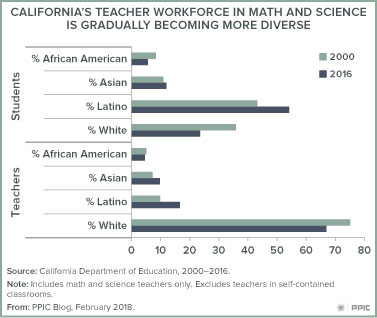 As California’s schools continue to implement new math and science standards, the challenge of developing a larger and more diverse teacher workforce will loom large. There are examples of efforts both in California and in other states designed to address some of these challenges. For example,