Public Higher Education in California Faces a Fiscal Crisis

[vc_row][vc_column][vc_column_text]As the coronavirus pandemic continues to disrupt California’s economy, the Newsom administration is projecting a $54 billion decline in state revenues for the 2021 fiscal year and revising the budget accordingly. California’s public universities—which do not have dedicated funding streams or constitutional protections—face disproportionately large funding cuts. So far, the federal government has provided some emergency relief to mitigate the pandemic’s unprecedented impact on higher education. Without additional support, however, the state’s public colleges might have to reduce student access and services.

During the Great Recession, a drop in state revenues of $40 billion in 2009 led to cuts equaling roughly one-third of state funding for the University of California (UC) and California State University (CSU) systems (on a per student basis). Consequently, tuition doubled at UC and CSU, faculty and staff were laid off or furloughed, and critical capital improvements and maintenance were deferred.

In turn, students faced reduced access to courses, higher student-faculty ratios, increased costs, and fewer support services. As the economy improved, the state was able to increase allocations to the state’s colleges. As a result, UC and CSU admitted thousands of additional students, graduation rates went up, and the number of degrees awarded increased substantially.
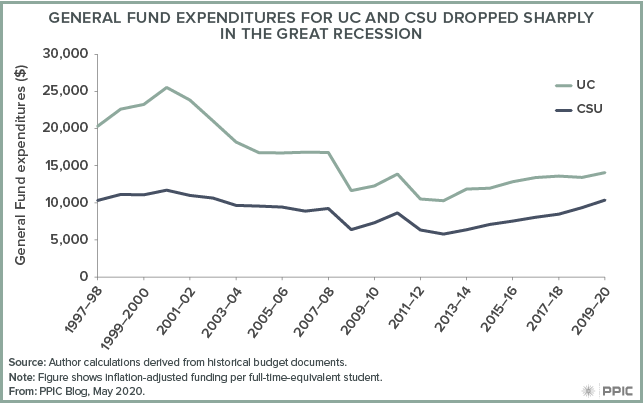
figure - General Fund Expenditures for UC and CSU Dropped Sharply in the Great Recession

Early evidence suggests that the global pandemic could have an even more dramatic fiscal impact on public higher education in California. In the short-term, public colleges face critical revenue shortages: now that students have been sent home and instruction has moved online, revenues from auxiliary enterprises (housing, food, parking, etc.) have evaporated. In addition, UC has suspended elective surgeries at its medical centers and is incurring costs associated with research and treatment of the coronavirus. CSU has projected revenue losses of $337 million for the spring semester, while UC projects a $500 million loss for the month of March alone.

In the longer-term, the systems may find it challenging to raise additional revenues. The percentage of out-of-state students—who pay higher tuition—is now capped at 18% for the five most popular UC campuses, and enrollment of international students is likely to decline due to visa and travel restrictions. Endowment funds are shrinking and tuition increases are controversial. Moreover, unprecedented levels of unemployment will increase demand for federal, state, and institutional financial aid programs.

Governor Newsom’s May budget revision includes a 10% cut for each public higher education system. The revised budget proposal also reduces state financial aid for students who attend nonprofit private colleges from $9,084 to $8,056 per year. The budget proposal does allow UC and CSU to redirect some restricted revenues and to refinance debt at historically low interest rates. However, without additional revenue–whether through federal or state support, or tuition increases—it will be difficult to improve access, quality, and student success in the coming years.[/vc_column_text][/vc_column][/vc_row]

COVID-19 Highlights the Need for Statewide Student Data

The pandemic makes it clearer than ever that California would benefit from a data system that links information across educational institutions. Without it, California policymakers will continue to lack important information—including insights into the impact of the coronavirus pandemic on our students and educational institutions.

Better data would help determine who is most affected by the pandemic, where to direct support, and how to prepare for future crises. For example, is the pandemic affecting key educational transitions of some students more than others? Some regions more than others? Where should the state best direct its resources to ensure students keep moving through the educational pipeline? Right now, these questions cannot be fully answered.

The governor’s office remains supportive of building a statewide data system, and the state’s Cradle to Career Workgroup is still aiming to deliver a proposal to the legislature by the end of 2020.  At its most recent meeting, the workgroup endorsed creating a multifaceted system, including data tools for the general public and researchers, as well as ways for practitioners, students, and families to link data regarding transitions to and between colleges.

The workgroup also endorsed including early childhood data, to focus on early determinants of educational success and align with the governor’s focus on early childhood care. Over the summer and fall, the workgroup will decide on proposals that define the scope of the system, ensure privacy and security, and govern access.

Balancing the state’s need for connected data with the current economic downturn may be difficult. However, forgoing all of the recent progress could indefinitely stall this important effort, not only hampering the flow of critical information but also leaving the state flying blind during the next crisis.

PPIC will continue to participate in an advisory capacity for the Cradle to Career Workgroup and will also convene the California Education Data Collaborative to aid and inform the state in creating a useful data system that helps students and provides valuable direction for the state—during good times and bad.

COVID-19 Alters College Admissions

[vc_row][vc_column][vc_column_text]Admissions may look different for students entering college in fall 2021. Social distancing to protect communities during the COVID-19 outbreak will impact where students attend classes and where they will live—and recent policy updates around standardized testing and GPA requirements will impact how colleges determine eligibility and placement in courses. But even as admissions become more flexible, some students still struggle to get on the path to college.

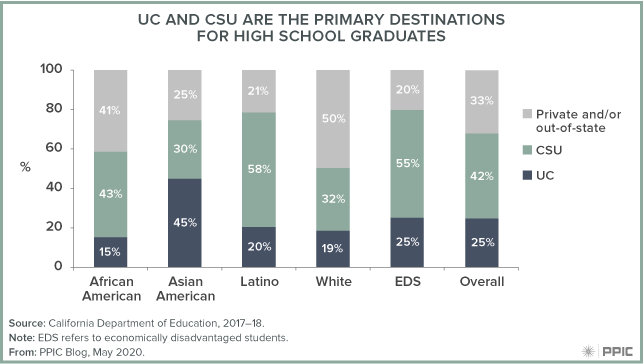
California’s public universities are the primary destination of the state’s high school graduates and community college transfers headed to a four-year college. In 2017–18, nearly 200,000 California high school graduates applied to the University of California (UC) or California State University (CSU), and 84,000 were enrolled.

figure - UC and CSU Are the Primary Destinations for High School Graduates

For students applying for admission to colleges in fall 2021, eligibility requirements and application processes are changing. Most standardized tests used for admission—such as SAT and ACT—and for placement purposes, such as the Smarter Balanced Assessment, are either postponed or cancelled.

In light of these cancellations, UC and CSU temporarily suspended testing requirements for fall 2021 applicants, meaning students do not need to include a test score on their application. In addition, UC and CSU systems are temporarily accepting pass/fail in lieu of a letter grade for courses completed in winter, spring, and summer 2020, as more K–12 districts and community colleges choose not to assign letter grades while students adjust to distance learning during the pandemic.

These adjustments are meant to ease anxiety over college admissions in a time of crisis, and there is some evidence that eliminating high stakes standardized tests could lead to more underrepresented students being placed in college-level courses and being eligible for college.

However, when high schools and community colleges lack sufficient resources, even with flexible grading in place, remote education may fail disadvantaged students. More than half of K–12 students from low-income households do not have broadband access at home. Notably, PPIC research found that online courses at community colleges exacerbated achievement gaps.

During their junior and senior years, high school students are more likely to fall off the college pathway, and disadvantaged students are even more likely to do so. And until recently, disadvantaged students were also more vulnerable to being diverted away from community college courses necessary for transfer admissions.

All students must cope with the changing college application process. But first-generation college applicants come from families who are new to the process; those with less internet/technology access may also be less familiar with how to apply. These students may see less support in the college application process than they would if they were still in school.

Now, more than ever, targeted outreach efforts and collaborations between K–12 and higher education will be critical to ensuring equitable access to a college education and economic mobility.[/vc_column_text][/vc_column][/vc_row]
Students Prepare for AP Exams during COVID-19

In response to disruptions from COVID-19, the 2020 AP exams will be open book/open note format and taken online at home, according to the College Board. The new exams are scheduled May 11–22. At 45 minutes each, the exams will be much shorter and cover less material—focusing on content covered prior to March school closures.

An increasing number of colleges, including those in the University of California system, have affirmed they will award college credit for 2020 AP exams that score a 3, 4, or 5. While these changes give flexibility to students still hoping to earn college credits, all students may not benefit equally.

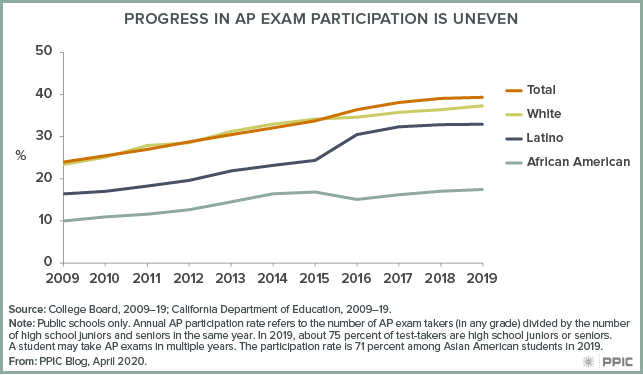
Nearly 380,000 students in California public schools took an AP exam in 2019, up 63% from a decade ago. Participation among Latino students grew from 16% in 2009 to 33% in 2019. However, participation by African American students plateaued in 2015.

figure - Progress in AP Exam Participation Is Uneven

For disadvantaged and vulnerable students, limited access to learning options at home may cause a dip in participation and performance. Nearly half of students from low-income families do not have broadband access at home; neither do a third of Latino or African American students. And broadband access remains problematic in rural areas, where 41% of school-aged children do not have access.

Students with special educational needs may face additional challenges. The pandemic and resulting school closures have had a disproportionate impact on this student population, with many losing access to special education support professionals and services.

Efforts to close these gaps are underway: the state Superintendent recently formed a new task force to close the digital divide, and the governor announced several cross-sector partnerships to support distance learning. The California School Board Association just announced its effort to push for a $2 billion broadband bond on the November ballot to address rural connectivity.

AP assessments begin in just a few weeks. The College Board has suggested that students without internet or a device contact them for assistance, but the scope of the organization’s ability to respond is untested. In addition, test preparation and participation may be difficult for students who are also caregivers at home and lack separate, quiet testing space.

It is unclear how many California students will take the 2020 AP exams, but they are still being encouraged to do so. In an April webinar, the College Board noted that 86% of AP teachers across the nation will still assign a letter grade to their courses during this school closure, with bonus points for completing an AP exam.

At 91%, the vast majority of AP enrollees still want to earn college credits. Schools and teachers across the state are helping students navigate the new system. As the state ramps up efforts to implement distance learning and maintain continuity of learning amid school closures, AP results should be closely monitored so that we understand the impact on socioeconomically disadvantaged students and special education students.

Lessons from the Great Recession Can Protect College Students Today

[vc_row][vc_column][vc_column_text]Budget cuts for state services are likely on the horizon due to the economic disruption of COVID-19. This means state funding for public higher education may well be reduced—leading to restrictions in access and lowered enrollments. California went through this very scenario during the Great Recession, with thousands of students turning to for-profit colleges in lieu of public colleges.

figure - Enrollments Spiked for California For-Profit Colleges during the Recession

While some students at for-profit colleges earned a degree, many did not graduate and ended up with large amounts of debt. State and federal government subsequently put restrictions around for-profit colleges, but upcoming changes at the federal level could weaken the federal rules.

The recently announced federal Education Stabilization Fund will disproportionately provide emergency relief funds to private for-profit colleges. In California, only 5% of the state’s undergraduates attend for-profit colleges, but these schools will receive 10% of federal funds.

In contrast, 55% of undergraduates attend the state’s community colleges, which will receive only 34% of federal aid. (That’s because many low-income students who attend community college rely on state aid rather than federal financial aid: these students are not counted in the federal emergency funding formula.)

During the Great Recession in 2008, higher education faced deeper cuts than other state services. With escalating tuition, fewer instructional staff, and a narrow application window, students had less access to the state’s public colleges, especially community colleges.

At the same time, some for-profit colleges began to market heavily, and thousands of students enrolled in expensive programs. By several measures—graduation rates, student debt, loan default rates, and employment outcomes—private for-profit institutions often have poor outcomes. Of course, some colleges have a better track record than others.

People hurt most by the recession—and lack of access to college—were saddled with debt they couldn’t pay back. In response, California and the federal government both instituted new regulations requiring for-profit colleges to be more transparent and accountable.

California went a step further than the federal government. The state required colleges to meet minimum standards of graduation and loan default rates to be eligible for Cal Grants, the state’s financial aid program for low-income students. Enrollments in for-profit colleges in California declined, and some of the largest for-profit institutions, like Corinthian and ITT Technical Institute, declared bankruptcy as the economy improved and funding to public higher education was restored.

California policymakers should seek to avoid the mistakes of the last recession by ensuring that access to public higher education is not restricted during this recession. The key is to find ways to limit budget cuts so that public higher education remains accessible to all Californians looking to advance their knowledge and improve their economic well-being.[/vc_column_text][/vc_column][/vc_row]

Displaced by COVID-19: Moving Out of College Housing

With college students already taking courses online in response to the COVID-19 pandemic, many are also faced with moving out of campus housing. It’s a necessary disruption to help keep the virus from spreading, but one that can place students far from academic support and other services precisely when they need support and services most.

While the disruption is temporary, the benefits of being on or near campus go beyond proximity to classes. Campus housing gives students better access to tutoring, counseling, health, and academic services. For these and other reasons, students who live in university housing have higher persistence and graduation rates.

Nearly all colleges are urging students to move out, and the vast majority of university-housed students will likely leave—or have left—campus. Some colleges have allowed students to stay in housing if they choose, while others require students to leave unless they qualify for an exemption, such as for international students, for health and safety concerns, or if they do not have a home to return to.

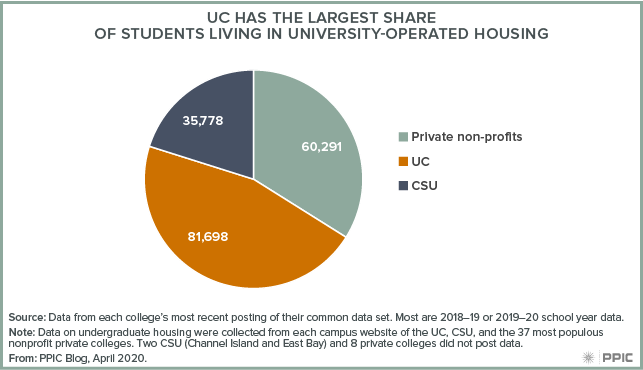
Prior to the pandemic, about 24% of all undergraduate students, at least 177,000, lived in university owned or operated housing at California public and private nonprofit colleges, most commonly in dormitories. Most students living in college housing are at the University of California (UC) and private nonprofit universities, even though the California State University (CSU) system enrolls far more undergraduates. CSU students are much more likely to commute from home or an off-campus apartment. Community colleges, which educate the largest number of college students in the state, rarely own and operate their own housing.

figure - UC Has the Largest Share of Students Living in University-Operated Housing

Freshmen are especially likely to live in university housing, making up a slight majority (51%) of the total. About 90% of freshmen at UC and private nonprofits live in college-operated housing. If the pandemic continues to displace students into the fall semester, those colleges will have to grapple with how to help new students adapt to college without living on campus.

The consequences of this large-scale early departure from campus are uncertain. As students move off campus, schools are working to find ways to provide essential student supports and potentially offer new ones, such as laptops and internet access, to limit the disruption in learning.

One effort by the California College Student Emergency Support Fund offered $500 hardship grants for low-income students to help pay for housing, technology, and other expenses. Within 90 minutes of the launch of the application, 1,000 students had applied. Within 24 hours, demand had far surpassed resources, and 65,000 students were placed on a waiting list, suggesting that a significant unmet need remains.

COVID-19 Shutdown Forces Colleges to Ramp up Online Learning

[vc_row][vc_column][vc_column_text]California colleges are moving classes online in response to the COVID-19 pandemic, which means most students at most colleges will take classes remotely. For example, the entire University of California and California State University systems have moved almost all undergraduate education to online settings. Such a dramatic change is necessary for public health, but may interfere with student access and success.

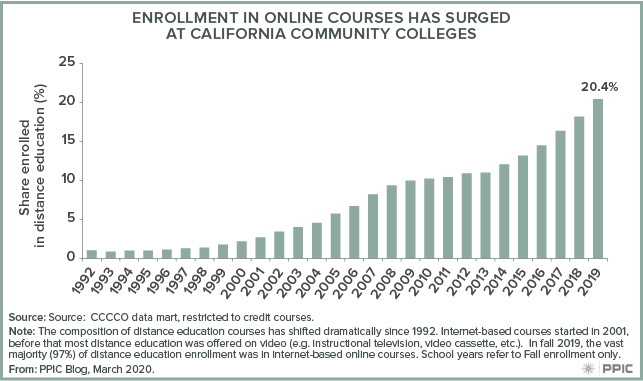
California’s community colleges can offer others a lesson in effective practices for distance education. These schools have been at the forefront of remote learning for more than four decades, from correspondence courses in the early days to instructional television and video cassettes in the 1980s. In the early 2000s, community colleges began to offer internet-based online courses.

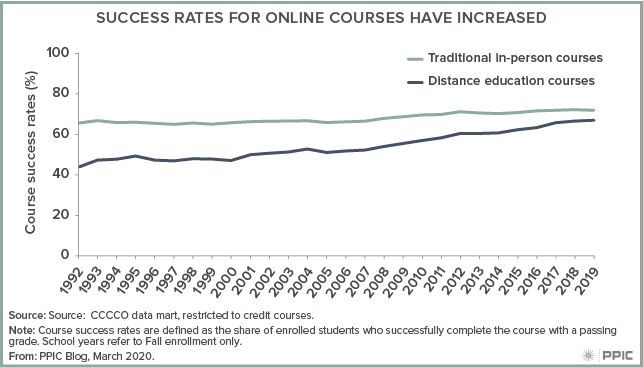
The availability and popularity of distance courses have exploded with the internet, as have course success rates. The share of enrolled students completing and passing a course has skyrocketed, narrowing the gap in success between online and in-person courses substantially.

figure - Enrollment in Online Course Has Surged at California Community Colleges

figure - Success Rates for Online Courses Have Increased

Policies around closing the success gap were intentional, with the Community College Chancellor’s Office leading efforts to improve online courses through the Online Education Initiative and the California Virtual Campus. Resources available to administrators and faculty include modules on effective course design, remote tutoring, student services, and even proctoring of exams.

Effective practices involve more than moving a face-to-face course online. Success means providing faculty support and training, setting appropriate student expectations, and promoting interaction among faculty, students, and course materials.

Better software has also cleared paths to and shifted the debate around online pedagogy. Instead of discussing how to replicate face-to-face learning, educators are examining the advantages of online learning over the traditional model. By identifying student needs, personalizing learning, and giving instant feedback, teachers may have more avenues to eliminate the online performance gap.

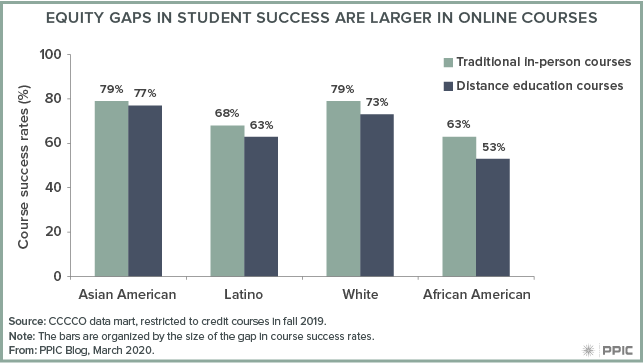
Still, problems remain. Students with limited technology, such as those without access to broadband, may not be able to access online courses. In community colleges, Latinos are less likely to enroll in online courses than other groups, which may reflect the digital divide. And while course success rates have improved across the board, equity gaps remain large.

figure - Equity Gaps in Student Success Are Larger in Online Courses

The COVID-19 crisis is unprecedented, and California’s colleges deserve credit for quickly moving courses and student supports to online platforms. Clear and effective communication with students remains key. More than ever colleges must also identify and reach out to vulnerable students—low income, food insecure, and homeless—who face challenges transitioning online and need extra support.[/vc_column_text][/vc_column][/vc_row]
Testimony: California Is on Track to Close the Degree Gap

[vc_row][vc_column][vc_column_text]Hans Johnson, director and senior fellow at the PPIC Higher Education Center, testified February 25, 2020, before the Assembly Budget Subcommittee (No. 2) on Education Finance, chaired by Assemblymember Kevin McCarty. Here are his prepared remarks.

At the PPIC Higher Education Policy Center, we have long been concerned about the future of California’s workforce. Would the state have enough college graduates to meet evolving economic demands? We have produced a series of reports addressing the dynamics of this issue.

Five years ago, we projected a shortage of highly educated workers in California. Specifically, our economic projections to 2030 showed that about two in five jobs would require at least a bachelor’s degree, while demographic projections suggested that only about one in three Californians would attain this level of education. This shortfall amounts to 1.1 million bachelor’s degrees.

PPIC noted that to fill this shortfall, the state and its higher education systems would need to act—increasing access, transfer, and completion especially among groups historically underrepresented in higher education, including low-income students, first-generation college students, Latinos, and African Americans.

We identified ambitious targets that—if met—would close the degree gap. Those targets included large increases in access to the University of California (UC) and California State University (CSU), both for first-time freshmen and for transfer students. They also included substantial increases in graduation rates. At the request of the legislature, UC and CSU both issued reports on how they might meet those targets.

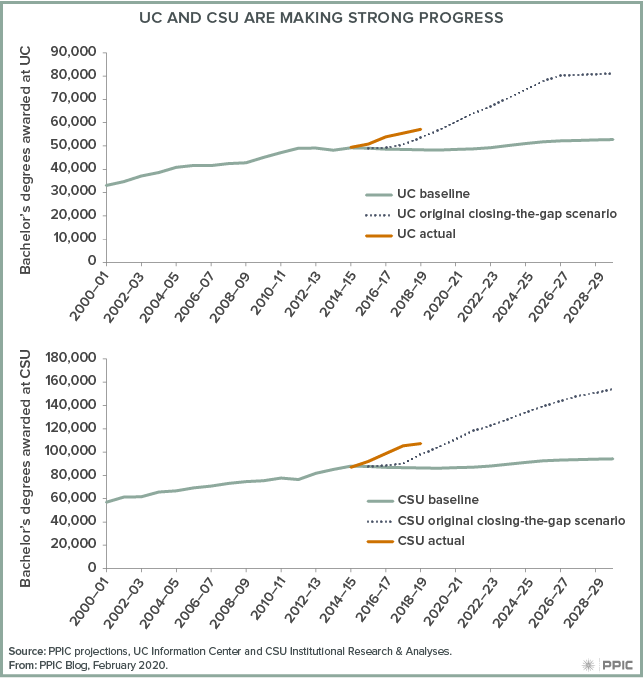
Today, I’m pleased to say that California is currently on track to close the gap. The concerted efforts of policymakers, higher education officials—including staff and faculty—and, of course, students have led to these early gains.

State General Fund allocations for each system have increased substantially since the Great Recession, allowing for increased enrollment and renewed efforts to improve student persistence and completion. Both UC and CSU have exceeded PPIC’s closing-the-gap targets. These early gains have reduced the degree gap by almost 80,000.

figure - UC and CSU Are Making Strong Progress

Two primary actions have led to these gains.

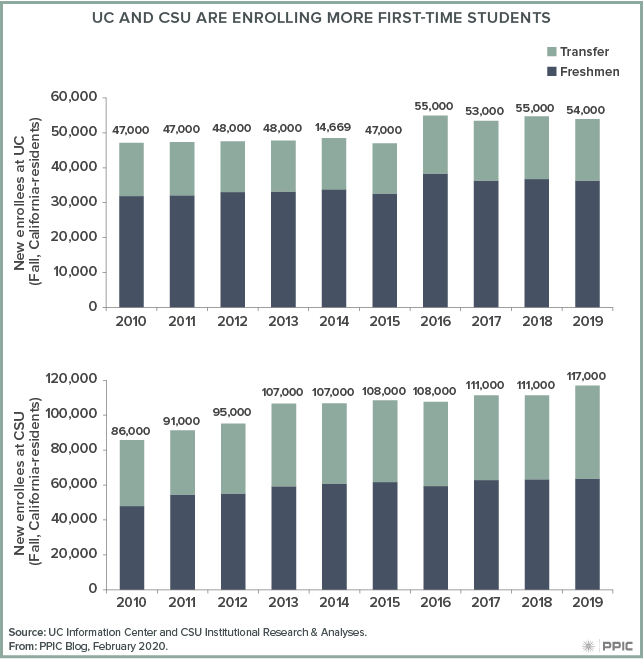
First, increases in state funding have allowed UC and CSU to enroll substantially more first-time students from California—both freshmen and transfer students. At UC, enrollment of transfer students went up 16% between fall 2010 and fall 2019. Enrollment of freshmen grew 14%. At CSU, enrollment increased 41% for transfer students and 33% among freshmen over the same time period. Notably, UC’s gains occurred primarily in one year, from 2015 to 2016, when the legislature and governor tied a $25 million allocation to increasing enrollment by 5,000 students. In that single year, total first-time enrollment of freshmen and transfer students went up 10%, with gains concentrated among African Americans (36%) and Latinos (25%).

figure - UC and CSU Are Enrolling More First-Time Students

Second, programs to improve student persistence and graduation rates have also paid off—and contributed to enrollment growth. These gains have been especially sharp at CSU, which has received substantial funding from the state to support its graduation initiative. At CSU, six-year graduation rates for California-residency students have increased from 57% for 2009 entering freshmen to 67% for the 2013 cohort. At UC, four-year graduation rates for California-residency students have increased from 62% for 2010 entering freshmen to 68% for the 2014 cohort. (Six-year graduation rates at UC remain very high, around 85%). Graduation rates for transfer students have also increased at both systems.

These early successes are very promising. Still, California needs to build on them if it is to close the degree gap fully. The demand for college remains high. PPIC’s statewide surveys show that the vast majority of parents (79%) want their child to earn at least a bachelor’s degree. College preparation among high school graduates has increased, with the share of students completing the college preparatory requirements of UC and CSU now at an all-time high. And while applications to UC and CSU have levelled off or even declined a bit recently, application levels are still near record highs. All but one UC campus and many CSU campuses already do not have room to admit all eligible applicants.

Looking ahead, strong demand for UC and CSU is likely to continue as college preparation improves and the transfer pathway becomes more efficient and effective. New initiatives, including reforms in remedial education at the community colleges and CSU, have the potential to substantially improve student success rates and boost transfer. New articulation agreements, such as the Associate Degree for Transfer, have streamlined the pathway from community colleges to four-year colleges, especially CSU. (PPIC will be issuing a report on transfer trends later this year.) And an increased focus on improving student outcomes has led to multiple substantive reforms designed to increase persistence and completion at UC and CSU.

Finding ways to accommodate all eligible students is a pressing challenge, but one that must be met in order to ensure a better future for all Californians. Through thoughtful planning—and yes, additional funding—closing the degree gap is possible. Improving access and completion is a necessary and critical component to ensuring that more low-income, first-generation, and underrepresented students enjoy the benefits of a college degree. The early progress I’ve highlighted here has led to greater access and success for underrepresented students, creating momentum to improve the wellbeing of all Californians.[/vc_column_text][/vc_column][/vc_row]

Video: College Eligibility for the University of California

As the University of California (UC) and the California State University (CSU) consider changes to eligibility requirements, important questions are being raised about college admissions standards and educational equity. In Sacramento last Friday, PPIC researcher Niu Gao outlined the findings of a new report on the potential effect of an expanded science requirement on UC eligibility across the state, and a panel of experts addressed larger questions about college eligibility and access.

Gao explained that the potential impact of an expanded science requirement on college eligibility is tied to “the inequitable distribution of educational resources, and also opportunities both within and outside of schools.”

Varsha Sarveshwar, president of the UC Student Association, underlined the importance of institutional barriers that make it difficult for some students to take required courses. “When you’re a high school student you’ve got . . . a lot of things you have to worry about, particularly if you’re trying to apply to UC. And some of those institutional barriers, such as scheduling, or maybe not meeting all the prerequisites—those can have a really big impact on students.”

Yvette Gullatt, UC’s vice provost of diversity and engagement, said that “for UC, when we’re thinking about equity, we have to follow our land-grant mission, which is to ensure that every student in California has the opportunity to attend the university.” Instead of making top-down changes, “we need to consult, and we need to look at data, and we need to get feedback.” In short, she said, “we need to really understand, ground up, how these things actually work.” She added that this kind of consultation and analysis led UC to reject a change to its science requirement.

Improvements in course placement policies as well as course scheduling could lower barriers for many students. But teacher shortages make it challenging to provide access to courses, especially for schools in low-income areas. Blain Watson, principal of Dominguez High School in the Compton Unified School District, offered an example. At Dominguez—which has 1,800 students on campus and several hundred more in a continuation program—“the actual number of kids taking physics is limited to one teacher, and that one teacher teaches both physics and mathematics.”

More generally, Watson highlighted the need to keep kids in class and engaged, so that they can succeed in required courses and have access to a wide range of electives. For Watson, fostering this engagement involves helping teachers build relationships with students—“building capacity in teachers to teach from the heart.” Sarveshwar noted that helping students prepare for and get through college requires culturally competent counseling and support, starting as early as middle school. As she put it, “How much of college readiness is a matter of belonging?”

Pointing Eligible Students to Available CSU Campuses

Large numbers of students are turned away from their campus of choice each year because many California universities receive more freshman and transfer applications than they can admit. At the California State University (CSU), campuses with more applications than they can admit are called “impacted.” All but 2 of the 23 CSU campuses have at least one program of study impacted for the 2020–2021 school year; at 7 campuses every program is impacted.

For CSU, students can easily apply to more than one campus. One application covers all campuses, and students pay a $70 per-campus fee for each school they select (although about half receive fee waivers). First-time freshman applicants and transfer applicants both apply to around 3 CSU campuses on average (3.3 campuses for freshmen, 2.6 for transfers).

About 32,000 eligible freshmen and transfer applicants were denied admission to their preferred CSU campus due to capacity issues in 2018. In 2019, CSU started a program to redirect denied students, offering admission to one of ten campuses with space. In the first year, about 20,000 students were offered admission at an alternate campus, and about 900 enrolled (4.5%), according the CSU Chancellor’s Office. The program was most successful among redirected transfer students, who enrolled at an 8.2% rate compared to freshmen at 1.9%.

We don’t know what happened to the students who did not enroll, as the state has no way of tracking student records between institutions. Some may have ended up at a UC, a private college, or other institution. Freshmen applicants may have decided to attend a community college with plans to transfer later. A statewide longitudinal data system can help the state create better policy around capacity in higher education.

As the CSU redirection program continues and applicants understand the process better, interest in the program—and enrollment rates—may increase. However, a similar long-standing program at the University of California has had similar low rates of enrollment from redirected students. CSU is considering ways to improve program timing and delivery; using their excess capacity to put almost 900 extra students on the road to a bachelor’s degree in the first year of the policy is already an important step.