Making Progress on Connecting Student Data across California

California students may fall through cracks in the state’s public education system because K–12 data and college data are not connected. For example, the state and its public universities are currently unaware of students who do not apply to UC or CSU despite being eligible, making it impossible to encourage these students to apply. Connecting education data can help California recognize and improve key transitions in student progress.

The current data system is fragmented across institutions, leaving California as one of eight states without a modernized approach to tracking its educational pipeline. By passing the 2019 California Cradle-to-Career Data System Act, the state is taking action toward linking education data across its many sectors.

As a first step, California has appointed a workgroup that will recommend a framework to the legislature and the Department of Finance within a year. This workgroup will determine relevant data elements to include—variables such as graduation, eligibility, and enrollment—along with when and how to combine data, where to store results, and who governs access to data.

So far the process has been inclusive and transparent, with representatives from all sectors of education, advocacy groups, researchers, technology experts, lawyers, and others stepping forward to serve on committees and advisory groups. Many member organizations of the California Education Data Collaborative, an organization convened by PPIC, are serving in advisory groups. Advisory group meetings are open to the public, and people can find information, meeting materials, and notes on the California Data System website. Public comments are encouraged at all meetings and on the website.

On January 16, PPIC attended its first meeting with the Policy and Analytics Advisory Group, where we discussed use cases around research and accountability, such as analyzing how financial aid offers to high school students impact college outcomes. The advisory group also agreed on a critical first step for the state: evaluation and analysis of student pathways from school to work. Advice from this advisory group and others will help the state’s workgroup make recommendations on January 30 to determine the scope and first phase of the data system.

PPIC will continue to participate in the advisory group and monitor the monthly workgroup meetings; notes and materials will be posted at California Data System, and we will update progress on this blog.


Video: A Conversation with Leon Panetta

Leon Panetta, former secretary of defense and CIA director, joined PPIC president Mark Baldassare in Sacramento last week for a wide-ranging conversation about leadership. Baldassare began by asking Panetta to “put on your CIA hat” and compare the targeting of Osama bin Laden during the Obama administration with the recent killing of Iranian general Qasem Soleimani. The main difference, Panetta said, is that bin Laden had directly attacked the United States, and that he and other Al-Qaeda leaders were almost certainly planning more attacks.

Panetta explained that the Obama administration “never seriously considered an attack on Soleimani,” because “the result would be that we would increase the chances of war with Iran.” The issue was not whether Soleimani was a “bad actor,” but whether the US wanted to escalate the conflict: “When you make those kinds of decisions, you ought to damn well consider the risks of war.”

For Panetta, the tense situation with Iran underlines the importance of leadership. “In a democracy we govern either by leadership or by crisis.” Leadership, he continued, involves actively addressing major challenges—and this, in turn, entails uncertainty and risk. “If you’re not willing to take the risks associated with leadership . . . , crisis will drive policy in this country.”

Panetta sees impeachment as “a reflection of our times”—we have “a president who doesn’t abide by moral boundaries” and a Congress that “can’t work together.” But he is hopeful that the Senate will deal with the trial “in a fair and impartial way.” Otherwise, he continued, “there is a danger that impeachment is going to become just another political tool.”

Asked to assess how things are going in California, Panetta identified three interrelated leadership challenges: political imbalance, economic inequality, and education. To have a chance of restoring political balance in Sacramento, he said, Republicans are “going to have to look at immigration . . . inequality . . . climate change.” At the same time, the state’s Democratic leadership will have to collaborate with a broad range of stakeholders to tackle economic inequality—and its efforts will need to include a focus on education, which “is absolutely critical to the future of California.”

While Panetta is clearly worried about the level of dysfunction in Washington, he is not entirely pessimistic. “I’ve seen Washington at its best and Washington at its worst. The good news is that I’ve seen Washington work!” More seriously, he stressed the need for people to engage in the political process: “They’ve gotta be willing to fight for what they believe is right.” He conceded that politics “has gotten tougher.” But, he added, the great satisfaction of being involved in our democracy is that “you can do things to make people’s lives better.”


Governor Newsom Proposes New Investments in Math and Science Teachers

The governor unveiled his proposed 2020-21 budget last week, which includes record-high levels of K-12 and community college funding—a $3.8 billion dollar increase over last year. This includes $900 million for K–12 educator recruitment and development, building on a nearly $150 million investment from last year’s budget.

These new investments are an attempt to address the statewide teacher shortage, which is most acute in the high-need subjects of math and science (special education is also a high-need area). The hope is that these investments will pay dividends in improving the size and the quality of the teaching force in these subjects, which are important for college success and for jobs in the 21st century economy.

Most notably, the proposed funding includes one-time increases to address teacher shortages in key ways:

  • $350 million in competitive grants for teacher professional development
  • $193 million to address teacher shortages in high-need subjects
  • $175 million for residency programs to prepare and retain teachers in high-need subjects
  • $100 million to fund $20,000 stipends for teachers in high-need subjects at a high-need school for at least four years

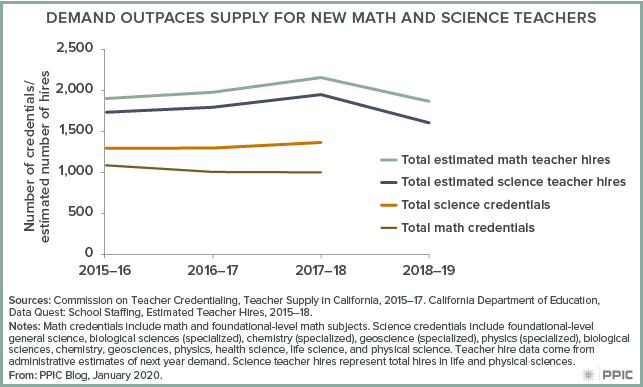
Schools across the state face critical teaching shortages in math and science, leading many schools to increase their reliance on less-credentialed and less-experienced educators. Difficulty in staffing these subjects also means that some schools must reduce course offerings, impeding student access to math and science coursework. Indeed, the number of new math and science teaching credentials has not matched demand for such teachers in recent years. In fact, the number of new math credentials has actually fallen over the past two years, constraining schools in both hiring and course offerings.

figure - Demand Outpaces Supply for New Math and Science Teachers

These continued shortages have important implications for student opportunities in STEM fields. For example, nearly one-third of high school graduates do not meet current UC and CSU requirements for science coursework, and many schools do not have the number of teachers required to offer three or four years of math and science to all interested students. Proposed increases to science eligibility requirements for UC admission—and for math requirements at CSU—mean that increasing the supply of qualified new math and science teachers is more essential than ever. Continued shortages will make it difficult to both accommodate this increased demand and to address equity gaps in the availability of high-quality math and science coursework.

In this light, the governor’s proposal provides reason for optimism. Increased funding for teacher recruitment and retention should help to encourage young adults to enter teaching and retain those who do. And more money for training and development should help to ensure that schools are able to choose among qualified teachers. Whether this will be enough to truly make a dent in the state’s teacher shortage remains to be seen; it depends crucially on whether these investments will be continued in future years or end up as one-time relics from a strong budget year.

Demand for UC and CSU Enrollment Remains Strong

The number of high school graduates has remained steady for several years, with no expectation of significant increases any time soon. And yet demand for admission to the state’s public universities continues to grow.

A quick look at trends among California’s high school graduates—in particular, their preparation for college—helps explain this paradox. Other sources of enrollment growth, including increases in transfer students and improved retention, also play an important role. Understanding these trends is critical, since annual state funding for the University of California (UC) and the California State University (CSU) depends partly on anticipated enrollment growth.

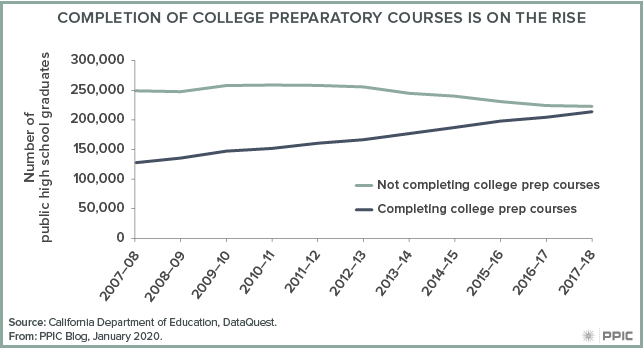
The good news is that more and more of California’s high school graduates have passed the college preparatory curriculum (known as the “A-G” courses) required by UC and CSU. Over the past five years, the number of high school graduates completing the A-G courses has increased 28%, even as the total number of high school graduates has remained largely unchanged.

By 2017–18 (the most recent data available), almost half (49%) of California’s high school graduates had completed the A-G courses, a remarkable increase from just ten years earlier when only about one-third (34%) did so. As a consequence, the number of high school graduates eligible for UC and CSU has reached record numbers.

figure - Completion of College Preparatory Courses Is on the Rise

Of course, enrollment demand depends on more than just new freshmen. The number of students that transfer from the state’s community colleges also adds to enrollment growth. Over the past five years, that number has also grown (up 25% at UC and 14% at CSU).

Improvements in persistence and completion also lead to greater enrollment, as fewer students drop out. At both UC and CSU, persistence and graduation rates are increasing. For example, at CSU the share of freshmen that graduate within six years has increased from 54% (fall 2008 entering cohort) to 62% (fall 2013 entering cohort).

Accommodating this enrollment growth is good for the state. College graduates are in high demand in the state’s labor market and—on average—earn far higher wages than less educated workers. PPIC has projected that demand for highly educated workers will keep growing as the state’s economy continues to change. Finding ways for California students to attend and graduate from college improves their well-being—and that of the state.

Covering the Real Costs of College

Faced with the state’s high cost of living, California college students struggle to secure adequate food and housing. Even amid one of the largest and longest economic expansions in state history, 33% of students are housing insecure and 35% have low or very low food security, according to a California Student Aid Commission survey of 150,000 college students. As the state seeks to meet economic demand by producing more students with degrees and certificates, the full cost of college remains a barrier to progress.

Governor Newsom and the legislature have recognized the need to reform state financial aid programs to address the full cost of college. The 2019–20 state budget provided $41 million in ongoing funding to help colleges address food and housing insecurity, $19 million to support rapid rehousing programs, and increased the number of competitive state grants for non-traditional students from 25,750 to 41,000.  Additionally, the legislature increased the maximum award amount that students with children pay for non-tuition college costs from $1,672 to about $6,000.

However, broader reform of the state grant aid program remains elusive. Two recent bills sought to expand eligibility for Cal Grants by eliminating current age, time out of high school, and high school GPA requirements. The bills also sought to provide additional non-tuition aid to community college students and students in career education programs.  The bills did not make it to a vote; however, they will be re-examined in the next legislative session. Estimated at $2 billion per year, proposed reforms would nearly double the annual cost of the program.

Consequently, the California Student Aid Commission, the agency that distributes financial aid, intends to streamline these proposals to constrain costs while increasing access. Higher education is a vital tool that increases economic and social mobility; ensuring all students have equal access to an affordable education is paramount to modernizing California’s economy. An equitable and financially viable approach to financial aid will be critical if the state’s booming economy slows in coming years.

Strengthening Career Pathways in California’s Community Colleges

California lawmakers have made large state investments—totaling more than $1 billion over the past five years—to support and expand career education.  As the primary provider of career training in the state, California’s community college system was the recipient of much investment in this area, and their creation of the Strong Workforce program has established an ongoing source of funding to continue this work.

To assist policymakers, practitioners, and students to better understand how career education programs can meet regional workforce needs and connect students to well-paying, in-demand jobs, PPIC has engaged in a multi-year research agenda focused on community college career education pathways. We highlight our work in this area in a recent article, Strengthening Career Pathways in California’s Community Colleges, in Techniques magazine, a national publication that provides career education faculty and practitioners with timely analysis and insights to inform the delivery of high quality career education programs.

The article highlights recent research from PPIC’s Higher Education Center on the structure of career education pathways and their value to the students who complete them. Since many career education students are older than typical college-age students—and are likely to have work or family obligations (or both)—the article also highlights how various reforms being enacted by the community colleges could help students complete career training pathways, with a focus on the new online-only college, CalBright, that began enrolling students for the first time in October 2019.

College Applications Are Up and Admission Rates Are Down

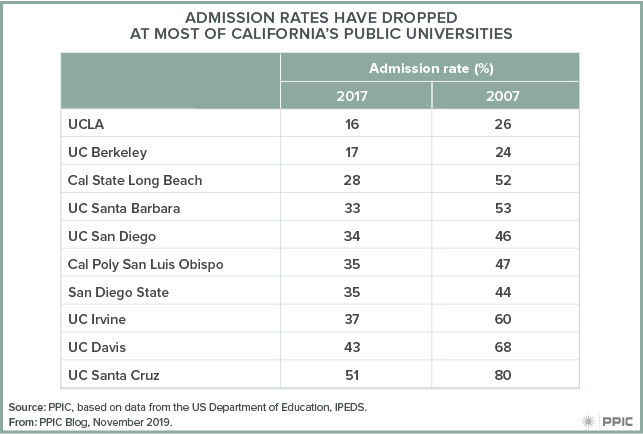
Across California, thousands of high school seniors are in the process of completing college applications. If recent trends continue, the number of applications this year should be staggering. Keeping up with demand has been a challenge; most colleges have reduced their admission rates in the face of large increases in student interest.

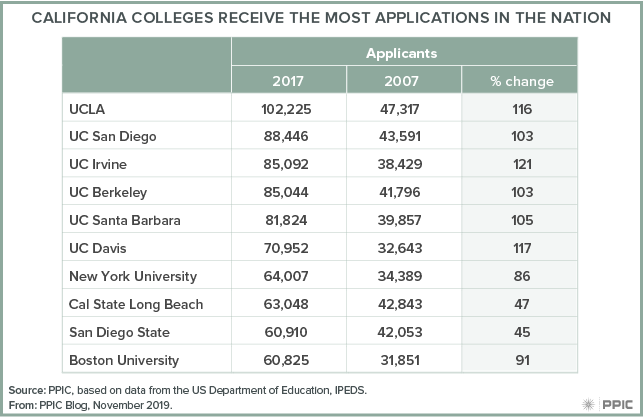
California colleges and universities garner the most applications in the nation. Of the top 10 most popular schools in the country, eight are in California (six UC campuses and two CSU campuses). UCLA has led the nation in applications every year for at least the past 17 years. In 2017, it became the first college in the country to receive more than 100,000 freshmen applications.

table - California Colleges Receive the Most Applications in the Nation

The popularity of UC campuses has surged over the past 10 years, with UC Irvine moving to 3rd in the nation in 2017, up from 7th in 2007. UC Davis moved to 6th from 11th, and UC Santa Cruz jumped to 15th from 32nd.

In the CSU system, Cal Poly San Luis Obispo has moved to 18th from 23rd. And even though other CSU campuses fell in the rankings, they still experienced large increases in applications.

Of course it makes sense that California colleges would lead the nation: the state has more high school graduates than any other and offers a robust system of public universities. And students are applying to more colleges than they did in the past, which contributes to the growth in applications.

But much of the increase is attributable to improvements in college preparation. Between 2007 and 2017, the number of California high school graduates completing the courses required for UC and CSU eligibility increased by almost 60%. In 2007, only about one third of high school graduates completed the required college preparatory courses, but by 2017 almost half had done so, a remarkable improvement in a relatively short time.

Unfortunately, California’s public universities have not been able to accommodate all qualified applicants. In fact, they lead the nation in turning applicants away.

table - Admission Rates Have Dropped at Most of California’s Public Universities

Each of the UC campuses except Merced are unable to admit all of the eligible students who apply. Seven CSU campuses (including Long Beach, San Diego, and San Luis Obispo) are impacted for all undergraduate programs, meaning they cannot admit all qualified applicants; all but one of the other campuses are impacted in certain majors. Both UC and CSU refer qualified applicants to campuses that have more room, but more needs to be done to expand capacity at campuses with high demand.

Do Californians Support the Proposed School Bond?

When Californians go to the polls in March, they will not only cast a vote in the presidential primary—they will also vote on an education bond to fund construction and modernization projects. Given differences in support for the bond across the state’s regions and demographic groups, turnout will play a pivotal role in whether this measure passes.

In the closing days of the legislative session, the legislature passed and the governor later signed a bill placing Proposition 13 (the Public Preschool, K–12, and College Health and Safety Bond Act of 2020) on the March ballot. If approved by voters, the measure would authorize $15 billion in general obligation bonds to pay for the construction and modernization of California’s public schools, community colleges, and four-year colleges.

The September PPIC Statewide Survey took an initial look at support for this proposition. While two-thirds of Californians (66%) are in favor, 54% of likely voters say they would vote yes—just slightly above the majority needed to pass.

Are some Californians more likely than others to support the bond measure? Unsurprisingly, there is a wide partisan divide, with three in four Democratic likely voters (76%) saying they would vote yes compared to just three in ten Republicans (29%). Overall, independent likely voters are divided (48% yes, 44% no). But among Democratic-leaning independents, nearly two in three (64%) are supportive.

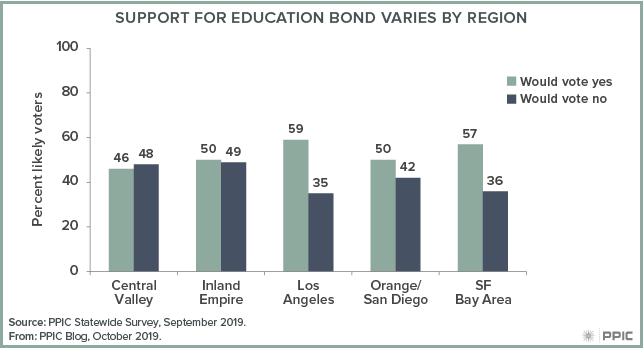
Support varies across regions, with Los Angeles (59%) and San Francisco Bay Area (57%) likely voters expressing the most support, compared to about half of likely voters elsewhere in the state.

figure - Support for Education Bond Varies by Region

While support is similar among likely voters with (55%) and without (53%) children in the house, there are differences across other demographic groups.

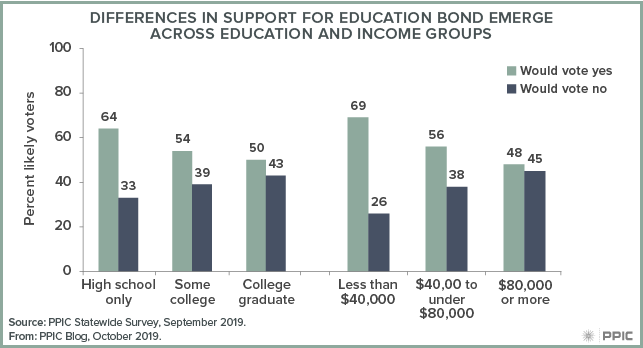
White likely voters (47%) are much less likely than Latinos (74%) and those of other racial/ethnic groups (62%) to say they would vote yes. And since school construction bonds are often paid off by property taxes, it’s notable that homeowners (44%) are far less likely than renters (71%) to say they would vote yes. Support is higher among younger likely voters (66% age 18 to 44, 48% age 45 and older). It declines as education and income levels increase.

figure - Difference in Support for Education Bond Emerge Across Education and Income Gaps

Overall, support for the education bond currently hovers at around half for likely voters, but there is much stronger support among many regional and demographic groups—suggesting that passage could depend on who shows up to vote. If Democrats and Democratic-leaning independents turn out in large numbers for the presidential primary, that could affect the fate of this bond. Stay tuned to the PPIC Statewide Survey as we continue to track this measure in advance of the March primary.

Video: Improving Educational Opportunity in California

What is the one thing that could be done to improve educational opportunity in California? Mark Baldassare, PPIC’s president and CEO, posed this question at the start of his conversation with Linda Darling-Hammond, president of the California State Board of Education, and Eloy Ortiz Oakley, chancellor of the California Community Colleges.

Darling-Hammond responded with a list of five major characteristics of school systems in other countries and states that have closed “opportunity gaps”: an equitable, adequate funding system; high-quality teachers and leaders; a thoughtful curriculum and assessment system; wrap-around support for students; and schools designed to allow for productive learning.

Then she circled back to California’s “number one thing”: “We’ve got to fix the teacher shortage—and we’ve got to do it quickly, purposefully, and soon.”

For Oakley, the “one thing” is to change “how we look at education, how we look at opportunity in California.” In short, we need to stop providing “the least amount of resources to the students, the communities that need them the most.”

A key part of this change involves “blurring the line” between the K–12 (or “TK–12”) and community college systems. Oakley noted: “There was a point in time when we felt that a high school diploma was the default to get into the workforce. Those days are gone. . . .We need to see the path to community college as the required path for everybody to get some sort of post-secondary credential.”

Darling-Hammond agreed that the two systems can and should work together. A good example of productive collaboration, she added, is concurrent enrollment, which allows high school students to take college courses (and earn college credit). These programs help students “find their passion” and move toward meaningful careers.

Funding is another key issue for both systems. Darling-Hammond pointed to the impact of significant post-recession increases in funding during the Brown and Newsom administrations and the potential impact of the governor’s commitment to early childhood education. But, she added, “just to get to the national average . . . we need about $12 billion more in the TK–12 system.”

Oakley agreed that “for those of us who managed our way through the recession, we’re certainly in a much better place.” The community college system could certainly benefit from more funding, he added, but state investments in early childhood education might be even more beneficial: “If we could prioritize the funding at the lowest level, for the youngest learners, that would make our job in the community colleges easier.”


2020 Primary: Funding Higher Education Facilities

The state legislature recently passed a $15 billion bond measure to fund upgrades to education buildings and facilities. Voters will decide whether to support this bond as part of the March 2020 primary ballot.

For higher education, the measure would provide $6 billion to the state’s three higher education systems, the University of California (UC), the California State University (CSU), and the California Community Colleges (CCC). These funds would be distributed equally ($2 billion each)—even though the systems enroll significantly different numbers of students.

The legislature will approve specific projects as part of the annual budget process. As a condition of making funds available, the bill requires UC and CSU to develop affordable housing plans for their students.

figure - Proposed Bond Funding Varies on a per Student Basis

The last time the state proposed and passed a ballot measure supporting higher education was more than a decade ago. Proposition 1D (2006) passed with almost 57% support. The total amount of funding for higher education in that initiative was about half of what is proposed in the current measure ($3.1 billion compared to $6 billion).

figure - 2020 Initiative Proposes Much More Funding for CSU and CCCs than the 2006 Measure

During the Great Recession funding for UC, CSU and the community colleges fell. One of the ways the systems responded was to defer maintenance on buildings, foregoing repairs and upgrades as a way to save money in the short run. Our estimate of the cost of addressing the resulting backlog of capital projects tops $30 billion for the UC and CSU systems. The proposed ballot initiative would provide bond authority to cover a little more than 10% of that.

The state’s community colleges are in a slightly different position. Local community college districts can issue their own bonds and make most of their own capital finance decisions. Since passage of Proposition 39 (2000), which made it easier for community colleges to pass bond measures, community college districts have been relatively successful in funding their capital needs. From 2001 to 2016, voters approved $35 billion in borrowing for local community college capital projects. In addition, Proposition 51 (2016) provided community colleges with $2 billion in state bond funding.

We know that bond measures for education generally have the support of voters, and recent PPIC polling suggests that a $15 billion education bond has a slim margin of support. Time will tell whether voters will be persuaded this time around.