Janet Napolitano, the new president of the University of California and the former U.S. secretary for Homeland Security, said Monday that she told President Obama that the United States cannot thrive unless California thrives—and California cannot thrive unless the University of California thrives. Napolitano was responding to a question about why Californians should care about the public university system. Her comments were part of PPIC’s 2014 Speaker Series on California’s Future, which drew an online and in-person audience of nearly 500 to a conversation with PPIC President Mark Baldassare at the Sheraton Hotel in Sacramento. The wide-ranging discussion opened with a presentation from Hans Johnson, PPIC senior and Bren fellow, who provided context about the state’s need for educated workers.
The UC president, who also served as governor of Arizona, talked about tuition and budget issues, as well as online education, access for low-income students, and the lessons she’s learned since starting this job about six months ago. Napolitano said there was much the university is doing well: 42 percent of UC students are eligible for grants to low income students, 46 percent are the first generation in their families to go to college, and more than one-third are from families where English is not the primary language. She also said no public research university in the country is more efficient at helping students graduate within four years.
Still, she talked at length about the changes underway in funding for higher education and the need for new models. She emphasized that tuition will not increase for the 2014-15 school year and said that the university is dedicated to a tuition rate that is “as low and predictable as possible.” She also said she hoped to increase the university’s financial connection to philanthropy and the private sector. She said the state could do more and it should do more to support higher education.
Speaking about the future of higher education, Napolitano said online learning “is a tool in the tool box,” not a silver bullet. She said it is not necessarily cheaper than traditional classroom instruction and—despite some claims—no more effective at remedial education. She said, however, that it could get students access to classes not available on their campus.

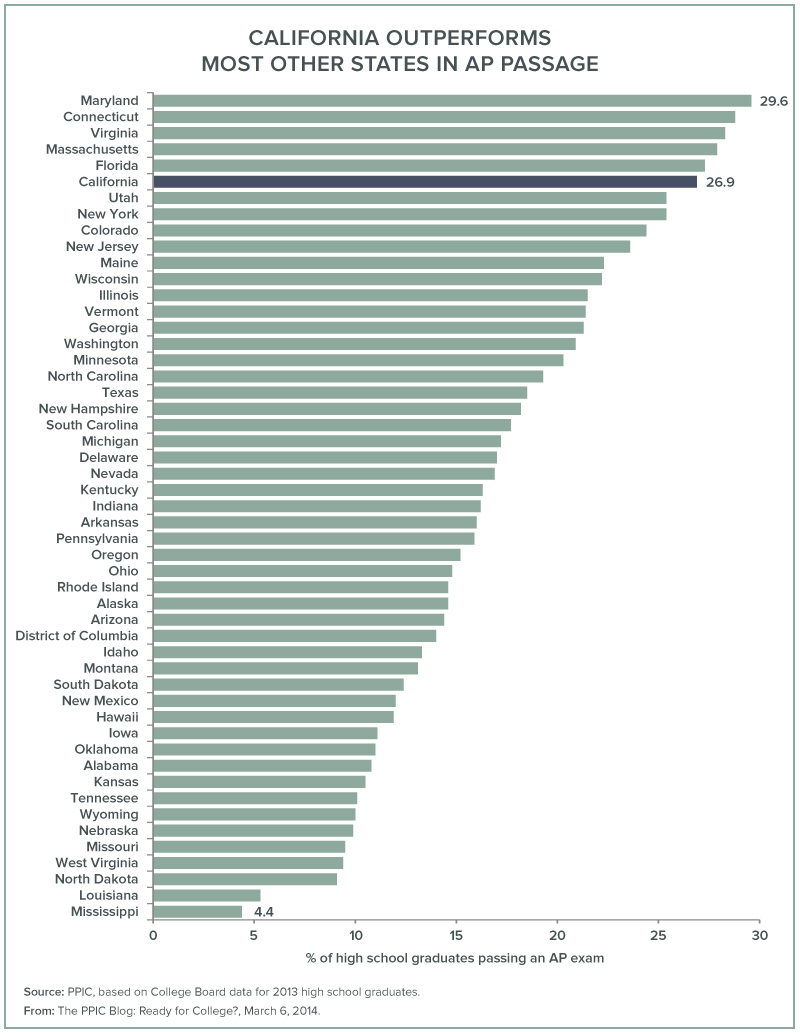
 California’s high school graduates outperform their peers in the rest of the country on AP exams. In 2013, more than one in four California high school graduates (26.9%) passed at least one AP exam sometime during high school, compared to one in five in the nation as a whole. Among the 50 states and the District of Columbia, California high school graduates ranked sixth highest. Moreover, the share of graduates successfully completing an AP exam is going up fast in California—higher than in the rest of the nation. Between 2003 and 2013, the share of high school graduates passing at least one AP exam increased 9.6 percentage points in California, compared to 7.9 percentage points for the entire nation. California has a higher share of graduates taking AP exams than does the nation as a whole (45.6% versus 35.0%), with passage rates among AP exam takers slightly higher in California (59.0% versus 57.4%).