How Does UC Compare in Enrolling Nonresident Students?

Record-high numbers of out-of-state students are enrolling in the UC system. Estimates show that one out of every five freshmen starting at a University of California campus this fall will be a student who attended high school in a state outside of California or outside of the U.S.

Nonresident students pay about three times the tuition of a California resident. Since the state’s deep cuts to higher education budgets, the UC system has increasingly relied upon nonresident student enrollment as a source of revenue. In fact, Senator Kevin de León recently suggested raising tuition on nonresidents to increase revenue for UC. Several other legislators and members of the public have criticized the increased recruitment and admission of nonresidents. All of which raises a question: How does UC’s enrollment of nonresident students compare to that of similar universities in other states?

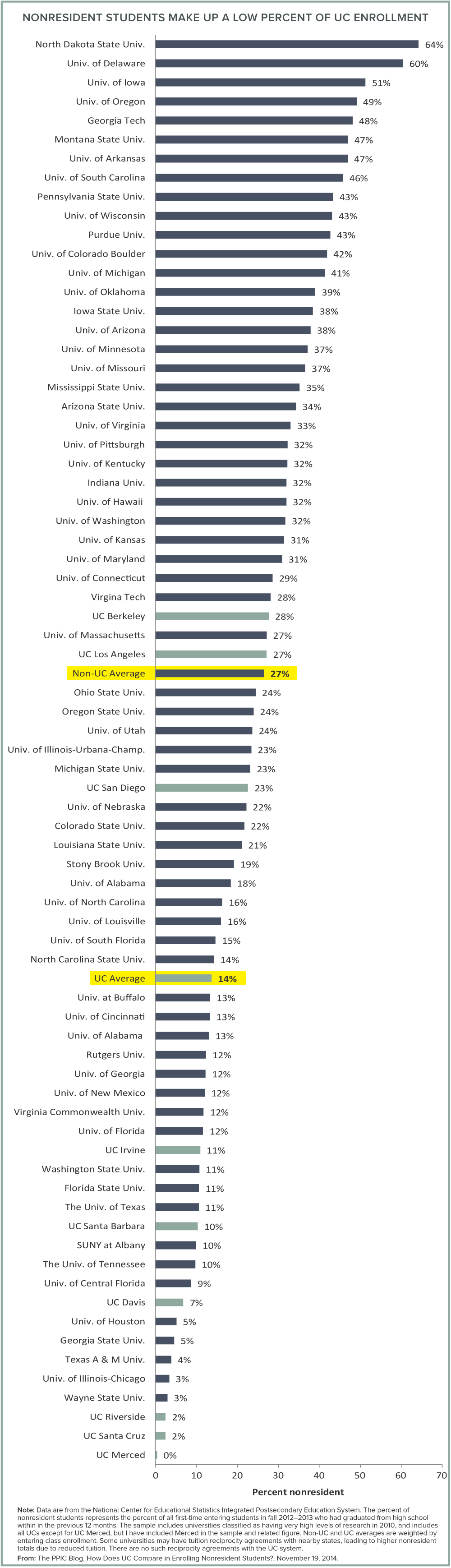
Among public, four-year research universities nationwide, only UC Berkeley and UCLA are above the national average in the proportion of students paying out-of-state tuition. The UC average is well below the national average for similar universities. In fact, the UC system claimed six of the bottom 17 spots, as the following chart demonstrates.
Looking at the trend over time, the UC system has enrolled relatively low levels of nonresident students compared to other similar universities, but that average has been increasing sharply since 2010. However, nonresident enrollment is also increasing at other top-tier, public universities throughout the nation—likely because of budget woes in other states. In the most recent two years, there has been no national data for a comparison, but UC provides the number of students intending to register each year, which is likely an upper bound for nonresident enrollment. The number of nonresident students has continued to climb, especially at UC Berkeley and UCLA, where they are estimated to make up 29.8% and 30.1% of 2014 freshmen enrollees, respectively. But even with these increases, nonresident enrollment is still likely lower at UC Berkeley and UCLA than it is at many prestigious public four-year universities, and the UC system is likely well below the national average for similar schools.

UC President Janet Napolitano has stated that she has considered limiting the number nonresident students in the UC system. But instead of setting system-wide limits, and relying on some universities to have fewer nonresidents to balance Berkeley and UCLA, the president and board of regents may consider setting enrollment limits for nonresident students for each university in the system. The full board of regents meets Thursday to vote on a plan for raising tuition at UC. If UC cannot increase revenue through tuition increases or from the state, they may seek to enroll more nonresidents, as they have done in the past. Even though the UC system has a relatively low proportion of nonresident students compared to the nation, such a move would still likely generate controversy.

Note: (BOTTOM CHART) Data are from National Center for Educational Statistics Integrated Postsecondary Education System (IPEDS) and the UC Office of the President. Solid lines indicate data retrieved from IPEDS; dotted lines indicate estimated enrollments based on UC Office of the President’s reported Statement of Intent to Register (SIR). The percent of nonresident students represents the percent of all first-time entering students in fall 2012–2013 who had graduated from high school within in the previous 12 months. The IPEDS sample includes universities classified as having very high levels of research, and includes all UCs except for UC Merced, but I have included Merced in the sample and related figure. Non-UC and UC averages are weighted by entering class enrollment. Universities are not required to submit nonresident counts to IPEDS in odd years, and some do not. Those odd year values are imputed from the even years surrounding them.

Paying for Higher Education

As concerns have grown about access to and affordability of California’s higher education system, understanding costs has become more critical than ever. How are institutions—and students—faring?

This question is the focus of three reports released by PPIC and a panel discussion held last week in Sacramento. Hans Johnson, a Bren fellow at PPIC, first summarized the research. One report shows that federal financial aid has shielded low-income students from rising tuition at the University of California and California State University. A second report evaluates both revenues and spending—including faculty salaries and benefits— and concludes that UC and CSU have not become less efficient in the past several years. A third report suggests that as California begins to reinvest in public higher education, it could tie funding more closely to results—for example, the number of degrees awarded—to meet state goals. In his presentation, Johnson noted that the state’s current goals—the Master Plan for Higher Education—are more than 50 years old and overdue for an update.

Panelists took up the issue of goals—how to set them, what to measure, and how to share the costs—in a discussion moderated by Patrick Murphy, PPIC research director. Participants were Henry Brady, dean of UC Berkeley’s Goldman School of Public Policy; Nancy Shulock, former executive director of CSU Sacramento’s Institute for Higher Education Leadership and Policy; and Amy Supinger, California policy consultant for the Lumina Foundation.

Video: Making College Possible

At a time when California’s economy needs more college graduates, a new PPIC report examines the role of grants and scholarships in making higher education both accessible and helping students graduate. Hans Johnson, the report’s author and PPIC Bren Fellow, talked about his findings at a briefing last week in Sacramento.

He found that although total financial assistance available through federal grants, Cal Grants, institutional aid, and private scholarships has increased, it has not kept pace with the actual cost of attending California State University and community colleges. These are the California colleges that enroll most low-income students in California—a state in which nearly 60 percent of K–12 students qualify for free and reduced price lunch programs.

“If we want the economic ladder to success to work in California, we need more students to go to and complete college,” he said. “And given our student population, a lot of those students will be from very low-income families.”

He recommended strategies to make college more affordable and accessible. They include directing any additional aid to low-income students and helping more students complete financial aid forms.

California’s New Leaders Focus on Poverty

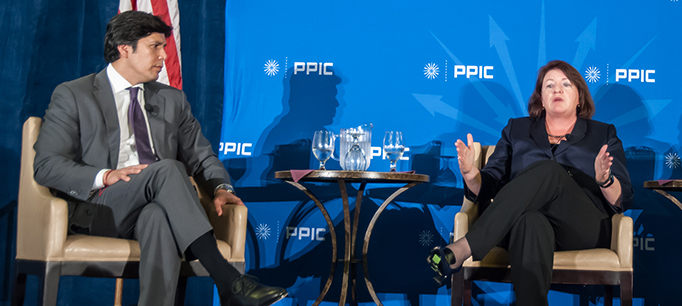
Assembly Speaker Toni Atkins and Senator Kevin de León, who will take over as senate president pro tem later this month, each told a Sacramento audience about growing up in poverty and the role it has played in their shared view of the state’s responsibility to those in need.

“We share similar values and similar stories that have made us care about the values and the issues that we’re talking about today,” said Atkins, who was raised in a poor, rural Virginia family and now represents the San Diego area. De León, who was born in San Diego and represents Los Angeles, said he is the youngest child of a single immigrant mother and the only family member to graduate from high school. Atkins and de León, both Democrats, were elected by their respective legislative chambers earlier this year to serve as leaders.

Both lawmakers cited a recent PPIC report — Child Poverty and the Social Safety Net in California by Caroline Danielson and Sarah Bohn — that said about 50% of California children live in poverty or near-poverty. The remarks, part of the PPIC 2014 Speaker Series, were made to a capacity audience of about 400 in the ballroom of the Sheraton Grand Hotel. The discussion was moderated by PPIC President Mark Baldassare and streamed live to hundreds more.

The wide-ranging conversation touched on a number of major issues—including health care, the drought, immigration, and taxes. Both leaders said that they believe the state should talk about changes to the state tax structure and consider whether to extend the temporary taxes that voters passed in Proposition 30. Atkins cautioned that it will be difficult to gain support from voters for an extension of the taxes.

De León expressed strong support for affirmative action, which he credited for his ability to attend college and become a legislator. He also said California should continue to lead on immigration issues because the federal government has been unable to pass a reform plan. And he noted that polls suggest Californians support health coverage for undocumented residents.

Atkins, meanwhile, encouraged more cities to follow San Francisco and San Jose, which recently increased the minimum wage. Both leaders also said they have worked together in the past and believe they will have a good working relationship going forward.

Now Hiring: Skilled Health Workers

Changing medical technology, an aging population, and new health care policies have raised important questions about the workforce that will be needed to care for patients in the future. These issues were featured in a new report from PPIC—California’s Healthcare Workforce Needs: Training Allied Workers—and discussed at a luncheon in Sacramento on Friday that included a briefing by coauthor Shannon McConville, PPIC research associate.

The report notes that California will have to add 450,000 jobs to its health workforce over the next decade. With nearly 40 percent of these additional health jobs expected to require some college training below a bachelor’s degree, training programs at California’s community colleges and private two-year institutions will play an important role.

Participating in the panel discussion were Dr. Jocelyn Freeman Garrick, director of the Alameda County Health Pipeline Partnership; Catherine Martin, vice president of the California Hospital Association; and PPIC research fellow Sarah Bohn, a report coauthor. The panel, which was moderated by PPIC research director Patrick Murphy, explored the challenges faced by both public and private higher education institutions in keeping up with rapidly advancing skills requirements in the health care industry. Topics included differences between public and private schools and programs and partnerships that can train Californians for health workforce needs.

The Future of Online Education in Public Colleges

Policymakers and educators have a lot of questions these days about whether new communication technologies can be helpful in higher education. Will they lower the cost of teaching, provide access to those who are otherwise left out, or provide more effective individualized instruction? With encouragement from Sacramento, California’s three public higher education segments are pursuing new initiatives in online education. On Tuesday, PPIC hosted a lunch event on this topic.

Hans Johnson, PPIC Bren Fellow, talked about his recent study, co-authored with PPIC research associate Marisol Cuellar Mejia, about online education in the state’s community colleges. The study found that participation in online courses has soared in the last decade but that success rates—in terms of course completion and passing grades—are lower for online students.

An expert panel expanded the discussion, with Joseph Moreau, executive sponsor of the Online Education Initiative at the California Community Colleges; Ashley Skylar, quality assurance manager for academic technology services at the California State University; and Arnold Bloom, who teaches an online course in climate change at UC Davis. Panelists talked about efforts to improve the quality of online instruction—the course materials and training of instructors. They also said it is too soon to tell whether online education may save money, but the size of California’s higher education systems provides opportunities for collaboration among campuses, which may produce more cost-effective education.

Fulfilling the Promise of Online Education

Online learning has become a topic of great debate in higher education. Its advocates have high hopes that it will expand opportunities and rein in costs. Policymakers in Sacramento have taken note. The new state budget provides tens of millions of dollars to support online learning.

When most people think of on online education, they think of MOOCs—massive open online courses—which provide free access to classes taught by faculty from the nation’s top universities. MOOCs have garnered headlines and been the subject of much debate about their potential to reinvent higher education. Meanwhile, California’s community colleges have quietly created an extensive set of offerings in online education. They now provide more online credit courses than any other public higher education institution in the country—a testament to the community colleges’ willingness and ability to innovate.

Enrollment has soared from just a few thousand students a dozen years ago. By 2012, online course enrollment in the state’s community colleges totaled almost one million, representing about 11 percent of total enrollment. Among students taking credit courses in 2011–12, one of every five took at least one online course. Indeed, practically all of the community college enrollment increases over the past ten years have occurred in online courses.

The Public Policy Institute of California has completed an analysis of student success in these courses that points out both the opportunities and challenges in providing online education. We found that online courses are providing some students with an important and useful tool that helps them achieve their community college goals. For example, students who take at least one online course are more likely to earn a degree, transfer to a four-year college, or earn a certificate than students who take only traditional courses.

But there are significant problems. First, the digital divide is evident. Latino students are less likely than students from other ethnic groups to take online courses. Moreover, the achievement gap is exacerbated in online settings. African Americans and Latinos have lower success rates in traditional classes than Asians and whites, and the achievement gaps are even wider in online courses.

And finally, even though online students tend to be stronger academically, they are less likely to successfully complete online courses than traditional courses. This lower course success rate is true across all types of students, a wide set of subjects, and almost all colleges. Indeed, once we controlled for student characteristics—such as overall grade point averages and other factors such as colleges and course subject—students are at least 11 percentage points and as many as 14 points less likely to successfully complete an online course than otherwise similar students in traditional format classes.

California’s community colleges need both more information and a more strategic approach before online learning can fulfill its promise. Little is known about the cost of developing and providing online courses. We won’t know if online learning is less expensive than traditional course work—as some of its advocates believe—unless we begin to systematically collect cost information.

The colleges won’t be able to improve outcomes for the rich diversity of their students unless they take a number of steps. They need to evaluate the online courses being taught now, identify the most successful instructional and technological approaches, and provide professional development for faculty to create and deliver high-quality online learning. They need to provide services for online students to help improve success rates. And they can use the power of technology to track students’ progress in detail, and offer instruction that is more targeted and customized.

Once high quality courses are identified and developed, it will be a challenge to ensure that those courses are readily available to students across California’s vast community college system. The community college’s Online Education Initiative is an important step in the right direction. Its goals are consistent with our recommendations to identify best practices and implement them widely. Its success will depend on identifying and implementing effective policies and programs that improve student outcomes. Going forward, a strong strategic approach will help California to make the most of its investments in online learning.

Online Courses and Achievement Gaps

This commentary was first published in the Sacramento Bee on May 15, 2014.

Online learning is a hot topic in higher education. Certainly the MOOCs, massive open online courses offered for free and featuring faculty from top universities in the country, have garnered a lot of attention. But perhaps more important has been the rise of online courses—for credit—in the nation’s accredited public colleges. Here in California the state’s community colleges have taken the lead, with course enrollments of about 1 million—more than in any other public higher education system in the nation.

Online learning offers the promise of expanded access to and success in higher education. To truly fulfill that promise, it must do so across the diverse population of California students. Currently, it’s falling short.

At the Public Policy Institute of California, we have recently completed an analysis of student access and success in online courses offered by the state’s community colleges, an important access point for students who are underrepresented in higher education. Online courses offer convenience to students who are often juggling family and work responsibilities. The rapid growth in enrollment in online courses, from just a few thousand 10 years ago to around 1 million today, is a testament to the increasing demand for higher education. Enrollment has grown rapidly among all the state’s ethnic groups. But in a reflection of the state’s digital divide, growth among Latinos has lagged that of other groups.

Perhaps most troubling, achievement gaps are exacerbated in online courses. Completion and success rates for traditional courses are lower among Latino and African American students than among white and Asian students. That gap is even wider online. In traditional classes, the achievement gap between white and African American students is 12.9 percentage points. It is 17.5 percentage points in online courses. Similarly, the gap between whites and Latino students is 7.3 percentage points in traditional courses, but is 9.8 percentage points in online courses. In contrast, white students tend to perform slightly better than Asian students in traditional courses, with an achievement gap of 1.4 percentage points. But they do slightly worse than Asian students in online courses, with an achievement gap of -1.4 percentage points.

Achievement gaps exist among other groups as well. Our research found that older students—those over 25—perform better than younger students in traditional courses. This performance gap widens in online courses, from 10.2 percentage points to 14.8 points. The achievement gap between female and male students is 1.9 percentage points in traditional courses and 3.1 percentage points in online ones. In other words, when demographic groups differed in their performance in traditional courses, these differences tend to be magnified online.

For online learning to reach its full potential, California’s community colleges need deliberate strategies and plans to improve student outcomes in online courses, with a special focus on narrowing achievement gaps among underserved and underrepresented students. Community colleges need to ensure high standards of quality for online courses and provide professional development for faculty to design and deliver them. They also need to incorporate student support tools—both technical and instructional. The community colleges’ new Online Education Initiative is currently pursuing these strategies.

There are ways in which online learning has the untapped potential to yield better student outcomes than the traditional setting does. Online courses can enable instructors to track students’ progress in detail and provide more targeted and effective guidance—potentially offering customized instruction that can address achievement gaps.

Online learning is here to stay.  With smart and informed policies and programs, it can reach many more students and do so much more effectively.

Visit the PPIC Higher Education Center.

Is College the Answer to Income Inequality?

In both California and the nation, income inequality is at or near record levels. Educational attainment is by far the single most important determinant of an individual’s income. A key question, then, is whether improvements in educational outcomes can reduce inequality. In a recent commentary for EdSource, we conclude that increases in college completion will increase wages, but will not significantly narrow the income gap. Here’s why:

College graduates earn a lot more than workers with less education. For example, workers with a bachelor’s degree earn 57 percent more on average than similar workers with only a high school diploma. But the range in wages for college graduates is much greater than the range for less educated workers. For example, among workers with a graduate degree, the top wage earners (those in the 75th percentile) earn $33 more per hour than those at the bottom of the wage distribution (25th percentile). Wage gaps are much lower among less educated workers – only $11 among workers with a high school diploma. Moreover, during the past three decades wage gaps have increased dramatically among college graduates. The large and growing variation in wages among college graduates leads to higher inequality.

This does not mean we should abandon policies to increase college enrollment and completion. Inequality at relatively high wages is better than low wages for everyone, and improvements in educational attainment will lead to higher incomes on average. But don’t expect to substantially reduce income inequality simply by increasing the rate of college graduation.

Boosting Transfers From Community College to CSU

To increase the number of college graduates in California, state policymakers are working to make it easier for community college students to transfer to four-year institutions, particularly the California State University (CSU) system. Legislation in 2010 required state community colleges to create a special degree that would ease the transition to CSU campuses.

Researchers Colleen Moore and Nancy Shulock provided a progress report on the implementation of this new degree at a PPIC briefing on Friday. These two researchers are from the Institute for Higher Education Leadership and Policy at CSU Sacramento and are the authors of a new report for PPIC, From Community College to University: Expectations for California’s New Transfer Degrees.

They found that the new degrees have improved pathways for community college students. But many community colleges still offer transfer degrees in only a few majors, and some CSU campuses accommodate the degree in only some of their degree programs. In other words, the program still has a long way to go before it is fully implemented.