
California community colleges are reforming to the way they assess their students’ college readiness and place them in remedial courses. A recently passed measure—Assembly Bill (AB) 1805—may increase both the uniformity and transparency of placement policies. PPIC research indicates that AB 1805 has the potential to improve student outcomes and narrow achievement gaps.
Our research finds that clearer and more uniform policies can make assessment results more portable for students. A previous measure, AB 705, established a set of measures a college must use to determine college readiness (e.g., coursework, grades, and/or grade point average). However, colleges continue to have autonomy to set their own rules, as opposed to using the Chancellor’s Office default placement rules. Our latest study finds that varying policies across colleges is a cause for concern. For example, two colleges within the same district might both use high school GPA to place students, but their GPA cutoffs might differ; this could pose problems for students who are assessed at one institution but want to take a transfer-level course at the other college.
AB 1805—which will be implemented systemwide in fall 2019—may help address this concern by mandating that colleges publicize their placement policies. As a result, students will be better informed and may also be more motivated to challenge placement decisions or enroll at colleges with broader access to transfer-level courses.
Variation in placement policies may also contribute to inequitable access to transfer-level courses. Our research indicates that underrepresented students may have more difficulty gaining access to transfer-level courses if they attend colleges with stricter placement rules. AB 1805 requires colleges to report the number of students placed into transfer-level coursework (with or without concurrent support) to the Chancellor’s Office and the public each year, providing racial/ethnic breakdowns. This should make it easier to see whether colleges are implementing placement policies that are fostering inequitable student outcomes.
Over the summer, PPIC engaged in an exhaustive scan of college websites and catalogs to get a sense of how placement policies are being communicated to students. We found that most community colleges do not provide clear and complete information—in fact, only 19 colleges provide placement details (e.g., GPA cutoffs). As we move forward, it will be critical to monitor the implementation of AB 705 and AB 1805 at the college level—including the placement measures being used and levels of access to transfer-level courses. By examining the policies and practices at colleges where underrepresented students experience uneven access to transfer-level courses, progress can be made toward improving outcomes and narrowing achievement gaps.


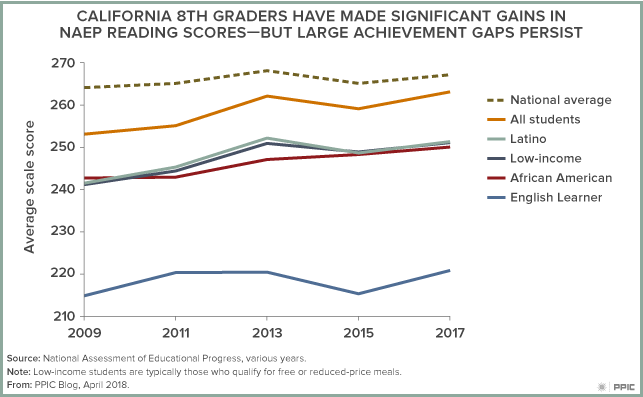


 To the right we present results for the CST and the Smarter Balanced tests, alongside California students’ scores on the National Assessment of Educational Progress (NAEP), a national ongoing assessment of what children know in a variety of subject areas. While these three test results are not directly comparable because each measures competence relative to different standards and each has its own definition of what it takes for a student to score “proficient,” it is important to have a clear sense of how our students are faring on each. The Smarter Balanced test results for each student group are higher than the NAEP, but low relative to the most recent CST.
  California’s public school system has seen dramatic changes in recent years, and the 2014–15 Smarter Balanced test results are an important baseline to measure how these changes are affecting students. In the past, California students’ test results improved almost every year that the CST was administered. Today, both the Common Core State Standards and the LCFF aim to improve outcomes for all students and close achievement gaps. Multiple years of Smarter Balanced test results will be needed to monitor progress. These new higher standards are meant to improve outcomes well beyond secondary schooling, and the least advantaged students have the farthest to go. The new curriculum and new funding should help get them there.


