California’s K–12 Educational Progress: Good News and Bad News

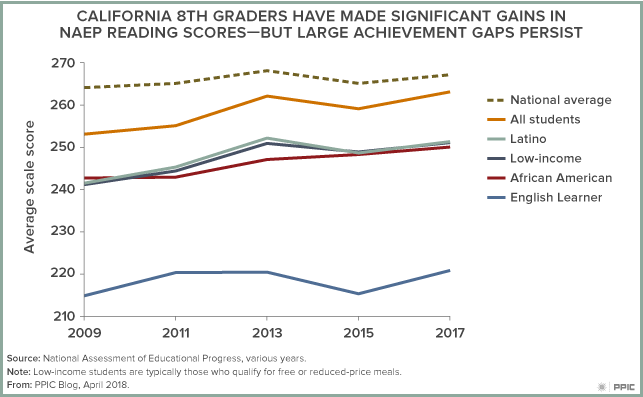
New data on the educational progress of California’s K–12 students offers a mixed picture: there have been sizable gains in grade 8 reading scores, but more work is needed to close achievement gaps for English Learner, low-income, and African American and Latino students.

The data comes from the 2017 National Assessment of Educational Progress (NAEP), commonly referred to as the nation’s report card. Administered periodically in grades 4, 8, and 12, NAEP serves as a common yardstick for states and informs many national policy decisions.

The NAEP results show that the average reading score for California 8th graders has risen from 259 to 263. While the latest score is still below the national average (267), it marks a significant improvement, and the state’s 4 point gain is larger than the 1 point increase at the national level. The increase is driven by improvement at both ends performance scale: fewer students performed at the lowest level and more students performed at the advanced level.

However, there were no significant improvements in grade 8 math and no gains in either subject in grade 4. Also, California did not see any significant narrowing of its student achievement gaps. For instance, the average reading score for Latino students in grade 8 was 27 points lower than that of white students; this gap is not significantly different from the 30 point gap in 1998. Similarly, the average score for low-income students was 28 points lower than that of other students, and that gap is not different than it was as in 1998 (32 points).
Naep Score Figure

The NAEP results provide a useful benchmark of student performance; this is especially important in light of the sea changes under way in California’s public K–12 system. The state revamped its school finance and accountability systems with a focus on improving outcomes among English Learners and other “high-need” students. It also adopted new educational standards in math, English language arts, science, and English language development, and implemented a new assessment system.

A recent PPIC survey finds that a solid majority of adults believe that the financial reforms, in particular, will improve the achievement of English Learners and low-income students. As the reforms take hold, PPIC will continue to monitor their impact.

Early Results from Education Reforms

California’s K–12 system is implementing an unprecedented number of reforms. The state’s school funding system and curriculum standards are new, as are all statewide tests. A new school accountability system is being developed. A number of large urban districts are changing their high school graduation requirements. These reforms are designed to equalize opportunities for students and close achievement gaps among demographic groups.

It will be some time before we know what all of these changes add up to, but PPIC researchers who examined the early results of two reforms presented their findings at a PPIC event in Sacramento last week.

California’s New Standardized Tests

PPIC senior fellow Laura Hill summarized the results of California’s new standardized tests, the focus of a PPIC report she coauthored. The scores show that English Learners and economically disadvantaged students are far behind other student groups—possibly farther behind than initially thought. As the accountability system evolves in the state, the test results are an important call to action for districts and schools struggling to help high-need students, Hill said. High-need students did well in some schools and districts, and the first-year results provide an opportunity to learn from their experiences.

College Prep for All?

Julian Betts, an economics professor at the University of California, San Diego, and PPIC adjunct fellow, examined a high school graduation requirement that makes college preparatory courses mandatory for all students. Major urban school districts—including Los Angeles, San Diego, San Francisco, and Oakland—recently implemented this requirement, making it mandatory for students to complete the a–g sequence of classes required for admission to the University of California or California State University. Based on a PPIC analysis of the San Diego Unified School Districts’ Class of 2016, Betts and his coauthors concluded that this requirement is likely to help many students but damage the prospects of others. He suggested steps that San Diego and other districts can take to help lower-achieving students meet the new graduation goals.

Learn more

Visit PPIC’s K–12 education pages
Visit the PPIC Higher Education Center