More Students Are Earning STEM Degrees

The number of students graduating with a bachelor’s degree in science, technology, engineering, or math (STEM) has risen dramatically in California. Both students and colleges are responding to changes in our economy, which increasingly rewards highly educated workers, especially those with STEM degrees.

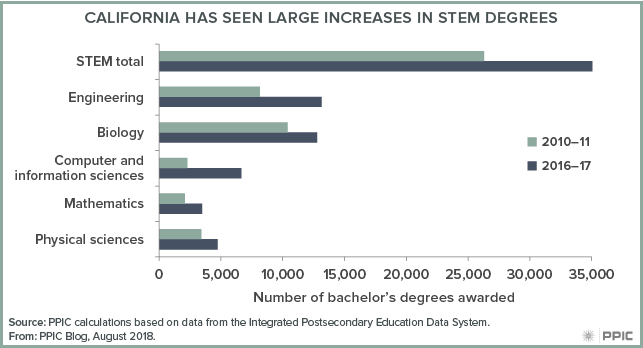
Between 2010–11 and 2016–17, the number of STEM bachelor’s degrees awarded by colleges and universities in California increased 55%, more than triple the rate of growth in other degrees (17%). By 2016–17, 20% of all bachelor’s degrees awarded were in a STEM field, up from 16% in 2010–11.

These increases occurred across the board for all STEM fields and for all higher education sectors in the state. Increases were especially sharp in engineering, which surpassed biology as the most common STEM degree. Computer and information sciences also saw big gains, with almost three times as many bachelor’s degrees awarded in 2016–17 as in 2010–11. The increase in computer science is particularly notable, as its popularity had declined after the “dot com” bust of the early 2000s.
STEM fields are especially popular at the University of California (UC), which awards almost half of the state’s STEM degrees (compared to only 21% of other bachelor’s degrees). In contrast, California State University (CSU) awards 37% of the state’s bachelor’s degrees in STEM, compared to more than half (52%) in other majors. STEM is also less common at private colleges, especially for-profit institutions.
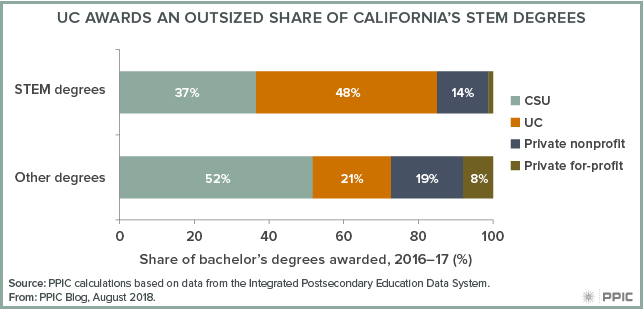
But there is wide variation across colleges. At UC San Diego (56%) and UC Merced (48%), about half of bachelor’s degrees awarded in 2016–17 were in a STEM field, compared to only 27% at UC Santa Barbara. In the CSU system, 37% of bachelor’s degrees at Cal Poly San Luis Obispo were in STEM, compared to only 8% at Cal State Dominguez Hills. And among the state’s larger private nonprofit colleges (those with at least 1,500 bachelor’s degrees awarded), half of Stanford University’s bachelor’s degrees were in STEM, compared to only 8% at Azusa Pacific.

The rapid growth in STEM majors is a testament to changing interests among students. Those interests are academic, but also economic. Strong labor market outcomes for STEM graduates—especially for those with degrees in engineering and computer science—almost certainly contribute to the increasing demand for those majors.

Colleges have responded, at least in part, by building more capacity for STEM majors. Moreover, public colleges have led the way, with UC and CSU experiencing the largest shifts toward STEM degrees. Between 2010–11 and 2016–17, the share of bachelor’s degrees awarded in STEM fields increased 6.8 percentage points at UC (from 30.0% to 36.8%) and 4.4 percentage points at CSU (from 10.7% to 15.1%), compared to only 2.7 percentage points at private nonprofit colleges (from 12.4% to 15.1%).

While more could be done to fully meet student demand—at many campuses, engineering and computer science majors have more applicants than can be accommodated—the evidence to date shows that California’s higher education system has been able to substantially increase capacity in STEM fields.

Video: Californians and the Environment

With the November election less than four months away, Democrat Gavin Newsom leads Republican John Cox by 24 points in the governor’s race—and nearly all likely voters see the candidates’ positions on environmental issues as important. In the US Senate race, Dianne Feinstein continues to lead fellow Democrat Kevin de León by double digits. These and other key findings in the July PPIC Statewide Survey were presented by researcher Alyssa Dykman at a Sacramento briefing last week.

Californians are much more likely than adults nationwide to say that global warming is extremely or very important to them personally. A majority of likely voters see global warming as a very serious threat to California’s economy and quality of life, and a solid majority say that the effects of global warming have already begun. This may help explain why most Californians are in favor of the state making its own policies to address climate change.

Other survey highlights:

  • Approval ratings for the president and Congress—both overall and on environmental issues—remain far lower than those for the governor and state legislature.
  • There are wide partisan differences in views on climate change and what the state should do about it.
  • Likely voters see drought and water supply as the top environmental issue facing the state; a majority support a water bond on the November ballot.
  • A majority of likely voters favor higher emissions standards for automobiles as well as state laws that aim to reduce greenhouse gas emissions in other areas.

Higher Education Finance: How Does California Stack Up?

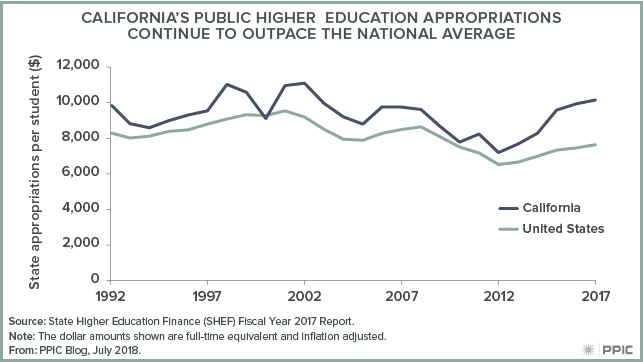
California’s public higher education spending per student has increased significantly since the end of the Great Recession—it is now higher than at any time since 2002. According to a recent report by the State Higher Education Executive Officers Association (SHEEO), spending increased 41% per student (based on full-time equivalents and adjusted for inflation) between 2012 and 2017 in California, compared to 17% across the rest of the nation. California’s percentage change was third highest in the nation, after Oregon and New Hampshire (both with an increase of 47%). However, both of those states provide much less support per student: in 2017, New Hampshire appropriated $2,959 per student and Oregon allocated $6,514, compared to California’s $10,157. California also ranked third in terms of absolute increases ($2,960 in California, compared to $3,781 in Hawaii and $3,608 in Illinois).

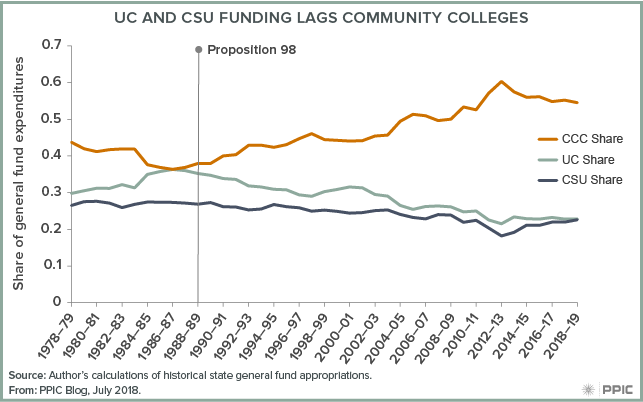
California’s funding increases have not been evenly distributed across the three public systems. Since 1988, the community colleges have benefited from the Proposition 98 funding guarantee for K–14 education. As a result, per student funding for the community colleges is now at an all-time high, but is still below peak UC and CSU funding levels.

Governor Brown recently signed the state budget for 2018–19, which includes $19.2 billion General Fund and local property tax funds for all public higher education systems—about 8% more than the 2017–18 allocation. This continues the recession recovery trajectory and prevents tuition increases at UC and CSU. Moreover, the governor and legislature have made investments in the Rainy Day Fund—increasing reserves to $13.8 billion—that will help protect higher education from recession-related cuts during the next economic downturn.

Nearly Half of the Working Poor Are Working Full Time and Year Round

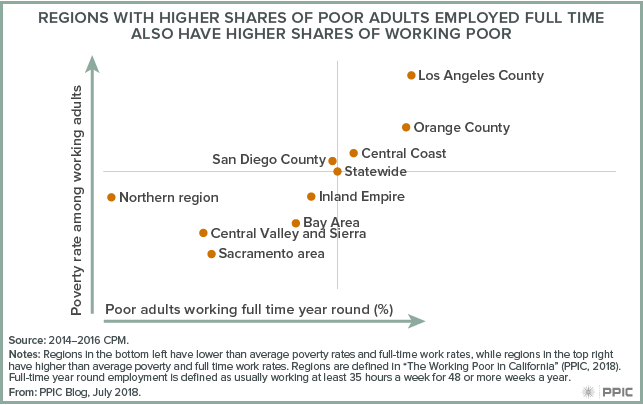
Roughly 2 million out of 16 million working Californians (ages 25‒64) live in poverty, according to California Poverty Measure (CPM) estimates—and nearly half (45%) of these workers are employed full time and year round.

We see a positive association between poverty rates and rates of full-time, year-round employment across regions. In other words, in areas of the state with higher shares of poor adults working full time—including Los Angeles and Orange Counties—the rates of poverty among working adults are also higher.

In those regions, working poverty is clearly not mainly attributable to working insufficient hours. It is driven by wage rates and other factors—measured in the CPM—like the cost of living, necessary expenses, and access to safety net resources (or lack thereof). For many of the working poor, the most promising strategies for improving wages require access to high-quality education and training.

How Wildfires Affect California’s Water Supply

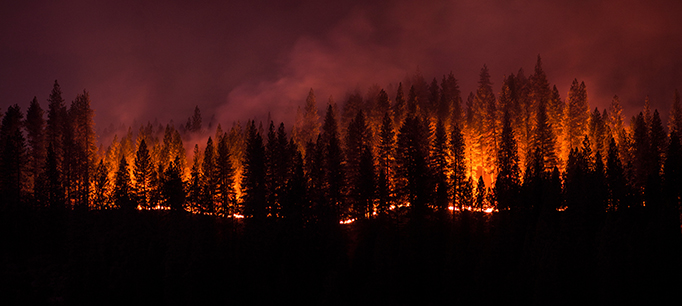
Summer marks the traditional beginning of California’s fire season, although the warming climate has stretched the season considerably. Until the winter rains arrive, wildfires will burn forests and grasslands throughout the state. Since January 1, about 3,700 fires have consumed more than 111,000 acres of land—outpacing 2017, the most destructive and deadly fire season in state history.

While public safety and economic costs deserve and receive a great deal of attention, wildfires also have consequences for the management of water—including the amount and quality of supply, and the potential for flooding.

Fire can bring short-term water supply benefits by increasing runoff for downstream use. Most precipitation that falls on hillsides is captured by plants and soils and sent back into the atmosphere. By removing vegetation and reducing the ability of soils to hold water, most burns lead to an increase in runoff. The amount of increase depends on the type of vegetation that is burned. In Sierra conifer forests, reducing tree cover by about 40% may result in a 9% increase in water yield. Conversely, burning grasslands leads to negligible increases in water supply.

Managing forests with mechanical thinning and prescribed burning simulates the effects of low- and moderate-severity wildfire—creating opportunities to improve forest health while increasing water supply. But before concluding that forest fires and active management can reliably increase water supply, it’s worth noting that increases in water can be short-lived as vegetation rapidly grows back. And in drier forests like those of the southern Sierra Nevada, most downstream users are unlikely to see increased yields.

Wildfire can also bring some serious water management challenges.

Intense fires remove vegetation that prevents excessive erosion. Soils burned at high severity can also lose the ability to absorb water for a few years after a burn. When rain falls on these fire-ravaged slopes, the fast-moving runoff can erode soils and ash, transporting them into rivers. These flows threaten drinking-water quality and fill water supply and hydropower reservoirs with sediment. Following a series of severe wildfires in the American River headwaters, Placer County Water Agency experienced significant damage to its water supply and hydropower infrastructure, including costly impacts from increasing sediment and debris. The agency is now working with multiple partners to reduce wildfire risk above two reservoirs using prescribed burning and mechanical thinning.

The damaged soils and loss of vegetation following a severe burn can also increase the threat of downstream flooding and landslides. In some cases, these slides can become “debris flows”—fast-moving rivers of mud, rock, and other materials that can take out everything in their path. These are one of the most dangerous types of flash floods in California. The most recent and deadly example of this was in Montecito following the December 2017 Thomas Fire (the largest fire by area in state history). In early January 2018, record-high rainfall fell on the fire-scarred slopes above Montecito. The resulting debris flows killed 23 people and damaged or destroyed 400 homes.

Experts are predicting another year of intense wildfire activity. Water managers in affected regions will need to address the impacts of fire on local water supply and flood hazards, and must also account for such impacts in future planning.

Good Budget News for Higher Education

The California State Legislature and Governor Brown recently reached a $200 billion budget deal that includes just over a billion dollars in new funding for the state’s public higher education systems. This funding forestalls proposed tuition increases at UC and CSU and allows each system to support increasing student access and success. Moreover, the governor and legislature’s work to maximize the state’s rainy day fund should help to reduce the likelihood of drastic tuition increases in the future, should an economic downturn threaten higher education funding.

The new funding will allow UC and CSU to enroll an additional 1,500 and 3,641 undergraduates, respectively, next fall.  These enrollment increases—coupled with more dollars allocated to improve time-to-degree, boost graduation rates, and close achievement gaps—will help each system to do their part to provide much-needed growth in the number of college graduates in the state.

The budget deal also includes the governor’s top two higher education priorities: the creation of an online-only community college and the introduction of a new community college funding formula. This year, community college funding per full-time student will exceed $8,000—the highest level in the systems’ hundred-year history. (Mainly this is because community college funding falls under Proposition 98, the K–12 funding guarantee passed by voters in 1988.)

The online community college will be launched with $100 million and receive $20 million per year going forward. The goal? To provide opportunities to earn short-term credentials to California’s “stranded workforce” (workers stuck in low paying jobs or jobs that are likely to be automated soon), to help such workers to better compete in today’s labor market. The online college will offer credential programs that have demonstrated labor market value and are not already offered at brick-and-mortar community colleges.

The establishment of a community college funding formula will be phased in over three years. It will provide funding for low-income and underrepresented minority students, reward colleges for improved student outcomes, and reduce reliance on increased enrollment to secure state funding. This approach represents the ongoing emphasis on improving student outcomes at the community colleges.

This is Jerry Brown’s final budget deal—it will be up to the next governor to work with the legislature to ensure the ongoing health of the public higher education system. California’s future economy depends on it.

Remaking Flood Management to Support Salmon

California’s aquatic ecosystems and the species that depend on them are in trouble. Dramatic changes in water and land use over the past 150 years have transformed the state’s freshwater landscape, and the latest drought brought additional stress. We talked with Lewis Bair, general manager of Reclamation District No. 108, about where we need to go from here.

PPIC: What needs to change to reverse the crisis in the state’s aquatic ecosystems?

Lewis Bair: California’s water infrastructure was designed to manage floods and provide water for crops, and when it was built we didn’t really understand how this system might affect fish and other species. Now we know that the state’s flood management system cuts off rivers from their floodplains, which provide important habitat for aquatic creatures. We’re starving our ecosystem. We’ve removed 90% of the floodplains and lost 80% of the fish.

There used to be 25 salmon canneries on the Sacramento River. Between 1910 and 1930 the canneries lost 80% of their harvest. California hadn’t yet built its big reservoirs when this happened, but we had completely separated rivers from their floodplains, which were the main source of food for the fish. There are plenty of challenges for struggling species in California, but the floodplain issue is one we haven’t addressed and I think it could make a significant difference, especially for salmon.

Going forward, we need a fundamental change in our mindset, from the current focus on regulatory or mitigation approaches for habitat work to an emphasis on recovery. We need to get steady funding for recovery efforts and build the relationships required to be successful. That requires a lot of big changes—and also requires people to get out of their silos. We need better-coordinated science. And we need to review what we’ve learned and build on it.

PPIC: What does the condition of California’s salmon tell us about what is happening in aquatic ecosystems?

LB: Salmon are struggling, and it’s not a surprise. But there are things we can do to help. I’ve been fortunate enough to work on projects to restore parts of the floodplain to help salmon in the Sacramento Valley. There’s no question that floodplain restoration is the most important thing we can do for salmon right now. Our current flood management system tries to drain land quickly, but salmon and other creatures need the water to say in place awhile. The natural floodplain used to spread flood waters over a few weeks. Now the water comes and goes in just a few days. We’re working on a project that spreads water out and allows “fish food” to grow. You need 3‒4 weeks for that process to be really productive.

These floodplain efforts take place during winter, an off season for farming, which makes it a complementary practice to farming. The fish are essentially a third crop for these lands—rice is grown in summer, and the flooded rice fields support waterfowl in fall and winter.

PPIC: What’s needed to take recovery to the next level?

LB: We’re working with some environmental NGOs now to draft ideas on how to modernize the state’s water infrastructure to improve water for ecosystems. I truly believe that we have broad agreement on at least 90% of what is needed for our environment. Instead of arguing about the 10% where we don’t agree, we need to get the 90% done. The state may need something like a resources department with the authority and vision to oversee multiple agencies. The governor’s EcoRestore program for the Delta is one model for providing that leadership. Success will depend on having the locals and NGOs in key roles on the ground.

I’m very excited about the direction things are going right now. We have great NGO partners wanting to get past the perception that water users are the bad guys―now it’s all about how to move forward as partners.

Watch a panel discussion on partnerships for healthy ecosystems (with Lewis Bair)

Video: 2020 Census: What’s at Stake for California?

The decennial census plays an essential role in American democracy. The stakes are huge for California—the state stands to lose political representation and federal funding if there is a significant undercount—and 2020 is fast approaching. At a time when straightforward facts are in short supply, PPIC is providing essential, objective information about the importance of an accurate census count in California.

In this video, PPIC research director Sarah Bohn explains why the census is of particular importance to the Golden State this time around.

Primary Takeaways: Democracy Is Alive and Well in California

With the release of the official Statement of the Vote, the final tally is in for the 2018 California primary. The election outcomes are encouraging news for California’s democracy—especially in light of criticisms of the top-two primary system by the national media. Several important statewide trends stand out:

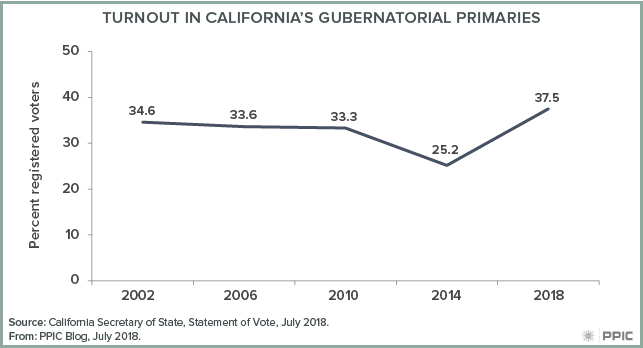
  • Strong political participation. A record-setting 19 million Californians—75.7% of eligible adults—were registered to vote in the gubernatorial primary. This threshold has not been reached since the middle of the 20th century. Moreover, the 7.14 million voters who cast ballots is an all-time high for a gubernatorial primary and, at 37.5% of registered voters and 28.4% of eligible adults, the turnout rates are the highest reported in the five gubernatorial primaries since 2000. Since his election four years ago, California Secretary of State Alex Padilla has been on a mission to make it easier for Californians to register to vote and cast ballots, and the efforts seem to be working. The May PPIC survey found that likely voters’ attention to election news was relatively high, so credit also goes to the media for stoking interest in political participation.

  • More independent voters. Many Californians are responding to the hyper-partisanship of national politics by eschewing the major parties and registering as independents (also known as NPP for “No Party Preference”). In June’s election, for the first time in the state’s history, NPP voters outnumbered Republican voters (25.5% to 25.1%). In the past four years, the number of NPP voters increased (+1,103,602) more than the number of Democratic voters (+745,598), while Republican ranks shrunk (-267,311). The makeup of the June ballot reflected the political clout of NPP voters. Four of the statewide races included NPP candidates, giving voters some nonpartisan choices they did not have under the previous primary system. And in a first for the general election, the top two candidates for insurance commissioner are a Democrat and an NPP candidate (formerly a member of the Republican Party).
  • Diverse statewide candidates. After much consternation about the likelihood of a single-party race at the top of the ticket, five of the eight partisan races—including the governor’s—feature a Democrat running against a Republican. Except for the governor’s race, the top-two primary results offer a diverse pool of candidates to choose from in the fall, at least among Democratic options. The US Senate election and the seven down-ticket races include five Latinos, four women, two Asian Americans, and one African American. Also, eight of the nine statewide races—including the governor’s—are contests between Northern and Southern Californians. While many Republicans are likely to skip voting in a US Senate race with two Democratic candidates, as they did in November 2016, a Democratic-only race for the open lieutenant governor seat will be closely watched for signs of cross-party voting.
  • Popular state ballot measures. Four of the five state propositions placed on the June primary ballot by the legislature passed. This is consistent with the historically high pass rate for legislative ballot measures. With the legislature’s approval holding steady and at a relatively high level in the May PPIC survey, the four state propositions each passed by healthy margins—including a 58% “yes” vote for the state water and parks bond. The latter results bode well for the state housing bonds passed by the legislature and placed on the November ballot. (Citizens’ initiatives appear only on the November general ballot.)

The main takeaway from the June primary is that the vital signs of California’s democracy are healthy. In the wake of California’s many election reforms, records may be shattered in the numbers of registered voters and ballots cast this fall—and throughout the 2020s. The top-two primary system may have its quirks, but it is well suited for the burgeoning number of NPP voters. NPP candidates have found a home in the top-two primary, an NPP will be on the fall ballot, and there will likely be NPP statewide officeholders in the future. The fears about major party voters feeling left out of the fall election were overblown, and most top two candidates reflect the state’s diversity. Positive responses to the June ballot measures suggest an easy time for the state propositions from the legislature this fall; the fate of the nine citizens’ initiatives—including a repeal of the recent gas tax increase—is currently less clear.

At PPIC, the race for governor, US senator, and superintendent of public instruction stand out as uniquely worthy of public attention. We have invited the two candidates in each race to participate in conversations with me about the future of California. Stay tuned for more information about these public events. Meanwhile, throughout the fall the PPIC Statewide Survey will focus on the governor’s race, the US Senate election, and the congressional races—as well as the gas tax repeal and other state propositions that impact our future. We look forward to informing discussions and raising awareness about the importance of this consequential election for the state and nation.

What Does the Repeal of Net Neutrality Mean for California Schools?

As the Federal Communications Commission’s (FCC) repeal of net neutrality phases in, concerns that Internet service providers (ISPs) could speed up or slow down traffic from certain websites or prioritize certain content loom large. Changes to Internet service, if any, will probably be slow and gradual; however, the repeal has potentially important implications for the digital divide in and outside of California’s schools.

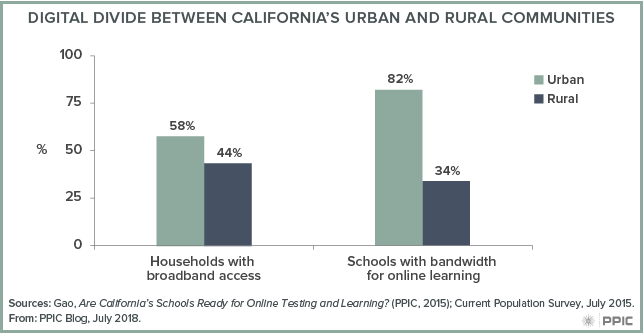
K‒12 schools rely increasingly on online content and management systems to deliver instruction (e.g., blended learning), administer standardized tests (e.g., Smarter Balanced assessments), and manage educational data (e.g., cloud computing). As online learning becomes ubiquitous, access to high-speed Internet is no longer optional—it’s a necessity. Most schools receive discounted Internet services through the federal E-rate program, but if providers decide to introduce tiered pricing based on content, students and educators could lose access to quality education programs. Tiered pricing could also exacerbate the digital divide between urban and rural districts. PPIC research shows that close to 70% of rural districts lack sufficient bandwidth for digital learning, compared to 18% of urban districts. If this gap persists or widens, students in rural areas may be left behind in the digital race.

Another concern is the homework gap. The FCC reports that 70% of teachers assign homework that requires access to broadband, while an estimated 860,000 (22%) households with school-age children in California do not have home Internet service. For many of these households, the cost is too high. Low-income families may get government subsidies (e.g., the Lifeline program) or discounts from ISPs. However, if providers create a fast lane for customers who pay premiums and a slow lane for those who don’t, the homework gap may widen. Rural residents may be particularly affected by these changes, because they tend to have more limited Internet access and fewer ISPs.

Federal and state policymakers have placed net neutrality near the top of their agendas. A major legislative effort to restore net neutrality fell short in the US House of Representatives. In California, two Senate bills (SB 822 and SB 460) that would establish a stringent net neutrality regime are being considered in the state legislature. Other states, including Montana, New York, and Oregon, are taking similar legislative or executive action