How the Pandemic Has Disrupted Food Chains

The COVID-19 health emergency has changed what we eat and where we eat it. We talked with Dave Puglia, president and CEO of Western Growers (which represents family farms growing fresh produce) and a member of the PPIC Water Policy Center advisory council, about how these changes are affecting California’s agricultural sector.
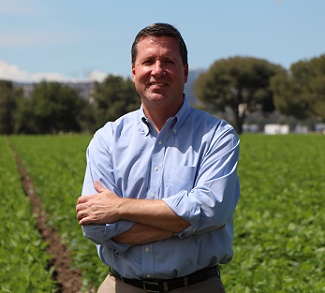
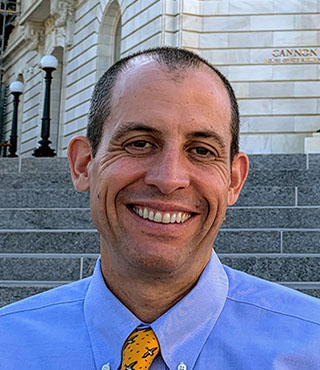
photo - Dave Puglia

PPIC: How has the pandemic affected food supply chains?

DAVE PUGLIA: The pandemic shut down the food service sector—restaurants, schools and universities, hotels—so suddenly and completely that it just blew up supply chains. This caused many farmers to divert their produce from food service outlets to retail markets. That added more confusion to the food chain, as certain commodity prices dropped like a stone due to oversupply, while some other crops did quite well, fueled by people buying more produce that is less perishable. Foods like carrots, onions, and potatoes have been flying off the shelves.

Those first few weeks were incredibly damaging to American agriculture, and particularly the fresh produce industry. California’s desert region was in full swing for harvesting when the shutdowns began. I watched one of my members plow 350 acres of romaine lettuce into the ground. A lot of fresh produce made it to food banks—our members doubled the amount they usually ship to them—but we saw some food banks wave off perishable fresh produce, which requires adequate cold storage space and must be distributed quickly. For growers, transportation was an added cost.

We’re not out of the woods yet. The food service sector is still largely shut down. California’s coastal farms are now starting to harvest. They had to project a month ago how much crop to plant without knowing if restaurants will be open, half open, or still closed. And for those with permanent crops—table grapes, nuts, and stone fruits—their crops are coming. They’ll have to make these same tough decisions about whether it pencils out to pay for the labor, shipping, and cooling costs to harvest their crop. To put it in perspective, harvesting—which includes labor and energy—comprises about half the costs to produce, say, an acre of lettuce.

Farming has always been a risky business, but this has created an impossible guessing game for growers in fresh produce.

PPIC: What can be done to help get more farm products to emergency food programs?

DP: The top priority is to inject capital into the food system now. Ideally, the federal government would increase food purchases so we can deliver more produce to food banks and organizations that serve people in need. The CARES Act began to fund this, but the amount was small—$600 million over six months, across the whole country. That won’t buy a lot of food. The quickest way to help is to dramatically increase funding to this program.

At the state level, increasing the tax credit for food going to food banks could help. Currently, California has a 15% tax credit on the value of produce that the state’s farmers deliver to food banks. Clearly, the state needs every tax dollar it can get, but if we’re trying to keep farmers going so they can continue to grow our food and support the economy, that would be a good way to help.

PPIC: What further steps would mitigate the damage?

DP: The immediate need is for the federal government to expand its agricultural relief package in the CARES Act. The caps on the relief package were not practical for fresh produce, dairy, and cattle. Growers got $125,000 per farmer, which was appreciated—but it’s a very small amount given the losses for the higher value crops, which cost more to produce. For example, a farmer growing romaine lettuce spends about $10,000 per acre. The average-sized lettuce farm is 225 acres; the relief package covered losses for about 12.5 acres of that. Strawberries cost roughly $50,000 per acre to produce; the relief package covered just 2.5 acres of lost production on the average 55-acre farm.

The state has been helpful in crafting practical guidance for continued operation of our farms, which helped the industry implement distancing very quickly. We have a big challenge there, as these folks work and live in close quarters. It was also very helpful that the governor acted quickly on our request to help farmworkers with emergency childcare. These are mostly families where both parents work and don’t have the option of a parent staying home with the kids.

Going forward, I hope that coming out of this crisis we don’t see a raft of new regulatory costs. The cost of doing business in California is already quite high. If the cost of farming here compared to Mexico or Arizona gets much higher, it will incentivize more farmers to relocate.

PPIC: What changes to California agriculture do you envision coming out of this crisis?

DP: Farmers are amazingly adaptive people, and I’m encouraged by the many California farms that are finding new, more efficient ways of operating and producing food because of this crisis.

Will there be fewer restaurants in two years’ time, or will Americans have returned to their previous habits of eating out? No one knows. But growers will adapt to changing demand, and they’ll respond very quickly.

Many Low-Income Families Left Out of Federal Stimulus Benefits

As part of the federal response to COVID-19, the IRS has started issuing stimulus checks—to boost consumer confidence—directly to millions of families. For the record number of Californians who have lost jobs, hours, and certainty around their incomes, these payments could come just in time.

We estimate that about 81% of Californians live in a family that will receive an “economic impact payment,” with the typical family receiving around $2,200. In total, Californians could receive about $26 billion through the program.

However, nearly 20% of families are unlikely to receive a stimulus check. Because the payments phase out as incomes rise, most of these families are above the income cutoff ($99,000 for single tax filers and $198,000 for joint filers without children). But nearly a third are among the state’s lowest income families. In part, this reflects the fact that only people who have filed taxes recently, or who receive either supplemental security income (SSI) or social security, will receive a check.

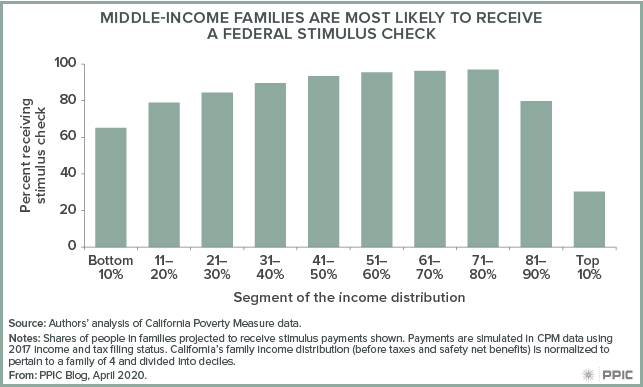
People with very low incomes are not required to file taxes, and they will not receive stimulus checks unless they actively share their banking details with the IRS. Partly for this reason, our estimates indicate that just 65% of people in families with the lowest 10% of incomes—less than about $22,000 a year for a family of four—are likely to receive a check.

By comparison, 90% to 97% of those in middle-income families—with annual incomes of $52,000 to $176,000—are likely to receive a check.

figure - Middle-Income Families Are Most Likely To Receive a Federal Stimulus Check

Yet even if all Californians who do not file taxes submit their information to the IRS, people in low-income families will still receive checks at lower rates than middle-income families. Because many low-income families include undocumented residents, the entire family is ineligible for these federal payments. If families with undocumented members were eligible, all families from the 11th to 80th percentiles of the income distribution could potentially receive a check.

To help Californians during this crisis, the state’s safety net will need to reach those most affected economically. The temporary expansion of unemployment insurance will provide much more aid to certain low-income families than the federal stimulus payments. And California’s recently announced Disaster Relief Fund, which will use public and private funds to provide up to $1,000 per household to families of some undocumented immigrants, will help to fill in certain gaps. But while replacing wages is important, a response focused only on wages would skip many people in need.

Food assistance programs like CalFresh and school meals are also critical safety net supports because of their wide reach, and expansions are also underway. Along with the federal stimulus payments, these are important steps, but—depending on the length and the depth of the crisis—more remains to be done.

Food Security in a Time of COVID-19 Insecurity: How the Virus Affects Farming

How will the COVID-19 pandemic affect California’s agricultural sector—which is important for food supplies locally, nationally, and in many other countries? We talked to Cannon Michael—a sixth-generation farmer and member of the PPIC Water Policy Center Advisory Council—about the pandemic’s potential to disrupt farming.

photo - Cannon Michael

PPIC: What risks does the virus bring to California’s farm sector?

CANNON MICHAEL: For most farmers, the immediate focus is on our workers—not only keeping them safe from the virus, but also being mindful of the pressures they’re facing at home right now. Most of our workers can’t work from home. Many have kids out of school or partners who’ve lost their jobs.

The big concern going forward is the virus going through our workforce. The disruptions of food supply we’re seeing in stores right now is caused by changes in buying habits and difficulty keeping shelves stocked. But if there’s disruption on farms—if crops don’t get harvested in time or the logistics for getting food to market go down, that would be much scarier. We’re already facing labor uncertainty due to changes to a visa program that allows workers from Mexico and Central America to come here for seasonal farm work. Many of California’s larger farms rely heavily on this temporary labor force. In the early days of the crisis, the H-2A visa program was restricted so that only workers already in the program last year were allowed to come back this year. Rule changes and congestion have made getting across the border harder, too. We’re seeing a slowdown of workers at a time when we may need more. That’s a real concern for the food supply.

There’s a finite pool of people living here to do the hand work required on the state’s farms. There’s a risk that the large companies will do whatever it takes to get those folks if they can’t get seasonal laborers. It could be a threat to smaller farms if larger entities start to pull workers away using incentives that smaller farms can’t match.

The disruption of markets—such as the closure of restaurants and food service operations—is a huge concern for growers. Impacts will vary by region, commodity, and individual company exposure. Western Growers reports that some farmers are heavily embedded in the food service supply chain with crops in the ground now. They have nowhere to put that food, because other growers with retail channels for those commodities are operating at maximum capacity and can’t take any more product into their systems. Other farmers say they may need to scale back acreage. Some crops could be affected by changing international markets or the general financial downturn. There’s the potential for huge swings in marketability and profitability for many farmers.

We’re also not sure if there will be any new requirements for food safety in coming months. There are already good protocols in place for food safety that anyone involved in fresh produce has to comply with, and farmers are accustomed to these high standards. The good news is that food safety experts say there is a low risk of getting the virus from food products or packaging. The advice from the experts is that normal food safety practices will suffice.

PPIC: What steps are being taken to protect farm workers from infection?

CM: We are rapidly approaching the time when most farms will be extremely busy, which means a lot of people on the farm. New state guidance on protecting farmworkers from COVID-19 is being developed. But most farmworkers live in very close conditions and so even with safe practices on the farm, it’s going to be harder to control the risk in their homes and communities under current conditions. If the virus gets into the farmworker population I think we’d see a very fast rise in infection, which would have a dramatic impact on the farm sector and food supply.

On our farm we’re providing regularly updated health information in all the places that people congregate. The California Farm Bureau and industry groups have reacted quickly to make information available in English and Spanish. We’re making sanitation equipment widely available, and presenting guidelines on hand washing and social distancing.

PPIC: What policy changes could help address these risks?

CM: Fixing federal immigration policy is critical. The key point is we need to get food off the farms, and to do that we have to have enough laborers. One hopeful sign is that the federal government recently announced it will relax the new restrictions on the H-2A program. That should help people get here to work.

It’s also critical that rural communities aren’t forgotten in this public health crisis. We need a plan to address the special public health challenges in farm communities.

I don’t want to pound people over the head with this, but the crisis really drives home the importance of agriculture and the value of a stable food supply.

And I’d just like to encourage everyone to reduce the panic buying, which has created big challenges in the supply chain as well as making it harder for more vulnerable people who can’t shop that way. We will produce the food and get it to the markets but we will all be safer if people just buy what they need.


Medi-Cal Expansion for Undocumented Seniors

Under the proposed expansion of Medi-Cal to undocumented seniors, vulnerable Californians would gain comprehensive health insurance. The policy improves access to care for individual seniors and could alleviate the financial burden on counties that serve undocumented immigrants in indigent care programs, increasing resources for other low-income groups.

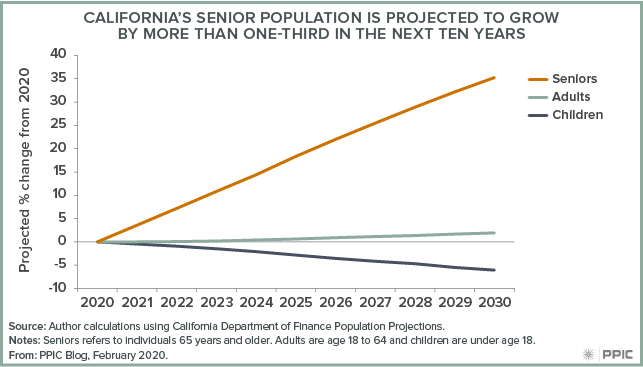
The senior population in California is projected to increase by over 2 million in the next decade, dramatically outpacing growth of younger groups in a demographic shift known as the Silver Tsunami. This increase, in particular among those in older age groups (75 to 84), will test California’s health care delivery and financing systems, because seniors are more likely to be disabled and to have complex or multiple health conditions than younger groups.

Figure - California’s Senior Population Is Projected to Grow by More than One-Third in the Next Ten Years

While most California seniors have health insurance—with Medicare being the most common—not all seniors have coverage. Many uninsured seniors are likely to be undocumented, making them ineligible for Medicare or to purchase coverage through Covered California, the state’s health insurance marketplace. These same seniors may have limited finances and therefore also are likely to struggle to access and afford health care.

Currently, most uninsured, undocumented seniors rely on safety net providers and a limited form of Medi-Cal that covers only emergencies, along with indigent care programs in certain counties that choose to cover undocumented immigrants. Under the expansion, these seniors would gain access to full-scope Medi-Cal, connecting them to preventive care and to programs to improve their disease management. Some expansion funds would also apply to the In-Home Supportive Services (IHSS) program, which pays for a caregiver—often a relative—to provide support for a senior to continue living at home rather than entering a costly long-term care facility.

The budget estimates state costs of $320 million for the expansion, which would benefit 27,000 individuals. If enacted, the policy could have implications for local finances. Counties in California provide health care and mental health services to the medically indigent, with some areas—most notably Los Angeles—serving undocumented immigrants. These county programs, together with community clinics and emergency rooms, are essential access points to health care for undocumented, uninsured seniors. If undocumented seniors become eligible for full-scope Medi-Cal, the state would finance their care instead of the county, where applicable. This shift could free up funding that could then be invested in other health-related county responsibilities, such as disaster preparedness, prevention activities, and substance use disorder treatment.

A complicated fiscal relationship between the state and counties, however, makes it difficult to estimate how much funding could be redirected if this group of seniors gain access to Medi-Cal. As state lawmakers consider the policy change, it will be important to consider how it may affect local and state finances.

Video: Counting the Central Valley

The 2020 Census is fast approaching, and the stakes are high for California—political representation and federal funding are on the line. The San Joaquin Valley, with a population of 4.3 million, may be one of the state’s hardest-to-count regions. In Sacramento last Friday, PPIC convened a discussion about how valley communities are preparing for the census.

California has long been home to high numbers of “hard to count” residents—including young children, renters, and immigrants. In 2020, the difficulty of counting all Californians will be greater than ever. PPIC researcher Joe Hayes outlined the challenges, which range from uneven internet access to a lack of trust: “Individuals are less likely to respond out of privacy concerns, on the one hand, but also out of distrust for the federal government.”

The good news is that state and local governments have invested heavily in outreach. Complete Count Committees have been established counties across the state, and community-based organizations are spearheading outreach efforts. To help guide these efforts, PPIC created interactive maps that show hard-to-count communities across the state. Maria Jeans, program coordinator for the Maddy Institute, moderated a panel discussion about the factors that make counting the Central Valley so challenging—and how challenges are being addressed.

Jesus Martinez, executive director of Central Valley Immigrant Integration Collaborative, highlighted the challenge of organizational capacity. As local preparations for the census got under way in 2018, he realized that “only a handful” of those who wanted to get involved “had any type of personal or institutional experience with the census.”

Don Saylor, a Yolo County supervisor, cited the difficulty of reaching remote rural settings across the Central Valley and the large numbers of farmworkers, language minorities, young children, and residences with multiple households. He included students enrolled at UC Davis and other colleges in the Central Valley—especially those “who are renters, living in different kinds of group settings”—as a hard-to-count population.

The panelists agreed that the fear generated by federal immigration rhetoric and policies are particularly challenging for the Central Valley. As a result, census outreach must focus on more than just making sure California gets its fair share of federal funding. As Martinez put it, “This is a human rights and civil rights issue for us now. It is the right of immigrants to be included in the 2020 Census.” Much of the outreach involves person-to-person conversations—canvassing and phone banking, “house meetings” among neighbors, and interactive media.

Cindy Quezada, senior program officer at Sierra Health Foundation, noted that encouraging people to participate is not the only challenge. “Sometimes people might want to participate but they don’t have a way to,” she said. “Either you’re living in a trailer in a backyard so you’re not going to get the invite and you’re not going to get an enumerator visit, or you may not speak a language that’s supported.” These structural barriers “are something we should really be paying attention to.”

Proposition 187 and a Changing California

Twenty-five years ago, in the midst of the worst economic crisis since the Great Depression, 59% of Californians voted to pass Proposition 187. The landmark ballot measure sought to set up a state-run immigration system and deny most public benefits—including K–12 education—to undocumented immigrants. The measure was later found to be unconstitutional, but its impact was pivotal in transforming California into what it is today.

Most Californians now support policies to protect undocumented immigrants. A recent PPIC survey found 61% of Californians and 54% of likely voters are in favor of state and local governments making their own policies and taking actions, separate from the federal government, to protect the legal rights of undocumented immigrants. In addition, our April survey found 57% of Californians (54% likely voters) support public school districts designating themselves “sanctuary safe zones” to indicate they will protect undocumented students and their families from federal immigration enforcement efforts.

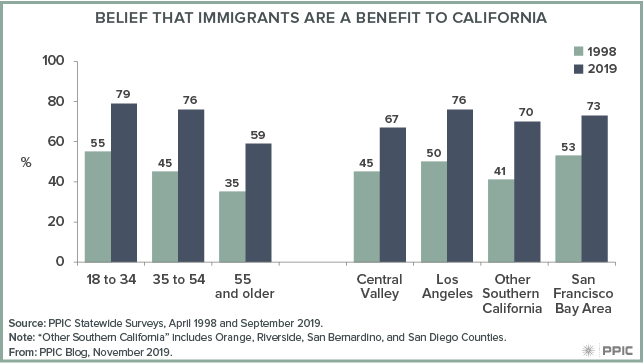
Californians’ overall views toward immigrants have also shifted. The PPIC Statewide Survey has monitored this issue since 1998. In April 1998, Californians were divided: 46% viewed immigrants as a benefit to California because of their hard work and job skills, while 42% viewed immigrants as a burden because they use public services. Since then, the share of Californians viewing immigrants positively has increased 25 points (71% benefit, 22% burden).

Across age groups and regions, the perception that immigrants are a benefit has risen by more than 20 points. Positive perceptions are also up across racial/ethnic groups, by 27 points among African Americans, 20 points among Latinos, 18 points among whites, and 12 points among Asian Americans. The share of Democrats viewing immigrants positively has increased 37 points, while the share of Republicans holding this view has decreased 2 points.

figure - Belief that Immigrants Are a Benefit to California

In recent years, Californians have supported policies to improve the lives of immigrants, such as providing health care for young undocumented Californians, taking state and local actions to protect immigrants, and supporting a pathway to citizenship. What role will immigration play in the upcoming election? Stay tuned to the PPIC Statewide Survey as we continue to examine Californians’ view of immigrants.

Motivating Californians to Fill Out the 2020 Census

The 2020 Census will determine the distribution of billions of dollars in federal funds and the accuracy of political representation at the local, state, and federal levels. Emphasizing the benefits to local communities is likely the best way to encourage participation and counteract the concerns many Californians have about confidentiality.

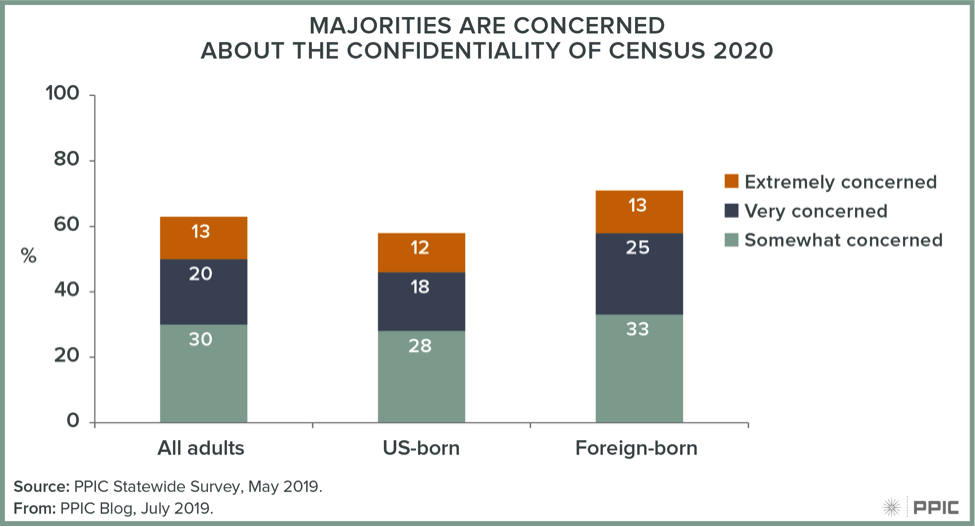
The latest PPIC Statewide Survey shows that 63% of Californians are concerned about whether the Census Bureau will keep their responses confidential, as the law requires. The concern is more acute among Latinos (74%) and African Americans (74%) than among Asian Americans (64%) or whites (52%). Immigrants are also much more likely to be concerned than US-born residents.

Figure: Majorities Are Concerned About the Confidentiality of Census 2020
The Census Bureau conducted an extensive survey and a set of focus groups to identify key reasons for people’s possible reluctance to participate in the census, as well as potential motivating factors that could improve participation. The focus groups revealed that merely informing people of the Census Bureau’s data protection policies was unlikely to assuage concerns.

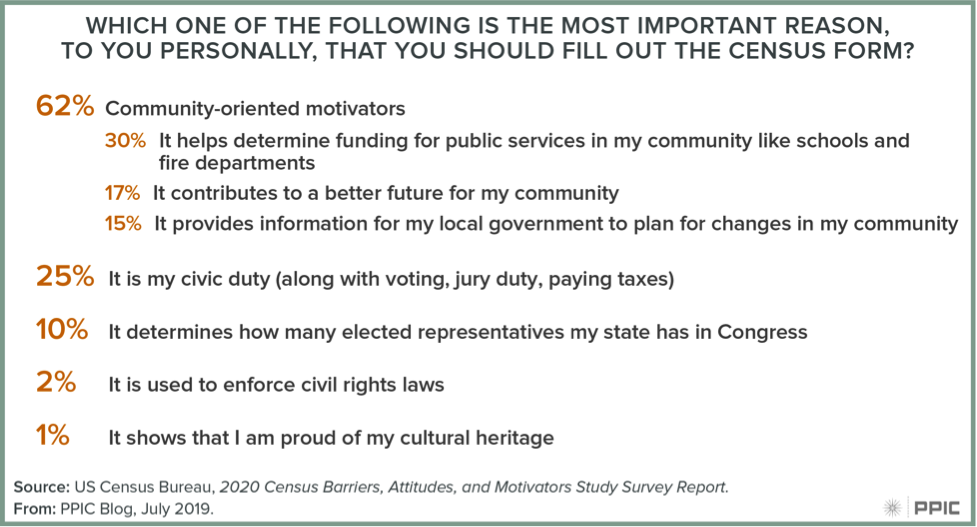
Focus group participants across all demographic groups identified the census’s role in providing federal funding for communities as the main motivator for responding to the census. And 62% of survey respondents said that benefits to the community—determining funding (30%), contributing to a better future for the community (17%), and providing information for local planning (15%)—are the most important reason to fill out the census.

Figure: Most Important Reason to Fill Out the Census Form

But fewer than half of survey respondents knew that the census is used to determine local funding levels, suggesting that this information could go a long way toward motivating participation. Focus group participants—who were chosen from demographic groups deemed likely to respond at low rates—also indicated that hearing directly from trusted voices in their own communities would be important.

Community organizations and elected officials are already acting on this information. On April 1, Los Angeles city and county officials convened a rally to promote the census, emphasizing the link to federal tax dollars for local programs. The Hispanic Federation’s messaging also highlights the census’s role in allocating federal funds.

More efforts are underway. Governor Newsom has pledged an investment of $187 million for outreach activities to boost participation. Meanwhile, the California Complete Count Office has begun issuing grants to help local organizations communicate directly with hard-to-count populations.

Focusing on local funding and community benefits is a promising approach, but a strong outreach strategy will have to go further. A complete and accurate count will likely depend on hard-to-count populations working to develop and deliver the most effective messages for their own communities.

Interview: Citizenship and the 2020 Census

This post is part of a series examining challenges involved in the 2020 Census and what’s at stake for California. 

photo - Eric McGheeAfter a heated legal battle, the Supreme Court has ruled that the Trump administration cannot for now include a question on the 2020 Census asking if residents are US citizens. We spoke with PPIC senior fellow Eric McGhee about what this decision means for California.

PPIC: Why is the citizenship question controversial?

Eric McGhee: First, the question could significantly discourage responses among immigrants, who might fear the data would be used to target them. It didn’t go through the normal testing process for new questions, and many Census Bureau employees recommended against adding it because of concerns about data quality.

Second, the Trump administration says the question is necessary to properly enforce the Voting Rights Act. But advocates for immigrant communities dispute this justification and argue that current citizenship data is sufficient to protect against voting discrimination.

Third, it could have a huge impact on political representation and how congressional and state legislative districts are drawn. Districts are currently drawn based on total population. But this question could make it possible for states to use citizens or voting-eligible residents instead, which would tilt representation in favor of those groups.

PPIC: What does all this mean for California?

EM: Response rates will likely be better if the question is not added. But there’s also concern that the damage has already been done—immigrants still might not be inclined to respond. Immigrants make up about a quarter of California’s population, so we’re particularly vulnerable.

A large undercount could result in less federal funding for California. We’re also the only state at risk of losing a congressional seat from an undercount—other states with high immigrant populations like Arizona and Texas might not gain as many seats, but they probably won’t lose a seat they already have, even if there’s a bad count.

Households with undocumented members are the most likely to be undercounted. PPIC research looked at the possibility of a 10% undercount of these households, a reasonable assumption based on existing research. It would mean missing about half a million Californians.

The reality is that census data is thoroughly protected, even from law enforcement agencies like the FBI and ICE. But our May PPIC survey—conducted before the Supreme Court decision—found 63% of Californians were concerned the Census Bureau will not keep responses confidential. Latinos (74%), immigrants (71%), and African Americans (70%) were especially likely to be concerned.

There are other uncertainties too. The 2020 Census will use a new internet-based approach, which hasn’t been comprehensively tested. And people in general are becoming more reluctant to respond to the census. This means the bureau has to do more follow-up, which is expensive and increases the likelihood of problems arising.

PPIC: What can California do to ensure a complete and accurate count?

EM: California is way ahead of other states in terms of funds it has dedicated to census outreach. The state has already appropriated about $100 million to support a better count, and Governor Newsom has proposed another $50 million or so. Philanthropic organizations have chipped in about $30 million. There’s been a great deal of planning at the state and local levels to get the best count possible.

Addressing concerns about confidentiality could go a long way toward encouraging people to respond. Research also suggests that raising awareness about the census’s role in funding public services like health care, roads, highways, and fire and police departments is another promising approach.

Video: Mobilizing the Inland Empire for the Census—and for the Future

As California’s diverse regions prepare for the 2020 Census, community-based organizations and local leaders are playing key roles. An event last week in Riverside offered insights on the Inland Empire’s outreach strategies for the Census and beyond. Cosponsored by PPIC and the Center for Social Innovation at the University of California, Riverside, the event featured a panel of state and local experts.

The discussion was moderated by Michelle Decker, president and CEO of the Community Foundation. She began by asking Eric McGhee, PPIC senior fellow, to explain the importance of an accurate census count in California. The census helps determine the distribution of federal funding to the states; gathers information about the population that is valuable to policymakers and businesses alike; and is the basis for reapportionment and redistricting. As McGhee pointed out, an undercount of California’s population could be costly in all of these areas.

McGhee noted that California has large shares of “the kinds of groups that tend to be undercounted—Asian Americans, African Americans, Latinos, renters, very young children, noncitizens.” Finally, he outlined concerns about inadequate funding, which has prevented a thorough testing of the process, and the climate of fear in immigrant communities, which could result in lower response rates even if the Supreme Court rules against the inclusion of a question on citizenship later this month.

But there is some good news: “It wouldn’t take that much for California to overcome some of these challenges,” McGhee said. California is arguably more mobilized than any other state, and the Inland Empire is one of the state’s most mobilized regions.

Deborah Phares, Census 2020 project manager at the Community Foundation, sees the census as a great opportunity for policymakers and organizations across Riverside and San Bernardino Counties. The region’s collaborative efforts were galvanized by a state request for information about innovative census outreach strategies. “We decided that we were going to pursue and support and advocate for allocation of resources based on need,” said Phares, adding that the regional plan is designed to avoid overlapping efforts and to integrate data so that organizations could work together “in a very deep way.”

Karthick Ramakrishnan, founding director of the Center for Social Innovation, underscored the significance of a two-county approach to census outreach that draws from a wide range of communities-—geographic sub-regions and demographic groups. “I think the kind of work that’s happening in the Inland Empire is the envy of the rest of the country. . . .We’re building some pretty amazing tools that will stand the test of time.”

Kathleen Kelly Janus, the newly appointed senior advisor on social innovation in the Governor’s Office, agreed: “I think there’s a huge opportunity to invest in capacity building through all these census dollars that are coming in.” She added that the cross-sector approach involving foundations, community-based organizations, policymakers, and other groups “is a model that we can use not just for the census but for all of these other issues that Governor Newsom wants to address.”


Skills-based Immigration and California’s Workforce

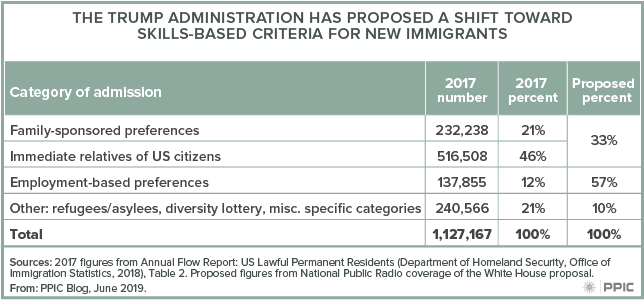
[vc_row][vc_column][vc_column_text]The White House recently issued a summary of an immigration plan that would shift the nation’s largely family-based immigration system toward a skills-based approach that would probably prioritize immigrants with higher levels of formal education. Given that the education levels of new immigrants are already on the rise, what impact might a skills-based system have on in California, the state with the largest immigrant population?

The proposed new system would increase the percentage of skills-based legal immigrants from 12% to 57%, leaving the total number of immigrants at 1.1 million per year.

table - The Trump Administration Has Proposed a Shift Toward Skills-based Criteria for New Immigrants

In recent years, about two-thirds of immigrants with lawful permanent residence status (or “Green Cards”) have been admitted to the US through family-based preferences. The proposed new system would reduce this by half, to 33%. The White House statement emphasizes that priority would still be given to immediate family members of both US citizens and lawful permanent residents.

Past PPIC research suggests that family-preference immigrants have historically been high- and low-skilled. And California’s economy relies on immigrants at both ends of the educational spectrum. Nearly a third of the state’s working-age immigrants lack a high school diploma, and they make up a large portion of the workforce in industries requiring less formal education. However, the foreign-born now constitute 31% of California workers who have at least a BA, and they are overrepresented in high-skill industries like technology and health care.

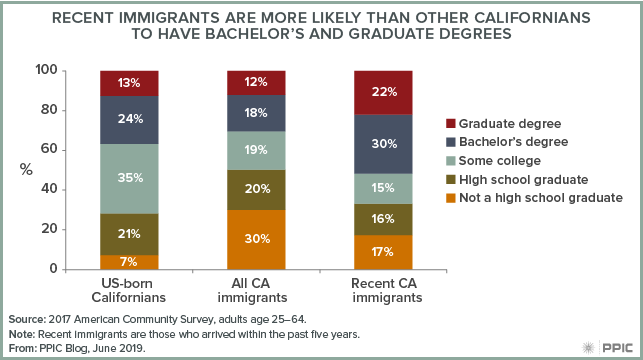
Recent PPIC research finds that new immigrants in California are increasingly well-educated. In 2017, a slight majority (52%) of the state’s working-age immigrants with fewer than five years in the US had a bachelor’s or graduate degree, compared to only 22% in 1990. Only 17% had not graduated from high school, down from 47% in 1990. Indeed, recently arrived immigrants are more likely than US-born Californians to have college or graduate degrees.

figure - Recent Immigrants Are More Likely than Other Californians to Have Bachelor’s and Graduate Degrees

It is impossible to know exactly how a skills-based immigration system would affect California. But given the trend toward higher education levels among new immigrants and state economy’s reliance on both high- and low-skilled workers, a shift toward such a system might not be necessary to meet California’s workforce needs.[/vc_column_text][/vc_column][/vc_row][vc_row][vc_column][/vc_column][/vc_row]