Health Care Access for California’s Immigrants

Governor Newsom is proposing to expand access to Medi-Cal—the state’s Medicaid program—for low-income young adults up to age 26, regardless of their immigration status. This could help a vulnerable segment of the immigrant population. Californians are signaling broad support.

Overall, immigrants make up about 27% of the state’s population and are less likely to have health insurance than US-born Californians. Immigrants are also less likely to have private insurance, partly due to differences in employment industries and income.

Figure - Health Care Coverage Rates are Lower For California Immigrants in All Age Groups

Documented immigrants—including those with green cards and visas—may qualify for Medi-Cal without being subject to the five-year waiting period required by federal law. They can also purchase private health plans through Covered California, the health insurance exchange that was created as part of the Affordable Care Act (ACA). However, most recently-arrived elderly immigrants are not eligible for Medicare because they have not paid Medicare taxes over a long enough period.

California offers a patchwork of health care options for undocumented immigrants, who are not covered by the ACA. For instance, low-income children and pregnant residents are eligible for Medi-Cal regardless of immigration status, and some counties include undocumented immigrants in programs for those who cannot afford medical care. Additional options for undocumented immigrants include community clinics, rural health clinics, emergency rooms, or a limited version of Medi-Cal for medical emergencies.

Californians support health care access for undocumented immigrants. In a 2015 PPIC Statewide Survey, a slim majority of Californians (54%) supported the idea of providing health care coverage to undocumented immigrants. In March 2019, about two-thirds (64%) expressed support for the governor’s proposed expansion of Medi-Cal coverage to low-income young adults, including those who are undocumented.
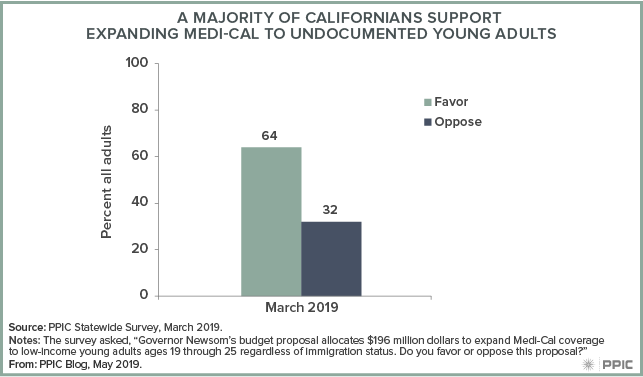
Figure - A Majority of Californians Support Expanding Medi-Cal to Undocumented Young Adults

The governor’s May budget revision delays implementation of the expansion, but it would still have an impact: by providing coverage to approximately 90,000 undocumented young adults in the first year, it could help make the health care landscape less complicated for an important share of California’s immigrant population.

Immigrants Are Key to California’s Health Workforce

Governor Newsom’s proposed budget includes more than $85 million to train health care workers—a reflection of the state’s anticipated need to fill over 107,000 new health care jobs every year between 2016 and 2026. This projected increase is due to a growing and aging population, as well as greater access to care under the Affordable Care Act. California’s immigrant population will be an important source of workers in this sector.

In California, nearly one in three health care workers is foreign born, compared to one in six nationwide. This is partly because of the high share of immigrants among California’s working-age population. While immigrants make up about a quarter of all Californians, they are almost a third of working-age Californians—with even higher shares of immigrants among those with less than a high school diploma (49%) or those holding a graduate or professional degree (36%).

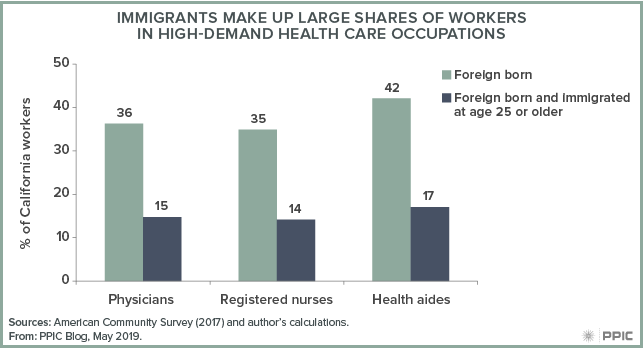
Immigrants also make up a large proportion of California workers in high-demand health care occupations, such as primary care providers (who are particularly needed in rural areas), nurses, and health aides. In 2017, 36% of the state’s physicians and 35% of registered nurses were foreign born. Forty-two percent of California’s nursing, psychiatric, and home health aides were foreign born.

figure - Immigrants Make Up Large Shares of Workers in High-demand Health Care Occupations

As California considers how to train people for these jobs, programs that account for the diversity of immigrants’ educational backgrounds will be important. Many highly skilled immigrant health workers were age 25 or older when they arrived in the country, suggesting that they may have had at least some training abroad. To help foreign-trained health professionals, some California universities already have programs to guide them through the steps necessary to enter the state’s health workforce. Training programs for support roles in health that require less than a four-year college degree are another opportunity that could encourage lower-skilled immigrants to enter the health sector.

Immigrants can also benefit the health workforce in other ways. For example, health care workers who speak languages other than English, as many immigrant workers do, can be a resource for low-income patients facing linguistic barriers to health care access. In the coming years, meeting California’s health care workforce needs will require multiple strategies—but engaging the state’s immigrant population can be a part of the solution.

Californians’ Views of Immigration Policy—Now and Then

From building a border wall to declaring a crisis at the border, immigration policy proposals from the Trump Administration continue to provoke controversy and stir national debate. How do Californians—who live with the nation’s highest share of immigrants—view such proposals? And more broadly, how have their views of immigration policy changed over time?

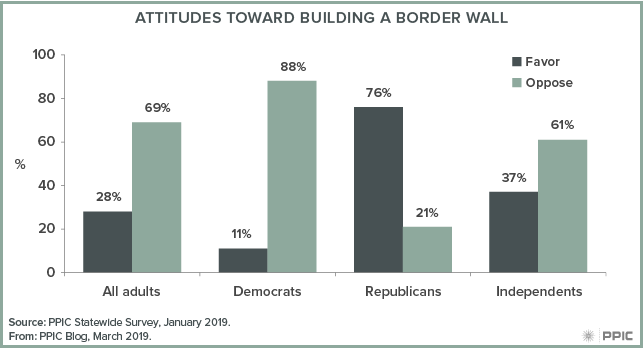
When it comes to a border wall, Californians’ views are decidedly different than those of adults nationwide. Fewer than three in ten Californians (28%) supported building a wall along the entire border with Mexico in our January survey, but twice as many American adults (56%) were in favor of this proposal in a January CNN survey.

However, the wall is a highly partisan issue in California. Support among California Republicans is quite notable, with 76% in favor. Among other partisans—and across regions and demographic groups—support fails to eclipse 40%.

figure - Attitudes Toward Building a Border Wall

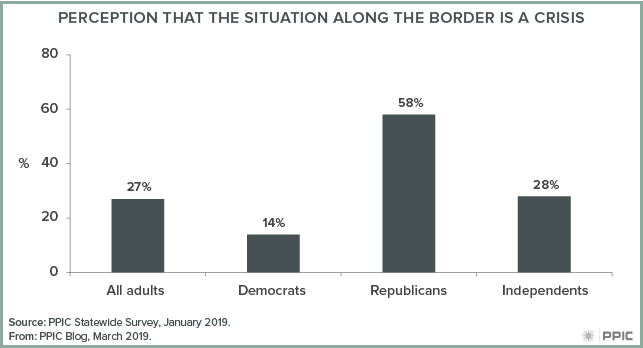
There’s more agreement between Californians and other Americans regarding the situation at the border. Relatively few Californians in our January survey or adults nationwide in a January ABC/Washington Post survey call the situation at the US-Mexico border a “crisis” (27% California, 24% nationwide).

Again, there are stark partisan differences over this topic in California. Republicans (58%) are far more likely than Democrats (14%) and independents (28%) to call the border situation a crisis. Across regions and demographic groups, one in three—or fewer—say this.

figure - Perception that the Situation Along the Border Is a Crisis

Californians’ views of immigration policy have changed a great deal since the passage of Proposition 187 nearly 25 years ago. Supported by 58% of the vote, Prop 187 sought to make undocumented immigrants ineligible for public benefits. Blocked by a federal judge, the measure was never enforced.

Today, 58% of Californians support California’s state and local governments in making their own policies and taking their own actions—separate from the federal government—to protect the legal rights of undocumented immigrants in California.

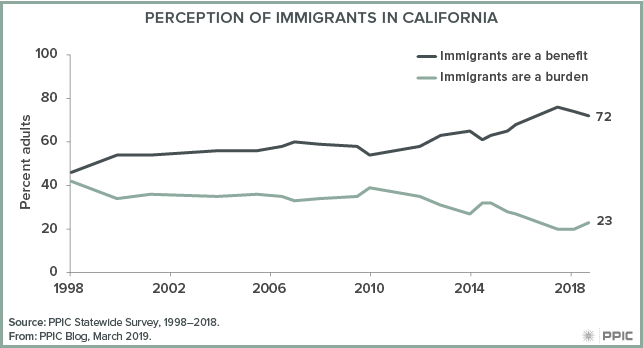
Not only have Californians’ views of immigration policy changed over time, so have their perceptions of immigrants. While state residents have generally held positive views of immigrants, in recent years these perceptions have become much more positive.

figure - Perception of Immigrants in California

Since the PPIC Statewide Survey last talked to Californians, President Trump has declared a national emergency as he seeks funds to build the wall, while California—along with other states—has sued the federal government over this claim. As California and the Trump Administration continue to spar over immigration policy, stay tuned while we track Californians’ perceptions and policy preferences related to this issue.

Federal Immigration Proposal Could Have Widespread Impact

The Department of Homeland Security (DHS) has recently proposed changing how it decides whether a person is or will likely become dependent on government assistance. If implemented, this change would make it harder for immigrants to meet the government’s standard of self-sufficiency—and may deter them and others from using government services for which they are eligible. Through December 10, DHS is requesting public comments on the proposal, which could potentially have wide-ranging impacts on California and its large immigrant population.

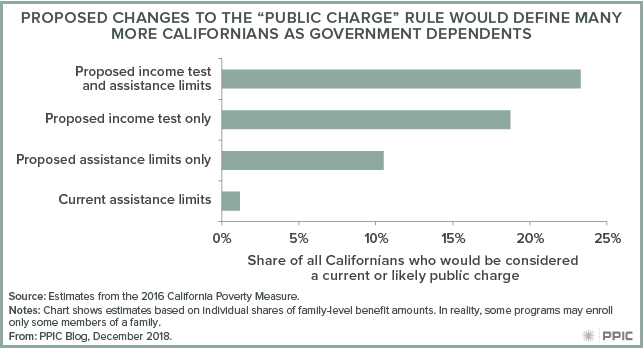
The federal government can typically deny applications for green cards or entry into the United States to people who are or will likely become “public charges,” i.e., dependent on government assistance. Under current guidance, DHS considers an immigrant a public charge if they receive more than half of their income from cash assistance—which includes TANF (known as CalWORKs in California), General Assistance (GA), and Supplemental Security Income (SSI)—or are in government-funded, long-term institutional care (like a nursing home).

The proposed rule is much broader: it defines dependence as receiving more than about $1,800 (for 2018) in assistance from not only the current programs but also the food assistance program SNAP (CalFresh) and/or Section 8 housing vouchers and rental assistance. DHS also proposes that an income of less than 125% of the federal poverty level ($25,100 in 2018 for a family of four) would be a strong predictor of becoming a public charge and recommends length of enrollment in certain health programs as another factor to consider.

How big of a change is this? While data aren’t available to examine safety net participation among the noncitizens whose immigration cases would be affected by the rule, we estimate that even before including health programs, as many as 23% of all Californians would be considered public charges, or likely to become so—which gives a sense of how broad the proposed rule is. Some 18.7% of Californians would be considered likely to become public charges based on their income level alone. By contrast, at most 1.2% of all Californians receive more than half their income from CalWORKs, GA, and SSI, and would be considered public charges under the current rule. These calculations are based on the California Poverty Measure (CPM), a joint effort of PPIC and the Stanford Center on Poverty and Inequality.

California has more immigrants than any other state—and hence much at stake. For those on visas, the proposed rule would make it harder to qualify for a green card or extend their stay. But in practice, the largest impact would likely be on immigrants and their families who, purely out of caution, forego safety net benefits for which they are eligible. DHS cites this sort of disenrollment as a source of long-term savings—but notes that these savings are liable to be offset by worse public health outcomes and increased poverty rates. Based on studies of welfare reform in the 1990s, the UCLA Center for Health Policy Research estimates that if the rule change takes place, 15% to 35% of families with noncitizens might disenroll from safety net programs. At the high end, as many as 765,000 people could disenroll from CalFresh and Medi-Cal, leading to around $1 billion less in federal aid to California each year.

California’s attorney general and some local governments have already voiced their opposition to the proposed changes, which come at a time when the state has been expanding access to health and social safety net programs. Reduced participation in these programs, whether from reasonable or unnecessary caution, would directly counteract the state’s efforts to reduce poverty. Public comment for the proposal closes on December 10.

How Changes in Immigration Affect California’s Workforce

[vc_row][vc_column][vc_column_text]Immigrants are essential to California’s workforce. In the past two decades, as labor market needs have shifted, the composition of recent immigrants (those arriving in the last five years) has changed dramatically. Today, recent immigrants to California are much more likely to hold a bachelor’s or more advanced degree than in the past—and in fact are now more likely than US-born Californians to do so.

While the number of recent immigrants to California fell by 24% between 2000 and 2016, the number of highly educated immigrants rose by 41%. In 2016, about half of recent immigrants held at least a bachelor’s degree. Highly educated immigrants work in every major industry in the state and comprise about 30% of the highly educated workforce.

These changes in educational attainment coincide with other shifts in immigration patterns. A large portion of the decline in immigration to California can be attributed to the falling numbers of immigrants arriving from Mexico. In 2000, over half a million recent immigrants came from Mexico. By 2016, that number fell by more than 70% to less than 150,000 people.

Now, China has slightly edged out Mexico as the leading country of origin, and these top two countries are followed by India, the Philippines, and Vietnam. Immigrants from China and India tend to be highly educated: in 2016, 47% of recent immigrants from China—and around 80% of recent immigrants from India—had at least a bachelor’s degree. The interactive below allows you to further explore changes in education levels over time among recent immigrants overall and from these five countries.

The sharp increase in highly educated immigrants and the decline in less-educated immigrants reflect the changing labor market in California. Unemployment rates for workers with at least a bachelor’s degree (3.3%) are about half those of less-educated workers (6.5%). With California expected to face a shortfall of 1.1 million college graduates by 2030, highly educated immigrants are a key component to helping the state address the workforce skills gap.[/vc_column_text][/vc_column][/vc_row][vc_row][vc_column][vc_raw_html]JTNDZGl2JTIwY2xhc3MlM0QlMjd0YWJsZWF1UGxhY2Vob2xkZXIlMjclMjBpZCUzRCUyN3ZpejE1Mjc4Nzg3ODgxNDYlMjclMjBzdHlsZSUzRCUyN3Bvc2l0aW9uJTNBJTIwcmVsYXRpdmUlMjclM0UlMEElMDklM0Nub3NjcmlwdCUzRSUwQSUwOSUzQ2ElMjBocmVmJTNEJTI3JTIzJTI3JTNFJTNDaW1nJTIwYWx0JTNEJTI3RURVQ0FUSU9OJTIwTEVWRUxTJTIwVkFSWSUyMEFDUk9TUyUyMElNTUlHUkFOVCUyMEdST1VQUyUyMCUyNyUyMHNyYyUzRCUyN2h0dHBzJTNBJTI2JTIzNDclM0IlMjYlMjM0NyUzQnB1YmxpYy50YWJsZWF1LmNvbSUyNiUyMzQ3JTNCc3RhdGljJTI2JTIzNDclM0JpbWFnZXMlMjYlMjM0NyUzQkNhJTI2JTIzNDclM0JDYWxpZm9ybmlhc2ltbWlncmFudHNhbmRlZHVjYXRpb25sZXZlbHNfMCUyNiUyMzQ3JTNCSW1taWdyYW50c2luQ2FsaWZvcm5pYWJ5ZWR1Y2F0aW9uYW5kY291bnRyeW9mb3JpZ2luJTI2JTIzNDclM0IxX3Jzcy5wbmclMjclMjBzdHlsZSUzRCUyN2JvcmRlciUzQSUyMG5vbmUlMjclMjAlMkYlM0UlM0MlMkZhJTNFJTBBJTA5JTNDJTJGbm9zY3JpcHQlM0UlMEElMDklM0NvYmplY3QlMjBjbGFzcyUzRCUyN3RhYmxlYXVWaXolMjclMjAlMjBzdHlsZSUzRCUyN2Rpc3BsYXklM0Fub25lJTNCJTI3JTNFJTBBJTA5JTA5JTNDcGFyYW0lMjBuYW1lJTNEJTI3aG9zdF91cmwlMjclMjB2YWx1ZSUzRCUyN2h0dHBzJTI1M0ElMjUyRiUyNTJGcHVibGljLnRhYmxlYXUuY29tJTI1MkYlMjclMjAlMkYlM0UlMEElMDklMDklM0NwYXJhbSUyMG5hbWUlM0QlMjdlbWJlZF9jb2RlX3ZlcnNpb24lMjclMjB2YWx1ZSUzRCUyNzMlMjclMjAlMkYlM0UlMEElMDklMDklM0NwYXJhbSUyMG5hbWUlM0QlMjdzaXRlX3Jvb3QlMjclMjB2YWx1ZSUzRCUyNyUyNyUyMCUyRiUzRSUwQSUwOSUwOSUzQ3BhcmFtJTIwbmFtZSUzRCUyN25hbWUlMjclMjB2YWx1ZSUzRCUyN0NhbGlmb3JuaWFzaW1taWdyYW50c2FuZGVkdWNhdGlvbmxldmVsc18wJTI2JTIzNDclM0JJbW1pZ3JhbnRzaW5DYWxpZm9ybmlhYnllZHVjYXRpb25hbmRjb3VudHJ5b2ZvcmlnaW4lMjclMjAlMkYlM0UlMEElMDklMDklM0NwYXJhbSUyMG5hbWUlM0QlMjd0YWJzJTI3JTIwdmFsdWUlM0QlMjdubyUyNyUyMCUyRiUzRSUwQSUwOSUwOSUzQ3BhcmFtJTIwbmFtZSUzRCUyN3Rvb2xiYXIlMjclMjB2YWx1ZSUzRCUyN25vJTI3JTIwJTJGJTNFJTBBJTA5JTA5JTNDcGFyYW0lMjBuYW1lJTNEJTI3c3RhdGljX2ltYWdlJTI3JTIwdmFsdWUlM0QlMjdodHRwcyUzQSUyNiUyMzQ3JTNCJTI2JTIzNDclM0JwdWJsaWMudGFibGVhdS5jb20lMjYlMjM0NyUzQnN0YXRpYyUyNiUyMzQ3JTNCaW1hZ2VzJTI2JTIzNDclM0JDYSUyNiUyMzQ3JTNCQ2FsaWZvcm5pYXNpbW1pZ3JhbnRzYW5kZWR1Y2F0aW9ubGV2ZWxzXzAlMjYlMjM0NyUzQkltbWlncmFudHNpbkNhbGlmb3JuaWFieWVkdWNhdGlvbmFuZGNvdW50cnlvZm9yaWdpbiUyNiUyMzQ3JTNCMS5wbmclMjclMjAlMkYlM0UlMEElMDklMDklM0NwYXJhbSUyMG5hbWUlM0QlMjdhbmltYXRlX3RyYW5zaXRpb24lMjclMjB2YWx1ZSUzRCUyN3llcyUyNyUyMCUyRiUzRSUwQSUwOSUwOSUzQ3BhcmFtJTIwbmFtZSUzRCUyN2Rpc3BsYXlfc3RhdGljX2ltYWdlJTI3JTIwdmFsdWUlM0QlMjd5ZXMlMjclMjAlMkYlM0UlMEElMDklMDklM0NwYXJhbSUyMG5hbWUlM0QlMjdkaXNwbGF5X3NwaW5uZXIlMjclMjB2YWx1ZSUzRCUyN3llcyUyNyUyMCUyRiUzRSUwQSUwOSUwOSUzQ3BhcmFtJTIwbmFtZSUzRCUyN2Rpc3BsYXlfb3ZlcmxheSUyNyUyMHZhbHVlJTNEJTI3eWVzJTI3JTIwJTJGJTNFJTBBJTA5JTA5JTNDcGFyYW0lMjBuYW1lJTNEJTI3ZGlzcGxheV9jb3VudCUyNyUyMHZhbHVlJTNEJTI3eWVzJTI3JTIwJTJGJTNFJTBBJTA5JTNDJTJGb2JqZWN0JTNFJTBBJTNDJTJGZGl2JTNFJTBBJTNDc2NyaXB0JTIwdHlwZSUzRCUyN3RleHQlMkZqYXZhc2NyaXB0JTI3JTNFJTBBJTIwJTIwJTIwJTIwJTIwJTIwJTIwJTIwJTIwJTIwJTIwJTIwJTIwJTIwJTIwJTIwJTIwJTIwJTIwJTIwdmFyJTIwZGl2RWxlbWVudCUyMCUzRCUyMGRvY3VtZW50LmdldEVsZW1lbnRCeUlkJTI4JTI3dml6MTUyNzg3ODc4ODE0NiUyNyUyOSUzQiUwQSUyMCUyMCUyMCUyMCUyMCUyMCUyMCUyMCUyMCUyMCUyMCUyMCUyMCUyMCUyMCUyMCUyMCUyMCUyMCUyMHZhciUyMHZpekVsZW1lbnQlMjAlM0QlMjBkaXZFbGVtZW50LmdldEVsZW1lbnRzQnlUYWdOYW1lJTI4JTI3b2JqZWN0JTI3JTI5JTVCMCU1RCUzQiUwQSUyMCUyMCUyMCUyMCUyMCUyMCUyMCUyMCUyMCUyMCUyMCUyMCUyMCUyMCUyMCUyMCUyMCUyMCUyMCUyMGlmJTIwJTI4JTIwZGl2RWxlbWVudC5vZmZzZXRXaWR0aCUyMCUzRSUyMDcwMCUyMCUyOSUyMCU3QiUyMCUwQSUwOSUwOSUwOSUwOSUwOSUwOXZpekVsZW1lbnQuc3R5bGUud2lkdGglM0QlMjc2NTBweCUyNyUzQnZpekVsZW1lbnQuc3R5bGUuaGVpZ2h0JTNEJTI3NjAwcHglMjclM0IlMEElMDklMDklMDklMDklMDklN0QlMjBlbHNlJTIwaWYlMjAlMjglMjBkaXZFbGVtZW50Lm9mZnNldFdpZHRoJTIwJTNFJTIwNTAwJTIwJTI5JTIwJTdCJTBBJTA5JTA5JTA5JTA5JTA5JTA5dml6RWxlbWVudC5zdHlsZS53aWR0aCUzRCUyNzUwMHB4JTI3JTNCdml6RWxlbWVudC5zdHlsZS5oZWlnaHQlM0QlMjc3MzBweCUyNyUzQiUwQSUwOSUwOSUwOSUwOSUwOSU3RCUyMGVsc2UlMjAlN0IlMEElMDklMDklMDklMDklMDklMDl2aXpFbGVtZW50LnN0eWxlLndpZHRoJTNEJTI3MTAwJTI1JTI3JTNCdml6RWxlbWVudC5zdHlsZS5oZWlnaHQlM0QlMjc3MzBweCUyNyUzQiUwQSUwOSUwOSUwOSUwOSUwOSU3RCUwQSUwOSUwOSUwOSUwOSUwOXZhciUyMHNjcmlwdEVsZW1lbnQlMjAlM0QlMjBkb2N1bWVudC5jcmVhdGVFbGVtZW50JTI4JTI3c2NyaXB0JTI3JTI5JTNCJTBBJTA5JTA5JTA5JTA5JTA5c2NyaXB0RWxlbWVudC5zcmMlMjAlM0QlMjAlMjdodHRwcyUzQSUyRiUyRnB1YmxpYy50YWJsZWF1LmNvbSUyRmphdmFzY3JpcHRzJTJGYXBpJTJGdml6X3YxLmpzJTI3JTNCJTBBJTA5JTA5JTA5JTA5JTA5dml6RWxlbWVudC5wYXJlbnROb2RlLmluc2VydEJlZm9yZSUyOHNjcmlwdEVsZW1lbnQlMkMlMjB2aXpFbGVtZW50JTI5JTNCJTBBJTNDJTJGc2NyaXB0JTNF[/vc_raw_html][/vc_column][/vc_row]

Do Californians Support State Action on Immigration?

California became the nation’s first sanctuary state in January, when Governor Jerry Brown signed legislation (SB 54) that limits cooperation by local law enforcement with federal immigration authorities. In March, the US Justice Department announced that it was suing California over three immigration-related laws—including SB 54. Since then, six counties—including San Diego and Orange—and at least 13 cities have voiced opposition to the sanctuary laws, either by passing resolutions or by joining the Justice Department’s lawsuit against California.

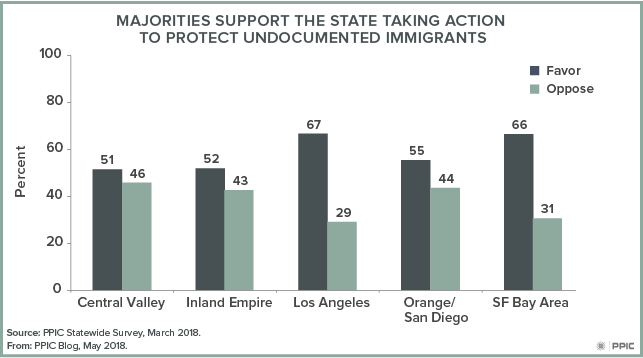
A solid majority of Californians (61%) support the state taking action to protect undocumented immigrants. But there is a stark partisan divide: the March PPIC Statewide Survey found eight in ten Democrats in favor of and eight in ten Republicans opposed to the state taking action. It is notable that there is majority support across the state’s regions. This includes 55% support among residents in Orange and San Diego Counties, home to a majority of the cities opposing the sanctuary laws. About half of residents in the Central Valley and the Inland Empire favor the state taking action. And support is even higher in Los Angeles and the San Francisco Bay Area, where it hovers around two-thirds. There are some differences between coastal (64%) and inland (52%) residents.

Across demographic groups, there is considerable support for state action on this issue—in fact majority support drops below 50% only among whites (47%). Support is highest among Latinos (76%), immigrant residents (73%), those with a high school degree or less (71%), Californians age 18 to 34 (67%), and those living in households making less than $40,000 (67%).

While the courts will ultimately decide the fate of the federal lawsuit, two things are clear: 1) California will continue to chart its own course on issues its leaders care about, and 2) immigration continues to be a topic that divides partisans but unites many other Californians across the state. Stay tuned to PPIC as the Statewide Survey will continue to monitor the opinions of Californians on this important policy issue.

Expanding Health Care Coverage for Undocumented Immigrants

As efforts to create a state-based single-payer health system confront complex questions of costs and federal uncertainty, advocates and state lawmakers are pushing forward with incremental policy measures to expand access to health coverage. The largest group of Californians that remain without comprehensive health insurance are undocumented immigrants, who were largely excluded from the coverage expansions created by the Affordable Care Act. Estimates suggest that almost 60% of uninsured Californians are undocumented.

Today, the Senate Health Committee is holding a hearing on SB 974 (Lara), which would allow all income-eligible California residents, regardless of immigration status, to enroll in comprehensive coverage through Medi-Cal (the state’s Medicaid program). California has already extended Medi-Cal coverage to undocumented children under 19, who have been eligible for comprehensive health benefits since May 2016. At the end of last year, nearly 220,000 undocumented children were enrolled in Medi-Cal, with costs estimated at $280 million in the recent fiscal year’s budget. No cost estimates are available yet for covering undocumented adults. But comprehensive coverage for the undocumented population must come from state funds, since federal Medi-Cal funding can only be used to support emergency services for undocumented immigrants.

In previous research, we estimated that about half of California’s undocumented population would likely qualify for Medi-Cal based on their income levels if restrictions on immigration status were removed. But this varied across regions. In Los Angeles County and parts of the Central Valley, more than half of undocumented immigrants had incomes below the Medi-Cal eligibility threshold of 138% of the federal poverty level, or FPL ($34,600 for a family of four). Bay Area counties had lower shares of income-eligible undocumented immigrants.

Currently, undocumented adults rely on the health care safety net—including community clinics, public hospital systems, and emergency departments—to access needed medical care. These providers play an integral role in caring for both those that remain uninsured and those covered by our vastly expanded Medi-Cal program. As policymakers consider ways to expand comprehensive health coverage, it is important that they continue to support the state’s safety net providers.

Californians and Immigration Policy

During President Trump’s first year, perhaps no issue caused more conflict between the state and federal government than immigration. In January, California became a sanctuary state. Yesterday, the US Justice Department filed a lawsuit against California over three state immigration-related laws that were passed by the California Legislature in 2017. How do residents feel about the state and local governments making their own policies and taking actions, separate from the federal government, to protect the legal rights of undocumented immigrants?
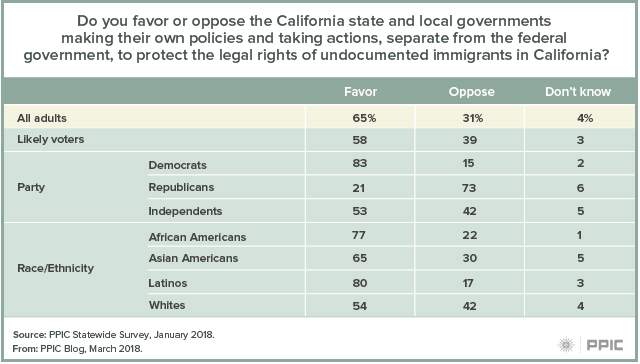
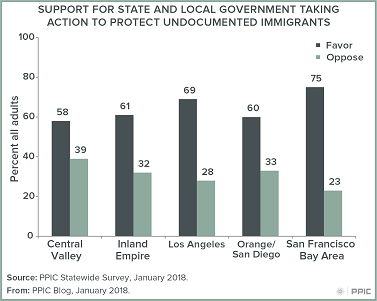
In January, we found that most Californians are in favor (65% adults, 58% likely voters), as we also found a year ago (65% adults, 58% likely voters). Today, eight in ten Democrats are in favor, compared to half of independents and two in ten Republicans. Majorities across regions support state and local government action.

We also find support across age, education, income, and racial/ethnic groups. Latinos and African Americans are more likely than Asian Americans and whites to be in favor.

Read “Californians and DACA” (PPIC blog, February 6, 2018)


Californians and DACA

In September, the Trump administration announced an end to the DACA (Deferred Action for Childhood Arrivals) program, which includes protections for some undocumented immigrants who were brought to the United States as children. Under DACA, those who qualify and pass a background check can receive protection from deportation and a work permit. California is home to about 223,000 DACA recipients—more than one-fourth of the national total.

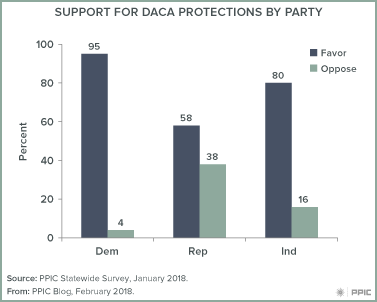
The administration and Congress have been negotiating a potential compromise that would preserve DACA protections for qualifying individuals. In January, the PPIC Statewide Survey found that 85% of adults and 81% of likely voters in California favor the protections offered by DACA. Recent surveys by ABC/Washington Post and CNN have found similarly high levels of support for DACA among adults nationwide. In California, support has increased slightly since September, when three-quarters of adults and likely voters were in favor of DACA protections.

In today’s politically polarized environment, it is notable that majorities of California Democrats, Republicans, and independents support the DACA program. In PPIC’s January survey, we find that while Republicans are less likely than Democrats and independents to support DACA protections, a solid majority (58%) are in favor. Indeed, DACA has a high level of support across the state’s regions and demographic groups, with at least three in four adults in favor. Results were similar in September, when strong majorities across parties and at least seven in ten across demographic and regional groups expressed support.
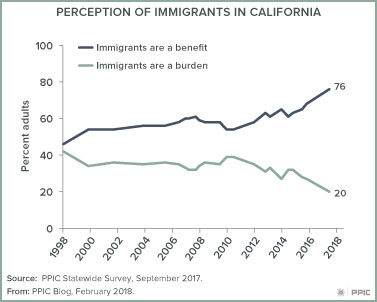
The high levels of support for DACA are perhaps unsurprising given Californians’ shifting attitudes toward immigrants. In PPIC’s September survey, three in four Californians (76%) said that immigrants are a benefit to the state because of their hard work and job skills—a high mark in PPIC surveys. Only 20% said immigrants are a burden because they use public services. Indeed, Californians are now far more likely to see immigrants as a benefit than they were in April 1998 when we first asked this question (46% benefit, 42% burden).

Interestingly, this shift in attitudes is not unique to California. In a June 2017 survey of adults nationwide, the Pew Research Center found that 65% of adults thought immigrants strengthened the country, while 26% felt immigrants burdened the country. This is a stark contrast to 1994, when only 31% of adults nationwide felt immigrants strengthened the country and 63% said they were a burden. As the debate on DACA and immigration policy continues, looking at changes in public attitudes on this issue can highlight areas of potential compromise for policymakers.


Video: How Californians View National Issues

With the nation focused on a range of contentious issues, the September PPIC Statewide Survey provides a California perspective. Dean Bonner, associate survey director, shared the key findings at a Sacramento briefing last week.

Among them:

  • A record-high share of Californians have a favorable opinion of the Affordable Care Act, and most want Republicans to work with Democrats to improve the law. While most Californians say it is the federal government’s responsibility to make sure that all Americans have health coverage, just a third favor a single-payer, government-run national health insurance system.
  • Three-fourths of Californians—also a PPIC record high—view immigrants as a benefit rather than a burden. There is broad and bipartisan support for protections provided by DACA, which shields from deportation some undocumented immigrants brought to the US as children and allows them to get a work permit if they pass a background check.
  • Half of Californians say they are very concerned about the possibility of North Korea having a nuclear missile that could reach the state.
  • Two-thirds of Californians view possible Russian interference in the 2016 as a serious issue.
  • Half of Californians say race relations have gotten worse in the United States over the last year. They are less pessimistic when it comes to race relations in the state.