California’s Quick Response to COVID-19 Likely Saved Lives

As of April 21, nearly 5,000 Californians are hospitalized and more than 1,300 have died due to COVID-19, but proactive public health measures may have safeguarded many others. Because the coronavirus spreads exponentially, days matter. And early actions before the statewide shelter-in-place order may have proved especially effective in reducing transmission.

The Bay Area had some of the state’s earliest cases of coronavirus, which spurred a rapid response. Santa Clara was the first county to declare a public health emergency, and large companies in the region asked employees to work from home as early as the first week of March.

Seven Bay Area counties—including Alameda, Contra Costa, Marin, San Francisco, San Mateo, Santa Clara, and Santa Cruz—implemented shelter-in-place orders beginning on March 17. Los Angeles County instituted a comparable order mere days later, but the virus was already spreading rapidly.

As of now, regions are in different phases of flattening the COVID-19 death curve. In Los Angeles County, the last week of data suggest the number of deaths doubles about every 8 days. That is a faster rate than Florida (12 days), but still far slower than New York in its deadliest week—when deaths doubled almost every day.

Other parts of Southern California also saw a spike, with deaths doubling every 8 days. Meanwhile, at 12 days, deaths in the Bay Area are doubling more slowly, as they are in the Sacramento region at 15 days. Both the San Joaquin Valley and other parts of the state have essentially plateaued at 19 and 32 days.
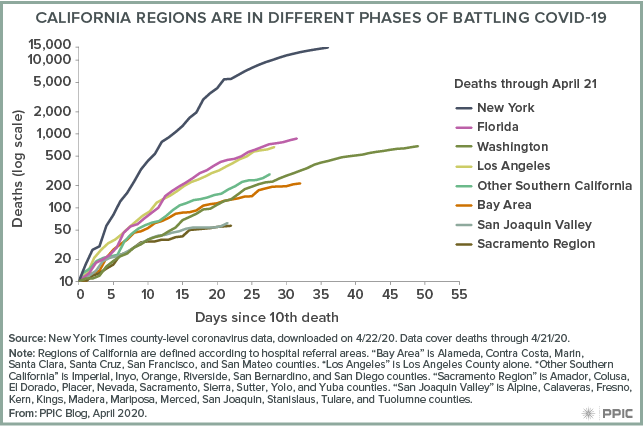
figure - California Regions Are in Different Phases of Battling COVID-19

Local policies have also curbed demand for COVID-19 hospital care. Statewide, hospitalizations and ICU beds filled due to COVID-19 have been trending downward for two weeks, but have ticked up slightly the last few days. Certain counties—notably Los Angeles—have continued to see an upward trend in COVID-19 patients in intensive care, although it does seem to be plateauing.

In Los Angeles in recent weeks COVID-19 patients occupied about 30% of total ICU beds, compared to less than 15% in the Bay Area. The San Joaquin Valley and Sacramento regions also seem to be faring well, with about 10% of ICU beds filled due to the coronavirus. Regional estimates of ICU occupancy rates (as of 2018) suggest hospitals can manage current levels of COVID-19 patients while meeting other intensive care needs.
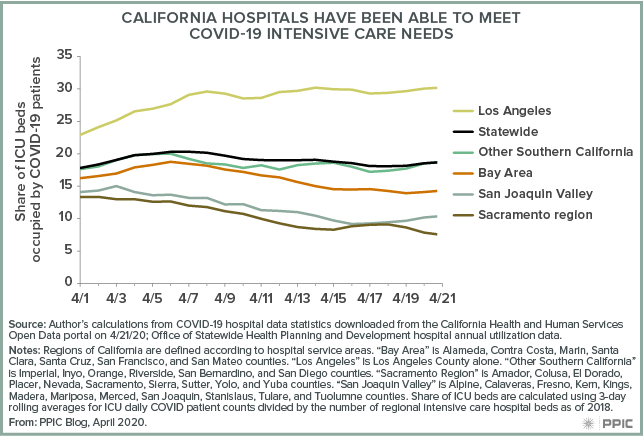
figure - California Hospitals Have Been Able To Meet COVID-19 Intensive Care Needs

Governor Newsom listed clear criteria for reopening the state’s economy in the midst of the global pandemic. All of California will meet certain benchmarks, such as data tracking and scientific advances in testing and treatment, on a single timeline. Others, such as plans for conducting business while social distancing and protecting vulnerable residents, will likely differ by region.

The state acknowledges that communities may reopen at different times based on circumstances. Recent experiences suggest that responsive local policies could help the state reopen while suppressing COVID-19 hospitalizations and deaths.
Race, Health, and the Risk of COVID-19 Complications

For adults younger than 65, many underlying health conditions are emerging as risk factors that can lead to severe complications of COVID-19. Within this larger population, certain minority groups are under particular threat due to disproportionate rates of such conditions. While California’s overall share of nonelderly adults at risk is relatively low, disparities in health endanger some more than others during this health crisis.

Governor Newsom cited protecting individuals most at risk of COVID-19 complications as a necessary criterion for restarting California’s economy. Though we cannot yet draw conclusions from incomplete data—about one-third of cases and over a tenth of deaths do not have complete data on race and ethnicity—certain risk factors are more prevalent along racial and ethnic lines.

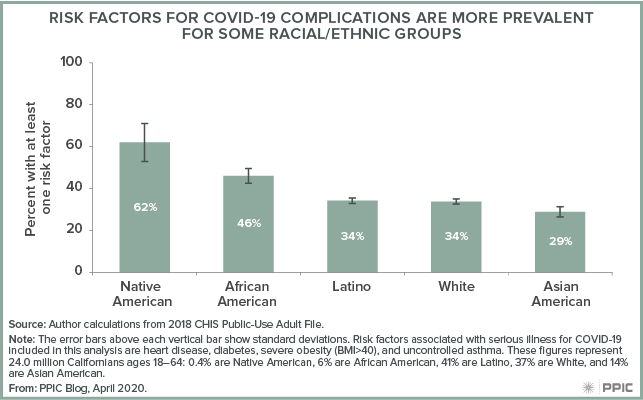
According to the Center for Disease Control, potential risk factors include heart disease, diabetes, severe obesity (BMI greater than 40), and uncontrolled asthma; smoking is also likely to increase risk. In California, over 60% of Native Americans and about 46% of African Americans have at least one of those health concerns. By comparison, roughly one-third of whites, Latinos, and Asian Americans have one or more of these health issues.

Native Americans are diagnosed with heart disease at rates almost four times that of whites (19% to 5%), have higher rates of smoking (51% to 14%), and double the uncontrolled asthma (12% to 6%). African Americans have much higher rates of diabetes (24% to 14%) and severe obesity (12% to 4%) than whites. Asian Americans and Latinos also have higher rates of diabetes (about 19%) compared to whites (14%).

figure - Risk Factors for COVID-19 Complications Are More Prevalent for Some Racial/Ethnic Groups

Due to higher poverty and uninsured rates, minority groups also face more difficulty accessing health care. At the same time, individuals in these populations may frequently hold jobs with a higher risk of exposure to coronavirus.

The California Department of Public Health has begun to publish data on cases and deaths by race/ethnicity. Some counties, such as San Francisco, are doing the same at the local level. While limited testing capacity and incomplete data prevent a true understanding of who is most impacted by the coronavirus, better knowledge of existing health disparities can help California protect and heal its most at-risk members as the state plans its next steps in responding to the public health crisis.

Communicating to California’s Seniors about Coronavirus

Older adults are especially vulnerable to the coronavirus (COVID-19). Early data show that mortality rates among people age 60 or older are many times higher than among younger adults. Protecting this population is paramount to limiting the health consequences of the COVID-19 pandemic. In California, this means communicating information in ways that can effectively reach a particularly diverse older population.

California’s senior population is large and growing fast. In 2018 the number of older adults in California reached 8.0 million, up from 5.7 million ten years earlier, according to the American Community Survey. Today, one in five Californians is age 60 or over, a record high.

The rapid growth in the older population is not unique to California. Throughout the nation—as in most developed countries of the world—populations are aging rapidly. The aging of the very large baby boom cohort, declining birth rates, and increasing life expectancy have expanded the senior population.

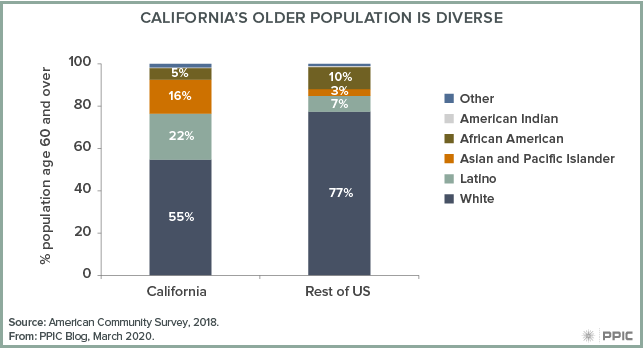
What sets California apart is its diversity. People of color make up almost half (45%) of California’s 60 and over population, about double the share of the rest of the nation (23%). In California, Latino and Asian American populations make up relatively high shares.

figure - California’s Older Population Is Diverse

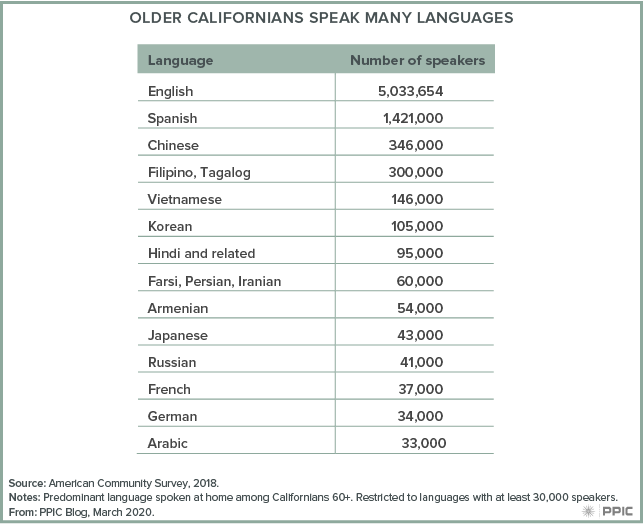
California’s older population is also diverse in terms of language: 37% of older Californians speak a language other than English at home, compared to 13% in the rest of the nation. While Spanish predominates among non-English speaking households, dozens of languages have at least 10,000 speakers. Among the 2.9 million Californians who do not speak English at home, 1.2 million are not proficient in English (speaking only some or no English).

figure - Older Californians Speak Many Languages

The vast majority of older adults live in the state’s large metropolitan areas—Los Angeles, Orange, San Diego, and Ventura Counties, along with the Bay Area. But in some lightly populated rural counties, they make up one-third or more of the population. These counties, in the far northern part of the state (Modoc, Trinity, and Siskiyou) and in the Sierra Nevada (Alpine, Amador, Calaveras, Mariposa, Nevada, Plumas, Sierra, and Tuolumne), could face acute local health care challenges.

It is essential that health services and public health messaging in California consider the state’s diverse population of older adults. Culturally and linguistically appropriate public health announcements, news, and services will help ensure that all Californians in all regions of the state have up-to-date information on the novel coronavirus and steps they can take to protect themselves and lessen its spread.

Voting Matters to Most Californians, but Many Don’t Show Up

Most Californians see voting as critical to a healthy democracy. In our February Statewide Survey, overwhelming majorities of adults (86%) and likely voters (96%) said voting in the 2020 elections is very important, a view held among those registered (90%) and not registered (76%) to vote.

However, while most hold this view, we know that 85% of California adults are eligible to vote but only 70% are registered. Low political participation is cause for worry in and of itself. If a small electorate does not represent the population—as is the case in California—there is even greater cause for concern.

Today, California’s adult population is 42% white and 35% Latino; the remainder are Asian American (15%), African American (6%), and other (3%). Yet 57% of California likely voters are white—only 20% are Latino, and the balance are Asian American, African American, and other. The percentage flips among nonvoters: 56% are Latino and only 22% are white.

figure - Likely Voters Do Not Represent California’s Diversity

And while a third of adults are foreign born, 83% of Californians who frequently vote in state elections are US born. Among nonvoters, 34% are US born (California Department of Finance 2019).

Differences between likely voters and nonvoters sharpen along age and socioeconomic lines. Frequent California voters are age 45 and older (65%), own their home (64%), have attended (39%) or graduated (41%) college, and have annual household incomes of $60,000 or more (59%). Nonvoters are younger than age 45 (65%) and renters (65%); about one in five are college graduates, and one in four earn $60,000 or more.

The political attitudes of voters and nonvoters also differ markedly and often reflect their socioeconomic conditions. Although the many nonvoters in the state may make their preferences known in public opinion surveys on issues, the views of likely voters prevail at the ballot box, when they decide on important matters that affect all Californians.

For example, single-payer healthcare has been a topic of robust discussion leading into the Democratic primary. In California, a split has emerged between nonvoters and likely voters over the question of whether health care coverage should be the responsibility of the federal government. While most nonvoters (72%) say it is the government’s responsibility, fewer likely voters (55%) hold this view.

figure - Nonvoters View Healthcare as a Government Responsibility

On Election Day, it’s important for all Californians eligible to vote make their voices heard. The state has made participating in elections more seamless than ever—even those not yet registered can take advantage of same-day voter registration at a local polling place. Californians overwhelmingly believe in the importance of elections. Today is the day to act on that belief.

Proposition 187 and a Changing California

Twenty-five years ago, in the midst of the worst economic crisis since the Great Depression, 59% of Californians voted to pass Proposition 187. The landmark ballot measure sought to set up a state-run immigration system and deny most public benefits—including K–12 education—to undocumented immigrants. The measure was later found to be unconstitutional, but its impact was pivotal in transforming California into what it is today.

Most Californians now support policies to protect undocumented immigrants. A recent PPIC survey found 61% of Californians and 54% of likely voters are in favor of state and local governments making their own policies and taking actions, separate from the federal government, to protect the legal rights of undocumented immigrants. In addition, our April survey found 57% of Californians (54% likely voters) support public school districts designating themselves “sanctuary safe zones” to indicate they will protect undocumented students and their families from federal immigration enforcement efforts.

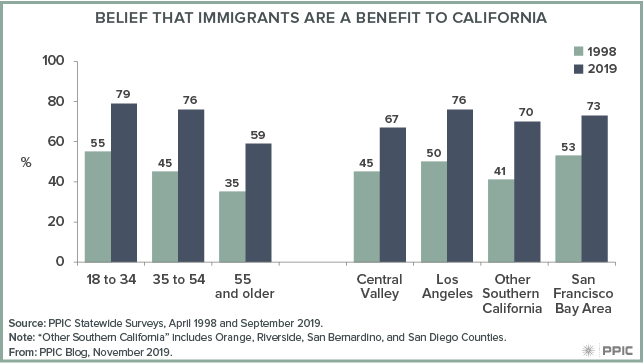
Californians’ overall views toward immigrants have also shifted. The PPIC Statewide Survey has monitored this issue since 1998. In April 1998, Californians were divided: 46% viewed immigrants as a benefit to California because of their hard work and job skills, while 42% viewed immigrants as a burden because they use public services. Since then, the share of Californians viewing immigrants positively has increased 25 points (71% benefit, 22% burden).

Across age groups and regions, the perception that immigrants are a benefit has risen by more than 20 points. Positive perceptions are also up across racial/ethnic groups, by 27 points among African Americans, 20 points among Latinos, 18 points among whites, and 12 points among Asian Americans. The share of Democrats viewing immigrants positively has increased 37 points, while the share of Republicans holding this view has decreased 2 points.

figure - Belief that Immigrants Are a Benefit to California

In recent years, Californians have supported policies to improve the lives of immigrants, such as providing health care for young undocumented Californians, taking state and local actions to protect immigrants, and supporting a pathway to citizenship. What role will immigration play in the upcoming election? Stay tuned to the PPIC Statewide Survey as we continue to examine Californians’ view of immigrants.

The Mood of California Voters and the 2020 Election Cycle

This post is excerpted from my speech at the Sacramento Seminar on October 4, 2019 in San Francisco.

Pollsters often say that a public opinion survey is a snapshot in time. The latest PPIC Statewide Survey was conducted in the days after the California Legislature finished its work in 2019 and while startling news was breaking that the president called a foreign leader for a political favor—which has resulted in the launch of an impeachment inquiry. The mood of California voters in this timely survey—especially their level of unhappiness and anxiety—is noteworthy because of its far-reaching implications for the March primary and the November election.

Let’s start with President Trump’s approval rating, which now stands at 35% among California likely voters. This is unchanged from the last reading in our July survey and has been remarkably stable over time. Today, 83% of Republicans approve of his job performance, compared to just 38% of independents and only 7% of Democrats. Given its partisan makeup, California is a reliably blue state on the Electoral College map. Still, low approval ratings for the president will increase turnout, influence the Democratic presidential primary choice, and affect all of the legislative races next year.

Meanwhile, approval ratings for Congress remain low even in the wake of Democratic control of the US House of Representatives. Today, just 24% of California likely voters approve of the way that Congress is doing its job. This is unchanged from the start of the year—as well as from a year ago when Republicans controlled the House. In California, likely voters across party lines give low approval ratings to Congress. If this trend continues, incumbents will have to work harder to keep their seats in 2020.

Closer to home, Governor Newsom and the legislature are getting mixed reviews in their first year of making policy together. Among likely voters, 43% approve and 44% disapprove of the governor, while 38% approve and 51% disapprove of the legislature. Since the beginning of the year, disapproval has increased significantly for the governor (+15 points) and the legislature (+8 points). Today, more than six in ten Democrats approve of the job that the governor and legislature are doing, compared to fewer than four in ten independents, and less than two in ten Republicans. If their ratings remain in the doldrums, the governor and legislators will have little sway over Californians’ ballot choices next year.

figure - Approval Ratings of State Elected Officials

Equally important, California’s likely voters are in a negative frame of mind about the state of their state—even in the midst of low unemployment and budget surpluses. Fifty-four percent say that things in California are going in the wrong direction (41% say right direction). When asked about economic conditions in California for the next 12 months, a similar 54% expect bad times (37% say good times). Pluralities across party lines are now expecting bad economic times in the next 12 months—a timeframe that includes most of the 2020 election campaign season.

figure - Likely Voters Expect Bad Economic Times in the Next 12 Months

State bonds and tax measures will face headwinds if this level of economic unease continues. This is already evident in the modest support for the $15 billion school bond (54%) and the split-roll property tax initiative (47%) in our recent survey.

figure - Modest Support for Likely 2020 State Ballot Measures

Digging deeper into the survey, more than six in 10 likely voters worry about being able to afford the cost of their health care, six in ten are concerned about the threat of a mass shooting where they live, half are worried about experiencing natural disasters such as wildfires, and four in ten worry about someone they know being deported. Candidates’ promises and plans to address these fears will likely impact the standing of current frontrunners Joe Biden, Bernie Sanders, and Elizabeth Warren—and their challengers—in a Democratic presidential primary which is very much up for grabs, as our recent survey shows.

How will voters’ views change over the next 12 months? Clearly, the political wildcard is the impeachment inquiry and how it will impact perceptions of the president, Congress, and the major parties. Uncertainty about the economy is another unknown factor. In the short run, the impeachment inquiry is likely to increase polarization, lead to more political gridlock in Washington, and heighten expectations for the governor and legislature to do more to solve the problems facing California.

PPIC Statewide Surveys will continue to monitor the broader political and economic attitudes, as well as voters’ preferences for presidential candidates and ballot measures, throughout what will be a consequential 2020 election.

Single-Payer Health Care and the Governor’s Race

One issue that may prove decisive for Democrats in the 2018 governor’s race is single-payer health care. With the leading Democratic candidates supporting a single-payer system—and the leading Republican candidates in opposition—the race has shed light on the financial, political, and regulatory challenges associated with expanding health coverage across the state.

Last year, the state senate passed a bill (SB 562) that would establish a single-payer health insurance program to cover all Californians. However, the bill was shelved in the state assembly until further notice. According to estimates by the nonpartisan Legislative Analyst’s Office, the bill’s total annual costs would be about $400 billion. Democratic gubernatorial candidates Gavin Newsom and Delaine Eastin have been the most vocal proponents of single-payer health care and have publicly backed the bill. Democratic candidates Antonio Villaraigosa and John Chiang, while supportive of the idea, have expressed concerns over financing and implementation. Both the leading Republican candidates, John Cox and Travis Allen, strongly oppose single-payer health care and have emphasized the need for more competition in the marketplace.

With candidates’ differing positions, how are Californians feeling about single-payer health care today?

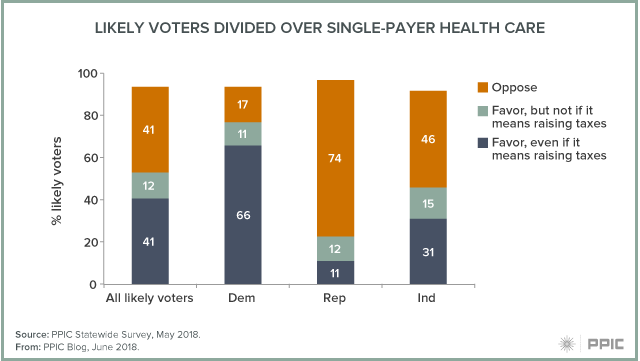
The May PPIC Statewide Survey found a majority of California’s likely voters (53%) favor a single-payer state plan. However, if this plan requires raising taxes, support declines to 41%. Across parties, an overwhelming majority of Democratic likely voters (77%) are in favor, while an overwhelming majority of Republicans (74%) are opposed; independent likely voters are divided (46% favor, 46% oppose). Notably, 66% of Democratic likely voters would favor a single-payer system—even if it means higher taxes.

The issue has become a litmus test for Democrats—pitting progressives against pragmatists—but, overall, Democrats express strong support for a single-payer system. Among likely voters who call themselves strong Democrats, 81% are in favor, compared to 69% who say they are not very strong Democrats. Among likely voters who call themselves strong Republicans, 83% are opposed to a single-payer system (the sample size for those calling themselves not very strong Republicans is too small for analysis).

Given partisan divides, the next governor may face significant political hurdles moving forward with single-payer health care. Coupled with statewide challenges, California would need to collaborate with the federal government to implement such a system. In consideration of these factors, the June primary is an opportunity for Californians to determine their future leadership and the state’s policy directions—including a possible step toward single-payer coverage.

Video: Gavin Newsom’s Priorities

Gavin Newsom, California’s lieutenant governor and a candidate for governor in 2018, was asked in a San Francisco forum last week to name the three issues that will make the biggest difference in California’s future. Newsom, who is also a former mayor of San Francisco, predicted that both California and the nation will be grappling with these issues over the next ten years:

  • Debt and demographics. With California’s population aging rapidly, the state and its cities face growing public employee pension and health care liabilities. “As a progressive Democrat, I’m not naïve about the commitments we’ve made and the commitments we must fulfill,” Newsom said. “Nor am I naïve, as a former mayor, about the challenge of meeting those commitments . . . Cities like Richmond are facing the prospect that by 2021, by one estimate, upwards of 40% of their general fund will go to retiree contributions.”
  • Energy and climate change. The state has set ambitious goals to reduce greenhouse gas emissions and increase energy efficiency. “The next governor has to deliver,” he said.
  • Information technology and globalization. “The issue that animates my anxiety: work, the future of work.” The days of having a job or career have given way to something radically different, forcing us to think in terms of portable benefits and retirement security, he said. Further, workers in retail, food and beverage, and clerical jobs—the top employment categories—are on the “edge of automation.” Displacement of these workers will require us to have a different conversation about skills, education, and social mobility, Newsom said.

The conversation with Newsom was part of the PPIC Speaker Series on California’s Future. PPIC is inviting all major candidates for governor to participate in a public event if they reach a certain threshold in the polls. The goal is to give Californians a better understanding of how the candidates intend to address the challenges facing our state.

Watch all candidate videos.

Video: How Californians View National Issues

With the nation focused on a range of contentious issues, the September PPIC Statewide Survey provides a California perspective. Dean Bonner, associate survey director, shared the key findings at a Sacramento briefing last week.

Among them:

  • A record-high share of Californians have a favorable opinion of the Affordable Care Act, and most want Republicans to work with Democrats to improve the law. While most Californians say it is the federal government’s responsibility to make sure that all Americans have health coverage, just a third favor a single-payer, government-run national health insurance system.
  • Three-fourths of Californians—also a PPIC record high—view immigrants as a benefit rather than a burden. There is broad and bipartisan support for protections provided by DACA, which shields from deportation some undocumented immigrants brought to the US as children and allows them to get a work permit if they pass a background check.
  • Half of Californians say they are very concerned about the possibility of North Korea having a nuclear missile that could reach the state.
  • Two-thirds of Californians view possible Russian interference in the 2016 as a serious issue.
  • Half of Californians say race relations have gotten worse in the United States over the last year. They are less pessimistic when it comes to race relations in the state.

Video: Attorney General Becerra on the Issues

The Trump administration has clashed with California on a range of issues, and the state’s new attorney general, Xavier Becerra, is at the forefront of the legal battles with Washington. Before a large crowd in Sacramento, Becerra talked about his views and what he has done so far on a range of issues. He spoke with Mark Baldassare, PPIC president and CEO.

Some key highlights:

  • Environment: Becerra said he has been most active so far on this issue and vowed to continue to be aggressive, whether it is initiating lawsuits, joining other suits, or moving forward with the Paris climate agreement, to the extent the state can do so. “I’ve got the governor’s back on anything he wants to do on the environment,” he said.
  • Immigration: Becerra said he favors legislation to make California a sanctuary state as long as it does not undermine the ability of local law enforcement to protect public safety by, for example, combating drug and sex trafficking.
  • Health care: Becerra said that single-payer health care is ultimately the right approach to coverage. “I hope California gets further along in recognizing that affordability only comes when you have universality,” he said.