Video: A Conversation with Governor Gavin Newsom

Governor Gavin Newsom’s conversation with PPIC president Mark Baldassare last week focused on energy policy and climate change. After noting that it had been one year since PG&E declared bankruptcy, Baldassare asked the governor about his vision for the future of California utilities. Newsom responded by broadening the question. “We have to start thinking about our energy future and our transportation future and our low-carbon, green growth future in a collaborative mindset.”

In this context, he continued, “PG&E’s bankruptcy has turned out to be an extraordinary opportunity for this state. . . . It’s allowed us to ask questions . . . that otherwise weren’t front and center.” PG&E, he said, has to come out of bankruptcy with a vision for the future that prioritizes long-term thinking and public safety rather than shareholder return. The bottom line? California needs a “transformatively different” utility. And, he added, “if PG&E can’t do it, we’ll do it for them.”

Key to planning for the state’s energy future is making sure it works for all Californians. Going green, Newsom said, “can’t mean more income inequality.” It has to benefit both the “haves” and the “have nots”—creating jobs and ensuring affordable energy, and mitigating the dislocation that comes with change.

Another key area is wildfire mitigation and prevention. Newsom noted that the 2019 fire season was less damaging than other recent seasons, in part because “we’ve never been more prepared.” The state has been investing in new technology that monitors and predicts wildfires, as well as equipment for suppressing fires and responding to crises.

Wildfire prevention is complex, in part because, as Newsom pointed out, the federal government owns the majority of forest land in California. “We are doing the job the federal government is no longer doing,” Newsom said, adding that “the Trump administration’s budgets have been proposing cuts to forest management.” Land-use patterns are another complicating factor. New building codes have helped recently built housing survive fires, but there are a large number of older buildings in fire-prone areas.

As Newsom sees it, the challenge of implementing the state’s ambitious climate mandates is to bring politics and policy into alignment. “Politically, I recognize that what’s necessary may be impossible. But also I recognize from a policy perspective that what is impossible has to become necessary.” The ultimate goal, of course, is to move California forward: “The world is changing. We have to change with it.”


Video: Gavin Newsom’s Priorities

Gavin Newsom, California’s lieutenant governor and a candidate for governor in 2018, was asked in a San Francisco forum last week to name the three issues that will make the biggest difference in California’s future. Newsom, who is also a former mayor of San Francisco, predicted that both California and the nation will be grappling with these issues over the next ten years:

  • Debt and demographics. With California’s population aging rapidly, the state and its cities face growing public employee pension and health care liabilities. “As a progressive Democrat, I’m not naïve about the commitments we’ve made and the commitments we must fulfill,” Newsom said. “Nor am I naïve, as a former mayor, about the challenge of meeting those commitments . . . Cities like Richmond are facing the prospect that by 2021, by one estimate, upwards of 40% of their general fund will go to retiree contributions.”
  • Energy and climate change. The state has set ambitious goals to reduce greenhouse gas emissions and increase energy efficiency. “The next governor has to deliver,” he said.
  • Information technology and globalization. “The issue that animates my anxiety: work, the future of work.” The days of having a job or career have given way to something radically different, forcing us to think in terms of portable benefits and retirement security, he said. Further, workers in retail, food and beverage, and clerical jobs—the top employment categories—are on the “edge of automation.” Displacement of these workers will require us to have a different conversation about skills, education, and social mobility, Newsom said.

The conversation with Newsom was part of the PPIC Speaker Series on California’s Future. PPIC is inviting all major candidates for governor to participate in a public event if they reach a certain threshold in the polls. The goal is to give Californians a better understanding of how the candidates intend to address the challenges facing our state.

Watch all candidate videos.

A Water Sector Energy Hog

When we use water, we’re also using energy—sometimes a little, sometimes a lot. Overall, water use accounts for about 20 percent of California’s electricity use and 30 percent of natural gas used by businesses and homes. This energy is used to supply, convey, treat, and heat water.

Where does it all go, and more importantly, how can we best save both water and energy?

You might guess that our long-distance transport of water through the state’s network of canals and pumping stations is a big energy hog. The federal and state water projects combined move about a quarter of all water used in California. The State Water Project—which conveys water from the Sacramento–San Joaquin Delta to cities and farms in the San Joaquin Valley, the Central Coast, and Southern California—is the largest single user of electricity. But even so, the state’s water conveyance system is something of an energy sipper, accounting for just 4 percent of the sector’s total energy use.

Or maybe you’d assume that California farmers—who use about four times more water than the state’s urban areas—use the most water-related energy. But even though farmers pump some 10 million acre-feet of water in an average year, they use just 5 percent of California’s water-related energy.

Have you guessed it yet? Hint: The state’s cities, especially California households and industries, use by far the most water-related energy—and much of it goes down the drain.

Heating water is the most energy-intensive water-related activity. Some residential “end uses” of water—faucets, showers, and clothes washers—are energy hogs, accounting for 42 percent of all energy used in the water cycle. And in total, the residential, industrial, and commercial end uses of water account for more than 85 percent of energy used in the water sector. By comparison, supplying, pumping, and treating urban water make up about 5 percent. 

Reducing the energy footprint of the state’s water cycle will require more reductions in hot water use.

A recent study, which looked at the energy use of supplying, pumping, and treating water, estimated that the energy savings resulting from drought-related urban water conservation to date has equaled the combined savings of all energy efficiency programs offered by the state’s major energy utilities. The study did not account for water heating or other energy-intensive uses of water.

California has been a leader in energy efficiency for many years. Its efforts include reducing energy use of washing machines and dishwashers—which together still use less energy than showers. Last year, the state’s energy commission adopted new standards (which went into effect this summer) that will cut water flow in showerheads by 20 percent. The move is expected to save more than 2.4 billion gallons a year in the first year—and enough energy to power more than 200,000 homes for a year.

To further reduce the energy footprint of the state’s water cycle, it would be most effective to continue to target reductions in hot water use. This can be done by changing our habits (such as decreasing water heater temperatures), improving water-heating efficiency, and reducing the energy intensity of some industrial processes.

Saving energy in the water sector also reduces greenhouse gas emissions—nearly 10 percent of the state’s emissions are directly associated with water use. California plans to reduce its emissions 40 percent below 1990 levels by 2030, and the water sector can provide some of the most cost-effective ways to meet that goal.

But as always in California’s water management, there is no one-size-fits-all solution. Local assessments—with state agencies’ support—are needed to evaluate cost-effectiveness of various solutions locally and across regions. The state could then use these assessments to devise a statewide plan for reducing the water sector’s energy consumption and greenhouse gas emissions.

Learn more

Read California’s Water: Energy and Water (from the California’s Water briefing kit, October 2016)
Visit the PPIC Water Policy Center

PPIC Honors Statesman George Shultz

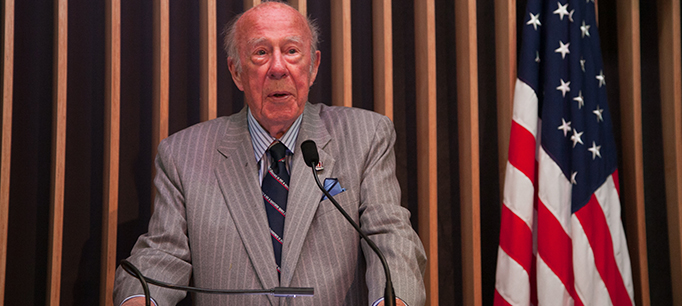
PPIC yesterday dedicated the George P. Shultz Forum at its Bechtel Conference Center, in honor of the U.S. statesman, economist, and businessman.

Shultz attended the dedication in the Bechtel Conference Center, a meeting and learning space located on the ground level at PPIC’s San Francisco headquarters. The George P. Shultz Forum is the main convening area at the conference center.

Mark Baldassare, PPIC president and CEO, noted that the George P. Shultz Forum will be a gathering place for a growing number of civic-minded groups. Speaking to an audience that included the PPIC board of directors, staff, donors, and special guests, Baldassare said, “This is a fitting way to honor George Shultz’s remarkable career in public service and his reputation for bridging policy divides on issues ranging from climate change to nuclear proliferation. It will be an inspiration to our guests.”

Senator Dianne Feinstein, speaking on video from Washington, noted key accomplishments in Shultz’s career. “When it comes to public policy and public service, there is no better model than George Shultz,” she said.

Shultz, who has a Ph.D. in industrial economics, was appointed secretary of labor in 1969, director of the Office of Management and Budget in 1970, and secretary of the treasury in 1972. He was president of the Bechtel Group from 1974 to 1982. He also served as chairman of the President’s Economic Policy Advisory Board from 1981 to 1982 and secretary of state from 1982 to 1989. He was awarded the Presidential Medal of Freedom, the nation’s highest civilian honor, in 1989. Since then, he has been a distinguished fellow at the Hoover Institution at Stanford University.

In his comments, Shultz reflected on lessons he had learned in his career of government service—including the importance of nonpartisanship. He said it is important that “PPIC keep the nonpartisan spirit alive.”

“Democracy is not a spectator sport,” he added. “And nonpartisan work is a very important part of it. You identify problems, get the facts straight, figure out how people feel, and put the information forward in a way that people can understand.”

The PPIC event also included a conversation between Lieutenant Governor Gavin Newsom and Baldassare. They talked about climate change and energy policy—issues that Shultz has focused on for many years. Newsom noted that Shultz’s career is a reminder that environmental stewardship and sustainability used to be bipartisan issues. He also said California needs to step up its leadership on climate policies and work to expand the clean technology sector.

Other guests at the event included former San Francisco mayor Willie Brown; Stephen D. Bechtel, Jr., retired chairman and a director of the Bechtel Group, Inc., and his family; and John Gunn, chairman emeritus of Dodge & Cox.

The Bechtel Conference Center was made possible by a gift from the Stephen Bechtel Fund in 2009. Its design and operation reflect PPIC’s focus on neutrality, consensus building, and respect for different perspectives. And the center’s LEED Gold certification highlights the emphasis that both PPIC and the Bechtel family place on environmental and technological innovation. This year, a group of donors led by Stephen D. Bechtel, Jr., provided a gift to dedicate the forum to Shultz. The gift will be used to upgrade the technology in the forum and establish a fund to make the space available to and affordable for other civic-minded organizations.