K–12 Education and the New State Budget

The recently enacted 2019–20 budget allocates 28% of the total state budget for all K–12 education programs: $103.4 billion ($58.8 billion from the General Fund). Proposition 98, passed by the voters in 1988, establishes a minimum annual funding level for K–12 schools and community colleges. This year, the Proposition 98 funding level is $81.1 billion, bringing K–12 per-pupil expenditures to nearly $12,000. According to the Department of Finance, total per-pupil funding, including all federal, state, and local sources amounts to $17,423.

In addition, the rainy day fund requires the state to set aside savings for future education spending based on specific criteria, including General Fund tax revenue and Proposition 98 funding levels. This year, for the first time ever, the budget triggers a deposit into Public School System Stabilization Account at $376.5 million.

figure - K-12 Funding Is at a New High

The Local Control Funding Formula (LCFF) is the primary manner in which funds are distributed to support students. This year’s budget brings the total LCFF funding to nearly $63 billion, a $1.9 billion increase from last year, accounting for a statutory cost-of-living adjustment.

This year’s enacted budget also includes funding to address a wide range of concerns, including pensions, special education, and full-day kindergarten. For teacher pensions (CalSTRS), the budget pays down the state’s ($2.9 billion) and the districts’ share ($1.6 billion) of the unfunded liability. Another $500 million for fiscal year 2019–20 reduces by 1.03% school districts’ contribution rate to CalSTRS and CalPERS (pensions for public employees). The budget adds $350 million to reduce that contribution rate by an additional 0.7% in 2020–21.

The budget aims to mitigate rising special education costs to districts by adding more than $600 million to support students with disabilities.

A $300 million one-time payment goes to the Full-Day Kindergarten Facilities Grant program, which allows districts to construct new facilities or retrofit preexisting ones for the purposes of ensuring access to full-day kindergarten.

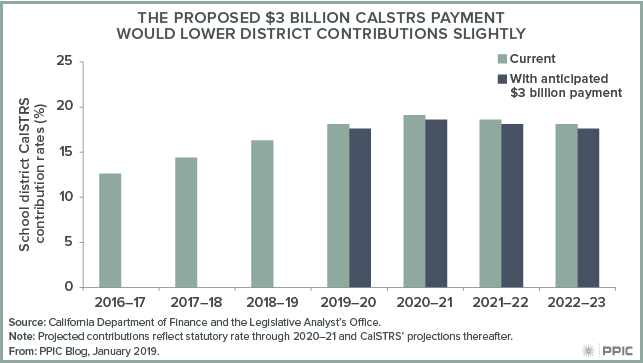
Despite the record funding level this year, two longer-term finance issues loom. The CalSTRS funding plan, as governed by AB 1469, has set school districts’ share of teacher pension costs to increase to 18.1% in 2019–20 and to 19.1% by 2020–21. While the budget’s funding toward the districts’ contribution rate will provide much-needed relief, growing pension costs will remain challenging.

Finally, in a time of growing costs, declining student enrollment is hampering districts across the state. Over the past five years, nearly half of all districts experienced enrollment losses—and this trend may continue over the next decade. Given that the state’s funding model is based on average daily attendance, declining enrollment is likely to persist as an important fiscal issue over the long run.

What’s Next for California’s Public Pensions?

Last week, the California Supreme Court issued an important ruling regarding public pensions. The case, CalFire Local 2881 v. CalPERS, was one of several lawsuits challenging the major 2013 pension reform law that was championed by then-Governor Brown. By upholding the changes contained in the law, the court’s decision answered one important question about the law’s legality. But it also left a much larger one unanswered: whether state or local governments will be able to alter some pension provisions during a future economic downturn.

Pensions present a significant challenge for California. The largest funds at the pension systems for California’s public employees (CalPERS) and state teachers (CalSTRS) have reported gaps of more than $138.9 billion and $107.3 billion, respectively, between their estimated obligations to retirees and the current value of their assets.

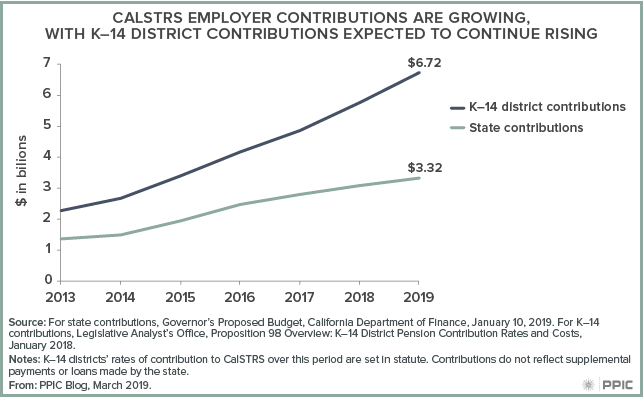
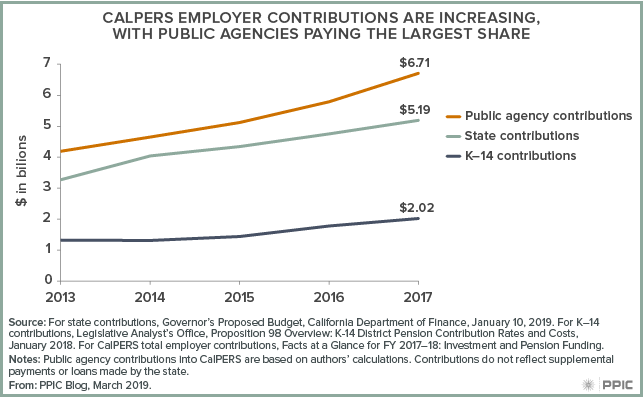
Closing those gaps will require larger payments from state and local governments, squeezing out dollars that would otherwise be used for programs and services. Employer contributions have already increased substantially in recent years. For example, public agency contributions into CalPERS increased from $4.19 billion to $6.71 billion from 2013 to 2017. And K–14 district contributions into CalSTRS have increased even more sharply, from $2.27 billion to $6.72 billion between 2013 and 2019. Indeed, the need to meet pension obligations was one of the financial pressures factoring into both the Los Angeles and Oakland teacher strikes.

CALPERS Employer Contributions Are Increasing with Public Agencies Paying the Largest Share

CALSTRS Employer Contributions Are Growing, with K-12 District Contributions Expected to Continue Rising

Prior to the end of his final term, Governor Brown anticipated that the court would rule broadly, giving future governors “the option of considering pension cutbacks for the first time in a long time.” Such flexibility would be helpful to policymakers trying to balance budgets should a future recession lead to a drop in revenues.

But the court’s ruling was far more narrow, saying that a pension provision provided by the legislature could later be removed. The provision in question—referred to as airtime—allowed public employees to “purchase” additional years of service for their pension calculations. By paying more into the system, someone with 15 years of service could have their pension calculated as if they had worked 20 years. It turned out this was costing more in future pension payouts than the value paid by the employee for the added years. The legislature ended the practice in 2013 and the court decision affirmed it could do that.

The court went on to say that since this specific benefit was not a “core pension right,” it was not part of an implicit contract with the employee. Treating certain pension benefits as a protected contract is part of a long-standing legal precedent known as the California Rule—a precedent that the court explicitly did not address.

So, what happens now? Two upcoming cases before the court, concerning employees from Alameda and Marin Counties, involve another provision of the 2013 reform that excludes certain kinds of pay (e.g., pay for on-call or standby work) from an employee’s pension calculation. Similar to the CalFire Local 2881 case, the unions maintain that how pay is calculated is part of the pension contract and cannot be changed.

Given the clear distinction the court just made between the airtime provision and the California Rule, it very well might take the same approach regarding the calculation of pay—ruling narrowly on the provision but leaving the bigger question untouched. If that happens, it would affirm the 2013 reform but fall far short of Brown’s vision of being able to reduce pensions outright as part of an effort to balance the budget.

Video: A Conversation with Chief of Staff Ann O’Leary

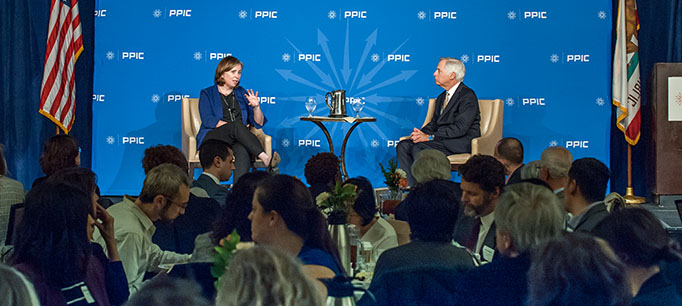
As the Newsom administration lays out its initial plans, PPIC invited chief of staff Ann O’Leary to discuss some of the governor’s top priorities. In a wide-ranging discussion with PPIC president Mark Baldassare last week, O’Leary identified the “cost crisis” in California as one of the main challenges that Governor Newsom plans to address.

“By ‘cost crisis,’ I mean how do we make sure that people in California can have affordability and the opportunity to really take advantage of the California dream?” O’Leary said. “I think too many people in California are really seeing that slip away. They’re not able to afford homes, they’re not able to afford child care, and they’re not able to pay for college for their children as they grow older.”

O’Leary pointed out that confronting this cost crisis would take many forms, such as taking on health care affordability, investing in “cradle to career” education, and addressing housing production and rising rents.

She underscored that the governor’s first proposed budget reflects his vision for promoting affordability and opportunity while ensuring the state’s long-term financial stability. Newsom’s plan includes a mix of one-time and ongoing funding as well as a robust rainy day fund, but “we also go further than that. We have a reserve fund for the safety net, and we also look at how we could use some of the surplus to pay down pension liabilities.”

The governor has also focused on other key challenges—for example, responding to wildfires and tackling the unmet need for safe drinking water in many parts of the state.

On wildfires, O’Leary noted that the governor wants to “make sure that we’re continuing with those recovery efforts to help communities that have been harmed, but also to prepare for future wildfires.” On drinking water, O’Leary said that the governor has already worked with the legislature to provide $20 million in emergency funding to address this issue.

Navigating the PG&E bankruptcy filing is another immediate priority. O’Leary said that over the next 60 days the governor’s team would be creating a roadmap for the state to “protect wildfire victims, protect employees who are out there every day trying to make sure we’re safe, and make sure fundamentally that we have safe and affordable power and that we’re meeting our clean-energy goals.”

O’Leary also discussed the federal-state relationship and how the governor plans to manage it. While pointing out that the state and federal governments need to work together as much as possible, O’Leary also underscored that California must stand up for its values when fundamental disagreements exist, especially on issues such as immigration and family planning. “These are differences of opinion. And it’s a needle we have to thread, but we’re going to do our best.”

Declining K–12 Enrollment Forces Major Budget Cuts in Many Districts

The teacher strikes in Los Angeles and Oakland reflect the fiscal stresses facing many school districts across the state. Rising pension and health care costs account for some of this pressure. For many districts, declining student enrollment is another factor.

Because state funding is based on average daily attendance, falling enrollment leads to lower state funding levels. Significant, sustained declines require districts to make difficult decisions to stay afloat financially. Since an average of 82% of K–12 spending goes to salaries and benefits, downsizing often means reducing teachers and administrators—or possibly closing a school.

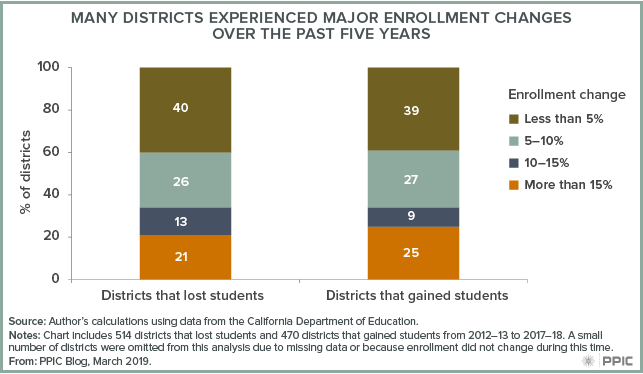
Over the past five years, overall K–12 enrollment in California increased by only 0.1%, or 6,600 students out of the more than 6.2 million attending public schools. This stable picture masks significant variation across districts. Roughly half of the state’s nearly 1,000 districts experienced enrollment losses, while the other half grew over this time. In many cases, the change was small: about 40% of districts experienced a net change—gain or loss—of less than 5% from 2012–13 to 2017–18.

However, the majority of districts saw an enrollment change of more than 5%. Indeed, 107 districts lost more than 15% of students. These districts were generally small: the average school had 700 enrolled students in 2012–13 and lost more than 170 students over the five-year period. In some cases, these large enrollment losses were associated with the closing of a charter school. Many of these districts, though, have only one school, and large percent reductions in enrollment require significant cuts in teachers, administrators, and other staff.

Many Districts Experienced Major Enrollment Changes Over the Past Five Years

Many large districts also lost significant numbers of students over the past five years. In Los Angeles County, for instance, 61 of 79 districts experienced enrollment declines—including Los Angeles Unified, which lost 34,000 students (a 5% decline) and Long Beach Unified, which lost almost 7,600 students (9%). In addition, seven districts with more than 10,000 students lost between 10% and 15% of enrollment. For a district of 10,000 students, losing 10% of enrollment translates into 1,000 fewer students—equal in size to two typical elementary schools. For example, Montebello Unified saw a dramatic 13% decline, losing more than 4,000 students during the five-year period.

Declining student enrollments can be due to a wide range of factors—changes in charter school enrollments, decreasing birth rates, or families moving away, among others. Laying off teachers and adminsitrators is painful—and closing schools is a particularly wrenching topic, as parents value their local schools.

Governor Newsom’s proposal to help districts with rising pension costs may relieve some—but not much—of the financial pressure for districts. K–12 financing in California is also affected by voter-approved initiatives that make significant school funding increases unlikely in the near term. There’s no easy solution, but unless these dynamics change, districts will need to learn to adjust to long-term enrollment and revenue reductions or face the risk of insolvency.

Will the Governor’s Budget Reduce the Heat on School Districts?

Last week Los Angeles district leaders reached a deal with public school teachers to end the city’s first teachers’ strike in 30 years, agreeing to higher teacher salaries, smaller class sizes, and more support staff. The strike was the culmination of long-brewing tensions over the amount and allocation of funds in California’s largest school district. Many other districts in the state are facing similar challenges, as the demand for resources grows faster than the available dollars.

Earlier this month, the governor’s first budget proposal acknowledged some of these broader difficulties. The 2019–20 spending plan proposes $3 billion in one-time payment to CalSTRS, the main teachers’ retirement system, on behalf of schools (separate from the General Fund K–12 spending determined by Proposition 98). The proposal also includes $1.1 billion to pay down a portion of the state’s share of the estimated CalSTRS liability.

The proposed $3 billion CalSTRS payment could take some financial pressure off school districts. Funding for schools is determined by two main formulas. First, total statewide funding is determined by applying a formula (Proposition 98) to the expected revenue from state and local property taxes. Then, another formula (the Local Control Funding Formula) is used to determine the bulk of the dollars available to individual school districts.

Distributing resources in this manner means local school districts, even one as large as Los Angeles, have limited control over the total amount of dollars they have to work with. But the demand for those dollars is constantly going up as districts find themselves paying more—overall and in particular areas such as special education services, health care premiums, and pensions. Pensions are especially challenging, as legislation passed in 2014 mandated that school districts’ share of teacher pension contributions would rise from 8% (2013) of their teacher payrolls to 19% by 2020. This increase will drive annual pension contributions to more than $1,000 per student in most local school districts.

How much relief might the governor’s proposed payment provide? The answer is some, but not much. The governor’s budget document states that the payment “will reduce the out-year contribution rate by half a percentage point.” Given that number, the expected relief amounts to an annual savings of around $25 per student. In large districts such as Los Angeles, this adds up to tens of millions of dollars annually, but districts with lower enrollment numbers will see more modest financial gains.

The CalSTRS payment proposal is a departure from prior state budgets. First, it represents an acknowledgment that, despite recent increases in total education spending, school districts still face fiscal challenges. Second, it proposes to direct non–Proposition 98 funds, making it a de facto increase in total K–12 resources. School district administrators are likely to appreciate both. However, the proposal still needs the legislature’s approval, and it’s not clear whether it would significantly relieve fiscal pressures on districts.

Whether the one-time CalSTRS payment represents a shift in future policy remains to be seen. If it is in fact only a one-time payment, the impact on the resources available to schools will be welcome but modest. It may, however, signal a different approach to education funding in the long run—something that would be worth watching.

Video: John Cox’s Priorities

Businessman John Cox, candidate for governor in 2018, was asked in a San Francisco forum last week to name the top three issues that will have major consequences in California’s future. Mark Baldassare, PPIC president and CEO, posed the question, which has been answered by all gubernatorial candidates appearing before PPIC audiences.

Cox said his top priorities are:

  • Removing the “corruptive” influence of special interest money. “The idea that special interests fund the campaigns of people they are looking to to get things done—it’s an indefensible system,” he said. “I don’t necessarily think that we send a whole bunch of corrupt people to Sacramento,” he said. “The trouble is, it’s a corrupt structure.” Legislators, he said, “are almost required to be professional fundraisers.”
  • Making the state more affordable and improving the business climate. The cost of housing, electricity, gasoline—the essentials to quality of life—are pushing the middle class into “almost-poverty situations,” Cox said, adding that improving the business climate is also essential so that the state can grow.
  • Addressing state employee pension debt. Cox said an overly generous legislature as well as governors and special interests have created a “debt bomb.” Our unfounded pension debt is a “sword of Damocles hanging over our economy,” he said.

How would Cox diminish the influence of special interests? He is sponsoring the Neighborhood Legislature Reform Act, which he hopes to qualify for the statewide ballot. The initiative calls for carving up each assembly and state senate district into 100 neighborhoods, each with its own representative. The 100 representatives in each neighborhood district would meet to choose one to go to Sacramento. In other words, there would still be just 120 legislators meeting in the Capitol. With districts that number just a few thousand households, candidates could run campaigns with a few hundred dollars, Cox said. The idea, he said, is that “you don’t need money to run a race.”

The conversation with Cox is part of the PPIC Speaker Series on California’s Future. PPIC is inviting all major candidates for governor to participate if they reach a certain threshold in the polls. The goal is to give Californians a better understanding of how the candidates intend to address the challenges facing our state.

Watch all candidate videos.

Video: Gavin Newsom’s Priorities

Gavin Newsom, California’s lieutenant governor and a candidate for governor in 2018, was asked in a San Francisco forum last week to name the three issues that will make the biggest difference in California’s future. Newsom, who is also a former mayor of San Francisco, predicted that both California and the nation will be grappling with these issues over the next ten years:

  • Debt and demographics. With California’s population aging rapidly, the state and its cities face growing public employee pension and health care liabilities. “As a progressive Democrat, I’m not naïve about the commitments we’ve made and the commitments we must fulfill,” Newsom said. “Nor am I naïve, as a former mayor, about the challenge of meeting those commitments . . . Cities like Richmond are facing the prospect that by 2021, by one estimate, upwards of 40% of their general fund will go to retiree contributions.”
  • Energy and climate change. The state has set ambitious goals to reduce greenhouse gas emissions and increase energy efficiency. “The next governor has to deliver,” he said.
  • Information technology and globalization. “The issue that animates my anxiety: work, the future of work.” The days of having a job or career have given way to something radically different, forcing us to think in terms of portable benefits and retirement security, he said. Further, workers in retail, food and beverage, and clerical jobs—the top employment categories—are on the “edge of automation.” Displacement of these workers will require us to have a different conversation about skills, education, and social mobility, Newsom said.

The conversation with Newsom was part of the PPIC Speaker Series on California’s Future. PPIC is inviting all major candidates for governor to participate in a public event if they reach a certain threshold in the polls. The goal is to give Californians a better understanding of how the candidates intend to address the challenges facing our state.

Watch all candidate videos.

Video: Survey Looks at Taxes and Pensions

As interest groups work to turn their ideas into initiatives for next year’s statewide ballot, the September PPIC Statewide Survey examined Californians’ views in two areas that may be put before voters in 2016: taxes and public employee pension reform.

Mark Baldassare, PPIC president and CEO, and Dean Bonner, associate survey director, presented the findings at a briefing in Sacramento last week.

Among the survey findings:

  • Half of likely voters favor extending the tax increases in Proposition 30 temporarily, but just a third favor making them permanent.
  • There is bipartisan support for raising taxes on cigarette purchases.
  • A majority of likely voters favor changing Proposition 13 to tax commercial properties according to their current market value.
  • Solid majorities of Californians see public pension spending as a problem, and most think voters should weigh in on changes to the system.
  • Most likely voters favor placing new public employees in a defined contribution system, similar to a 401(k) plan, rather than a defined benefits system.

The survey shows that Californians give their state leaders—the governor, legislature, and their own legislators—high approval ratings at the close of the legislative session. Baldassare offered his explanation at the briefing: there was little drama around the budget, the economy’s going well, and very few respondents in the survey mentioned fiscal issues as the most important ones.

Congress, on the other hand fares far less well in Californians’ eyes. Its 17% rating is not only much lower than the ratings likely voters give their state leaders, it is much lower than those of President Obama, Senators Barbara Boxer and Dianne Feinstein, and Californians’ own representative in the US House.

“Congress is a government institution that needs work, according to most Californians,” Baldassare said.

California–State of Change

As leaders from government, business, and philanthropy gathered last week to discuss California’s future, we were reminded once again that these are exciting times in our state. The discussions were part of PPIC’s full-day conference, California—State of Change, and they highlighted both the advantages our state enjoys and the major challenges ahead.

Speakers noted that the recovering state economy, newly elected state leaders, a richly diverse population, and a history of innovation provide much to build on—as well as a lot of building to do. For example, California has recently enacted sweeping changes in corrections and education finance. But, as the governor’s chief aide, Nancy McFadden, emphasized in her keynote address, most of the hard work of implementing these policies lies ahead.

Among other challenges noted in the subsequent panel discussions: a state tax structure that leads to extreme revenue volatility, a need for public employee pension reform, an uneven economic recovery that has left many Californians behind, government institutions that do not provide the tools for managing in the 21st century, and an electorate that is disengaged from the political process.

But, as other speakers reminded us, Californians are living in a time of reform. A change in term limits may lead to more stability in the legislature and result in more long-term policymaking. Recent initiatives to shift many school decisions from the state to the district level and to move state corrections responsibilities to the counties could make local governments labs for innovation—but only if we have the will and the data to evaluate the results.

Our final panel demonstrated that California still knows how to dream big. The discussion focused on three projects: a historic effort to combat climate change, the construction of high-speed rail, and the advancement of stem cell research. All have been controversial, but they show that California voters and elected officials embrace innovation, as they have throughout the state’s history. 

We invite you to watch the videos of each session. We hope you find the conversations as thought-provoking as we did.