Do Californians Support the Proposed School Bond?

When Californians go to the polls in March, they will not only cast a vote in the presidential primary—they will also vote on an education bond to fund construction and modernization projects. Given differences in support for the bond across the state’s regions and demographic groups, turnout will play a pivotal role in whether this measure passes.

In the closing days of the legislative session, the legislature passed and the governor later signed a bill placing Proposition 13 (the Public Preschool, K–12, and College Health and Safety Bond Act of 2020) on the March ballot. If approved by voters, the measure would authorize $15 billion in general obligation bonds to pay for the construction and modernization of California’s public schools, community colleges, and four-year colleges.

The September PPIC Statewide Survey took an initial look at support for this proposition. While two-thirds of Californians (66%) are in favor, 54% of likely voters say they would vote yes—just slightly above the majority needed to pass.

Are some Californians more likely than others to support the bond measure? Unsurprisingly, there is a wide partisan divide, with three in four Democratic likely voters (76%) saying they would vote yes compared to just three in ten Republicans (29%). Overall, independent likely voters are divided (48% yes, 44% no). But among Democratic-leaning independents, nearly two in three (64%) are supportive.

Support varies across regions, with Los Angeles (59%) and San Francisco Bay Area (57%) likely voters expressing the most support, compared to about half of likely voters elsewhere in the state.
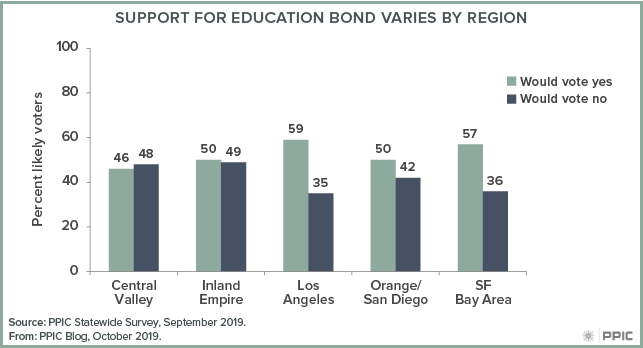
figure - Support for Education Bond Varies by Region

While support is similar among likely voters with (55%) and without (53%) children in the house, there are differences across other demographic groups.

White likely voters (47%) are much less likely than Latinos (74%) and those of other racial/ethnic groups (62%) to say they would vote yes. And since school construction bonds are often paid off by property taxes, it’s notable that homeowners (44%) are far less likely than renters (71%) to say they would vote yes. Support is higher among younger likely voters (66% age 18 to 44, 48% age 45 and older). It declines as education and income levels increase.
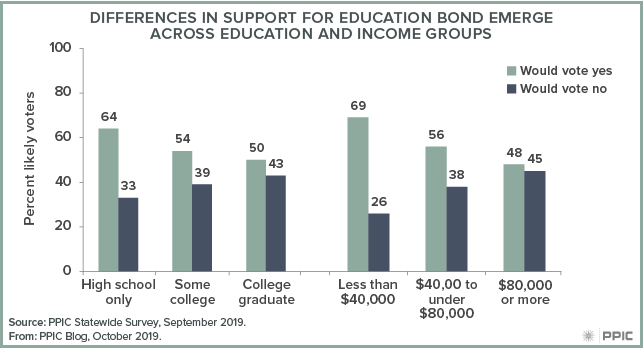
figure - Difference in Support for Education Bond Emerge Across Education and Income Gaps

Overall, support for the education bond currently hovers at around half for likely voters, but there is much stronger support among many regional and demographic groups—suggesting that passage could depend on who shows up to vote. If Democrats and Democratic-leaning independents turn out in large numbers for the presidential primary, that could affect the fate of this bond. Stay tuned to the PPIC Statewide Survey as we continue to track this measure in advance of the March primary.

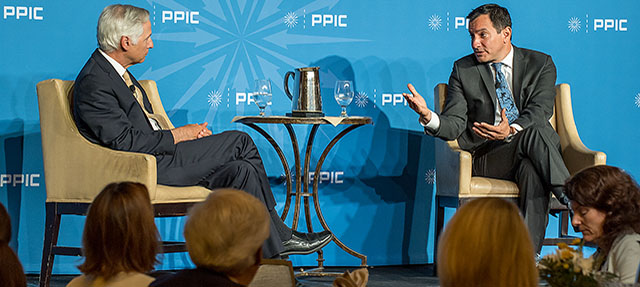
Video: Improving Educational Opportunity in California

What is the one thing that could be done to improve educational opportunity in California? Mark Baldassare, PPIC’s president and CEO, posed this question at the start of his conversation with Linda Darling-Hammond, president of the California State Board of Education, and Eloy Ortiz Oakley, chancellor of the California Community Colleges.

Darling-Hammond responded with a list of five major characteristics of school systems in other countries and states that have closed “opportunity gaps”: an equitable, adequate funding system; high-quality teachers and leaders; a thoughtful curriculum and assessment system; wrap-around support for students; and schools designed to allow for productive learning.

Then she circled back to California’s “number one thing”: “We’ve got to fix the teacher shortage—and we’ve got to do it quickly, purposefully, and soon.”

For Oakley, the “one thing” is to change “how we look at education, how we look at opportunity in California.” In short, we need to stop providing “the least amount of resources to the students, the communities that need them the most.”

A key part of this change involves “blurring the line” between the K–12 (or “TK–12”) and community college systems. Oakley noted: “There was a point in time when we felt that a high school diploma was the default to get into the workforce. Those days are gone. . . .We need to see the path to community college as the required path for everybody to get some sort of post-secondary credential.”

Darling-Hammond agreed that the two systems can and should work together. A good example of productive collaboration, she added, is concurrent enrollment, which allows high school students to take college courses (and earn college credit). These programs help students “find their passion” and move toward meaningful careers.

Funding is another key issue for both systems. Darling-Hammond pointed to the impact of significant post-recession increases in funding during the Brown and Newsom administrations and the potential impact of the governor’s commitment to early childhood education. But, she added, “just to get to the national average . . . we need about $12 billion more in the TK–12 system.”

Oakley agreed that “for those of us who managed our way through the recession, we’re certainly in a much better place.” The community college system could certainly benefit from more funding, he added, but state investments in early childhood education might be even more beneficial: “If we could prioritize the funding at the lowest level, for the youngest learners, that would make our job in the community colleges easier.”


Video: A Conversation with Assembly Speaker Anthony Rendon

When Anthony Rendon was elected to the California State Assembly in 2012, he thought he would focus on early childhood education. “I came to Sacramento after working in early childhood education for 20 years . . . probably thinking that I would work on that.” However, he continued, “You come here and you realize the extent to which all of these issues impact one another. I think it’s dangerous to isolate any single issues.”

As he noted in his conversation with PPIC’s Mark Baldassare last Thursday, Rendon has focused on many individual measures in this legislative session, including a recently signed bill to modify the criteria for police use of deadly force and a bill to address predatory lending. In the wake of the Gilroy shooting, he has also prioritized a package of gun control bills. He sees these measures as part of a broader focus on improving opportunity for all Californians.

Rendon became Speaker in 2016, when Jerry Brown was governor. At first, he found working with Brown to be “a little frustrating,” but “eventually, we did a lot together. . . . There was a very narrow focus, two or three things—criminal justice reform, climate change, but that was about it. Those are still the things he cares about.” Governor Newsom focuses on a wider range of issues. And, Rendon said, “He’s also more sort of open-ended. He’ll come in and say, ‘Hey, housing, what do you think?’”

One of the issues Newsom cares about is early childhood education—which is still a major priority for Rendon. While Brown “helped us to start down the path” to reinvesting in this area, “now we have a governor who believes that . . . it has a positive impact on families and communities and children.” Newsom’s belief translated into significant funding increases for early childhood education in this year’s budget. “The budget was phenomenal,” said Rendon. Early childhood education is particularly important, in his view, because it’s “not trying to fix something that’s already broken. It’s a way of addressing issues early on, it’s a way of breaking the cycle of poverty.”

Although the Democratic Party controls both the governor’s office and the legislature, Rendon believes it’s important to work with Republicans whenever possible. He sees some common ground on issues such as climate change and education—“the real issues that really impact Californians.” More generally, it is important that state leaders represent all Californians: “I want to be able to tell people . . . ‘I’m working for you.’”


Californians See Preschool as Important

Early childhood education, a policy priority for Governor Newsom, is viewed as important by an overwhelming majority of Californians. In the April 2019 PPIC Statewide Survey, 78% of Californians and 88% of public school parents said that attending preschool is important to a student’s academic success in kindergarten through grade 12.

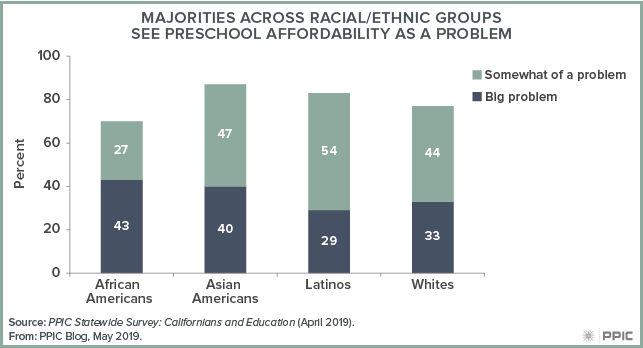
A similar share of Californians (80%) see the affordability of preschool as a problem. Democrats (46%) and Independents (38%) are much more likely than Republicans (25%) to say that it is a big problem. A majority across regions see affordability as a problem, with San Francisco Bay Area residents (42%) most likely to feel that it is a big problem. Across racial/ethnic groups, African Americans and Asian Americans are more likely than whites and Latinos to say that affordability is a big problem.

figure 1 - Majorities across Racial/ethnic Groups See Preschool Affordability as a Problem

Governor Newsom has proposed new funding that would address some of these affordability concerns. In April, we asked Californians if they were in favor of or opposed to the governor’s initial budget proposal from January, which allocated $125 million to expand full-day, full-year preschool to all eligible low-income four-year-olds. A majority of Californians—about two in three adults and three in four public school parents—favored this proposal. In addition, majorities across all demographic groups and regions favored it. In the May budget revision, the proposed funding was reduced to $31 million, which would pay for 10,000 new full-day preschool slots starting April 2020.

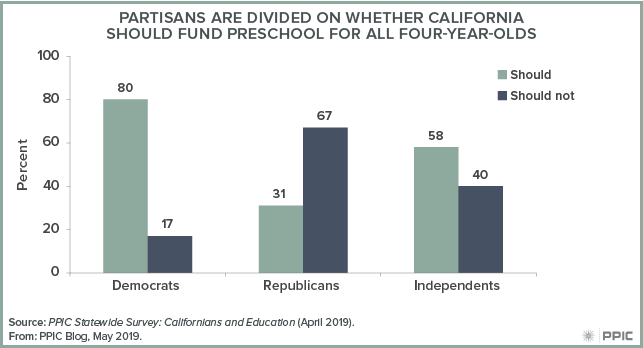
There is slightly less support for state-funded preschool in general: six in ten adults say that the government should fund voluntary preschool programs for all four-year-olds. State-sponsored preschool is a highly partisan issue, with Democrats much more likely than independents or Republicans to express support.

figure 2 - Partisans Are Divided on Whether California Should Fund Preschool for all Four-year-olds

With the release of the governor’s revised spending plan on May 9, the state budget process is well under way; the deadline for enacting the final budget is June 15. PPIC will continue to monitor the governor’s proposed allocations for early childhood education and the opinions of Californians on the issue.

Video: A Conversation with Chief of Staff Ann O’Leary

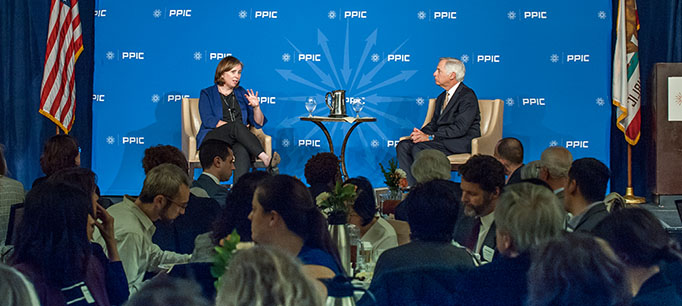
As the Newsom administration lays out its initial plans, PPIC invited chief of staff Ann O’Leary to discuss some of the governor’s top priorities. In a wide-ranging discussion with PPIC president Mark Baldassare last week, O’Leary identified the “cost crisis” in California as one of the main challenges that Governor Newsom plans to address.

“By ‘cost crisis,’ I mean how do we make sure that people in California can have affordability and the opportunity to really take advantage of the California dream?” O’Leary said. “I think too many people in California are really seeing that slip away. They’re not able to afford homes, they’re not able to afford child care, and they’re not able to pay for college for their children as they grow older.”

O’Leary pointed out that confronting this cost crisis would take many forms, such as taking on health care affordability, investing in “cradle to career” education, and addressing housing production and rising rents.

She underscored that the governor’s first proposed budget reflects his vision for promoting affordability and opportunity while ensuring the state’s long-term financial stability. Newsom’s plan includes a mix of one-time and ongoing funding as well as a robust rainy day fund, but “we also go further than that. We have a reserve fund for the safety net, and we also look at how we could use some of the surplus to pay down pension liabilities.”

The governor has also focused on other key challenges—for example, responding to wildfires and tackling the unmet need for safe drinking water in many parts of the state.

On wildfires, O’Leary noted that the governor wants to “make sure that we’re continuing with those recovery efforts to help communities that have been harmed, but also to prepare for future wildfires.” On drinking water, O’Leary said that the governor has already worked with the legislature to provide $20 million in emergency funding to address this issue.

Navigating the PG&E bankruptcy filing is another immediate priority. O’Leary said that over the next 60 days the governor’s team would be creating a roadmap for the state to “protect wildfire victims, protect employees who are out there every day trying to make sure we’re safe, and make sure fundamentally that we have safe and affordable power and that we’re meeting our clean-energy goals.”

O’Leary also discussed the federal-state relationship and how the governor plans to manage it. While pointing out that the state and federal governments need to work together as much as possible, O’Leary also underscored that California must stand up for its values when fundamental disagreements exist, especially on issues such as immigration and family planning. “These are differences of opinion. And it’s a needle we have to thread, but we’re going to do our best.”

Video: A Conversation with California’s Legislative Leadership

When Toni Atkins, President Pro Tem of the California State Senate, sat down to talk with PPIC president Mark Baldassare last week, she brought along a list of pressing issues. Asked to name the top two issues facing the state, she led off with housing: “The growing crisis around the lack of housing supply for all levels of Californians is one of our most critical issues.” Next came climate change and its effects across California. And then she added a third issue: water sustainability. In reality, she said, “there is always a list of issues and challenges that we are working on in California.”

Despite this long list, Atkins was optimistic about the legislature’s chances of working productively with Governor Newsom. “It’s early, but I would say that what I appreciate and enjoy about Governor Newsom is he really is a policy wonk at heart.” She added that while Jerry Brown and Gavin Newsom share many priorities, the two have very different styles. “Jerry Brown proposed a budget and he only wanted a few things,” while Governor Newsom “has thrown everything out there.”

After noting that it will be interesting to see how the legislature approaches this year’s budget process, Atkins highlighted the governor’s focus on homelessness and mental health issues and his commitment to early childhood education—which, she added, has been “a huge driving issue for the legislative women’s caucus.” She expressed particular interest in the governor’s proposal to “take juvenile justice offenders out of CDCR—the California Department of Corrections and Rehabilitation—and into more of a health/social services arena.”

Shifting from the state budget process to the ongoing drama over the budget—and border wall—at the federal level, Baldassare asked Atkins about the state government’s response to what is happening in Washington, DC. “You know, I’m so glad to be in California,” she replied. Citing the state’s diversity and the policies that foster it, she said that “to have that attacked in many ways at the federal level means all of a sudden you’ve got California really promoting state’s rights, to protect our policies, our values, and things that we hold dear.”

Atkins tended to be optimistic about even the thorniest issues—such as forestry management, building more housing, and water sustainability. Speaking about the cluster of issues related to climate change, she said, “Maybe the result of these catastrophic fires, and floods, and mudslides—maybe that is the way we’re now able to have a conversation we couldn’t have five years ago, before it was a crisis.” But she added that in order to move an agenda forward, “you’ve got to still have all the stakeholders at the table.”

More generally, Atkins stressed the importance of representing all Californians, regardless of party: “I think we have work to do together.”

Public Preschools Support Education, Work

As policymakers discuss California’s system of early childhood care and education, it is useful to look more closely at the families who use it—or might like to. Public preschools—enrolling four-year-olds and some three-year-olds—hold promise for improving school readiness and later life outcomes, particularly for low-income students who may not otherwise have access to high-quality preschool experiences. At the same time, publicly provided early education also serves a second goal: supporting work among low-income parents.

Full- or part-time work is typical among California’s low-income families with preschool-aged children. For a family of three, low-income means living on $37,167 a year – which is 185% of the federal poverty line, a threshold used to designate economic disadvantage in the K-12 education context. Among all such families, just 11% report no adults working in the past year. Lack of work is much more common in single-parent families (34%) than in families with two or more adults (6%). Research shows that access to subsidized child care raises employment among single mothers, suggesting that the larger percentage of single-adult families reporting no work reflects in part a lack of viable childcare options.

Most low-income preschool age children live in families with two adults (64%). Far fewer of these families than single-parent families report no work (7%); the share with both adults working full-time, year round is only 8%. The remaining 85% of low-income families with preschool-aged children and two adults rely on a combination of full-time and part-time work. In about a quarter of two-parent families, no adult has full-time work. This complexity reflects multiple factors—including opportunities for employment and family choices about care for young children.

In the context of a policy discussion about preschool, why are these patterns important? Working parents will be more likely to enroll their children in programs that align well with their work schedules. Non-working parents are more likely to seek work if they have reliable child care. Given that employment is a central piece of the financial picture for most California families, whether low-income or not, it is critical that policymakers keep the dual purposes of early care and education in mind as they consider ways to improve the system of public preschool in California.

Learn more
Just the Facts: Public Preschools in California
Just the Facts: Californians and Early Childhood Education
Just the Facts: Child Poverty in California