Special Elections Preview Fall Voting during COVID-19

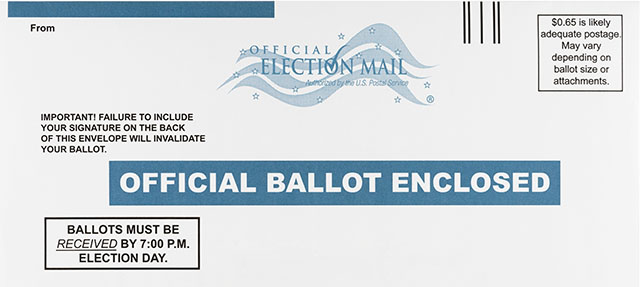
Given the risk of transmitting the novel coronavirus, Governor Newsom has mandated that all California voters receive a vote-by-mail ballot for the November election; socially distant in-person voting options are being worked out. This approach was taken for two recent special elections—one in Congressional District (CD) 25 in north Los Angeles and eastern Ventura Counties, and one in State Senate District (SD) 28 in Riverside County. Both were runoffs, and both first-stage elections coincided with the March 3 presidential primary. Some observers are looking to these elections as test cases for November.

Over the past 30 years, when one stage of a special election has coincided with a regularly scheduled election and the other has not, the stand-alone election has always had lower turnout. On average, the difference has been 25%. In the May run-off election, however, turnout in the LA portion of CD 25 was slightly higher than turnout in March (38%, compared to 36%, as of May 19).

LA County was able to offer in-person voting as an option in both elections because it had already replaced traditional polling places with a smaller number of in-person “vote centers” open to all voters in the county. That may explain some of the strong turnout, but the shift away from polling places was more abrupt in the Ventura portion and turnout increased from 51% to 55%. And Riverside’s SD 28, where the shift was also sudden, saw only a modest drop in turnout (44% to 38%).

We should be careful not to draw too many conclusions from these numbers. Some of the turnout dynamics reflect the competition in each race. In CD 25 in particular, the runoff was unusually interesting for Republicans compared to the March 3 primary, so many more were probably motivated to vote.

More important, the fall will be a very different experience, involving more than 40 times as many voters in all 58 counties with a wide range of backgrounds. The scale of the response must expand to match. Neither Ventura nor Riverside was able to offer in-person voting. That has to change for the fall. Voters who prefer to cast ballots in person tend to come from populations that are already underrepresented. The question is not whether but how many in-person voting sites can be made available.

Nonetheless, the strong turnout in these special elections is a hopeful sign. There is still much work to be done, but it may be possible to conduct a fall election that is both safe and fair.

Video: Californians and Education

In the era of COVID-19, about eight in ten adults fear getting sick, and 80% expect bad economic times ahead. At a virtual briefing on Thursday, PPIC researcher Alyssa Dykman said the drop in consumer confidence “is unprecedented in the history of the PPIC survey.”

The event featured Dykman, who presented attitudes on K–12 education, funding, and policy preferences along with concerns over the coronavirus pandemic in the latest PPIC statewide survey. PPIC President and CEO Mark Baldassare supplied deeper context for key findings and responded to online questions.

Approval ratings have hit rare numbers: at 78%, approval has surged for Governor Newsom’s handling of K-12 education, and at 92%, public school parents express overwhelming support for school district handling of school closures. COVID-19, however, has shaken support for school bonds, with about half or fewer adults and likely voters saying it’s a good idea now for state government to fund school construction projects.

Baldassare underscored Californians’ concerns around health and finances, stating that two-thirds of adults are worried about both. Many say their lives are disrupted and about half say the stress is affecting mental health.

What do these concerns mean for California schools? “People are giving state leadership and local leadership a lot of leeway in how they respond to the public health and economic crisis,” Baldassare said. But the state will see its first test of this extraordinary support in May, when the governor submits a revised budget that will reflect revenue loss from a sharp economic downturn.

That may also lead to roadblocks for state and local school funding in November. In the March primary, “the defeat of most of the local school bond measures really caught a lot of people by surprise,” Baldassare said. “It was difficult to pass school funding measures.” At the moment Californians are hesitant to commit more funding to schools, which may impact voting on the split-roll property bond measure and others in the November election.

The survey offers several takeaways around planning for California public education. “We’ve never had anything like the school closures that are taking place,” Baldassare said. He reflected that Californians may reconsider the value of teachers going forward, including whether “teachers have the resources they need in order to do the job,” and noted that the public may have “a new understanding of the important and difficult role teachers play every day in the lives of public school children.”

Californians also may now recognize the struggles of vulnerable students, especially in terms of online access.

“It is going to be a test of Californians’ political will,” Baldassare said, “the degree to which we are committed to improving student outcomes, particularly among the large numbers of English language learners and low income students across the state.”

School Funding, COVID-19, and the 2020 Election Year

This post is excerpted from Mark Baldassare’s prepared remarks for the PPIC Statewide Survey virtual briefing on April 23, 2020.

State funding for K–12 public schools will take center stage when Governor Newsom unveils revisions to the state budget in a few weeks. The growing fiscal toll of the COVID-19 crisis is likely to affect school funding plans as a deep economic recession looms. K–12 schools have the largest share of the state General Fund, and many Californians say it is their top priority for state spending. Still, California voters seem to be pulling back their support for school funding on ballot measures.

One of the biggest surprises in the March 3 primary was the defeat of the Proposition 13 state school bond (53% voted no). The last time a state school bond failed to pass was back in 1994. Proponents have tried to explain away this loss as confusion caused by the number 13—the same as the notorious anti-tax initiative that passed in 1978.

However, outcomes of local school bond measures point to a different story. Bucking recent trends, 63% of local school bonds on the March primary ballot failed to reach the 55% threshold needed to pass. It may be that early anxieties about COVID-19 resulted in voter caution about extending debt. In the absence of exit polls to validate this theory, the April PPIC Statewide Survey sheds light on what may have happened. It also offers sobering news for efforts to convince voters to support school funding measures in the November election.

First, though, let’s dispense with the notion that views about school funding have fundamentally shifted. Today, 55% of California likely voters say that state funding for their local public schools is not enough. And 53% would vote yes on a state school bond while 50% would vote yes on a local school bond. Moreover, 53% percent would vote yes on a split roll property tax to fund local public schools—a measure that appears headed for the November ballot. All of these results today are similar to those last April, suggesting that basic attitudes about school funding are fairly stable.

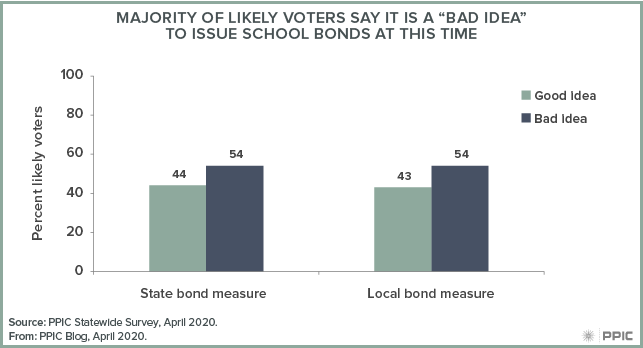
But current conditions appear to be having a strong effect on the timeframe for public support. Our survey was conducted from April 1 to 9—roughly a month from the primary and a few weeks into stay-at-home orders. We find that most likely voters say it is a “bad idea” to issue state (54%) or local (54%) school bonds at this time. Majorities of Californians without children in public school agree (bad idea: state 56%, local 57%). Fewer than half across the state’s regions say it is a good idea to issue these bonds now. Only those with children in public school think that it is a good time to issue state (57%) or local school bonds (58%).

figure - Majority of Likely Voters Say it is a “Bad Idea” To Issue School Bonds at this Time

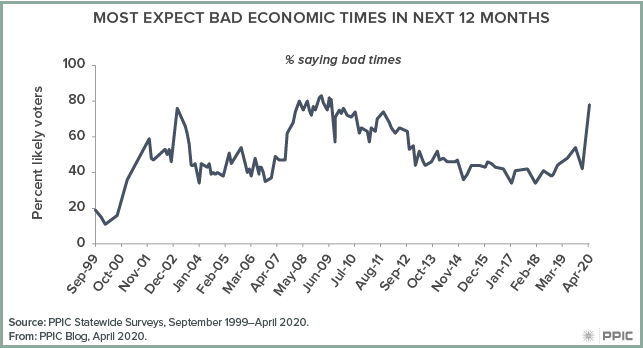
Why? Californians have had their world shaken by the COVID-19 crisis. Since January there has been a 36-point increase in expectations for bad economic times in California over the next 12 months (42% to 78%)—sending us to depths of consumer pessimism not seen since the Great Recession. And right now, 74% percent are worried about negative impacts of the coronavirus on their personal finances.

figure - Most Expect Bad Economic Times in Next 12 Months

This pessimism is likely to have profound implications for school funding measures on the November ballot. The state’s fiscal and economic problems will weigh heavily on voters’ minds when they are asked to make decisions on spending, taxes, and bonds. Many may be reluctant to ask taxpayers (like themselves) to foot the bill, or to increase commercial property taxes, to make up for shortfalls in school funding.

We can also expect a rocky road ahead for the governor and state legislature. Although our April survey found a steep rise in the governor’s and legislature’s approval ratings around handling K–12 public education, state leaders now face the prospect of having to cut back on popular plans to increase school funding. During the Great Recession, we saw the governor’s and legislature’s approval ratings tumble with state budget cuts to local schools.

Our surveys will be closely monitoring all of these dynamics as California heads toward a much-anticipated November presidential election.

Will Mail-in Ballots Benefit One Party?

If coronavirus is still active during this November’s presidential election, the risk remains of spreading the virus among voters and poll workers. The best solution is to limit in-person options and rapidly expand the number of voters who submit ballots through the mail.

This is the right choice for public health. But a debate around the degree of change needed is reasonable: how many mail-in ballots and how many polling places are needed to both keep people safe and allow fair access? And lurking in the background are darker questions: does one party stand to benefit as vote by mail expands? Is this a partisan game masquerading as a question of public health?

The short answer to both questions is no. On the surface, there might seem to be a partisan angle. Many Democrats have pushed for expanding vote by mail, while President Trump has firmly stated it would hurt Republican candidates. States friendly to voting by mail tend to vote more Democratic, while some Republican-leaning states like Texas have resisted more voting by mail even in the pandemic. And Californians who vote by mail are older and more likely to be white, demographics that also vote more Republican on average.

But these scenarios describe the status quo; they don’t tell us how election results might change if vote by mail became more widely available. When election jurisdictions—including some California counties—have rapidly expanded vote by mail, neither major party has clearly benefited. Likewise, early evidence from experiments with heavy vote by mail in California suggests an increase in turnout among Latinos, Asian Americans, and young people of up to seven percent, though often with a fair amount of statistical uncertainty.

The same analysis suggests overall turnout increased about two to three percent, making it difficult to say that the composition of the electorate changed much in the end. Thus, while the greater convenience of vote by mail does seem to draw in a few more voters, these voters aren’t that different on average from the ones who show up already.

The demographic differences between in-person and by-mail voters are real, but should not be overstated. People from all backgrounds and political persuasions vote in person. All of them will be at risk in an election where coronavirus is still active. Expanding vote by mail is now a pure question of public health and administrative capacity. Neither party should worry that it will put them at a disadvantage.

COVID-19 Will Make California Elections Challenging but Doable

California’s November 3 general election could come in the midst of a new viral surge. This poses tremendous risks to voters and poll workers at in-person voting sites. Even if we wanted to have the same number of polling places, it might be difficult to find volunteers willing to staff them.

The good news is that the transition to a safer approach, while challenging, is more manageable in California than in most states.

One option is off the table: postponing the fall election. Many states have postponed their primaries, but postponing a general election would require congressional approval and would run up against deadlines hardwired into the U.S. Constitution.

Instead, we must get as many voters to cast ballots by mail as possible. In most states, such a switch would be complicated, but California has long been friendly to vote by mail (VBM). California’s VBM rate is very high and growing. Almost two-thirds of ballots in the 2018 general election were either mailed in or dropped off at a polling place.

Fourteen counties have rapidly increased their VBM capacity already by sending every registered voter a VBM ballot by default. They have also replaced polling places with a smaller number of “vote centers” that are open to any voter in the county and for early voting before Election Day. Almost a quarter of registered voters are now covered by this system, up from 7% in the fall of 2018.

Five of these 14 counties switched to this new model in 2018 and saw the share of ballots cast by mail increase an average of 20% from the 2016 general election. Preliminary evidence also suggests the reform slightly increased turnout without negatively impacting underrepresented groups like Latinos, Asian Americans, and young people.

COVID-19 will move elections across the state closer to this model. Governor Newsom has mandated something like this for the special elections coming in April and May. Though this is a realistic path forward, it is not without obstacles. Preparation time is short. And the risk of infection will alter the siting and staffing of in-person options, even in experienced counties.

Furthermore, initial positive experiences in vote center counties may not translate to the rest of the state. A chaotic transition could create unforeseen problems that prompt some to throw up their hands and not vote at all. Young people and voters of color are more likely to use in-person voting, so great care must be taken to ensure they receive news of the change, trust that the change is being done fairly, and have options besides VBM if they want them.

Fortunately, California is well positioned here, too. Organizations like the Future of California Elections have helped make the state a national model for robust communication between election administrators and stakeholders.

The task is daunting, but we have little choice. Our best hope for a safe and fair election is to expand vote from home options as much as possible. The question is not whether to do it, but to recognize the challenges and work to mitigate them as much as possible.

Challenging Times for California

This is a time of global crisis. We are all living through a fast-moving, large-scale disaster that is having extraordinary public health and economic consequences. Here in California, public leaders and private industries took early action to mitigate the effects of COVID-19, putting policies in place to flatten the curve sooner than any other state. And while the full extent of the pandemic has yet to be realized, Californians should feel proud of our state’s ability to assess and respond rapidly to counteract this generational challenge.

The pandemic is touching every aspect of life today. Students, agricultural workers, health care practitioners—all Californians are struggling to adjust to enormous changes in their responsibilities and daily routines. At PPIC, we are thinking about the effects on our state’s most vulnerable populations: seniors living in areas with sparse medical care, children receiving free or reduced price lunches, essential workers struggling to stay above the poverty line.

We are also deeply concerned with what lies ahead. How will our economy—just recently in the longest growth cycle ever recorded—respond in the long term? How can the state improve opportunities for those hardest hit by this crisis? What can we observe, measure, and propose that will help California to rebuild itself efficiently, effectively, and equitably?

PPIC will be delving into these questions as this crisis plays out. For now, in these fluid and rapidly changing times, we are focused on bringing critical facts and information to the table—assessing the state’s economy, people, communities, and environment. Our blog series on COVID-19 provides wide-ranging analyses across key policy areas, from education to health care, from criminal justice to water policy. And the PPIC Statewide Survey will be offering perspectives on the pandemic and the economy from Californians across the state.

For 25 years, PPIC has worked hard to inform and improve public policy in California. 2020 may be one of our most challenging years yet, but we are ready and able to meet that challenge.

For PPIC’s full series on the coronavirus and California, visit our COVID-19 page.

Counting Californians and Holding Elections in a Pandemic

Today is Census Day, the day to count everyone living in the country in 2020. It’s not the deadline for responses—you have until August 14 to complete your census form—just the “anchor day” for counting those living in your household. We talked to California Secretary of State Alex Padilla about the challenges the COVID-19 pandemic brings to counting Californians—and for holding elections in November.

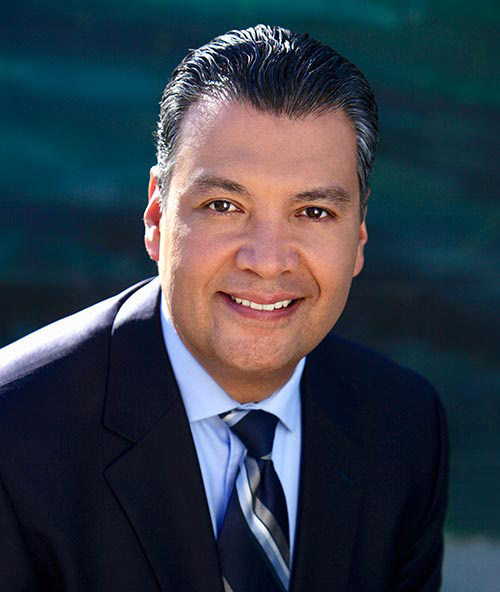
Photo - Alex PadillaPPIC: What challenges does the pandemic bring to conducting the census?

ALEX PADILLA: Ensuring a fair and accurate count is tough under normal circumstances, and it’s made more challenging by this global health pandemic. A lot of the state and local strategies for engaging the public on the census have had to be modified or replaced with ones that are more effective when people are staying at home. The good news is, this is the first time it’s been possible to do the census online, as well as by phone or paper. We’re seeing people get more creative at staying in touch while keeping their distance, whether through video chats with their coworkers or using teleconferencing to stay in touch with family and friends. We can also use these methods to remind everyone to do the census.

It’s really important to remember that participation in the census is how we ensure our communities receive their fair share of federal dollars for critical needs such as public health, education, public safety, housing, and infrastructure. This message is really striking a chord right now.

PPIC: As they shelter in place, what can Californians do to help ensure an accurate census count?

AP: Every Californian should participate in the census, but also remind people they’re in touch with to do so. Assuring a complete and fair count depends on everyone doing the census. It’s not just a count of adults or voters or citizens; it’s for everybody living here.

California has an especially high number of hard-to-count populations—for example, communities of color, young people, and immigrant families and communities. More than 70% of Californians fit into a hard-to-count category. It already takes extra effort to ensure participation by these groups. The pandemic is not making the job any easier—at a time when the job is more important than ever for ensuring the state gets its share of federal funding for critical needs over the next decade.

Based on the prior census 10 years ago, California’s most undercounted population were kids under five years old. My youngest just turned five, and especially now with all the kids at home, it’s hard to imagine forgetting to include him as he’s the loudest member of our household! Today, kids who weren’t counted in 2010 are now teens who’ve been in school for years, but their schools haven’t been getting their full share of federal education dollars. It’s a very tangible way to think about it, and it shows the importance of the census for our quality of life.

There are many options for participating in the census. Go online or call in today. Once you’ve submitted your information, help us by spreading the word with neighbors you’re checking in on and friends and family.

PPIC: Talk about the administration of the upcoming election.

AP: To put it in context, we should recognize that throughout the nation’s history, Americans have gone to the polls—in times of war, during the Great Depression, and even during the deadly 1918 flu pandemic. So it’s not a matter of if or when we’ll hold the election. We have a date: it’s Tuesday, November 3. It’s a matter of how we hold the election in a way that is accessible, secure, and healthy for everyone—voters, elections personnel, poll workers. Many things California has championed to get more people voting really make a lot of sense in an era of public distancing. You can register to vote online. Voting by mail and in-person early voting are good ways to avoid crowds. We’re diligently working on expanding those opportunities.

COVID-19 and California’s Census Count

The COVID-19 crisis has upended the carefully laid plans for the 2020 Census in ways that might have disproportionate effects on California’s count. The Census Bureau is making important adjustments, but California needs to be particularly vigilant about the potential consequences.

The Bureau began its self-response period on March 12, when it started mailing out invitations to participate in the census to virtually every household in the country. Self-response remains the safest and simplest way to gather census data because, unlike in-person interviews, it does not raise the risk of coronavirus exposure.

The virus has altered almost every other effort the Bureau had planned. The Bureau always does extensive follow-up with households that fail to self-respond. More people are likely to need follow-up in California than in the average state, so problems with that process will be felt more acutely here. Follow-up is generally in person, which raises risks that didn’t exist just a few weeks ago; at least one census worker has even tested positive for the virus. To accommodate some of these challenges, the Bureau has delayed hiring and pushed back both the start of the follow-up (from May 13 to May 28) and the cutoff date for completed self-response forms (from July 31 to August 14).

The Bureau’s plans for counting those in less conventional living arrangements have been upended as well. The original plan for group quarters such as college dorms and senior living facilities was to send out a census worker to collect information for the entire facility from a contact person. College students are supposed to be counted as if at school, but many have been sent away from their campuses. And senior facilities are protecting their highly vulnerable residents by strictly limiting access. The Bureau is exploring alternative approaches.

People who are homeless, particularly those living on the street or in cars, are especially difficult to count. Estimates suggest that homelessness is a bigger and faster-growing problem in California than in almost any other state. The Bureau had planned to count homeless people wherever they happened to be from March 30 to April 1. But the homeless population is especially vulnerable to the virus, and sending census workers out to count in person would put the workers and their communities at risk. The Bureau has delayed this effort by a month to lower the risk of contagion.

Finally, the Bureau does a wide range of communications work just to get the message out that the census is happening and is important. The Bureau’s carefully developed media campaign is likely to be overwhelmed by news about the pandemic. Moreover, a significant amount of outreach was to be conducted in physical spaces by trusted messengers in each community. All of that will need to be rethought. Not only are large gatherings generally banned, but most community spaces are closed.

Though there is some scheduling flexibility, a hard deadline looms. By law, the Bureau must submit total state populations to the president by December 31 so that congressional representation can be adjusted to reflect changes in population over the previous 10 years. This is the most basic constitutional function of the census. Changing that deadline would require congressional approval and could complicate the process of redrawing the lines of representational districts.

These challenges are significant, but a strong performance during the self-response period will mitigate them. PPIC will be monitoring and providing key analysis of the self-response process to help ensure that the state is in the best possible position before the follow-up period begins.

Voting Matters to Most Californians, but Many Don’t Show Up

Most Californians see voting as critical to a healthy democracy. In our February Statewide Survey, overwhelming majorities of adults (86%) and likely voters (96%) said voting in the 2020 elections is very important, a view held among those registered (90%) and not registered (76%) to vote.

However, while most hold this view, we know that 85% of California adults are eligible to vote but only 70% are registered. Low political participation is cause for worry in and of itself. If a small electorate does not represent the population—as is the case in California—there is even greater cause for concern.

Today, California’s adult population is 42% white and 35% Latino; the remainder are Asian American (15%), African American (6%), and other (3%). Yet 57% of California likely voters are white—only 20% are Latino, and the balance are Asian American, African American, and other. The percentage flips among nonvoters: 56% are Latino and only 22% are white.

figure - Likely Voters Do Not Represent California’s Diversity

And while a third of adults are foreign born, 83% of Californians who frequently vote in state elections are US born. Among nonvoters, 34% are US born (California Department of Finance 2019).

Differences between likely voters and nonvoters sharpen along age and socioeconomic lines. Frequent California voters are age 45 and older (65%), own their home (64%), have attended (39%) or graduated (41%) college, and have annual household incomes of $60,000 or more (59%). Nonvoters are younger than age 45 (65%) and renters (65%); about one in five are college graduates, and one in four earn $60,000 or more.

The political attitudes of voters and nonvoters also differ markedly and often reflect their socioeconomic conditions. Although the many nonvoters in the state may make their preferences known in public opinion surveys on issues, the views of likely voters prevail at the ballot box, when they decide on important matters that affect all Californians.

For example, single-payer healthcare has been a topic of robust discussion leading into the Democratic primary. In California, a split has emerged between nonvoters and likely voters over the question of whether health care coverage should be the responsibility of the federal government. While most nonvoters (72%) say it is the government’s responsibility, fewer likely voters (55%) hold this view.

figure - Nonvoters View Healthcare as a Government Responsibility

On Election Day, it’s important for all Californians eligible to vote make their voices heard. The state has made participating in elections more seamless than ever—even those not yet registered can take advantage of same-day voter registration at a local polling place. Californians overwhelmingly believe in the importance of elections. Today is the day to act on that belief.

Video: Californians and Their Government

In California’s March 3 primary, the state ballot will feature several initiatives—including a $15 billion bond for the construction and modernization of public education facilities. Slightly more than half of likely voters approve, while 42% are opposed and 8% are undecided. PPIC researcher Dean Bonner outlined this and other key findings from the latest PPIC Statewide Survey at a briefing in Sacramento last Friday.

In November, Californians may be asked to vote on a constitutional amendment that would require state and local governments to provide housing or shelter beds to all homeless residents. About six in ten adults and 55% of likely voters say they would vote yes on such an amendment. Majorities of adults and likely voters also support Governor Newsom’s proposal to allocate $1 billion to address homelessness.

Other survey highlights:

  • More than six in ten Californians say housing affordability is a big problem in their part of the state, and the cost of living is causing many to consider moving out of California.
  • A majority of Californians (53%) approve of the way Governor Newsom is handling his job; this is the governor’s highest approval rating to date.
  • Views on the governor’s plan to scale back the high-speed rail project are mixed, while most approve of his proposal to build only one tunnel under the Sacramento–San Joaquin Delta.
  • Bernie Sanders leads all other Democratic presidential candidates with 32% support among Democratic primary likely voters. Joe Biden has 14% support, 13% support Elizabeth Warren, and Pete Buttigieg and Michael Bloomberg were tied at 12%.