Low Crime Numbers Leveling off Under Shelter-in-Place

After large decreases in March, the latest numbers on crime in the wake of COVID-19 mostly point towards a leveling off, with continuing lower rates for four California cities—Los Angeles, Oakland, San Diego, and San Francisco. There are a few exceptions, such as commercial burglaries, which rose by about 37%.

Swings in crime numbers stem from many factors under any conditions, and certainly during a pandemic.  With improved weather and possible shelter-in-place fatigue, more people—potential victims and perpetrators—are out. The dire economic situation may be a factor, while state and local directives, such as zero bail, an issue of heightened concern within law enforcement, may be another.

Data on crime in these four large cities cover rates through April 2020. They represent preliminary numbers that are subject to revision before they are submitted to the California Department of Justice as part of the state’s official crime statistics. Furthermore, the numbers do not represent all of California.

A closer look shows that violent and property crimes broadly leveled off in April, after falling from February through March. In particular, violent crimes fell from 1,881 in February to 1,603 in March, and then came down slightly to 1,580 in April—a decrease of 16% since February. For property crimes, the number dropped from 4,294 in February to 3,399 in March, then fell somewhat further in April to 3,302, for a total February-to-April drop of 23.1%.
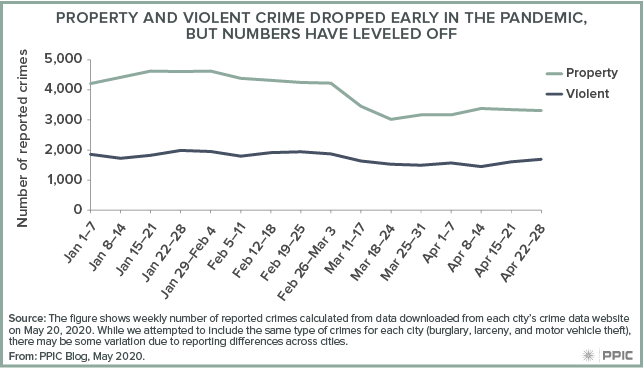
Figure - Property and Violent Crime Dropped Early in the Pandemic, but Numbers Have Leveled Off

Within these broader categories, some crime was on the uptick in April. While burglaries fell by 1.3% from February to March, the weekly number rose by 9.3% in April compared to February. This increase is primarily driven by commercial burglaries, up by 21.2% in March relative to February and up by 37.5% in April, again relative to February. Car theft is also up: after declining by 4.2% between February and March, it rose in April and is now 8.5% higher than in February.
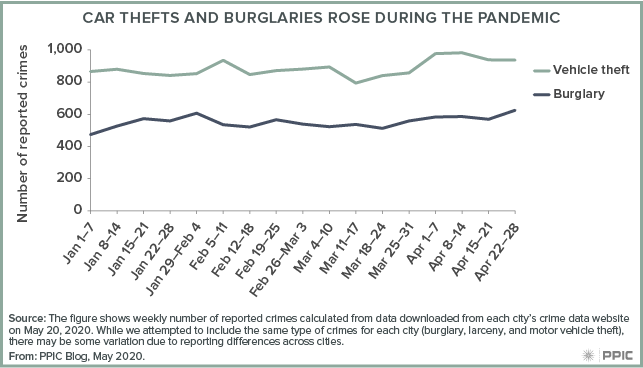
Figure - Car Thefts and Burglaries Rose during the Pandemic

The changes in crime numbers vary across these cities. For example, while commercial burglary is up in all four cities, the rise in vehicle theft is driven by Los Angeles, where the number of stolen vehicles increased from 352 to 363 and then 468 in February, March, and April; or up 32.9% compared to February. In Oakland, reported assaults rose in April; after dipping to 96 per week in March—from 116 in February—the average weekly number of assaults climbed to 129 in April. And while still below pre-pandemic numbers, assaults in Los Angeles in late April were higher than in March, up from 766 to 805 on average per week.

As crime in these four cities seems to be hovering at low rates, at or below the pre-pandemic numbers, there is no evidence yet that efforts like zero bail, which went into effect April 13, led to broad increases in crime. However, as some crimes are on the uptick, they deserve attention to determine whether they are part of common swings in crime numbers or early signs of reversing trends. If reversals are indicated, now is the time to identify contributing factors and investigate effective solutions.

What COVID-19 Budget Cuts Mean for Public Safety Spending

State funding aimed at programs and supervision for some jail inmates in jails and others on probation will drop sharply as a result of the COVID-19 crisis. While spending on the state correctional system will decrease less than 1% under recently announced cuts to the California state budget, funding for counties may drop 24%.

Probable cuts now loom over local budgets as well, and spending on local public safety may fall significantly.  Although lower jail populations during the pandemic could create budget savings, there may also be a higher need for re-entry and community-based services as released individuals return to communities.

In 2011, California enacted sweeping changes to its correctional system to address federal court orders to alleviate severe overcrowding in the prison system. This public safety realignment shifted correctional responsibilities for tens of thousands of offenders, from state prison and parole systems over to county sheriff and probation departments.

To fund the shift, the state created the local community corrections account, with money drawn from a dedicated portion of state sales tax revenue. Voters issued a constitutional guarantee for that portion of tax revenue when they passed Proposition 30 in November 2012. But while the percentage of revenue was guaranteed, the actual amount of sales tax collected can vary. The amount is now changing because of the COVID-19 crisis.

Counties were meant to use these funds to provide supervision and programming to individuals who were realigned from the state to the counties. More specifically, the state expected counties to fund cost-effective, evidence-based programming that improved offender rehabilitation and public safety in local communities. Such programming might include day reporting centers, expanded jail training programs, or specialized courts that handle individuals with drug dependency or mental health disorders.

Each county had the freedom to implement programs that best suited their situation. Community Corrections Partnerships (CCPs)—headed by the chief probation officer, with representatives from law enforcement, health and human services, and community organizations—provide realignment plans and recommend where to allocate funding.

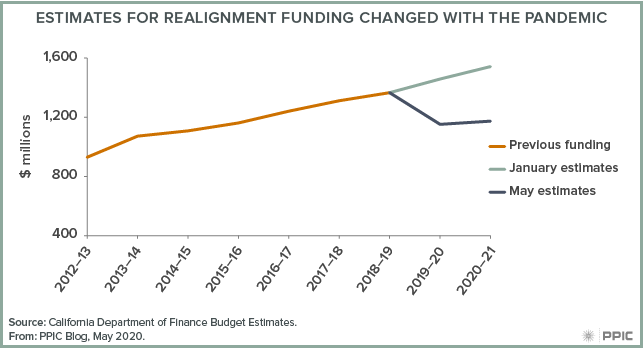
Realignment funding grew 47% from $930 million in 2012–13 to $1.37 billion in 2018–19. In state budget estimates from before COVID-19, sales tax revenue rose steadily, with the local community corrections fund expected to increase to $1.54 billion for fiscal year 2020–21.

Figure - Estimates for Realignment Funding Change with the Pandemic

However, the pandemic weakened the economy—in updated state budget estimates, the governor predicted a drop in sales tax revenue of more than 27% for 2020–21. The local community corrections account is now estimated to receive only $1.17 billion—a 24% decrease from the earlier estimate and 14% below the 2018–19 fiscal year.

Because revenues are paid to counties monthly, local agencies will feel the effect of sinking revenues almost immediately. The fiscal situation undoubtedly poses challenges for successful community re-entry programs; it is more important than ever to evaluate policies and programs that to lead to cost-effective solutions.

California’s Jail Population Has Plummeted during COVID-19

When the COVID-19 crisis began, state and county governments recognized that overcrowded jail conditions could pose unacceptable health risks for inmates and staff. As the crisis has unfolded, all counties have taken steps to decrease their jail populations. Some have made steeper reductions than others, and some of the measures that have facilitated these reductions—reducing pretrial detention and setting bail at zero for many crimes—may have longer-term significance as California considers whether to eliminate money bail.

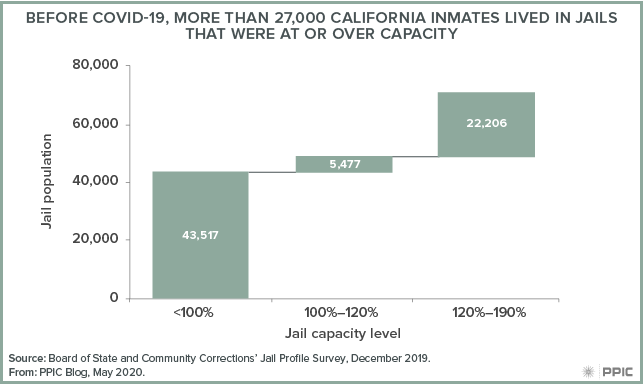
In December 2019, the average statewide daily population was 71,200—89% of capacity. However, about one in six county jails were at or over capacity, and twelve were between 120% and 190%. Looking only at numbers of jails understates the scale of the problem, because overcrowding was most prevalent in the biggest ones in a few large counties—Fresno, Los Angeles, Orange, Riverside, and San Diego. About four in ten (39%) California inmates—more than 27,000 people—lived in jails that were filled to or beyond capacity just prior to the pandemic.

Figure - Before COVID-19, More than 27,000 California Inmates Lived in Jails that Were at or Over Capacity

To reduce their jail populations, many counties began admitting fewer people to jail and releasing some inmates early. From February 29—when the Board of State and Community Corrections began reporting additional data—to April 11, the statewide jail population had fallen by 19%, to about 58,000 inmates. However, two county jail systems (Kings and Los Angeles Counties) remained over capacity and six county systems were at least 85% of capacity, accounting for over 20,000 inmates in total. Social distancing is challenging for inmates and staff at these capacity levels.

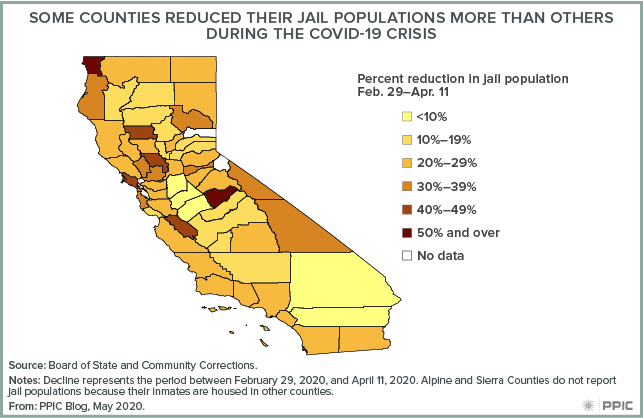
Between February 29 and April 11, all of California’s counties reduced their jail populations by releasing more people than they admitted. However, the reductions varied across counties: some lowered their jail populations by less than 10%, whereas others made reductions in excess of 50%.

Figure - Some Counties Reduced Their Jail Populations More than Others during the COVID-19 Crisis

To encourage further reductions in the jail population, the Judicial Council issued a statewide rule setting bail at $0 for misdemeanors and low-level felonies that went into effect on April 13. The “zero-bail” rule targets pretrial detainees, who historically have been about two-thirds of California’s jail population; many of these detainees are incarcerated mainly because they cannot pay bail. From April 11 to April 25, county jail releases continued to outpace admissions, with 14,154 people admitted and 19,924 released statewide.

Temporary state and county efforts to reduce jail populations come as California considers a permanent shift from cash bail to a risk-based system of determining pretrial release. Given the public safety concerns raised as the zero-bail rule was implemented, and the fact that voters will decide whether to make a permanent shift away from cash bail in November, it is important to assess the impact of zero bail and other emergency measures.

Jail Bookings Down Significantly during COVID-19

In the midst of the coronavirus pandemic, California has sought to reduce county jail populations through a range of actions, including a “zero bail” emergency measure. This means that most misdemeanor and lower-level felonies currently have no bail amount associated with them, and that suspects are more likely to be cited and released instead of booked into jail. This new practice, along with decreases in crime and local directives to reduce arrests and bookings, appear to have drastically reduced the number of people sent to jail at this time.

A number of offenses—including felony burglary, driving under the influence, and the most serious sexual and violent crimes—can still receive a bail amount above zero.  And law enforcement can still book someone into jail even for a so-called zero bail offense—but the arresting law enforcement agency (or the district attorney) has to request to a judge to set a bail amount. If the court denies the request then the suspect has to be released.

To get a sense of the magnitude of zero bail’s effect on releases and bookings, we looked at data from the Monthly Arrest and Citations Register (from 2016, the most recent available). These data do not perfectly identify zero bail offenses or the offenses excluded from the zero bail list. But they do allow us to identify an upper bound of the impact on jail bookings.

Of the roughly 1,140,000 arrests that we analyzed, about 791,000 were booked into jail (about 69% of arrests). About 317,000 of these bookings (or 40%) were for offenses in which bail is still is an option today. The remaining 474,000 bookings (or 60%) were for zero bail offenses.

This suggests that today, if the arrest offense distribution is currently the same as it was in 2016 and there are practically no requests to set bail for zero bail offenses, then only about 28% of arrests in California would lead to a booking into jail.

In 2016, misdemeanors made up the majority of arrests booked into jail (about 77%) for what are now zero bail crimes. Of these, the most common offenses were drugs (almost 28%), failure to appear in court on a misdemeanor offense (about 21%), drunk and disorderly conduct (12%), and traffic and petty theft (each about 5%). The most common felony offense bookings now set at zero bail were drug offenses (almost 30%), theft (22%), and vehicle theft (roughly 14%).

While crime appears to be down since the COVID-19 outbreak, and the type of crimes committed during the pandemic almost surely have changed, our examination of 2016 arrest data suggests that the implementation of zero bail—in addition to the effects of local directives and fewer crimes—means that far fewer people are being booked into jail at this time.

Recent statewide data from the Board of State and Community Corrections supports this conclusion, as it reveals that weekly jail bookings have dropped from 17,140 the week of February 23 to 6,880 the week of April 12 (a decrease of about 60%, consistent with our data analysis).

These findings suggest that the zero bail measure is playing a significant role in reducing crowding in California’s county jails and helping to make social distancing more achievable. Going forward, it will be important to monitor other possible impacts this reduction in jail bookings might have, including on homelessness, public safety, and access to health care.

How Will COVID-19 Affect Arrests in California?

The arrest rate in California is at its lowest level in decades, and as the COVID-19 crisis sends regions into economic and social disruption, further changes may emerge. Local law enforcement agencies are already adopting new arrest strategies to ensure public safety, to protect officers as well as to minimize jail crowding.

With some police departments starting to issue warnings or citations rather than make arrests, the number of misdemeanor arrests may fall. Departments are also delaying planned arrests unless doing so increases any risk to public safety, issuing summonses in the field rather than bringing detainees into a station for booking, and directing officers to take police reports online or over the phone instead of in person.

Measured as the incidence of arrests made per 100,000 in the population, the arrest rate in California had reached a peak of over 8,000 in 1989, and has since fallen fairly steadily, to under 3,500 in 2016. That 58% decline applies to rates of arrests made for felonies as well as for misdemeanors. This number reflects, in part, a parallel drop in crime rates, which are also at historic lows.

But it also reflects changes in legislation–in particular, the 2014 implementation of Proposition 47, which reclassified many lower-level property and drug offenses from felonies to misdemeanors, and the corresponding changes in law enforcement agencies’ priorities regarding the mix of offenses likely to be prosecuted.

Recommendations around arrests during the COVID-19 pandemic apply only to nonviolent misdemeanors and other lesser infractions. For instance, departments are advising officers to issue a ticket or citation for such crimes as vandalism, or low-level theft, rather than apprehend the perpetrator. Therefore, large-scale adoption of these recommendations would lead, all things being equal, to a larger share of arrests made for felonies, even if felony arrests themselves remained unchanged.

The share of arrests for felony offenses had been increasing gradually for decades, but fell dramatically after Proposition 47 was implemented. Felony offenses typically involve situations requiring immediate response, and officers have less discretion in deciding whether to make an arrest or take some other action. For example, an officer stopping a person for drug possession could issue a citation rather than make an arrest, but an officer responding to an aggravated assault is often obligated to take a suspect in for booking.

In these unprecedented times, however, all things are not likely to remain equal, and as the COVID-19 crisis evolves, changing social and economic circumstances will affect individual behavior, community responses, and law enforcement reactions.

Preliminary reports from four major California cities suggest that incidences of crime—property as well as violent—have dropped considerably since shelter-in-place orders went into effect. However, there is early evidence of an uptick in domestic violence. Monitoring the new approaches law enforcement is taking, and the outcomes of these interactions, will be key to determining which approaches are best suited to maintaining public health and safety.

COVID-19 and Crime in Major California Cities

Public safety is one of many areas of life being affected by the COVID-19 pandemic. Now that most Californians are staying home in response to the statewide shelter-in-place order, the overall number of reported crimes is declining in four of the state’s largest cities. But there is also evidence of an uptick in some types of crime.

We examined the daily reported crime numbers for two large Southern California cities and two Bay Area cities: Los Angeles, San Diego, San Francisco, and Oakland. It is important to note that while these cities make their data quickly available for analysis, the numbers are preliminary: law enforcement agencies update and review the data before submitting them to DOJ as official statistics. Also, we do not yet have data on other cities or rural areas across the state. And, finally, it is possible that our highly unusual circumstances are affecting the extent to which crime is reported.

Comparing the average weekly number of reported crimes in February to the number reported for the last week in March shows an overall drop from about 6,150 to 3,620—a decrease of 41%. Declines have been particularly large in the two Bay Area cities: about 69% in Oakland and around 55% in San Francisco. Crime reports began to fall in all four cities a few weeks before shelter-in-place orders were issued for the Bay Area (March 16) and the state (March 19)—after employers started urging their workers to stay home.

Property crime accounts for roughly 80% of the overall decrease: reports fell from a weekly average of 4,270 in February to 2,270 in the last week of March (a drop of about 47%). This trend was driven by a decline in larceny reports, particularly car break-ins. The drop in larcenies, which are most striking in the Bay Area, could quite possibly be largely attributable to the absence of tourists.

figure - San Francisco's Drop in Reported Property Crimes Stands Out

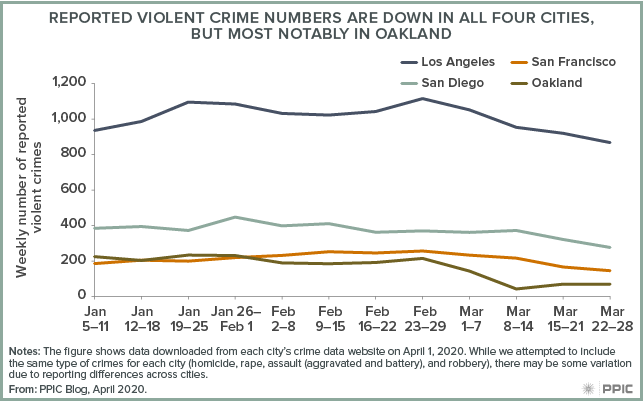
Overall reports of violent crime dropped from a weekly average of about 1,880 in February to about 1,360 in the last week of March—a 28% decrease. Oakland experienced the most dramatic drop—from about 200 to 70. The number of reported assaults dropped from 1,430 to around 1,100 (22%). The overall decrease in robberies—from about 350 to 260—was driven largely by the Bay Area.

figure - Reported Violent Crime Numbers are Down in All Four Cities, But Most Notably in Oakland

There are some notable exceptions to this downward trend. While reports of domestic violence are down overall for the four cities, Los Angeles saw an uptick in the last two weeks of March, and the weekly number of reported robberies in San Diego were also up somewhat. More broadly, a slight increase in reported commercial burglaries across all four cities suggests that burglars may be shifting from residential to commercial targets now that so many people are at home at all times of day.

It is too soon to draw firm conclusions about recent trends, but it will be important to track and monitor crime data so that we can identify vulnerabilities in our communities and determine whether new approaches are needed to maintain public safety in these challenging times.

Severe COVID-19 Infections May Threaten California’s Prisons

An inmate in the California prison system has tested positive for COVID-19, as have several corrections officers. California invests more than any other state in prisoners’ health, due to ongoing federal oversight mandating that the California Department of Corrections and Rehabilitation (CDCR) provide adequate health care. But overcrowded conditions where social distancing is improbable could intensify COVID-19 outbreaks in California’s prisons.

To limit the spread of COVID-19 between local communities and prisons, Governor Newsom has issued an executive order halting prison admissions and transfers to community-based reentry programs. Inmates who fall ill are being isolated, and those who work in prisons, including corrections officers and health professionals, are being screened before entering. Similar efforts to contain outbreaks are not unusual in CDCR. However, they usually apply to one prison, rather than to the entire system.

Overcrowding may exacerbate the potential for COVID-19 to spread rapidly though prison systems, threatening prisoners, corrections officers, and prison health professionals alike. According to the Bureau of Justice Statistics, about half of the country’s prison systems operate at or above capacity. In California, a court order mandates that the prison population remain under 137.5 percent of capacity. Currently, the prison population stands at just under 123,000, and the prisons are at 134 percent of capacity.

Prison environments also limit inmates’ and prison workers’ ability to practice social distancing. Dormitories present special challenges. The inmates who live in them and the correctional officers who supervise them must safely navigate open space in concert with each other. However, the cells in which most prisoners are housed present social distancing challenges of their own. While some inmates live alone, most have a cellmate. In some prisons, cell sizes fall short of the standard 25 to 35 square feet of space per person. Cellmates also typically sleep in bunk beds, which do not have six feet between the top and bottom bunks.

In addition, California’s prisoners may be particularly susceptible to COVID-19 because they are older or have preexisting medical conditions. In 2018, more than 30,000 inmates (24%) were over age 50, and over 5,000 (4%) were over 65. Prison populations tend to be far less healthy than the general public—9% of California’s inmates were classified as high clinical risk in 2012, meaning they had serious medical conditions that required significant resources to manage.

During COVID-19 infections, even mild or moderate chronic health problems that would usually be manageable could lead to serious complications. Illnesses that compromise the immune system or weaken the lungs can increase the risk of poor outcomes associated with COVID-19. According to California Correctional Health Care Services, more than 10,000 inmates were treated for hepatitis C in 2018. Approximately 8,000 of California’s inmates are diabetic. Twelve percent of male and one in five female inmates used medication to treat asthma in 2010—about double the rate among Californians. In 2015, 0.8 percent of California’s inmates were HIV positive—also more than double the rate among Californians. The heightened vulnerability of California’s prisoners to serious COVID-19 infections also puts the corrections officers who work alongside them and the health professionals who care for them at elevated risk for contracting the illness.

While older people are at greatest risk of severe outcomes related to COVID-19, younger people, particularly those with preexisting conditions, are also vulnerable to severe outcomes. If an outbreak happens within the prison system, many CDCR workers and inmates—young and old—may be at higher risk of experiencing serious complications as living conditions, age, and preexisting medical conditions combine to amplify the threat from COVID-19.

COVID-19 and California’s Vulnerable Populations

To take a closer look at access to care, PPIC has created an interactive, California Critical Care during COVID-19.

To reduce community spread of COVID-19, California has instituted statewide guidance to shelter in place until further notice, and to practice social distancing when leaving home for approved activities such as grocery shopping or exercise. Because COVID-19 is novel, no vaccine is available and no one has preexisting immunity. However, individuals are not equally at risk, and there are several known sources of vulnerability.

There are Californians at elevated risk of exposure to the coronavirus. For some, this risk is due to the nature of their work, as is the case for physicians, nurses, and other front-line medical staff. For others, such as California’s approximately 115,000 prisoners and 150,000 homeless individuals, living conditions pose serious challenges to social distancing. And being over 60 or having an underlying health condition makes over one-third of California’s adults especially vulnerable to serious or fatal complications—this estimate does not include undiagnosed medical conditions, which puts the actual figure higher.

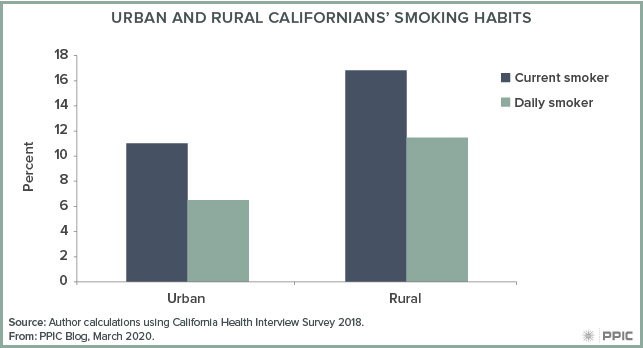
Californians in the state’s 21 rural counties may have lower exposure to the coronavirus because of the relative ease of social distancing. These individuals, who make up over 837,000 residents, may face significant challenges if they do contract the coronavirus. California’s rural adults are more likely to smoke than urban ones (16.8% versus 11.0%) (California Health Interview Survey 2018), and smoking is suspected to put coronavirus patients at higher risk of complications because it is known to damage lung health.

figure - Urban and Rural Californians’ Smoking Habits

Rural residents often have to travel farther to access critical care resources. This is especially concerning for the large numbers of elderly Californians who are low income, geographically isolated, or living alone in the state’s rural areas (California Department of Aging 2019).

Video: A Conversation with Chief Justice of California Tani G. Cantil-Sakauye

Last Thursday, at a lunchtime event in Sacramento, PPIC president Mark Baldassare talked with Tani Cantil-Sakauye, California’s chief justice and the leader of the state’s judicial branch. Their conversation covered a wide range of challenges and opportunities facing the courts today. In particular, Cantil-Sakauye spoke about civic education, the collaborative courts, and the critical importance of self-evaluation in the judicial branch.

Cantil-Sakauye is known for her efforts to make the courts accessible and understandable to all Californians. She became convinced of the need to educate the public about the judicial branch after the state judiciary was hit hard by budget cuts during the Great Recession. Cantil-Sakauye recalled that state legislators responded to her pleas for adequate funding with “quizzical looks” and questions: “‘What agency are you from? . . .Which chief are you?’ . . . And I thought a civics education initiative might be in order!“

She launched an initiative called the Power of Democracy in 2012: “Judges and lawyers, the president of the California Chamber of Commerce, labor unions, and scholars come together to teach civics to K–12 and also adult students.” In her view, helping Californians understand that “the courts exist for you to press your rights” empowers them to advocate for themselves and their communities.

Asked to name her greatest accomplishments, Cantil-Sakauye pointed to collaboration, civility, and problem solving. “The California judiciary is a collaborative, problem-solving entity,” she said. Indeed, California has led the nation in collaborative courts—community-based courts that specialize in issues such as homelessness, landlord-tenant disputes, domestic violence, veterans, or behavioral health. These courts address underlying problems by connecting people to services and programs that can help get their lives on track. As Cantil-Sakauye put it, “The whole point of a collaborative court is to end recidivism.”

The chief justice is especially proud of the judiciary’s willingness to evaluate itself: “We ask ourselves how we’re doing and we’re honest when we’re not doing well.” A case in point is bail reform. Questions about the efficacy and fairness of bail prompted the chief justice to form a committee to study the issue. After looking at the evidence and hearing from a wide range of stakeholders, the committee unanimously recommended the elimination of cash bail “because it does not serve the purpose of protecting the community or ensuring a person’s return to court.”

The bail reform law signed by Jerry Brown last year is being contested—voters will decide its fate in November. But efforts to improve bail and other aspects of the judicial system will continue. As Cantil-Sakauye put it, “More and more, California courts are becoming social justice centers.”

Video: Key Factors in Arrest Trends and Differences in California’s Counties

Police officers make more than a million arrests per year in California. Arrests to enforce laws and protect public safety can have wide-ranging consequences for individuals and communities, and there have long been concerns about racial disparities. But little is known about the factors that contribute to arrest trends across the state. At a recent event in Sacramento, PPIC researcher Brandon Martin outlined major findings from a new report on arrests, and a panel of experts offered state and local perspectives.

Martin pointed out that arrest rates have fallen significantly over the past few decades, largely in tandem with declining crime rates. He also noted that arrest rates are higher in relatively poor counties, while racial disparities are largest in more affluent counties. These and other findings add up to a broad view of arrests that can inform efforts to reduce overall rates and racial disparities.

Shirley Weber, who represents California’s 79th Assembly District, said that the racial disparity findings are not new to the African American community. She noted that African Americans who commit offenses are “more likely to be arrested and incarcerated . . . rather than just being picked up and talked to,” and that confrontations that lead to uses of force are also more likely. These disparities have significant effects on employment and family stability, among other things.

Edgar Boyd, pastor of First African Methodist Episcopal Church in Los Angeles, emphasized the need for police and communities to reduce disparities: “When you look at . . . the conflict that exists between communities and law enforcement across the state, you’ll find that there’s a possibility of less negative impact, if it’s worked on.” Tod Sockman, chief of police for the city of Galt, agreed: “Law enforcement spends a lot of time doing community outreach. I think that’s key to everything we’re doing.”

The panelists also agreed that while local efforts are critical, the state has an important role to play in monitoring disparities. Weber—who championed Assembly Bill (AB) 392, a measure that sets statewide standards for police use of force—said that it would be irresponsible for state lawmakers to view criminal justice challenges as local matters. After AB 392 passed, a number of police officers told her that they were pleased because “they had ideas of working to de-escalate . . . and now this bill says we gotta do it, and so they can blame it on me. And that’s OK! Because sometimes there are things at the local level that prevent you from moving in a direction.”

Recent criminal justice reforms have led to further reductions in arrest rates, seemingly without a major impact on public safety. But there is still room for improvement. Sockman pointed to increases in theft and the continuing challenge of addressing addiction and mental illness, and Weber noted the difficulty of changing course after decades of reliance on incarceration.

Boyd, who serves on the state’s Racial and Identity Profiling Advisory Board, made the case for ongoing dialogue: “Our work on this, our dialogue together . . . is all important. Every one of us has a role and a responsibility in that.”