Video: A Conversation with Assembly Speaker Anthony Rendon

When Anthony Rendon was elected to the California State Assembly in 2012, he thought he would focus on early childhood education. “I came to Sacramento after working in early childhood education for 20 years . . . probably thinking that I would work on that.” However, he continued, “You come here and you realize the extent to which all of these issues impact one another. I think it’s dangerous to isolate any single issues.”

As he noted in his conversation with PPIC’s Mark Baldassare last Thursday, Rendon has focused on many individual measures in this legislative session, including a recently signed bill to modify the criteria for police use of deadly force and a bill to address predatory lending. In the wake of the Gilroy shooting, he has also prioritized a package of gun control bills. He sees these measures as part of a broader focus on improving opportunity for all Californians.

Rendon became Speaker in 2016, when Jerry Brown was governor. At first, he found working with Brown to be “a little frustrating,” but “eventually, we did a lot together. . . . There was a very narrow focus, two or three things—criminal justice reform, climate change, but that was about it. Those are still the things he cares about.” Governor Newsom focuses on a wider range of issues. And, Rendon said, “He’s also more sort of open-ended. He’ll come in and say, ‘Hey, housing, what do you think?’”

One of the issues Newsom cares about is early childhood education—which is still a major priority for Rendon. While Brown “helped us to start down the path” to reinvesting in this area, “now we have a governor who believes that . . . it has a positive impact on families and communities and children.” Newsom’s belief translated into significant funding increases for early childhood education in this year’s budget. “The budget was phenomenal,” said Rendon. Early childhood education is particularly important, in his view, because it’s “not trying to fix something that’s already broken. It’s a way of addressing issues early on, it’s a way of breaking the cycle of poverty.”

Although the Democratic Party controls both the governor’s office and the legislature, Rendon believes it’s important to work with Republicans whenever possible. He sees some common ground on issues such as climate change and education—“the real issues that really impact Californians.” More generally, it is important that state leaders represent all Californians: “I want to be able to tell people . . . ‘I’m working for you.’”




Video: Recidivism of Felony Offenders in California

Over the past decade, California has implemented several corrections reforms—including public safety realignment in 2011 and Proposition 47 in 2014. The aim was to reduce incarceration levels and improve offender outcomes without reducing public safety. The rate of rearrest and reconviction, or recidivism—which has long been quite high in California—is an important indicator of the impact of the reforms. At a briefing in Sacramento last Thursday, PPIC researcher Mia Bird outlined the findings of a new report on recidivism among all types of felony offenders—including those sentenced to prison, jail only, jail followed by probation, or probation only.

Recidivism is often used to capture changes in reoffending in response to a policy change. However, it is important to note that these rates may also reflect changes in the practices of criminal justice agencies. The PPIC analysis, which draws on data collected from 12 representative counties, finds that overall recidivism rates for felony offenders declined between 2011 and 2015. Bird outlined several other key findings:

  • Rearrest and reconviction rates fell sharply for felony drug offenses; rearrest rates went up slightly among individuals convicted of offenses against a person (including violent offenses), but the reconviction rate did not change.
  • Recidivism rates declined for all four sentencing groups. Initially, there were increases in recidivism among individuals who were sentenced to probation, with or without jail time, but these rates decreased in later years and under Proposition 47.
  • Individuals released from prison had the highest reconviction rates; this finding is consistent with previous research that has found little evidence of a link between more-severe sanctions and lower recidivism.
  • Rearrest rates for felony offenses increased in the last several months covered by the analysis.

Bird noted that there are several possible interpretations of these findings. There are grounds for optimism: “We do see that we’ve achieved a really large reduction in incarceration and we haven’t seen big increases in recidivism. In many ways that suggests that we’ve managed this transition quite well.”

However, she underlined the need to recognize that recidivism rates are linked to multiple factors: “They may partially represent individual behavior and they may partially represent criminal justice practice.”

Asked what the PPIC analysis indicates about future steps the state should take, Bird said, “Policy that supports data collection, data integration, and monitoring and evaluation . . . is essential. We know we can do better if we know more.”

Video: Californians and Their Government

Less than a year before California’s presidential primary, likely voters who are Democrats or who lean Democratic are divided on strategy: is it more important for the party to nominate the candidate who seems mostly likely to defeat President Trump or the candidate whose positions align most closely their views? But almost all Californians see voting in the 2020 elections as very important. At a lunchtime briefing in Sacramento last Thursday, PPIC researcher Dean Bonner outlined these and other key findings from the latest statewide survey.

Two in three California likely voters say they will definitely or probably choose a candidate other than Trump. There is a huge partisan divide on this question: 93% of Democrats and 66% of independents would definitely or probably vote for another candidate if the election were held today, while 82% of Republicans would definitely or probably vote for Trump.

Most Californians say that the investigation by special counsel Robert Mueller did not clear the president of wrongdoing, and Californians are more likely that the nation as a whole to say impeachment proceedings should begin. But here, too, there is a partisan divide: 66% of Democrats say Congress should begin the process, compared to only 39% of independents and 9% of Republicans.

Other survey highlights:

  • A majority of Californians say their housing costs cause a financial strain; six in ten favor the governor’s plan to allocate $1 billion to address homelessness, and similar shares favor proposed new rules intended to create more affordable housing.
  • Three-quarters of Californians see participation in the 2020 Census as very important—but most have concerns about confidentiality.
  • An overwhelming majority are concerned about rising electricity bills in the wake of the PG&E bankruptcy.
  • Californians are concerned that the recent outbreak of measles could spread; most believe that vaccines are very safe and an overwhelming majority say vaccination against measles and other diseases should be required.

Is Momentum Growing to End California’s Death Penalty?

On March 13, Governor Newsom signed an executive order placing a moratorium on the death penalty for the 737 inmates on death row in California’s prisons. The order suspends executions for the remainder of Newsom’s administration but does not allow for the release of any inmates or alter any convictions or sentences. California joins Colorado, Pennsylvania, and Oregon as the only states where governors have taken executive action to halt the legal use of the death penalty.

Permanently abolishing California’s death penalty would require voter approval. When this question was on the ballot in 2012 and 2016, a slight majority of Californians (52% in 2012 and 53% percent in 2016) voted to uphold the death penalty as the maximum punishment for those found guilty of first-degree murder.

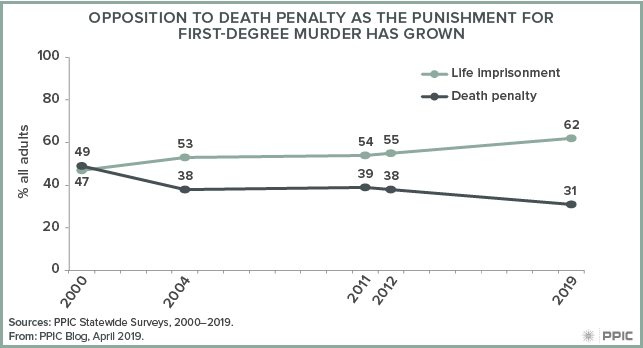
How do Californians view the death penalty today? In our March PPIC survey, a record-high 62% of adults (58% likely voters) prefer life imprisonment with no possibility of parole as the penalty for first-degree murder, compared to 31% of adults (38% likely voters) who prefer the death penalty. The preference for life imprisonment has grown steadily since January 2000, when opinions were divided among Californians (49% death penalty, 47% life imprisonment).

figure - Opposition to Death Penalty as the Punishment for First-Degree Murder Has Grown

The issue is highly partisan: three in four Democrats (76%) and more than half of independents (56%) favor life imprisonment over the death penalty, compared to only one in three Republicans (32%). Since September 2012, when we last asked this question, support for life imprisonment has risen substantially among Democrats (up 9 points) and independents (up 11 points)—but stayed about the same for Republicans (down 1 point).

The preference for life imprisonment has climbed across nearly all age, education, income, and racial/ethnic groups—with the exception of African Americans and Latinos. African Americans are now less likely to favor life imprisonment (67% today versus 75% in 2012), though their support is still high. Among Latinos, 69% prefer life imprisonment, same as in 2012. In contrast, Asian Americans are now much more likely to support life imprisonment (66% today versus 50% in 2012), as are whites (54% today versus 45% in 2012).

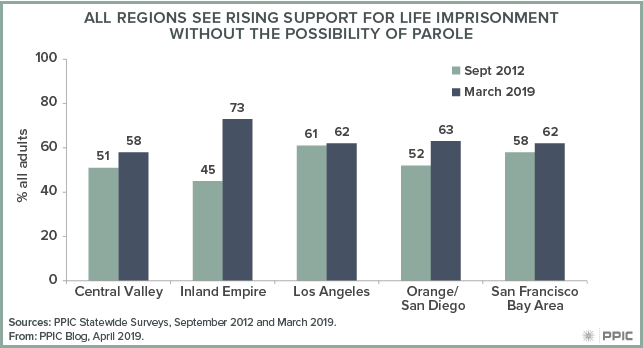
Support has also grown in all major regions of the state, with particularly large shifts in the Inland Empire and Orange/San Diego Counties. In the Inland Empire, 73% of residents favor life imprisonment, up 28 points since 2012. In Orange/San Diego Counties, 63% prefer life imprisonment, up 11 points since 2012.

figure - All Regions See Rising Support for Life Imprisonment Without the Possibility of Parole

Following the governor’s executive order, Assemblymember Marc Levine introduced a constitutional amendment that would abolish the death penalty in California. If approved by a two-thirds vote in the legislature, it will appear before voters on the 2020 ballot. Stay tuned as we continue to monitor Californians’ perceptions and policy preferences on this issue.

Video: Californians and Their Government

Californians are increasingly concerned about the cost of housing—a record-high share see affordability as a big problem in their region, and a majority support Governor Newsom’s proposal to put $1.8 billion toward increasing housing production. Dean Bonner outlined these and other key findings of the latest PPIC Statewide Survey at a Sacramento briefing last week.

This month’s survey gauges views on statewide challenges and the governor’s proposals for addressing them. For example, in the wake of last year’s historically destructive wildfires, an overwhelming majority of Californians support the governor’s plan to spend $415 million on wildfire preparedness and forest management. About two-thirds say the gap between rich and poor is widening in their part of the state, and a solid majority favor the governor’s proposal to allocate a billion to expand eligibility for the earned income tax credit.

Other survey highlights:

  • Slim majorities support the governor’s plan to scale back two major infrastructure projects: high-speed rail and the Sacramento–San Joaquin tunnels.
  • When asked whether the penalty for first-degree murder should be death or imprisonment for life with no chance of parole, a record-high 62% of Californians choose life imprisonment.
  • An overwhelming majority oppose President Trump’s declaration of a national emergency over the border wall—but support for the declaration is much higher among Republicans.
  • A majority of residents have a favorable view of the Affordable Care Act and most say that Covered California, the state’s health insurance exchange, has been working well.

A Closer Look at Women’s Arrest Rates

Historically, men have been arrested at much higher rates than women in California. However, a recent PPIC report found that while arrest rates declined for both men and women, they dropped significantly more for men than for women (57% and 13%, respectively) between 1980 and 2016. A closer look at gender breakdowns underscores some differences in arrest offenses of men and women—and suggests that they may be differently affected by criminal justice reforms.

Women are still arrested at significantly lower rates than men (1,603 arrests per 100,000 female residents in 2016, compared to 5,270 arrests per 100,000 male residents), but they now represent a larger share of total arrests statewide than they did in 1980, up from about 13% to almost 24%. A closer look reveals they also tend to be arrested for different types of offenses. Relative to their overall share of arrests, women represented a disproportionate share of arrests for property offenses (32%), compared to 23% of arrests for violent offenses and 22% for drug offenses. In stark contrast, women only make up about 7% of felony weapons arrests.

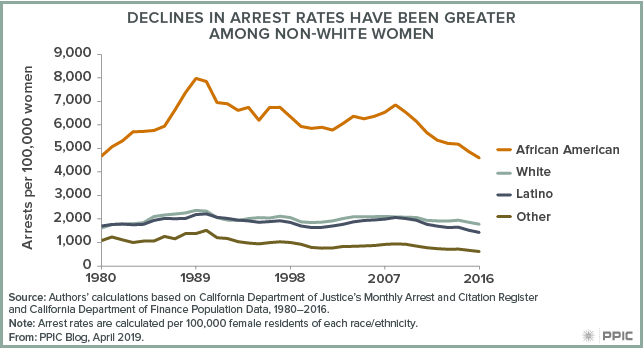
A look at trends in female arrest rates by race/ethnicity shows a decline for women of all races, with greater declines among non-white women. Between 1989—when overall arrest rates peaked—and 2016, arrest rates fell more dramatically for men than for women across all races/ethnicities, but the size of the gender gap varied:

  • Arrest rates for white women fell 25%, while arrest rates for white men fell 55%.
  • Arrest rates among Latino women declined by 35%, while rates for Latino men fell 68%.
  • Rates for African American women fell 42%, while rates for African American men fell 58%.

figure - Declines in Arrest Rates Have Been Greater Among Non-white Women

These differing trends are mostly driven by misdemeanor arrest rates, which have declined much more dramatically among men than among women. In 1980, women represented 14% of misdemeanor arrests, but in 2016 this share jumped to 25%, in part due to an increase in female arrest rates for misdemeanor assault and battery offenses. The female share of felony arrests also increased, up from roughly 12% in 1980 to almost 20% in 2016.

While many factors likely contribute to these trends, California’s criminal justice reforms—which have largely focused on property and drug offenses—are likely to have played a role, with different effects on arrests of men and women. Not surprisingly, given gender differences in arrest offenses, the data supports this. For instance, after Proposition 47 reclassified several drug and property offenses from felonies to misdemeanors in November 2014, the female arrest rate for drug offenses declined by 14% and the rate for property offenses fell by 22%, compared to 7% and 10% declines among men. Policymakers would do well to monitor arrest rates for men and women and keep them in mind when considering the impact of criminal justice reforms.

Can Pretrial Decisions Be Improved?

Controversy over the cash bail system in California has led to a number of recent legal and legislative actions that may spell the end of cash bail in the state. If that happens, risk assessment systems would take on heightened importance in decisions about pretrial detention. At stake are concerns about equity, consistency, and transparency in the pretrial process.

Californians who have been arrested but not yet convicted are 84% more likely to be detained than defendants in other states. California’s high bail amounts contribute to this high rate. Of the defendants who are released on bail, nearly all secure their release via bail bondsmen, who require a nonrefundable deposit equal to 10% of the bail amount. The average bail amount in California in 2015 was $50,000—five times higher than the national average. Many poor and middle class individuals lack the means to secure pretrial release through bail—one study found that 40% of Americans do not even have $400 on hand to cope with an emergency.

State and federal courts have begun to address this inequity. Last year, a state appellate court ruled that defendants should not be held before trial solely because they cannot afford bail. More recently, a federal judge ruled against San Francisco’s use of bail schedules, which set bail amounts. The judge found that although bail schedules seem scientific and transparent, bail amounts are set inconsistently, their origins are unclear, and they do little to ensure public safety.

Additionally, judges can override recommended bail amounts based on their assessment of a defendant’s likelihood of misconduct—arrest or failure to appear in court—if he or she is released during the pretrial period. And they can do so without reporting why. The result has been inconsistency in pretrial detention decisions for defendants who committed similar crimes.

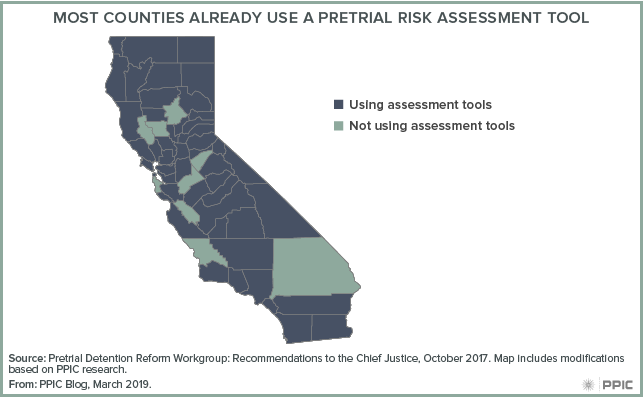
Concerns about inconsistency and lack of transparency motivated the recent passage of Senate Bill 10, which eliminates cash bail and mandates the use of risk assessment tools. These tools use mathematical models to predict pretrial misconduct. Pretrial detention recommendations based on these predictions are supposed to guide judges’ pretrial detention decisions. SB 10 will be subject to a November 2020 referendum—but it’s worth noting that 49 of California’s 58 counties already use some type of risk assessment tool.

figure - Most Counties Already Use a Pretrial Risk Assessment Tool

Risk assessment tools are not without controversy. They have been challenged as unfair and can only surmount this challenge if they are used within transparent and consistent risk assessment systems. Importantly, judges will still be able to override recommendations from those systems.

To ensure more transparency, it will be critical to collect information about why judges override such recommendations. Only with court data that comprehensively records information used to make pretrial detention decisions can the essential work of ongoing evaluation take place. These evaluations are key to determining how well risk assessment systems protect individuals’ liberty while also ensuring public safety—and how potential sources of unfairness in them can be identified and addressed.

Video: A Conversation with San Francisco Mayor London Breed

As part of our Speaker Series on California’s Future, PPIC invites elected leaders from across the political spectrum to participate in public conversations. The purpose is to give Californians a better understanding of how our leaders are addressing the challenges facing our state.

As a mayoral candidate, London Breed promised to focus on homelessness and affordable housing—two major challenges for San Francisco and for California as a whole. Not surprisingly, these issues took center stage in her conversation with PPIC president Mark Baldassare earlier this week.

“It is no secret that homelessness is one of the biggest challenges that’s facing our city, and that also comes with the need to build more housing,” said Breed. “I’ve been on a mission! I hired a housing delivery director—someone whose sole purpose is to cut back on bureaucratic red tape that gets in the way of building housing.”

Breed stressed the need for new approaches to behavioral health issues that complicate homelessness: “We have to think about this challenge differently and we have to make hard decisions.” For example, she favors strengthening conservatorship laws. She acknowledged that conservatorship for mentally ill adults is “very controversial.” But, she added, “our jails are being used as mental health facilities, and that’s not a solution.” She is also pushing for safe injection sites, which can provide substance abuse treatment when people are ready to seek it. “Treatment on demand is something we have to start looking at.”

The mayor is also committed to trying new strategies in other policy areas, such as police-community relations and education. “I do think we need to take some risks and propose some things that may make people uncomfortable but ultimately may help us to get the kind of results that will . . . make a difference.”

But Breed also emphasized accountability. Explaining why she wants to hire a mental health director, she said, “We’re a little bit all over the place right now and I want us to address those issues, organize things a lot better for the purposes of helping people.” In this and other areas, she said, “I want to see us make the right investments.”

Video: A Conversation with California’s Legislative Leadership

When Toni Atkins, President Pro Tem of the California State Senate, sat down to talk with PPIC president Mark Baldassare last week, she brought along a list of pressing issues. Asked to name the top two issues facing the state, she led off with housing: “The growing crisis around the lack of housing supply for all levels of Californians is one of our most critical issues.” Next came climate change and its effects across California. And then she added a third issue: water sustainability. In reality, she said, “there is always a list of issues and challenges that we are working on in California.”

Despite this long list, Atkins was optimistic about the legislature’s chances of working productively with Governor Newsom. “It’s early, but I would say that what I appreciate and enjoy about Governor Newsom is he really is a policy wonk at heart.” She added that while Jerry Brown and Gavin Newsom share many priorities, the two have very different styles. “Jerry Brown proposed a budget and he only wanted a few things,” while Governor Newsom “has thrown everything out there.”

After noting that it will be interesting to see how the legislature approaches this year’s budget process, Atkins highlighted the governor’s focus on homelessness and mental health issues and his commitment to early childhood education—which, she added, has been “a huge driving issue for the legislative women’s caucus.” She expressed particular interest in the governor’s proposal to “take juvenile justice offenders out of CDCR—the California Department of Corrections and Rehabilitation—and into more of a health/social services arena.”

Shifting from the state budget process to the ongoing drama over the budget—and border wall—at the federal level, Baldassare asked Atkins about the state government’s response to what is happening in Washington, DC. “You know, I’m so glad to be in California,” she replied. Citing the state’s diversity and the policies that foster it, she said that “to have that attacked in many ways at the federal level means all of a sudden you’ve got California really promoting state’s rights, to protect our policies, our values, and things that we hold dear.”

Atkins tended to be optimistic about even the thorniest issues—such as forestry management, building more housing, and water sustainability. Speaking about the cluster of issues related to climate change, she said, “Maybe the result of these catastrophic fires, and floods, and mudslides—maybe that is the way we’re now able to have a conversation we couldn’t have five years ago, before it was a crisis.” But she added that in order to move an agenda forward, “you’ve got to still have all the stakeholders at the table.”

More generally, Atkins stressed the importance of representing all Californians, regardless of party: “I think we have work to do together.”

Video: New Insights into California Arrests

Crime, policing, and community relations are subject to heated debate, but little is known about the first step in the criminal justice process: arrests. Who is arrested in California and what are they arrested for? How have arrest patterns changed over time and how do they differ across the state? Last week in Sacramento, PPIC researcher Magnus Lofstrom outlined findings from a new report and Brandon Martin—a PPIC research associate—moderated a panel discussion that put these trends in the context of state legislation and local police-community relations.

The PPIC report finds that overall arrest rates have dropped dramatically over the past few decades, largely due to declines in misdemeanor arrests. While there have been significant declines in arrests among juveniles and young adults, men, and African Americans, arrestees still tend to be younger, male, and nonwhite. After presenting these and other key findings, Lofstrom stressed that “this report raises more questions than it answers.” Future research, he said, will explore the factors that contribute to trends and differences in arrest rates across demographic groups and jurisdictions across the state. It will also look at the impact of recent criminal justice reforms.

The panelists focused on the importance of addressing the larger issue of long-term trust between law enforcement and the communities it serves. Gabriel Caswell, counsel to the California Senate Public Safety Committee, said that recent reforms such as the Racial and Identity Profiling Act have tried to strike a balance between officer safety and community transparency: “If the community has at least somewhat more access than they’ve been given historically, I think that will go a long way toward rebuilding trust.”

Marisa Arrona, local safety solutions project director for Californians for Safety and Justice, highlighted efforts to shift from reactive policing to the Blueprint for Shared Safety: “Shared safety is more than the absence of crime; it’s got to be the presence of well-being.” Instead of assessing safety only through crime rates, communities can also use other measures, such as harm reduction among vulnerable populations, access to victim services, or the number of former offenders who have access to jobs.

Daniel Hahn, Sacramento police chief, also cautioned against relying exclusively on crime numbers: “You’ve got to be very careful of what’s behind the numbers and make sure it’s actually meaningful to the community.” He stressed the need to look beyond simple solutions. In order to build trust between police and the communities, he added, “We gotta change the way we hire, change the way we train, include the community in the police department and the police department in the community.”