Toward Understanding Racial Disparities in Arrests

With tensions between law enforcement and minority communities continuing to make headlines, media outlets and academic researchers both report stark racial and ethnic differences in criminal justice experiences, including sentencing and incarceration. The disparity between African Americans and whites is especially striking. For example, the prison incarceration rate in California is 4,180 per 100,000 residents for African American men, compared with 420 for white men. It is likely that this inequality is significantly affected by the first step in the criminal justice process—arrests.

California’s various law enforcement agencies make a substantial number of arrests each year—1.35 million in 2016. While this is a staggering number, it’s also the lowest number of arrests since 1980 and marks a dramatic decline of more than one million arrests (64%) since a peak in 1990.

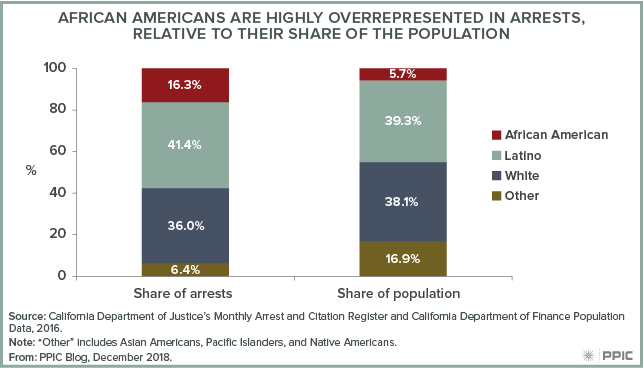
Looking at racial disparities, we find that African Americans are significantly overrepresented among those arrested in California. In 2016, African Americans made up less than 6% of the population but more than 16% of arrests. Latinos were slightly overrepresented in arrests as well, representing 39% of the population but 41% of arrests.
Though much of the penal code is determined by the state legislature, the state does not closely monitor how arrest decisions change over time or vary across jurisdictions, nor how these decisions may affect demographic groups differently. Two efforts—one implemented by the state legislature and one by PPIC—seek to fill this knowledge gap and will bring data-driven information into the broader discussion about policing and community relations.

In 2015, California’s legislature passed the Racial and Identity Profiling Act (AB 953). This legislation requires law enforcement agencies to begin collecting data in 2018 on all initial police interactions with the public, including reason, location, race/ethnicity, gender, and age. While this will provide an opportunity to learn more about law enforcement interactions, the data will not be available for statewide analysis until 2023 or later.

In the meantime, PPIC has launched a project to begin identifying areas in need of attention in California arrests and to frame the conversation for sustainable solutions at the state and local level. In our first report, we examine trends over time and provide a descriptive profile of arrestees, including patterns in race/ethnicity, gender, age, offense type, and the county where the arrest took place. Our interactive tool allows for deeper exploration of arrest rates across California counties.

Over the next two years, we will further examine whether arrestees were booked into jail or cited and released in the field. We will also seek to understand possible contributing factors to these arrest patterns—such as crime rates, law enforcement and correctional resources, economic conditions and expenditures, and demographics. This project uses unique data from the California Department of Justice’s Monthly Arrest and Citation Register (MACR).

As the state and local jurisdictions continue their data collection efforts on police interactions, PPIC’s research will provide a better understanding of long-term trends in arrests and differences throughout the state. Stay tuned for more insights on this critical but understudied aspect of California’s criminal justice system.

Video: The Impact of Proposition 47 on Crime and Recidivism

Proposition 47, passed by voters in November 2014, has generated considerable debate. By reducing penalties for some lower-level drug and property offenses, Prop 47 marked another significant step toward reducing California’s reliance on incarceration. Supporters of the reform believe that redirecting money that is no longer being spent on incarceration to behavioral health and other treatment programs would reduce recidivism. Opponents feared that Prop 47 would overburden local law enforcement and lead to increases in crime.

A panel discussion in Sacramento last Thursday encapsulated this debate—but also featured significant areas of agreement. PPIC researcher Mia Bird set the scene by outlining a new report, The Impact of Proposition 47 on Crime and Recidivism. The report finds no evidence that Prop 47 has affected violent crime rates but sees signs that it led to a rise in property crime—driven largely by thefts from motor vehicles. The report also finds a decline in recidivism, driven largely by a drop in rearrest and reconviction rates for offenders covered by Prop 47.

Bird pointed out that “Prop 47 likely sent a signal to law enforcement to reprioritize their resources away from arrests for drug possession toward more serious offenses.”

Fresno police chief Jerry Dyer underlined this point. “Whenever you have laws that take away your ability to arrest certain individuals for a felony, and you know there’s no room in the jail for misdemeanants, you shift your resources [toward] violent criminals.”

For George Gascón, San Francisco’s district attorney, “Prop 47 is a mild beginning of a process where we go back and see where we want to put public resources.” He pointed out that the negative impact of high rates of incarceration has been felt primarily in communities of color, and added that recent crime fluctuations need to be placed in the context of historically low crime rates over the past several years.

For Dyer, reclassifying some drug and property crimes as misdemeanors means that there are “no consequences for individuals who are committing crimes.” Dyer also noted that when Prop 47 passed, local law enforcement was still adjusting to the realignment of corrections responsibilities that was enacted three years earlier. The pace of reform has felt like “trying to take a drink of water out of a fire hose.”

While the panelists had differing views on the state’s shift away from incarceration, they agreed on the importance of treatment programs for mental health and substance abuse disorders. Gascón noted that with funding from Prop 47, “communities are beginning to experiment with different ways of treating the drug addiction and mental health issues that drive many crimes.” Dyer agreed, noting that “jail is no place for people with mental health issues.”

Kate Howard, executive director of the Board of State and Community Corrections (BSCC), explained how the BSCC developed a process for allocating 65% of the money saved by reductions in incarceration to local programs. The BSCC sought input from across the state, and the grant steering committee includes several ex-offenders, whose experience with the corrections system was “instrumental.” The first 23 grants were awarded in June 2017. While it is too early to measure their impact, Howard said there is “great reason for optimism.”

Tailoring Domestic Violence Programs to Reduce Recidivism

California law requires that all domestic violence offenders who receive a probation sentence participate in a one-year rehabilitation program. A bill (AB 372) currently under consideration in the state legislature would allow five counties (Napa, Santa Barbara, Santa Clara, Santa Cruz, and Yolo) to pilot a new kind of treatment program tailored to offenders’ risks—their likelihood of reoffending—and needs. This program must include practices that are shown by research to be effective or promising in terms of reducing recidivism.

Domestic violence is a serious public health and safety issue that affects families, communities, and criminal justice systems. Drawing on data collected in 12 California counties through the BSCC–PPIC Multi-County Study, we find domestic violence offenders make up a significant share of local jail populations. From October 2011 to October 2014, 6% of all jail bookings were associated with domestic violence. After the passage of Proposition 47—which reclassified certain drug and property offenses to misdemeanors—in 2014, domestic violence accounted for roughly 8% of jail bookings.

Domestic violence offenders also tend to have high rates of recidivism. Three-fifths of individuals convicted of domestic violence are rearrested within two years—and 67% of this group are rearrested for another domestic violence offense. The large volume of domestic violence offenses combined with high recidivism rates highlight the need to understand and address the factors underlying these offenses.

The demographics and criminal histories of domestic violence offenders vary greatly—suggesting that effective interventions may differ as well. When we examine individuals who received probation sentences between October 2011 and October 2015, the majority (85%) of offenders are men. However, women still represent a significant share of the population, and treatment needs may vary based on gender. In addition, while most of these offenders are age 35 or younger (the average age is 34), a sizable minority are age 46 or above. Older offenders may have distinct needs compared to younger offenders, as problematic relationship patterns may be more difficult to address over time.

Criminal history background may also help determine appropriate interventions. Among domestic violence offenders receiving probation sentences, 18% were convicted of felonies and 82% were convicted of misdemeanors. We find that domestic violence offenders have an average of nine prior arrests for any kind of offense. On average, these offenders have one prior domestic violence arrest; 53% have no prior arrests for domestic violence, while 5% have six or more priors.

This variation suggests that tailoring domestic violence programs based on offenders’ risks and needs could be beneficial. However, there is much to learn. Any effort to address this important problem should include substantial program monitoring and data collection on participants’ characteristics and outcomes—creating the opportunity to learn about effective practices and potentially apply them statewide.

Pretrial Risk and Cash Bail

Most of California’s jail inmates are unsentenced defendants awaiting arraignment, trial, or sentencing—and this heavy reliance on pretrial detention has come under scrutiny in recent years. The goals of pretrial detention are to make sure that defendants appear at court hearings and to ensure public safety. But California’s high pretrial detention rates have not been associated with more defendants appearing in court or lower levels of rearrest. Reforming the current system by allowing more defendants to be released pending trial could allow the state to free up scarce jail beds and realize substantial cost savings—while maintaining public safety.

Last year, state lawmakers examined the issue of cash bail, the predominate means by which defendants can be released pretrial. Legislation to change the system is pending. Under cash bail, judges can order defendants to pay a certain amount—which varies based on the alleged offense—in order to secure release. In most cases, defendants contract with bail bond companies to deposit the full amount of the bond with the court in exchange for a service fee (usually 10% of the bond). If the defendant complies with all court orders during the release period, the bond company gets the deposit back and keeps the defendant’s premium as payment. The idea is that the threat of financial penalty helps prevent pretrial misconduct—for example, making offenders less likely to flee the jurisdiction and more likely to appear in court.

However, there are several flaws in the bail system. Bail is calculated by offense, making it more challenging for defendants cited for more serious offenses to obtain release. This may make intuitive sense, but it turns out offense category is not typically a strong predictor of future misconduct. For instance, PPIC research found that misdemeanor probationers were in fact more likely to be booked into jail at least two times after release (19.6%) than felony probationers (17.6%). Moreover, cash bail makes it more difficult for low-income defendants to obtain release, regardless of their risk to public safety, raising concerns about whether the system is treating wealthy and poor individuals equitably.

The primary alternative is a risk-based framework in which law enforcement employs tools called risk assessments to determine which offenders can safely be released pretrial. Risk assessments use demographic data and information pertaining to a defendant’s criminal history to predict a defendant’s probability of disobeying the terms of his or her release. Some of these models show great promise. For example, researchers found judges in New York could reduce the jail population by 42% without affecting crime rates by following their model’s release recommendations.

But these tools have limitations. California already uses a range of risk assessment tools at the state and county levels, but they vary in predictive power based on whether they have been validated. Validating a risk tool means testing it using local data from the community of offenders it will be assessing. Counties using unvalidated, out-of-the-box risk assessments could improve their tools’ predictive powers by following the example of counties like Riverside, where county agencies collaborated with academics to tailor a tool that had been originally developed in Virginia to Riverside’s unique characteristics—boosting the model’s accuracy.

Local validation studies consume a lot of time and resources. Riverside’s took two years and required data from over 500 offenders. However, if the state continues to emphasize risk-based reform and evidence-based practices to improve its corrections system, making these models work for California and its counties should be a priority.


Video: Travis Allen’s Priorities

Mark Baldassare, PPIC president and CEO, asked Assemblymember Travis Allen, candidate for governor in 2018, to name the top three issues with major consequences for the state’s future—a question Baldassare has asked of all gubernatorial candidates appearing before PPIC audiences. Allen said his top priorities would be

  • Cutting taxes
  • Getting tough on crime, and
  • Fixing roads and expanding freeways

Allen, who is campaigning to repeal the state gas tax increase passed last year, said California is already collecting enough tax revenue to improve roads and unclog the freeways.

“We can fix our roads, we can expand our freeways, we don’t need to raise taxes further to do it,” he said. He added that voters should be the ones to decide if they want to raise taxes.

The conversation with Allen is part of the PPIC Speaker Series on California’s Future. PPIC is inviting all major candidates for governor to participate if they reach a certain threshold in the polls. The goal is to give Californians a better understanding of how the candidates intend to address the challenges facing our state.

Watch all candidate videos

Video: The Impact of Realignment on Recidivism

California embarked on a major public safety reform in 2011, when it shifted responsibility for lower-level felony offenders from the state to the counties. Prompted by a federal court order to reduce prison overcrowding, this realignment resulted in a dramatic drop in the prison population and a decline in overall incarceration levels. A related goal was to reduce the state’s persistently high recidivism rates. Has it worked it out that way?

A new PPIC report looking at the first two years of realignment finds that it has had a modest effect on recidivism, which has varied across counties and groups of offenders. The report is based on data from 12 counties that are representative of the state. It examines recidivism through two measures—rearrest and reconviction rates—for offenders affected by the change. Mia Bird, report coauthor presented the results at a Sacramento briefing last week.

Bird outlined several key findings, including:

  • Slightly higher recidivism rates among individuals on post-release community supervision (PRCS). These offenders were released from state prison after serving time for certain low-level felonies and then supervised by county probation agencies. Higher rates of recidivism in some counties—notably Los Angeles County, the largest—are a major factor.
  • No consistent effect on recidivism among individuals sentenced under section 1170(h) of the California Penal Code. These offenders were sentenced for a specific set of lower-level felonies and, under realignment, served time in county jail rather than state prison.
  • Lower recidivism among 1170(h) offenders who received “straight sentences”—but mixed results among those with “split sentences.” The group serving “straight sentences”—jail time only—had the best outcomes: the same two-year rearrest rates and two-year reconviction rates that are lower. Those who got “split sentences”—jail time followed by probation supervision—had higher rates of rearrest but lower rates of reconviction compared with similar individuals before realignment.

Bird said she expects these results to vary over time as the composition of offenders changes and counties gain experience with evidence-based practices to reduce recidivism. In addition, further study is needed of the higher recidivism rates for groups that are supervised after their release. It could be that more individuals are reoffending—or it could be that their misconduct is more likely to be detected because they are being monitored more closely under probation supervision, Bird said.

New Laws Expand Criminal Justice Reforms

Governor Jerry Brown recently signed a number of bills that extend the state’s efforts to reform California’s adult and juvenile criminal justice system. This legislative package supplements previous reforms; several of the new laws could further reduce the state’s prison population, which remains subject to a court-ordered population target. The bills cover issues at all levels, including arrest, conviction, incarceration, and parole.

Arrest and conviction

  • SB 395 strengthens protections for arrested minors under the age of 16 by requiring that they confer with an attorney prior to waiving their Miranda rights and being interrogated by police. AB 529 allows juveniles to have their records sealed if they are not convicted. SB 312 allows juvenile offenders convicted of serious or violent offenses committed after the age of 14 to have their records sealed.
  • SB 393 allows adults to request that the court seal their records if they are arrested but not convicted.

Sentence enhancements

  • Sentence enhancements allow prosecutors to seek additional prison time in certain circumstances—such as the use of a firearm or gang involvement. The number of enhancements has increased dramatically over the past 30 years. SB 180 eliminates the three-year sentence enhancement for certain circumstances related to selling drugs, though it leaves in place the enhancement for using minors in the sale of illegal drugs. SB 620 allows judges the discretion to dismiss or strike sentence enhancements for offenders who are in possession of a firearm while committing a crime.

Parole

  • AB 1308 and SB 394 raise the age limit for youth parole from 23 to 25, and grant the possibility of parole for juvenile offenders serving life sentences after they serve at least 25 years.
  • AB 1448 allows certain offenders older than 60 who have been incarcerated for more than 25 years to be released to parole. It is worth noting that AB 1448 codifies a practice that has been helping the state reduce overcrowding: a total of 557 offenders were released under this program between February 2014 and August 2017.

Impact of supervision on juveniles and families

  • SB 625 reinstates honorable discharges for juvenile offenders who have “proven their ability to desist from criminal behavior.” An honorable discharge removes long-term penalties, such as the ban on juvenile offenders working as police officers.
  • SB 190 limits the financial liability of families for the housing, transport, or supervision of juvenile offenders.

The goal of these laws is to improve offender outcomes by emphasizing rehabilitation and reentry to the community—and possibly reducing pressure on the state budget. State lawmakers believe these bills are grounded in evidence-based practices. For example, the reduction of long-term penalties for juveniles and young adults is grounded in neuroscientific evidence that decision-making ability does not mature fully until the mid-20s.

Two bills that aim to reform the state’s bail system, AB 42 and SB 10, did not reach the governor’s desk this legislative year. However, the debate over bail reform will most likely continue in 2018. Advocates for reform believe that evidence-based practices that base pre-trial release decisions on an offender’s likelihood of appearing in court or reoffending—not his or her financial means—could significantly reduce the number of pre-trial offenders held in county jails. Opponents believe that the current bail system is the best way to make pre-trial release decisions while protecting public safety.

Sentence Enhancements: Next Target of Corrections Reform?

Senate Bill 180, which has passed through the legislature and is currently on the governor’s desk, aims to change a sentence enhancement related to dealing drugs. The bill would repeal the three-year enhancement for a prior conviction related to drug sales, except in cases where a minor is used in the crime. The repeal would affect just 2.3% of the people who entered prison between October 2015 and September 2016. In light of the state’s efforts to downsize its prison and jail populations, however, the bill’s passage could create momentum for similar reforms.

California’s best-known sentence enhancement mechanism is the Three Strikes Law, passed in 1994. The law doubles the sentence of any offender convicted of a second serious or violent crime. A third conviction results in a sentence of between 25 years to life. There are roughly 38,000 second and third “strikers” in California prisons, a little more than one-third of the prison population.

Overall, California has more than 100 separate code sections that enhance sentences based on the current offense or the offender’s record. For example, using a firearm while committing a violent and/or sexual felony adds anywhere from 10 to 25 years. A gang-related felony results in 2 to 10 additional years, depending upon the seriousness of the offense.

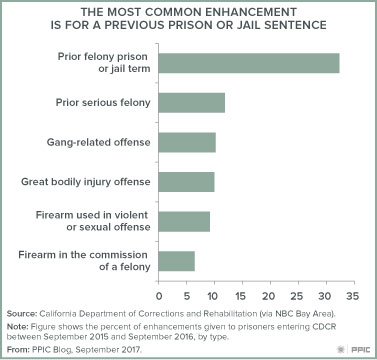
Figure jail sentence enhancementAs of September 2016, 79.9% of prisoners in institutions operated by the California Department of Corrections and Rehabilitation (CDCR) had some kind of sentence enhancement; 25.5% had three or more. Aside from second and third strikes, the most common enhancement adds one year for each previous prison or jail term.
Research on sentence lengths offers little support for the idea that the threat of longer sentences deters people from committing crimes. Physically removing a person from society does prevent him or her from engaging in criminal activity, which is part of the appeal of enhancements. However, research shows that this “incapacitation effect” varies across different types of offenders and that longer prison stays are wasteful when applied to people who are “low frequency” offenders.

When considering this bill and similar proposals, the state has the difficult task of balancing the costs of keeping people in custody— in terms of tax dollars spent on expensive prison beds as well as collateral costs borne by families and communities—against the potential cost to public safety.

Crime Rates Stable Overall, But Some Counties See Big Changes

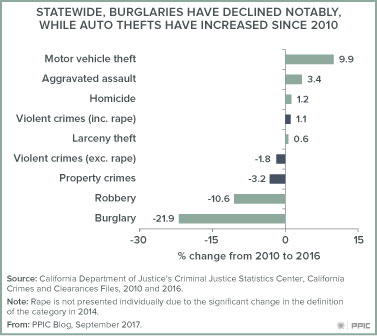
In 2011, California embarked on a series of criminal justice reforms, decreasing the state’s reliance on costly incarceration—and raising fears about the impact on public safety. A look at recently released crime numbers from the California Department of Justice show that while auto thefts are up almost 10%, the state has not seen a broad surge in crime since the reforms started. The violent crime rate is up 1.1% (and when adjusted for an important definitional change, is in fact down about 1%), while the property crime rate is down 3.2%. However, these statewide numbers mask substantial differences across counties.

Prompted by a federal court mandate to reduce the population of the state’s overcrowded prisons, California enacted public safety realignment in 2011. This historic reform shifted the management of lower-level felons from state prison and parole systems to county jail and probation systems. Since then—with the state still unable to meet the federal mandate—voters have passed three significant initiatives: Proposition 36 in 2012, Proposition 47 in 2014, and Proposition 57 in 2016. Due to the combined impact of these reforms, the state’s incarceration rate has declined dramatically and is now at a level not seen since the early 1990s.

While reforms were unquestionably needed—the state faced a possible federal order to release more than 30,000 prisoners early—critics have voiced concerns that public safety may be negatively affected and have asked whether less incarceration would reverse California’s long-term decline in crime rates.
Have reforms affected crime in California? A comparison of 2016 crime rates to those of 2010, the year before any of these reforms were implemented, provides a useful starting point.

The 2016 violent crime rate of 444 per 100,000 residents is up somewhat (1.1%) from the 2010 rate of 439 per 100,000 residents. However, the FBI implemented a change in 2014 that expanded the definition of sexual crimes that constitute rape. According to the FBI’s Uniform Crime Report, the new definition added about 38% to the number of reported rapes in 2014 in California, increasing the violent crime rate by about 8 more violent crimes per 100,000 residents. If we adjust the 2016 violent crime rate accordingly, from 444 to 436 per 100,000 residents, we find that this more comparable measure indicates a slight drop in violent crime (of about 1%) between 2010 and 2016.

The property crime rate in 2016 of 2,545 per 100,000 residents is down 3.2% from 2010 and is the second lowest rate observed since 1960 (the lowest was 2,459 per 100,000 residents in 2014). While the rate of auto theft is up 9.9%, burglaries have been decreasing noticeably since 2012 and are now down 21.9% from 2010. Larceny theft has changed very little (up less than 1%).

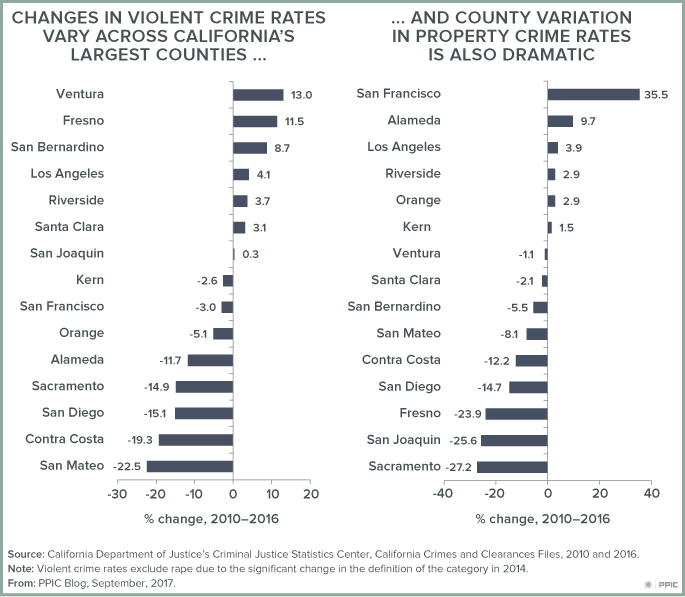
The picture is more complicated at the county level. A look at the 15 largest California counties shows that five saw double-digit drops in their violent crime rates between 2010 and 2016: San Mateo, Contra Costa, San Diego, Sacramento, and Alameda. But Ventura and Fresno Counties experienced increases of more than 10%. And while the property crime rate dropped more than 20% in three counties—Sacramento, San Joaquin, and Fresno—it went up a staggering 35.5% in San Francisco. Alameda County saw an increase of almost 10%.

How can we explain these differences? Before rushing to conclusions, there are several questions that need to be answered first. How have reforms affected factors such as arrests and incarceration? Do these differ across counties and what is their relationship to crime rates? Also, California’s crime trends may be affected by factors unrelated to recent reforms. How do statewide trends compare to what other states are seeing? Finally, have California’s reforms improved outcomes for those released from our jails and prisons? If so, this could help lower crime rates in the coming years. Our goal at PPIC is to address these important questions in our upcoming research.
Video: Reforms Challenge County Probation Departments

Changes in criminal justice policy have significantly altered the role of probation in the state and, as documented in a new PPIC report, have put considerable demands on counties.

The report, California Probation in the Era of Reform, is based on data from 12 counties and describes the changing characteristics of individuals under probation supervision. Viet Nguyen, report coauthor and PPIC research associate, presented the findings at a briefing in Sacramento. Among them:

  • Reforms shifted probation caseloads toward more serious offenders. Public safety realignment—implemented in 2011 and designed to address prison overcrowding—shifted the management of lower-level felons from the state prison and parole systems to county jails and probation departments. After realignment, the number of new probation cases increased steadily because of counties’ new responsibilities in managing two types of offenders: those released from state prison on post-release community supervision and those given “split sentences,” who serve part of their sentence in county jail and then are placed under mandatory supervision. In 2014, Proposition 47—which required that certain drug and property offenses be charged as misdemeanors—resulted in a dramatic decline in new felony and misdemeanor probation cases. But it also further concentrated the probation caseload on individuals who have committed more serious offenses.
  • Jail bookings are common among the probation population, especially for realigned offenders. Nearly half of people placed under probation supervision were booked into county jail within their first year. Realigned offenders had the highest booking rates, were more likely to enter jail multiple times in their first year, and stayed in jail longer than traditional felony and misdemeanor probation cases.
  • African Americans are overrepresented among people under probation supervision. African Americans make up 7.9% of the general population but 22.9% of those entering probation supervision. Overall, the shares of Latinos and whites under probation supervision were similar to their shares in the population, while Asian Americans made up a much smaller proportion of new probation cases.

Learn moreRead the report California Probation in the Era of Reform