Video: The Impact of Realignment on Recidivism

California embarked on a major public safety reform in 2011, when it shifted responsibility for lower-level felony offenders from the state to the counties. Prompted by a federal court order to reduce prison overcrowding, this realignment resulted in a dramatic drop in the prison population and a decline in overall incarceration levels. A related goal was to reduce the state’s persistently high recidivism rates. Has it worked it out that way?

A new PPIC report looking at the first two years of realignment finds that it has had a modest effect on recidivism, which has varied across counties and groups of offenders. The report is based on data from 12 counties that are representative of the state. It examines recidivism through two measures—rearrest and reconviction rates—for offenders affected by the change. Mia Bird, report coauthor presented the results at a Sacramento briefing last week.

Bird outlined several key findings, including:

  • Slightly higher recidivism rates among individuals on post-release community supervision (PRCS). These offenders were released from state prison after serving time for certain low-level felonies and then supervised by county probation agencies. Higher rates of recidivism in some counties—notably Los Angeles County, the largest—are a major factor.
  • No consistent effect on recidivism among individuals sentenced under section 1170(h) of the California Penal Code. These offenders were sentenced for a specific set of lower-level felonies and, under realignment, served time in county jail rather than state prison.
  • Lower recidivism among 1170(h) offenders who received “straight sentences”—but mixed results among those with “split sentences.” The group serving “straight sentences”—jail time only—had the best outcomes: the same two-year rearrest rates and two-year reconviction rates that are lower. Those who got “split sentences”—jail time followed by probation supervision—had higher rates of rearrest but lower rates of reconviction compared with similar individuals before realignment.

Bird said she expects these results to vary over time as the composition of offenders changes and counties gain experience with evidence-based practices to reduce recidivism. In addition, further study is needed of the higher recidivism rates for groups that are supervised after their release. It could be that more individuals are reoffending—or it could be that their misconduct is more likely to be detected because they are being monitored more closely under probation supervision, Bird said.

New Laws Expand Criminal Justice Reforms

Governor Jerry Brown recently signed a number of bills that extend the state’s efforts to reform California’s adult and juvenile criminal justice system. This legislative package supplements previous reforms; several of the new laws could further reduce the state’s prison population, which remains subject to a court-ordered population target. The bills cover issues at all levels, including arrest, conviction, incarceration, and parole.

Arrest and conviction

  • SB 395 strengthens protections for arrested minors under the age of 16 by requiring that they confer with an attorney prior to waiving their Miranda rights and being interrogated by police. AB 529 allows juveniles to have their records sealed if they are not convicted. SB 312 allows juvenile offenders convicted of serious or violent offenses committed after the age of 14 to have their records sealed.
  • SB 393 allows adults to request that the court seal their records if they are arrested but not convicted.

Sentence enhancements

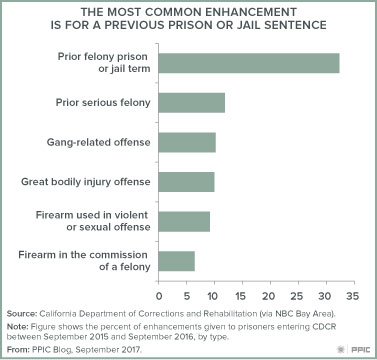
  • Sentence enhancements allow prosecutors to seek additional prison time in certain circumstances—such as the use of a firearm or gang involvement. The number of enhancements has increased dramatically over the past 30 years. SB 180 eliminates the three-year sentence enhancement for certain circumstances related to selling drugs, though it leaves in place the enhancement for using minors in the sale of illegal drugs. SB 620 allows judges the discretion to dismiss or strike sentence enhancements for offenders who are in possession of a firearm while committing a crime.

Parole

  • AB 1308 and SB 394 raise the age limit for youth parole from 23 to 25, and grant the possibility of parole for juvenile offenders serving life sentences after they serve at least 25 years.
  • AB 1448 allows certain offenders older than 60 who have been incarcerated for more than 25 years to be released to parole. It is worth noting that AB 1448 codifies a practice that has been helping the state reduce overcrowding: a total of 557 offenders were released under this program between February 2014 and August 2017.

Impact of supervision on juveniles and families

  • SB 625 reinstates honorable discharges for juvenile offenders who have “proven their ability to desist from criminal behavior.” An honorable discharge removes long-term penalties, such as the ban on juvenile offenders working as police officers.
  • SB 190 limits the financial liability of families for the housing, transport, or supervision of juvenile offenders.

The goal of these laws is to improve offender outcomes by emphasizing rehabilitation and reentry to the community—and possibly reducing pressure on the state budget. State lawmakers believe these bills are grounded in evidence-based practices. For example, the reduction of long-term penalties for juveniles and young adults is grounded in neuroscientific evidence that decision-making ability does not mature fully until the mid-20s.

Two bills that aim to reform the state’s bail system, AB 42 and SB 10, did not reach the governor’s desk this legislative year. However, the debate over bail reform will most likely continue in 2018. Advocates for reform believe that evidence-based practices that base pre-trial release decisions on an offender’s likelihood of appearing in court or reoffending—not his or her financial means—could significantly reduce the number of pre-trial offenders held in county jails. Opponents believe that the current bail system is the best way to make pre-trial release decisions while protecting public safety.

Sentence Enhancements: Next Target of Corrections Reform?

Senate Bill 180, which has passed through the legislature and is currently on the governor’s desk, aims to change a sentence enhancement related to dealing drugs. The bill would repeal the three-year enhancement for a prior conviction related to drug sales, except in cases where a minor is used in the crime. The repeal would affect just 2.3% of the people who entered prison between October 2015 and September 2016. In light of the state’s efforts to downsize its prison and jail populations, however, the bill’s passage could create momentum for similar reforms.

California’s best-known sentence enhancement mechanism is the Three Strikes Law, passed in 1994. The law doubles the sentence of any offender convicted of a second serious or violent crime. A third conviction results in a sentence of between 25 years to life. There are roughly 38,000 second and third “strikers” in California prisons, a little more than one-third of the prison population.

Overall, California has more than 100 separate code sections that enhance sentences based on the current offense or the offender’s record. For example, using a firearm while committing a violent and/or sexual felony adds anywhere from 10 to 25 years. A gang-related felony results in 2 to 10 additional years, depending upon the seriousness of the offense.

Figure jail sentence enhancementAs of September 2016, 79.9% of prisoners in institutions operated by the California Department of Corrections and Rehabilitation (CDCR) had some kind of sentence enhancement; 25.5% had three or more. Aside from second and third strikes, the most common enhancement adds one year for each previous prison or jail term.
Research on sentence lengths offers little support for the idea that the threat of longer sentences deters people from committing crimes. Physically removing a person from society does prevent him or her from engaging in criminal activity, which is part of the appeal of enhancements. However, research shows that this “incapacitation effect” varies across different types of offenders and that longer prison stays are wasteful when applied to people who are “low frequency” offenders.

When considering this bill and similar proposals, the state has the difficult task of balancing the costs of keeping people in custody— in terms of tax dollars spent on expensive prison beds as well as collateral costs borne by families and communities—against the potential cost to public safety.

Crime Rates Stable Overall, But Some Counties See Big Changes

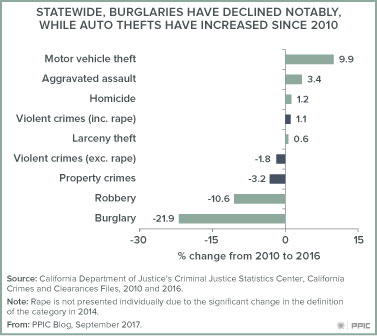
In 2011, California embarked on a series of criminal justice reforms, decreasing the state’s reliance on costly incarceration—and raising fears about the impact on public safety. A look at recently released crime numbers from the California Department of Justice show that while auto thefts are up almost 10%, the state has not seen a broad surge in crime since the reforms started. The violent crime rate is up 1.1% (and when adjusted for an important definitional change, is in fact down about 1%), while the property crime rate is down 3.2%. However, these statewide numbers mask substantial differences across counties.

Prompted by a federal court mandate to reduce the population of the state’s overcrowded prisons, California enacted public safety realignment in 2011. This historic reform shifted the management of lower-level felons from state prison and parole systems to county jail and probation systems. Since then—with the state still unable to meet the federal mandate—voters have passed three significant initiatives: Proposition 36 in 2012, Proposition 47 in 2014, and Proposition 57 in 2016. Due to the combined impact of these reforms, the state’s incarceration rate has declined dramatically and is now at a level not seen since the early 1990s.

While reforms were unquestionably needed—the state faced a possible federal order to release more than 30,000 prisoners early—critics have voiced concerns that public safety may be negatively affected and have asked whether less incarceration would reverse California’s long-term decline in crime rates.
Have reforms affected crime in California? A comparison of 2016 crime rates to those of 2010, the year before any of these reforms were implemented, provides a useful starting point.

The 2016 violent crime rate of 444 per 100,000 residents is up somewhat (1.1%) from the 2010 rate of 439 per 100,000 residents. However, the FBI implemented a change in 2014 that expanded the definition of sexual crimes that constitute rape. According to the FBI’s Uniform Crime Report, the new definition added about 38% to the number of reported rapes in 2014 in California, increasing the violent crime rate by about 8 more violent crimes per 100,000 residents. If we adjust the 2016 violent crime rate accordingly, from 444 to 436 per 100,000 residents, we find that this more comparable measure indicates a slight drop in violent crime (of about 1%) between 2010 and 2016.

The property crime rate in 2016 of 2,545 per 100,000 residents is down 3.2% from 2010 and is the second lowest rate observed since 1960 (the lowest was 2,459 per 100,000 residents in 2014). While the rate of auto theft is up 9.9%, burglaries have been decreasing noticeably since 2012 and are now down 21.9% from 2010. Larceny theft has changed very little (up less than 1%).

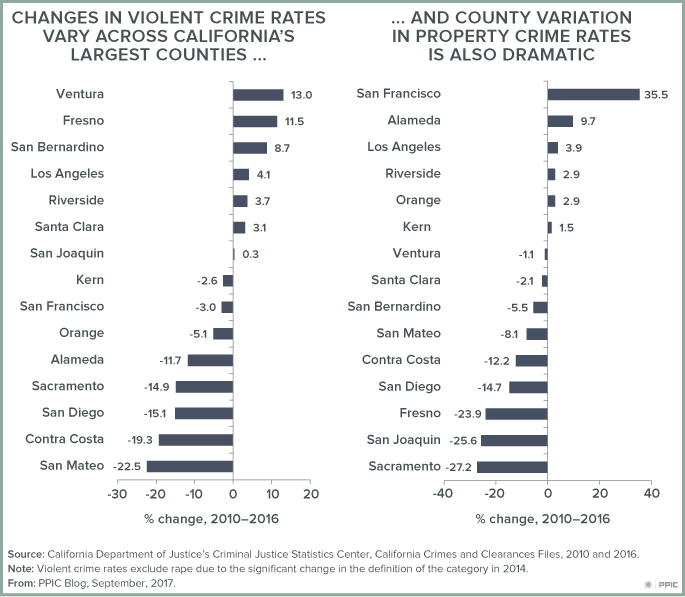
The picture is more complicated at the county level. A look at the 15 largest California counties shows that five saw double-digit drops in their violent crime rates between 2010 and 2016: San Mateo, Contra Costa, San Diego, Sacramento, and Alameda. But Ventura and Fresno Counties experienced increases of more than 10%. And while the property crime rate dropped more than 20% in three counties—Sacramento, San Joaquin, and Fresno—it went up a staggering 35.5% in San Francisco. Alameda County saw an increase of almost 10%.

How can we explain these differences? Before rushing to conclusions, there are several questions that need to be answered first. How have reforms affected factors such as arrests and incarceration? Do these differ across counties and what is their relationship to crime rates? Also, California’s crime trends may be affected by factors unrelated to recent reforms. How do statewide trends compare to what other states are seeing? Finally, have California’s reforms improved outcomes for those released from our jails and prisons? If so, this could help lower crime rates in the coming years. Our goal at PPIC is to address these important questions in our upcoming research.

Video: Reforms Challenge County Probation Departments

Changes in criminal justice policy have significantly altered the role of probation in the state and, as documented in a new PPIC report, have put considerable demands on counties.

The report, California Probation in the Era of Reform, is based on data from 12 counties and describes the changing characteristics of individuals under probation supervision. Viet Nguyen, report coauthor and PPIC research associate, presented the findings at a briefing in Sacramento. Among them:

  • Reforms shifted probation caseloads toward more serious offenders. Public safety realignment—implemented in 2011 and designed to address prison overcrowding—shifted the management of lower-level felons from the state prison and parole systems to county jails and probation departments. After realignment, the number of new probation cases increased steadily because of counties’ new responsibilities in managing two types of offenders: those released from state prison on post-release community supervision and those given “split sentences,” who serve part of their sentence in county jail and then are placed under mandatory supervision. In 2014, Proposition 47—which required that certain drug and property offenses be charged as misdemeanors—resulted in a dramatic decline in new felony and misdemeanor probation cases. But it also further concentrated the probation caseload on individuals who have committed more serious offenses.
  • Jail bookings are common among the probation population, especially for realigned offenders. Nearly half of people placed under probation supervision were booked into county jail within their first year. Realigned offenders had the highest booking rates, were more likely to enter jail multiple times in their first year, and stayed in jail longer than traditional felony and misdemeanor probation cases.
  • African Americans are overrepresented among people under probation supervision. African Americans make up 7.9% of the general population but 22.9% of those entering probation supervision. Overall, the shares of Latinos and whites under probation supervision were similar to their shares in the population, while Asian Americans made up a much smaller proportion of new probation cases.

Learn moreRead the report California Probation in the Era of Reform

Women in Jail

Women are the fastest growing segment of America’s jail population, yet the characteristics of female inmates are not well documented. Nationally, their numbers have increased 14-fold from 1970 to 2014. In California, the women’s jail population has risen 6-fold—from 1,725 in 1970 to 12,054 in 2014—twice as much as the male jail population over the same period.

PPIC’s work on jail populations shows that female jail inmates differ in lots of ways from their male counterparts, most notably in the types of offenses they are held on. This work is based on detailed records provided by 11 counties—which contain two-thirds of the state’s jail population—as part of a long term project PPIC has undertaken in collaboration with the California Board of State and Community Corrections to improve outcomes for correctional populations in California.

In the participating counties, women are more likely than men to be booked into jail for misdemeanors (54% of women to 48% of men). They are also more likely than men to be booked for property and drug offenses (46% to 36%). Women also serve less time for drug, property and all other crimes at both misdemeanor and felony levels.

Because of the different offending patterns between men and women, California’s recent corrections reforms have affected them differently. Public safety realignment, which took effect in 2011, transferred authority for thousands of lower-level felons from the state prison system to county correctional systems. Today, many lower-level felons now serve their sentences in jail rather than prison. These offenders have committed crimes considered non-serious, non-violent, and non-sexual—the type women are more likely to commit.

Both male and female offenders charged with these crimes increased in the first three years after realignment. However, a higher proportion of women who would have been sent to state prison before realignment were held in jails after realignment. By September 2014, three years after realignment began, 37% of the female jail population and 30% of the male jail population were charged with lower-level felony offenses.

In 2014, Proposition 47 reclassified several property and drug crimes from felonies to misdemeanors. These offenses are also committed by a greater share of women than men. As with realignment, Proposition 47 had a greater impact on women than men, and women appear to have more greatly benefited. One year after the proposition passed, the percentage of women in custody for Proposition 47 offenses dropped from 32% to 16%. The percentage of men in custody for Proposition 47 offenses dropped from 22% to 12%. In other words, a greater proportion of Proposition 47 offenders were women, and the share of women in jail dropped by a greater percentage after the proposition. The racial and ethnic composition of female offenders did not change across the reforms.

More broadly, research suggests that the reasons for and consequences of female offending are different. Treatment and intervention that will be most effective for women—called “gender responsive” strategies—need to be at the forefront of policy discussions about how to manage female offenders. Moreover, because of the short time most women actually spend in custody, those strategies should not focus solely on jail, but must extend to women’s reentry into the community.

Video: Assessing Corrections Reforms

California leads the nation in correctional reforms. It has dramatically reduced incarceration and done so without a major increase in crime rates, a new PPIC report concludes. But the state and counties still faces major challenges. A panel of state and local experts discussed them in Sacramento last week. Among some of the challenges:

  • Preventing the prison population from increasing. Under federal court order to reduce prison overcrowding, California enacted public safety realignment and quickly reduced the prison population to about 200,000 inmates. But Scott Kernan, secretary of the California Department of Corrections and Rehabilitation, said it may be a challenge to keep the number of inmates below the court-mandated target. Based on population projections, the prisons will run out of available beds soon, he said.
  • Continuing to improve prison health care. California continues to operate under a court-ordered federal receivership. Although the state has invested significantly to improve inmate health services, the receiver has turned over management of health care to the state at only 7 of the state’s 34 prisons. Kernan said the state is on a path toward full control.
  • Adapting to changing jail populations. The counties—sheriffs, probation departments, and the courts—have had to quickly adjust, first to an increase in their populations under realignment, then to an decrease under Proposition 47, which reduced penalties on some drug and property crimes. Today, jails built for short stays now house more serious offenders for longer periods. Probation departments had to quickly build relationships with community organizations to develop reentry services, said Wendy Still, Alameda County’s chief probation officer. “What I think is amazing,” she said, “Is just how fast the counties were able to make this shift and to be able to create the partnerships, to break down the barriers and begin to create these systems of care—and also to retrain their staffs.”
  • Understanding the impact of Proposition 47 on crime rates. The PPIC report says the impact of Proposition 47 on crime is not yet clear. Geoff Dean, Ventura County sheriff, argued that it has been significant and that it has clogged courts. He and Still both said that by reducing some felony drug offenses to misdemeanors, Proposition 47 removed incentives for offenders with substance abuse problems to get treatment. Before Proposition 47, certain offenders convicted of felonies went to drug court as an alternative to traditional prosecution, and they were required to get treatment. Misdemeanor offenders don’t face the same sanctions. “There’s a whole segment of that population that’s not getting treatment,” he said. “And the cycle continues.”

Panelists echoed the conclusions of PPIC report coauthor Magnus Lofstrom. The state and counties need to identify and implement cost-effective strategies to reduce re-offending—to reduce pressures on prisons and jails, improve public safety, reduce spending, and improve the lives of those in the corrections system and their families.

Spending on Corrections and Higher Education

California has long been criticized for its growing corrections expenditures, especially as General Fund spending on higher education has declined. The beginning of a new budget year is a good time to examine where the state now stands on spending in these two key areas.

California’s legislature recently adopted a budget for 2016–2017 that devotes $14.5 billion of General Fund revenue to higher education institutions, including the University of California, California State University, and California’s community college system. It allocates $10.6 billion for operations of the California Department of Corrections and Rehabilitation (CDCR), which is responsible for adults in state custody and parolees under state jurisdiction.

These budget allocations reflect a striking shift from California’s budget of forty years ago, when the state spent a larger share on higher education and a much smaller share on corrections. But by the 2008–2009 budget year, allocations to higher education (11.1%) and corrections (10.7%) were almost identical. In the years since, higher education spending has outpaced corrections in relative terms, largely because recent criminal justice reforms have drawn down the number of adults in state custody and on parole. Nonetheless, California spends more on corrections and less on higher education today, in relative terms, than at nearly any point in the past thirty years.

Despite these dramatic trends, spending in each area has actually increased alongside of growth in the populations served. Enrollment in higher education institutions has increased roughly 50% since the 1977–78 academic year; the budget has increased 65% (according to CPEC Fiscal Profiles). Until 2011’s realignment of California’s corrections responsibilities, the number of adults in CDCR custody had increased 555% and the budget increased 526% (CDCR Monthly Population Reports).

Clearly the costs of serving these two populations are different. On average, the cost of the CDCR population is much higher than the cost of students in higher education. Within each area, costs per person vary as well. The cost of educating a student at UC far exceeds the cost of doing so at a community college. Similarly, the cost of incarceration far exceeds the cost of supervising a parolee in the community. Although the per person cost of delivering services has risen over time, the dramatic increase in the prison population has been the key driver of the dramatic shift.

To reverse these trends, the state must identify and disseminate cost-effective strategies to reduce recidivism, further diminish California’s crime rates, and ultimately reduce the prison population enough to allow for the closure of state facilities or the elimination of in-state and out-of-state contract prison beds used to relieve overcrowding. Corrections realignment reduced state prison and parolee populations, but the anticipated savings from this policy shift have yet to materialize. Moreover, the most recent reports show a small uptick in the corrections population (CDCR Monthly Population Reports). ​

In the meantime, California needs to find ways to accommodate more students in its higher education systems—which it could do at relatively low cost by reducing time to degree, or at higher cost by increasing financial aid or expanding the number of slots for students. At the end of the day, ensuring that more of California’s youth attend and complete college will reap positive long-term benefits for the state, helping to meet the needs of the state’s future economy and create a brighter future for all Californians.

Chart source: California Department of Finance Chart C-1 Program Expenditures by Fund.

Learn more

Will California Run Out of College Graduates?
“California’s State Budget”
California’s Future: Corrections

Video: County Jails and the ACA

A majority of inmates in California’s jail system are likely to be eligible for Medi-Cal, and providing health care coverage for them could have multiple benefits. These are the key findings of a new PPIC report, Expanding Health Coverage in California: County Jails as Enrollment Sites.

Coauthor Shannon McConville presented the report to a Sacramento audience last week. She noted that the 4 million state residents who are still uninsured will probably be the toughest to reach. The legislature has allocated money to target these Californians and increase enrollment in health coverage under the Affordable Care Act (ACA).

At the same time, counties—which have gained new responsibilities for low-level criminal offenders—have new incentives to help inmates successfully transition back into the community and avoid further contact with the criminal justice system.

“Health coverage, newly available under the ACA, could be part of a more comprehensive reentry strategy,” McConville said.

Managed care plans are also increasingly focused on better integrating physical health and behavioral health, providing more mental health and substance abuse treatment—services needed by the jail population.

These policy changes add up to an opportunity to leverage federal and state Medi-Cal resources to improve both public health and safety. Enrolling inmates could improve health care in the jail system, lower county corrections costs, and reduce recidivism.

McConville said the work to achieve these goals is just beginning. Counties are still adjusting to their new responsibilities. As a first step, they will need to identify effective enrollment strategies that improve reentry and reduce recidivism.

Closing California’s Health Insurance Gap

California has made great strides toward closing the health insurance coverage gap under the Affordable Care Act (ACA). In 2014, the state reduced the share of the population that was uninsured by 5 percentage points, or about 2 million people. Early evidence suggests the state made additional gains in 2015, but more than 3 million California residents continue to lack health insurance and many are eligible for free or subsidized coverage. Reaching them may have benefits beyond meeting the state’s health coverage goals, including the potential to improve public safety and public health.

The characteristics of the remaining uninsured are striking. Younger men (those under age 45) make up less than one-fifth of California’s adult population but represent more than one-third of the uninsured. When we examine other characteristics of Californians who continue to lack coverage, we find the highest uninsured rates among those facing high levels of disadvantage. Uninsured rates among adults with low levels of income, education, or employment are above 30 percent. And when we focus more closely on young men with high levels of disadvantage, uninsured rates are well above 50 percent.

Because highly disadvantaged young men are detached from educational and labor market institutions, they are likely to be among the hardest to reach through traditional sites of enrollment. They are also disproportionately represented among people who are arrested and incarcerated in county jails and state prisons.

In our study of a subset of California counties, we find that more than three-fourths of individuals booked into jail are men under age 45. Within the counties under study, nearly half a million individuals flowed through the jail system in 2014. Given the substantial overlap in the characteristics of the uninsured and the characteristics of individuals who have contact with the criminal justice system, county jails may provide an opportunity to target a share of the remaining uninsured.

Enrolling county correctional populations in health coverage may also support efforts to improve reentry outcomes under Public Safety Realignment by reducing the likelihood of recidivism. Specifically, chemical dependency treatment and outpatient mental health programs have been associated with reductions in repeat arrests and fewer total arrests.

Many county jail systems are engaged in some form of enrollment assistance. However, approaches and resources vary across the state. Counties may take a “front door” approach, offering enrollment screening to the large group of individuals being booked into jail. Or they may take a “back door” approach, offering enrollment assistance to a much smaller group of individuals nearing the end of their sentences, as part of reentry planning. When resources are limited—and they almost certainly are—counties face trade-offs between providing some form of assistance to a large population and providing in-depth assistance to a smaller group.

This variation across counties creates an opportunity to identify best practices in providing enrollment assistance. Further, we can help counties that successfully enroll a substantial share of their correctional populations to evaluate the effects of enrollment on recidivism. This kind of research can inform efforts to make the most cost-effective use of criminal justice resources.


Chart Source: American Community Survey, Public Use Microdata Sample, 2014.
Chart Note: Insurance coverage is measured at the time of the survey. Results shown are for all California adults ages 18–64. Income levels are presented as poverty rates based on federal poverty level (FPL) thresholds related to income eligibility cutoffs for health insurance coverage programs including Medi-Cal (under 138% FPL), premium and copayment subsidies available for coverage purchased through Covered California (138%–250% FPL), and premium subsidies only for coverage purchased through Covered California (250%–400% FPL).