The Economic Toll of COVID-19 on Small Business

[vc_row][vc_column][vc_column_text]Fifty-six percent of California small businesses experienced “large negative” effects from the pandemic, according to a recent Census survey—a survey that includes businesses with up to 500 employees. Sectors hit hardest by initial job loss face the most severe setbacks. As small businesses weather closures brought on by COVID-19, policy efforts to support them will be important for the state’s economic recovery.

Ninety-five percent of businesses are very small businesses with less than 50 employees, and these businesses employ one-third of California’s workers. Unemployed Californians will need workplaces to return to after the state recovers—small and very small businesses are a common place for workers to land.

In response to the pandemic, about three-quarters of small businesses in hard-hit sectors, such as food service and entertainment, have had to take dramatic measures. That is, today business owners in these sectors are much more likely to have laid off employees, decreased employee hours, or suffered revenue losses since mid-April, compared to other sectors.

Compounding these struggles, many small businesses have already missed scheduled payments such as rent, utilities, or payroll. The impact has been particularly stark in accommodation and food services, where nearly two-thirds of business owners have missed payments since March 13.
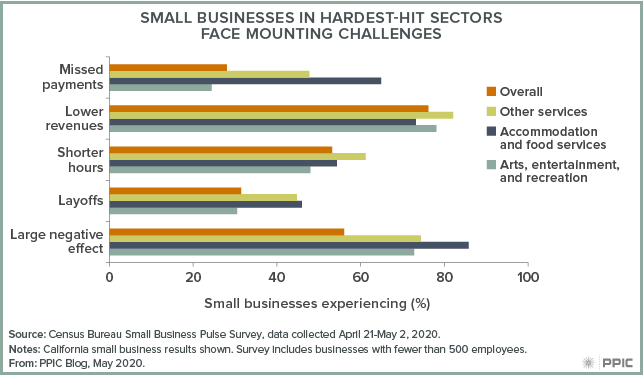
Figure - Small Businesses in Hardest-Hit-Sectors Face Mounting Challenges

Very small businesses are more likely to be owned by women and nonwhite Californians than larger businesses.  Latinos own 11% of these businesses but only 2% of larger businesses. Similarly, Asians own 23% of very small businesses versus roughly 10% of larger businesses. In California, women run 22% of such businesses, compared to 7% of larger businesses.

Within the industries hit hardest by COVID-19, very small businesses with less than 50 employees have even higher rates of Asian, Latino, and women ownership. In particular, one-third in this heavily affected sector—for example, restaurants and retail—are Asian-owned. Women also own 26% of very small businesses in these industries; another 20% are jointly owned by men and women.[/vc_column_text][/vc_column][/vc_row][vc_row max_width=”80″ visibility=”visible-desktop”][vc_column][vc_column_text][infogram id=”1pj99903epwez1i6zzgjry1njeamvd0vkmz?live”][/vc_column_text][/vc_column][/vc_row][vc_row max_width=”80″ visibility=”visible-tablet-landscape”][vc_column][vc_column_text]

[infogram id=”1pj99903epwez1i6zzgjry1njeamvd0vkmz?live”]

[/vc_column_text][/vc_column][/vc_row][vc_row visibility=”visible-tablet-portrait”][vc_column][vc_column_text]

[infogram id=”1pj99903epwez1i6zzgjry1njeamvd0vkmz?live”]

[/vc_column_text][/vc_column][/vc_row][vc_row visibility=”visible-phone”][vc_column][vc_column_text]

[infogram id=”1pj99903epwez1i6zzgjry1njeamvd0vkmz?live”]

[/vc_column_text][/vc_column][/vc_row][vc_row][vc_column][vc_column_text]Despite policymaker concerns about the survival of small businesses, initial efforts to provide assistance have fallen short of expectations. Over 88% of California small businesses in accommodation and food services applied for federal assistance through the Paycheck Protection Program (PPP), yet only 27% received any support. For other federal programs like Economic Injury Disaster Loans (EIDL) and Small Business Administration (SBA) Loan Forgiveness, less than half of the businesses in hard-hit industries that requested funding received any.

Policies to help these businesses manage the current downturn will influence the state’s economic recovery. Small businesses employ many of California’s workers, and small business ownership offers a path to economic mobility and success. In addition, young businesses—many of which are small—play a particularly important role in job creation.

While federal assistance will remain critical, state and local efforts can help fill the gap. Because some communities lack sufficient resources, state efforts to provide financial assistance through the Small Business Loan Guarantee Program are a step in the right direction.[/vc_column_text][/vc_column][/vc_row]

Overcrowded Housing and COVID-19 Risk among Essential Workers

[vc_row][vc_column][vc_column_text]Some Californians face substantial risk of illness within their own households under the state’s shelter-in-place order. Physical distancing and self-isolation can be virtually impossible in crowded homes, threatening the health of entire households. In crowded living conditions, individuals are at higher risk of transmitting infectious diseases, a factor that may challenge the state’s efforts to manage the pandemic while reopening the economy.

As the high cost of housing is a stark reality for nearly two-thirds of Californians, finding affordable housing can mean cohabiting with several other people. California’s overcrowding rate is well above the national average; the share of housing units with more than one occupant per room is 8.3% compared with 3.4% across the nation. Furthermore, overcrowding is much more common among renters than homeowners (13.4% vs. 4.0%), and in Latino households (18.4% vs. 2.4% of white households).

While most Californians have been staying home to reduce coronavirus transmission, essential workers do not have the option to shelter in place. Over one-third of California’s labor force works in essential occupations that require being physically present. Compared to nonessential workers, they are at higher risk of infection because they continue to circulate among others despite the shutdown.

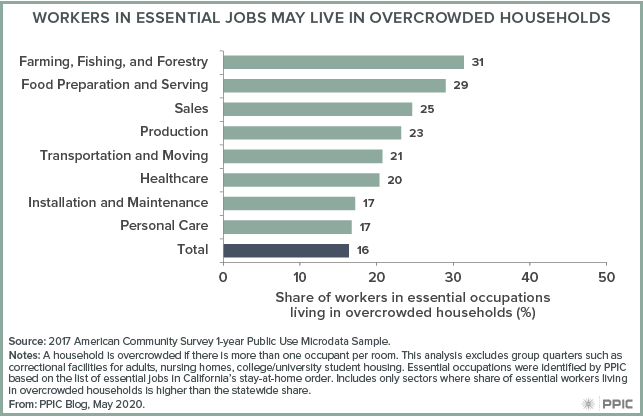
Essential workers are more likely than nonessential workers to live in overcrowded housing—16 percent versus 12 percent. That share is almost double for workers in farming (31%), and food preparation/serving (29%).

Figure - Workers in Essential Jobs May Live in Overcrowded Households

A recent study confirms that essential workers and those in larger households do face a higher risk of contracting coronavirus. It would be ideal to explore the relationship between COVID-19 cases and workers living in crowded conditions. However, inconsistent testing availability across regions makes cases an unreliable measure of the virus’s geographic spread; deaths, which are better measured, are a valuable proxy.

There is a clear link between COVID-19 deaths and essential workers who live in overcrowded homes, though the relationship is muddied by regional differences in terms of the age structure of the population,  underlying health conditions, and other factors. Santa Barbara (25%), Madera (23%), Los Angeles (21%), Orange (20%), and Tulare (19%) counties have the highest shares of essential workers in overcrowded homes. Los Angeles and Tulare are experiencing large numbers of deaths per capita, at 14 and 9 deaths per 100,000 people, but the other counties are not.[/vc_column_text][/vc_column][/vc_row][vc_row max_width=”80″ visibility=”visible-desktop”][vc_column][vc_column_text][infogram id=”1p375951mzw3k9c0mex60d30kdidymqxjlx?live”][/vc_column_text][/vc_column][/vc_row][vc_row max_width=”80″ visibility=”visible-tablet-landscape”][vc_column][vc_column_text]

[infogram id=”1p375951mzw3k9c0mex60d30kdidymqxjlx?live”]

[/vc_column_text][/vc_column][/vc_row][vc_row visibility=”visible-tablet-portrait”][vc_column][vc_column_text]

[infogram id=”1p375951mzw3k9c0mex60d30kdidymqxjlx?live”]

[/vc_column_text][/vc_column][/vc_row][vc_row visibility=”visible-phone”][vc_column][vc_column_text]

[infogram id=”1p375951mzw3k9c0mex60d30kdidymqxjlx?live”]

[/vc_column_text][/vc_column][/vc_row][vc_row][vc_column][vc_column_text]California will lift some shelter-in-place restrictions in the coming days, and more people will leave their homes to work. Examining work and living conditions together can identify areas where people are least able to take effective actions against the spread of the coronavirus. Designing policies to protect the health of workers and their households will be critical to managing COVID-19 while restarting the state’s economy.[/vc_column_text][/vc_column][/vc_row]

Who Lives in California’s Nursing Homes?

Seniors aged 65 and over are the age group most at risk of dying from the COVID-19 virus. As of May 6, according to the California Department of Public Health, seniors accounted for 79% of all COVID-19 deaths (1,894 out of 2,412) in the state. Seniors who live in nursing homes—skilled nursing facilities—are especially vulnerable. But state programs that allow seniors to remain living at home rather than entering nursing homes may help protect California’s most vulnerable population.

Residents of nursing homes make up less than 1% of the state’s population, but account for 39% (929 out of 2,412) of all COVID-19 deaths in the state and 10% (5,604 out of 56,212) of all confirmed COVID-19 cases. And at 78%, the vast majority of nursing home residents are seniors. Health care workers in the state’s nursing homes are also at risk. Seventeen have died and over 3,000 have contracted the disease.

Even as the senior population has grown with the aging of the baby boom cohort, the number of seniors in nursing homes has remained steady. According to the American Community Survey, about 88,300 seniors, or 1.7% of all seniors in California, live in nursing homes in 2018; that’s about the same number as in 2010 (87,500).

Figure - Little Change in Number of Seniors at California Nursing Homes

Women make up the majority of the seniors in California nursing homes (65%). Residents also tend to be very old—43% are age 85 or older—and not married. Similar to the overall senior population, the majority are white (58%). Even so, many residents (32%) speak a language other than English. Los Angeles County, the locus of the pandemic in California, has 35% of the state’s nursing home residents, but 26% of the state’s population.

Almost all nursing home residents have self-care limitations. That is, these seniors have a physical or mental health condition that has lasted at least six months and makes it difficult for them to attend to their own personal needs such as bathing, dressing, or getting around. And at least half (51%) are on Medi-Cal.

However, state and county programs have allowed more seniors to live at home. One such program, In-Home Supportive Services (IHSS), is intended to keep low-income seniors in their own homes rather than in nursing homes. IHSS offers services such as housecleaning, meal preparation, laundry, grocery shopping, personal care services—such as bathing, grooming, and paramedical services—and accompaniment to medical appointments.

Because of this arrangement, even seniors with self-care limitations are increasingly likely to stay in their own homes rather than move to a nursing home. Hundreds of thousands of California seniors receive care through IHSS.

The share of seniors in nursing homes across the rest of the country is about one-third higher than in California. A likely outcome of state efforts to keep seniors in their own homes has been to protect many seniors in this state from exposure to the pandemic.

COVID-19 Alters College Admissions

[vc_row][vc_column][vc_column_text]Admissions may look different for students entering college in fall 2021. Social distancing to protect communities during the COVID-19 outbreak will impact where students attend classes and where they will live—and recent policy updates around standardized testing and GPA requirements will impact how colleges determine eligibility and placement in courses. But even as admissions become more flexible, some students still struggle to get on the path to college.

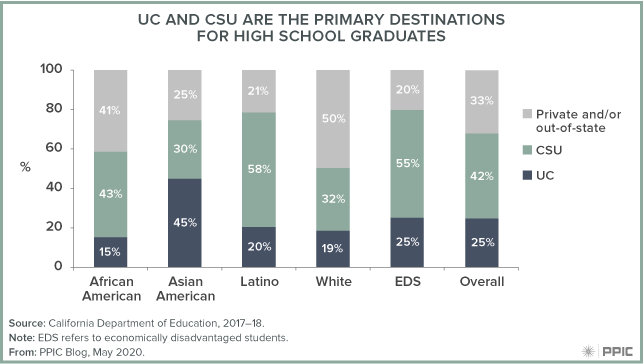
California’s public universities are the primary destination of the state’s high school graduates and community college transfers headed to a four-year college. In 2017–18, nearly 200,000 California high school graduates applied to the University of California (UC) or California State University (CSU), and 84,000 were enrolled.

figure - UC and CSU Are the Primary Destinations for High School Graduates

For students applying for admission to colleges in fall 2021, eligibility requirements and application processes are changing. Most standardized tests used for admission—such as SAT and ACT—and for placement purposes, such as the Smarter Balanced Assessment, are either postponed or cancelled.

In light of these cancellations, UC and CSU temporarily suspended testing requirements for fall 2021 applicants, meaning students do not need to include a test score on their application. In addition, UC and CSU systems are temporarily accepting pass/fail in lieu of a letter grade for courses completed in winter, spring, and summer 2020, as more K–12 districts and community colleges choose not to assign letter grades while students adjust to distance learning during the pandemic.

These adjustments are meant to ease anxiety over college admissions in a time of crisis, and there is some evidence that eliminating high stakes standardized tests could lead to more underrepresented students being placed in college-level courses and being eligible for college.

However, when high schools and community colleges lack sufficient resources, even with flexible grading in place, remote education may fail disadvantaged students. More than half of K–12 students from low-income households do not have broadband access at home. Notably, PPIC research found that online courses at community colleges exacerbated achievement gaps.

During their junior and senior years, high school students are more likely to fall off the college pathway, and disadvantaged students are even more likely to do so. And until recently, disadvantaged students were also more vulnerable to being diverted away from community college courses necessary for transfer admissions.

All students must cope with the changing college application process. But first-generation college applicants come from families who are new to the process; those with less internet/technology access may also be less familiar with how to apply. These students may see less support in the college application process than they would if they were still in school.

Now, more than ever, targeted outreach efforts and collaborations between K–12 and higher education will be critical to ensuring equitable access to a college education and economic mobility.[/vc_column_text][/vc_column][/vc_row]

Students Prepare for AP Exams during COVID-19

In response to disruptions from COVID-19, the 2020 AP exams will be open book/open note format and taken online at home, according to the College Board. The new exams are scheduled May 11–22. At 45 minutes each, the exams will be much shorter and cover less material—focusing on content covered prior to March school closures.

An increasing number of colleges, including those in the University of California system, have affirmed they will award college credit for 2020 AP exams that score a 3, 4, or 5. While these changes give flexibility to students still hoping to earn college credits, all students may not benefit equally.

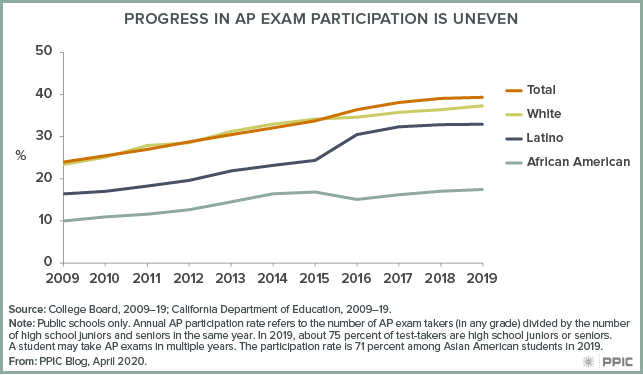
Nearly 380,000 students in California public schools took an AP exam in 2019, up 63% from a decade ago. Participation among Latino students grew from 16% in 2009 to 33% in 2019. However, participation by African American students plateaued in 2015.

figure - Progress in AP Exam Participation Is Uneven

For disadvantaged and vulnerable students, limited access to learning options at home may cause a dip in participation and performance. Nearly half of students from low-income families do not have broadband access at home; neither do a third of Latino or African American students. And broadband access remains problematic in rural areas, where 41% of school-aged children do not have access.

Students with special educational needs may face additional challenges. The pandemic and resulting school closures have had a disproportionate impact on this student population, with many losing access to special education support professionals and services.

Efforts to close these gaps are underway: the state Superintendent recently formed a new task force to close the digital divide, and the governor announced several cross-sector partnerships to support distance learning. The California School Board Association just announced its effort to push for a $2 billion broadband bond on the November ballot to address rural connectivity.

AP assessments begin in just a few weeks. The College Board has suggested that students without internet or a device contact them for assistance, but the scope of the organization’s ability to respond is untested. In addition, test preparation and participation may be difficult for students who are also caregivers at home and lack separate, quiet testing space.

It is unclear how many California students will take the 2020 AP exams, but they are still being encouraged to do so. In an April webinar, the College Board noted that 86% of AP teachers across the nation will still assign a letter grade to their courses during this school closure, with bonus points for completing an AP exam.

At 91%, the vast majority of AP enrollees still want to earn college credits. Schools and teachers across the state are helping students navigate the new system. As the state ramps up efforts to implement distance learning and maintain continuity of learning amid school closures, AP results should be closely monitored so that we understand the impact on socioeconomically disadvantaged students and special education students.

Many Low-Income Families Left Out of Federal Stimulus Benefits

As part of the federal response to COVID-19, the IRS has started issuing stimulus checks—to boost consumer confidence—directly to millions of families. For the record number of Californians who have lost jobs, hours, and certainty around their incomes, these payments could come just in time.

We estimate that about 81% of Californians live in a family that will receive an “economic impact payment,” with the typical family receiving around $2,200. In total, Californians could receive about $26 billion through the program.

However, nearly 20% of families are unlikely to receive a stimulus check. Because the payments phase out as incomes rise, most of these families are above the income cutoff ($99,000 for single tax filers and $198,000 for joint filers without children). But nearly a third are among the state’s lowest income families. In part, this reflects the fact that only people who have filed taxes recently, or who receive either supplemental security income (SSI) or social security, will receive a check.

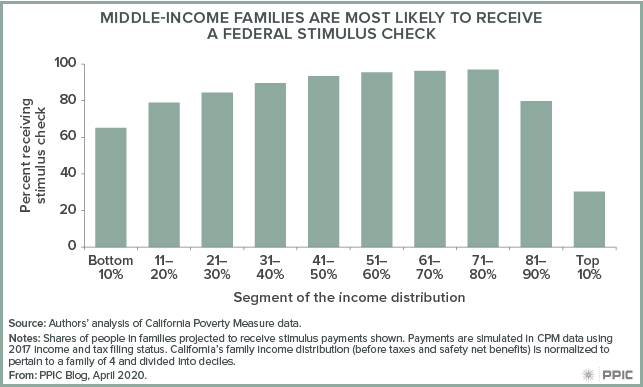
People with very low incomes are not required to file taxes, and they will not receive stimulus checks unless they actively share their banking details with the IRS. Partly for this reason, our estimates indicate that just 65% of people in families with the lowest 10% of incomes—less than about $22,000 a year for a family of four—are likely to receive a check.

By comparison, 90% to 97% of those in middle-income families—with annual incomes of $52,000 to $176,000—are likely to receive a check.

figure - Middle-Income Families Are Most Likely To Receive a Federal Stimulus Check

Yet even if all Californians who do not file taxes submit their information to the IRS, people in low-income families will still receive checks at lower rates than middle-income families. Because many low-income families include undocumented residents, the entire family is ineligible for these federal payments. If families with undocumented members were eligible, all families from the 11th to 80th percentiles of the income distribution could potentially receive a check.

To help Californians during this crisis, the state’s safety net will need to reach those most affected economically. The temporary expansion of unemployment insurance will provide much more aid to certain low-income families than the federal stimulus payments. And California’s recently announced Disaster Relief Fund, which will use public and private funds to provide up to $1,000 per household to families of some undocumented immigrants, will help to fill in certain gaps. But while replacing wages is important, a response focused only on wages would skip many people in need.

Food assistance programs like CalFresh and school meals are also critical safety net supports because of their wide reach, and expansions are also underway. Along with the federal stimulus payments, these are important steps, but—depending on the length and the depth of the crisis—more remains to be done.

Early Insights on California’s Economic Downturn

California’s unemployment rate jumped from a historically low 3.9% to 5.3% in March. For comparison, it took a full year from the official start of the Great Recession for unemployment to increase by 1.4 percentage points (although the levels were higher: 5.9% in December 2007 to 7.3% in December 2008). Notably, the March rate is based on data from the middle of the month, so it does not fully reflect the massive layoffs that occurred as the COVID-19 pandemic took hold.

Between March 15 and April 18, 3.4 million Californians applied for unemployment insurance. There has been much forecasting (including by us) about the sectors and workers that will feel the immediate effects of the downturn. We do not have demographic breakdowns and we don’t know which industries employed these workers. But recently released labor market data can provide some new insights.

By mid-March, California had recorded a net loss of 100,000 jobs, comprising about one-seventh the decline nationwide and reflecting the state’s early response to COVID-19 crisis. That’s less than 1% of the state’s 17 million jobs. The lion’s share of job loss (more than 80%) occurred in three service sectors: arts, entertainment, and recreation; accommodation and food; and “other services” (a category that includes automotive repair, personal care, and dry cleaning).

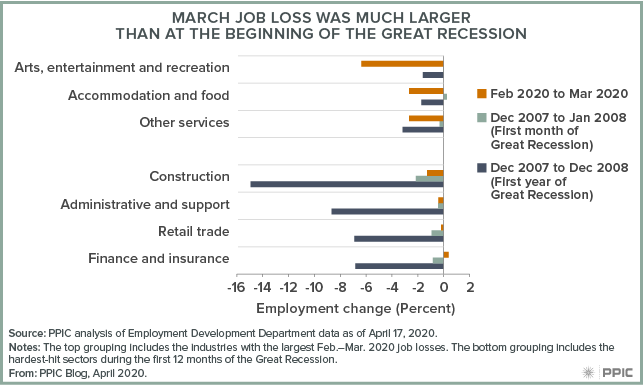
A comparison with the Great Recession highlights the severity of the current situation. Between February and March this year, employment in arts, entertainment and recreation fell 6.4%. Over the first year of the Great Recession, employment in this sector fell 1.6%. The number of jobs lost in the accommodation and food service sector was much higher between February and March, but these losses represented only 2.7% of the workforce in this much-larger sector.

A look at job losses in the industries that were hit hardest during the Great Recession shows that jobs are being lost much more quickly during the COVID-19 crisis. In the first month, construction—the recession’s most severely affected industry—saw a 2.2% decline, and no other sector experienced losses greater than 2%.

figure - March Jobs Loss Was Much Larger Than at the Beginning of the Great Recession

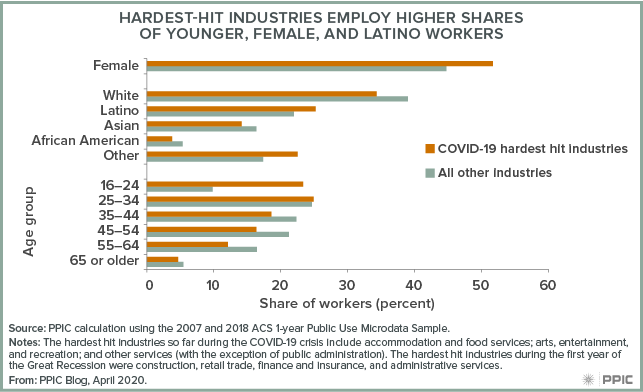
These initial data clearly show that the current crisis is hitting a different set of sectors than the Great Recession. It also shows that workers in the initially affected industries are more likely to be women (52% versus 45%), Latinos (25% versus 22%), and young adults (23% versus 10%) compared to workers in other sectors—and to workers in the hardest-hit industries during the first year of the Great Recession.

figure - Hardest-Hit Industries Employ Higher Shares of Younger, Female, and Latino Workers

As the current crisis continues to unfold, a more complete picture of the workers and industries affected will emerge. The staggering number of recent unemployment claims indicates that the losses in the March data are only the tip of the iceberg. April data will no doubt show deeper declines and a widening impact across sectors.

Unemployment insurance will provide an important economic backstop for many workers over the next several months. However, it will be important to monitor the workers and industries being affected by this crisis, both to ensure that policy efforts are directed where they are most needed and to inform additional measures to mitigate the economic damage.

California’s Quick Response to COVID-19 Likely Saved Lives

As of April 21, nearly 5,000 Californians are hospitalized and more than 1,300 have died due to COVID-19, but proactive public health measures may have safeguarded many others. Because the coronavirus spreads exponentially, days matter. And early actions before the statewide shelter-in-place order may have proved especially effective in reducing transmission.

The Bay Area had some of the state’s earliest cases of coronavirus, which spurred a rapid response. Santa Clara was the first county to declare a public health emergency, and large companies in the region asked employees to work from home as early as the first week of March.

Seven Bay Area counties—including Alameda, Contra Costa, Marin, San Francisco, San Mateo, Santa Clara, and Santa Cruz—implemented shelter-in-place orders beginning on March 17. Los Angeles County instituted a comparable order mere days later, but the virus was already spreading rapidly.

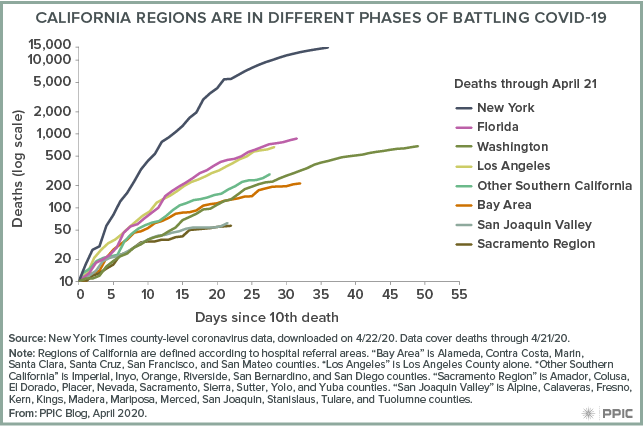
As of now, regions are in different phases of flattening the COVID-19 death curve. In Los Angeles County, the last week of data suggest the number of deaths doubles about every 8 days. That is a faster rate than Florida (12 days), but still far slower than New York in its deadliest week—when deaths doubled almost every day.

Other parts of Southern California also saw a spike, with deaths doubling every 8 days. Meanwhile, at 12 days, deaths in the Bay Area are doubling more slowly, as they are in the Sacramento region at 15 days. Both the San Joaquin Valley and other parts of the state have essentially plateaued at 19 and 32 days.

figure - California Regions Are in Different Phases of Battling COVID-19

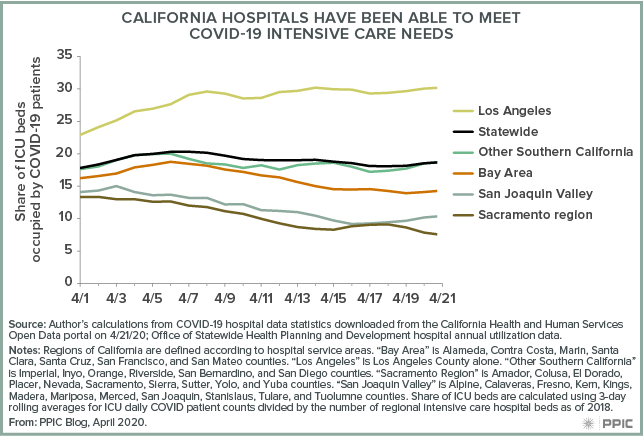
Local policies have also curbed demand for COVID-19 hospital care. Statewide, hospitalizations and ICU beds filled due to COVID-19 have been trending downward for two weeks, but have ticked up slightly the last few days. Certain counties—notably Los Angeles—have continued to see an upward trend in COVID-19 patients in intensive care, although it does seem to be plateauing.

In Los Angeles in recent weeks COVID-19 patients occupied about 30% of total ICU beds, compared to less than 15% in the Bay Area. The San Joaquin Valley and Sacramento regions also seem to be faring well, with about 10% of ICU beds filled due to the coronavirus. Regional estimates of ICU occupancy rates (as of 2018) suggest hospitals can manage current levels of COVID-19 patients while meeting other intensive care needs.

figure - California Hospitals Have Been Able To Meet COVID-19 Intensive Care Needs

Governor Newsom listed clear criteria for reopening the state’s economy in the midst of the global pandemic. All of California will meet certain benchmarks, such as data tracking and scientific advances in testing and treatment, on a single timeline. Others, such as plans for conducting business while social distancing and protecting vulnerable residents, will likely differ by region.

The state acknowledges that communities may reopen at different times based on circumstances. Recent experiences suggest that responsive local policies could help the state reopen while suppressing COVID-19 hospitalizations and deaths.

Will Mail-in Ballots Benefit One Party?

If coronavirus is still active during this November’s presidential election, the risk remains of spreading the virus among voters and poll workers. The best solution is to limit in-person options and rapidly expand the number of voters who submit ballots through the mail.

This is the right choice for public health. But a debate around the degree of change needed is reasonable: how many mail-in ballots and how many polling places are needed to both keep people safe and allow fair access? And lurking in the background are darker questions: does one party stand to benefit as vote by mail expands? Is this a partisan game masquerading as a question of public health?

The short answer to both questions is no. On the surface, there might seem to be a partisan angle. Many Democrats have pushed for expanding vote by mail, while President Trump has firmly stated it would hurt Republican candidates. States friendly to voting by mail tend to vote more Democratic, while some Republican-leaning states like Texas have resisted more voting by mail even in the pandemic. And Californians who vote by mail are older and more likely to be white, demographics that also vote more Republican on average.

But these scenarios describe the status quo; they don’t tell us how election results might change if vote by mail became more widely available. When election jurisdictions—including some California counties—have rapidly expanded vote by mail, neither major party has clearly benefited. Likewise, early evidence from experiments with heavy vote by mail in California suggests an increase in turnout among Latinos, Asian Americans, and young people of up to seven percent, though often with a fair amount of statistical uncertainty.

The same analysis suggests overall turnout increased about two to three percent, making it difficult to say that the composition of the electorate changed much in the end. Thus, while the greater convenience of vote by mail does seem to draw in a few more voters, these voters aren’t that different on average from the ones who show up already.

The demographic differences between in-person and by-mail voters are real, but should not be overstated. People from all backgrounds and political persuasions vote in person. All of them will be at risk in an election where coronavirus is still active. Expanding vote by mail is now a pure question of public health and administrative capacity. Neither party should worry that it will put them at a disadvantage.

Race, Health, and the Risk of COVID-19 Complications

For adults younger than 65, many underlying health conditions are emerging as risk factors that can lead to severe complications of COVID-19. Within this larger population, certain minority groups are under particular threat due to disproportionate rates of such conditions. While California’s overall share of nonelderly adults at risk is relatively low, disparities in health endanger some more than others during this health crisis.

Governor Newsom cited protecting individuals most at risk of COVID-19 complications as a necessary criterion for restarting California’s economy. Though we cannot yet draw conclusions from incomplete data—about one-third of cases and over a tenth of deaths do not have complete data on race and ethnicity—certain risk factors are more prevalent along racial and ethnic lines.

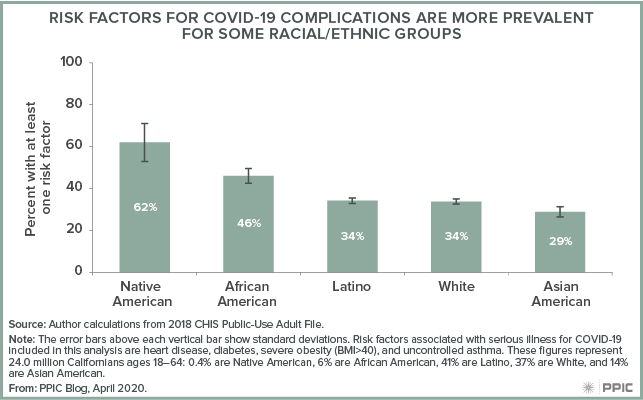
According to the Center for Disease Control, potential risk factors include heart disease, diabetes, severe obesity (BMI greater than 40), and uncontrolled asthma; smoking is also likely to increase risk. In California, over 60% of Native Americans and about 46% of African Americans have at least one of those health concerns. By comparison, roughly one-third of whites, Latinos, and Asian Americans have one or more of these health issues.

Native Americans are diagnosed with heart disease at rates almost four times that of whites (19% to 5%), have higher rates of smoking (51% to 14%), and double the uncontrolled asthma (12% to 6%). African Americans have much higher rates of diabetes (24% to 14%) and severe obesity (12% to 4%) than whites. Asian Americans and Latinos also have higher rates of diabetes (about 19%) compared to whites (14%).

figure - Risk Factors for COVID-19 Complications Are More Prevalent for Some Racial/Ethnic Groups

Due to higher poverty and uninsured rates, minority groups also face more difficulty accessing health care. At the same time, individuals in these populations may frequently hold jobs with a higher risk of exposure to coronavirus.

The California Department of Public Health has begun to publish data on cases and deaths by race/ethnicity. Some counties, such as San Francisco, are doing the same at the local level. While limited testing capacity and incomplete data prevent a true understanding of who is most impacted by the coronavirus, better knowledge of existing health disparities can help California protect and heal its most at-risk members as the state plans its next steps in responding to the public health crisis.