Early Insights on California’s Economic Downturn

California’s unemployment rate jumped from a historically low 3.9% to 5.3% in March. For comparison, it took a full year from the official start of the Great Recession for unemployment to increase by 1.4 percentage points (although the levels were higher: 5.9% in December 2007 to 7.3% in December 2008). Notably, the March rate is based on data from the middle of the month, so it does not fully reflect the massive layoffs that occurred as the COVID-19 pandemic took hold.

Between March 15 and April 18, 3.4 million Californians applied for unemployment insurance. There has been much forecasting (including by us) about the sectors and workers that will feel the immediate effects of the downturn. We do not have demographic breakdowns and we don’t know which industries employed these workers. But recently released labor market data can provide some new insights.

By mid-March, California had recorded a net loss of 100,000 jobs, comprising about one-seventh the decline nationwide and reflecting the state’s early response to COVID-19 crisis. That’s less than 1% of the state’s 17 million jobs. The lion’s share of job loss (more than 80%) occurred in three service sectors: arts, entertainment, and recreation; accommodation and food; and “other services” (a category that includes automotive repair, personal care, and dry cleaning).

A comparison with the Great Recession highlights the severity of the current situation. Between February and March this year, employment in arts, entertainment and recreation fell 6.4%. Over the first year of the Great Recession, employment in this sector fell 1.6%. The number of jobs lost in the accommodation and food service sector was much higher between February and March, but these losses represented only 2.7% of the workforce in this much-larger sector.

A look at job losses in the industries that were hit hardest during the Great Recession shows that jobs are being lost much more quickly during the COVID-19 crisis. In the first month, construction—the recession’s most severely affected industry—saw a 2.2% decline, and no other sector experienced losses greater than 2%.
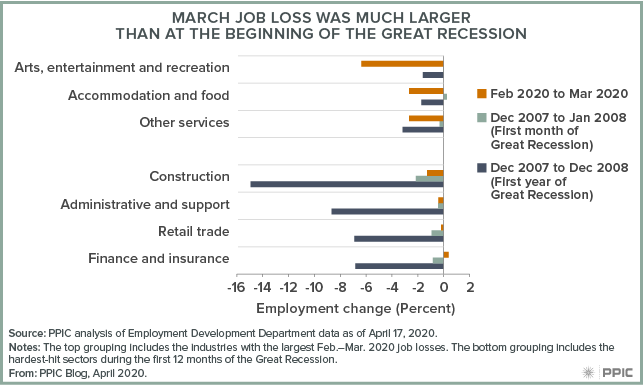
figure - March Jobs Loss Was Much Larger Than at the Beginning of the Great Recession

These initial data clearly show that the current crisis is hitting a different set of sectors than the Great Recession. It also shows that workers in the initially affected industries are more likely to be women (52% versus 45%), Latinos (25% versus 22%), and young adults (23% versus 10%) compared to workers in other sectors—and to workers in the hardest-hit industries during the first year of the Great Recession.
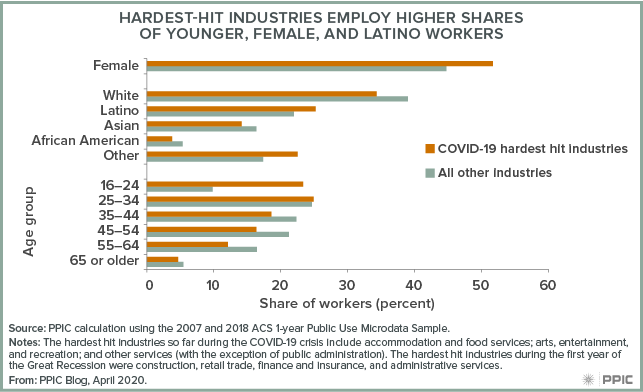
figure - Hardest-Hit Industries Employ Higher Shares of Younger, Female, and Latino Workers

As the current crisis continues to unfold, a more complete picture of the workers and industries affected will emerge. The staggering number of recent unemployment claims indicates that the losses in the March data are only the tip of the iceberg. April data will no doubt show deeper declines and a widening impact across sectors.

Unemployment insurance will provide an important economic backstop for many workers over the next several months. However, it will be important to monitor the workers and industries being affected by this crisis, both to ensure that policy efforts are directed where they are most needed and to inform additional measures to mitigate the economic damage.


Coping with COVID-19 in California’s Cities

California’s cities have been at the forefront of bold actions to manage the coronavirus pandemic. We talked to Carolyn Coleman, executive director of the League of California Cities, about the big challenges that the pandemic is bringing to cities across the state.

PPIC: How are cities coping with this unprecedented crisis?

Photo of Carolyn ColemanCAROLYN COLEMAN: Local government leaders are some of the most pragmatic people I know. This comes from being on the front lines and hearing from your constituents everywhere you go—grocery stores, parks, and churches. Local officials are problem solvers, and they signed on to help their residents have a better quality of life. They have approached this crisis with the same dedication and commitment to serve that they brought to dealing with past crises, like the recent wildfires.

Across California, city leaders have stepped up with tools like eviction moratoriums and measures to prevent utility shutoffs or price gouging to protect their residents. Several are creating funds that will provide short-term financial assistance to help keep their small businesses afloat.

City officials are also working with public health entities, hospitals, schools and faith-based organizations to make sure medicines and meals are delivered to vulnerable populations.

Cities have also been very nimble in adapting government business to a virtual model. Council meetings, town halls, and public hearings have moved online with virtual tools that ensure public engagement. They are also using websites, social media, and new technology platforms to engage with their residents and make sure they have needed information.

Early orders by California cities to stay at home or restrict gatherings are being credited with flattening the curve. There was some pushback when these orders were announced, but they’re saving lives here in California, and that started with local government leaders who were out in front of the crisis.

The economic disruption this crisis is having on families, businesses and governments is devastating. While saving lives, stay-at-home orders have led to business closures, furloughs, and layoffs, as well as decreases in tax revenues that local governments use to fund essential services like police, fire, and code enforcement. At the same time, cities are experiencing increased expenses because of COVID-19. We’ll be working closely with federal and state partners to fill revenue gaps so we can continue to provide the services our communities need right now.

PPIC: Are there particular needs in rural communities?

CC: For years, we’ve known that access to high-quality broadband is not as widely available as it should be in our rural communities. With schools closed and some health services moving online, this crisis is a wake-up call to get more broadband deployed across the state.

Rural communities also tend to have smaller budgets with fewer resources to respond to economic disruption caused by this crisis. As they navigate the shortfall in revenues and increase in expenses, their need for fiscal assistance from the state and federal governments could be proportionately as large as our biggest cities.

The federal Coronavirus Aid, Relief, and Economic Security (CARES) Act targets cities with more than 500,000 residents. Most of California’s 482 cities are smaller than that, and yet they may end up with needs that are proportionally as large as those of big cities. That’s why the League will continue to advocate for fiscal assistance for all of our cities, to ensure that none are left behind—during either the pandemic or the financial recovery from it.

PPIC: Talk about the ongoing housing shortages and homelessness in the context of this emergency.

CC: I applaud the governor and local leaders who in recent weeks have partnered closely to safely house more Californians. Every day we hear about cities opening new emergency shelters, putting out more handwashing stations, passing out hand sanitizer in homeless encampments, and taking other steps to protect public health. The governor is sending more trailers to cities for emergency housing, and housing construction is continuing—it’s an essential service. Pandemic or not, we all know we have to increase housing production so more of our families have places to live.

We’re also seeing some new ways to streamline the housing production process, which could become mainstream once the health crisis is over.

PPIC: What gives you hope during these challenging times?

CC: I’m heartened by the public leadership we’re seeing. Local leaders, and leaders at all levels of government, are stepping up to save lives. And the selflessness that surfaces in times like these is a reminder that we’re all connected. People rise.

Unemployment Benefits in the COVID-19 Pandemic

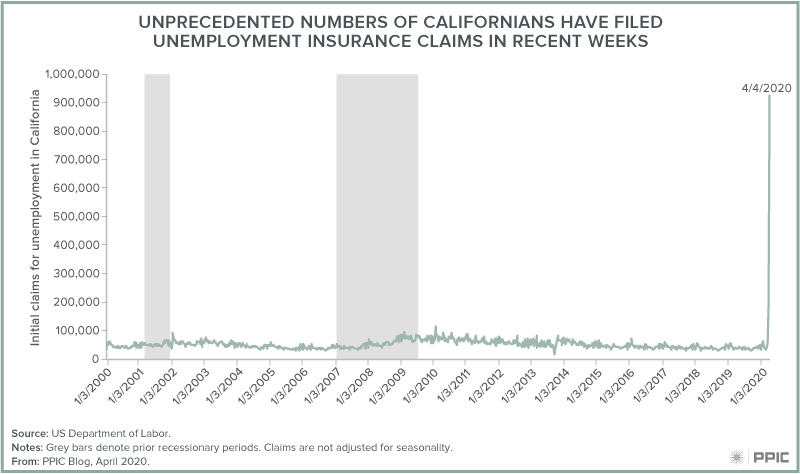
Today, the US Department of Labor revealed that 925,450 Californians filed initial unemployment insurance claims during the week ending April 4. This makes for a record-breaking three-week period during which nearly two million claims were filed in California, representing roughly 10% of the labor force. What kind of benefits can these millions of newly unemployed workers receive?

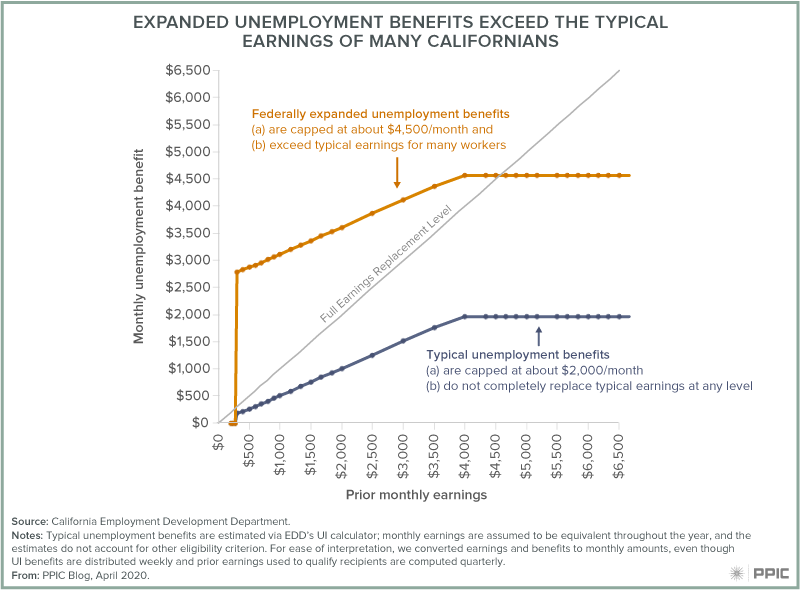
Typically, Californians who qualify for unemployment receive a maximum of $450 per week as long as they are actively looking for work, and that assistance can last for up to 26 weeks. (Notably, benefits in California are less generous than those in most other states: in 2019, its average weekly benefit of $345 ranked 29th.) However, federal policymakers are responding to unprecedented circumstances; so far, they have expanded both eligibility and benefits.

Federal legislation temporarily expands eligibility. The Coronavirus Aid, Relief, and Economic Security (CARES) Act makes self-employed Californians—including gig workers and other independent contractors—who are unable to work or have had hours reduced by COVID-19 eligible to receive benefits. Also, laid-off workers who expect to return to their current jobs are not required to be searching for work.

The new law also supplements and extends benefits. The CARES Act provides $600 per week on top of typical benefits for up to four months. This represents a dramatic boost for most unemployed Californians. The legislation also covers the cost of a 13-week extension of benefits, so that laid-off workers can now receive unemployment for up to 39 weeks.

Unemployed Californians who earn less than $4,000/month would normally qualify for a benefit that replaces roughly half of their earnings, and the benefit covers a smaller and smaller share of earnings above $3,894/month. The $600 federal supplement is higher than California’s maximum benefit and more than covers prior earnings for many unemployed Californians.

It is likely that workers in the state’s hardest-hit sectors make up a large share of early applicants for unemployment benefits. In the accommodation and food service industry—one of the hardest-hit sectors—the average monthly wage is roughly $2,000; an unemployed worker could receive up to $3,700 per month. The average worker in transportation and warehousing, another impacted industry, earns more than twice as much ($5,000/month), but unemployment benefits for this worker would be only slightly higher: up to $4,550 per month.

These expanded benefits will help millions of newly unemployed Californians, but the state and its workers face important limitations and challenges. Given the massive surge in applications, workers may have to wait several weeks—or months—to receive benefits. Moreover, laid-off immigrants who are unauthorized to work in the US will have to rely on other support.

More generally, California’s unemployment insurance fund reserves are inadequate to weather even a mild recession, although the federal government steps in to loan the funds when needed. In the longer term, policymakers should seriously consider reforms to the unemployment system, so that it can respond quickly and comprehensively in the next economic crisis.

Essential Workers and COVID-19

California is grappling with the dual threats of a public health crisis caused by the coronavirus and the additional economic fallout of necessary social distancing measures.  In the past week, we have seen unemployment claims skyrocket and policymakers forge supports for workers and businesses.

Meanwhile, there is a workforce that is tackling the public health crisis, keeping the economy going, and supporting Californians who are sheltering in place. While this essential workforce supports the state’s health and basic economic needs, many of these workers are not well equipped to weather the economic challenges of the COVID-19 crisis.

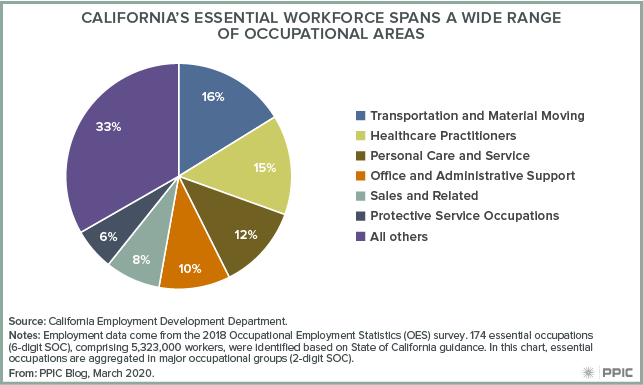
We estimate that in a typical year, roughly one-third to one-half of California’s labor force is employed in essential occupations. Essential workers fulfill a wide variety of roles in our economy, including in health care services, energy provision, food service, agriculture, and transportation. Some workers in these areas may be seeing layoffs and hours reductions depending on their industry, firm, or region.

figure - California’s Essential Workforce Spans a Wide Range of Occupational Areas

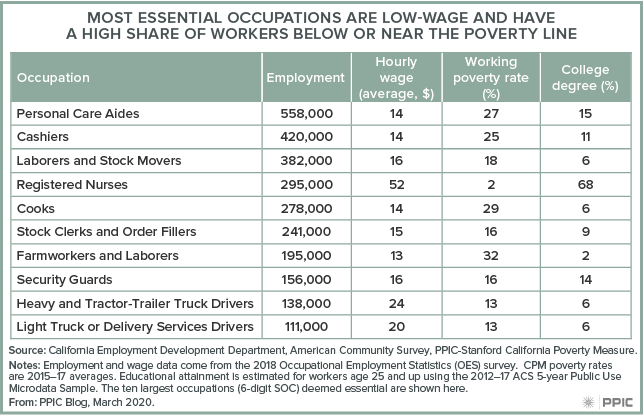
Some essential jobs are obvious, as they are on the front lines of the public health crisis. For example, registered nurses (the largest occupation within the healthcare practitioner category) are essential, have two- or four-year degrees (68% have a college degree, according to our analysis of American Community Survey data), and earn relatively high wages ($52.32 an hour).

However, workers outside of the health care sector are also on the front lines. Personal care aides—those who assist the elderly and others in their homes or personal care facilities—are the single largest essential job category. These workers earn $13.50 an hour on average and 85% do not have a college degree.

Differences in skills and pay translate into notable differences in economic well-being for these workers and their families. A slightly higher share of essential workers than non-essential workers are poor or nearly poor, according to the California Poverty Measure: 14% of essential workers live in poor families compared to 11% of non-essential workers (the comparable estimates for near poverty are 19% and 14%, respectively).

figure - Most Essential Occupations Are Low-Wage and Have a High Share of Workers Below or Near the Poverty Line

Grocery store cashiers, store clerks, farmworkers, and delivery and truck drivers make up sizeable shares of the essential workforce.  Given the low hourly wage rates for these workers, some may face hardships in caring for children or family members with schools and care facilities shuttered.

In addition, many essential workers experience the cost and risk of maintaining their own health while interacting with the public. In low wage essential jobs, access to health benefits and paid sick leave is limited, even in normal times. During the COVID-19 crisis, expanding access to personal protective gear could reduce the health risks among workers whose job requires some level of contact with the public.

Mandated lockdowns are now slated to continue through at least May 1 in some parts of the state and  may last even longer. Ensuring the ability of essential workers to continue their jobs safely and effectively will be crucial over the coming months. As policymakers implement support for unemployed Californians, it is important that they also consider ways to assist and protect the many essential workers on the front lines. Paid sick leave, adequate health coverage, income support, access to child care, and sufficient personal protective gear should all be part of the policy discussion.

How Will the Coronavirus Affect California’s Economy?

As Californians limit their daily activities to slow the spread of the coronavirus, the state economy is poised to take a major hit. The pandemic is increasing the need for some goods and services (such as health care) and reducing demand for others (such as travel- and entertainment-related services), so the near-term economic consequences are more serious in some sectors than in others. Moreover, these consequences could exacerbate the unevenness of economic conditions and opportunities across regions.

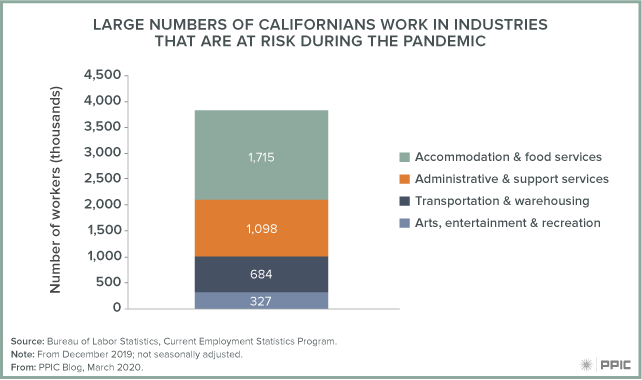
Initially, the largest downturns are likely to occur in sectors that rely on the movement of people and nonessential goods. Recent forecasts have identified several “at risk” sectors: accommodations and food service; arts, entertainment, and recreation; administrative and support services, especially employment services; mining and oil/gas extraction; transportation and warehousing; and agriculture (UCLA Anderson and Moody’s Analytics). Shocks in these industries will be driven by reduced local demand, as well as slowing of trade in and out of California’s ports (especially relevant for the transportation and warehousing and agriculture sectors).

These sectors—excluding agriculture—comprise 10% of the state GDP and employ 3.9 million workers. Unemployment insurance claims data is starting to show the impact on workers, but it will be a while before we get detailed data for all California workers (including those who do not apply for unemployment insurance).

We can, however, learn a lot about the pandemic’s impact on workers, sectors, and regions from recent employment statistics. Employment in these sectors makes up more than a fifth of overall non-farm employment in both California (22%) and the nation as a whole (21%).

figure - Large Numbers of Californians Work in Industries that Are at Risk during the Pandemic

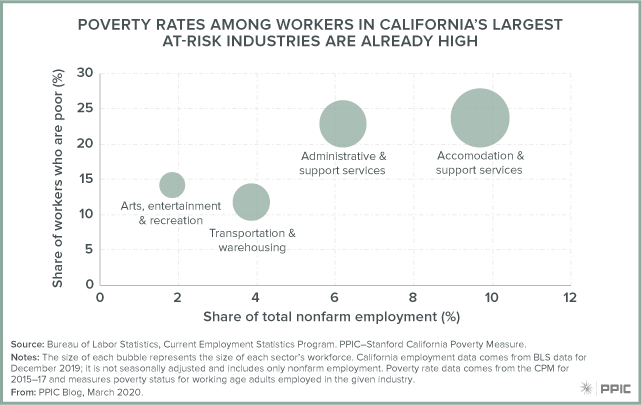
The workforce in these industries is not just large; it also comprises a wide range of occupations (for example, pilots as well as baggage handlers in the transportation industry; hotel managers as well as cleaning staff in the accommodation industry). At this point, we cannot predict exactly how the COVID-19 crisis will affect these workers. But reduced hours and layoffs are highly likely, and the workers least able to weather the storm are those who already struggle with poverty.

Overall, we estimate that 19% of Californians employed in these industries are working poor and another 22% are just above the poverty line (“near poor”). The poverty rate among workers in the accommodation and food service sector is 24%. This sector, which is being hit hard by reduced tourism and dining out, is the largest of those expected to experience the most immediate economic consequences.

figure - Poverty Rates among Workers in California’s Largest At-Risk Industries Are Already High

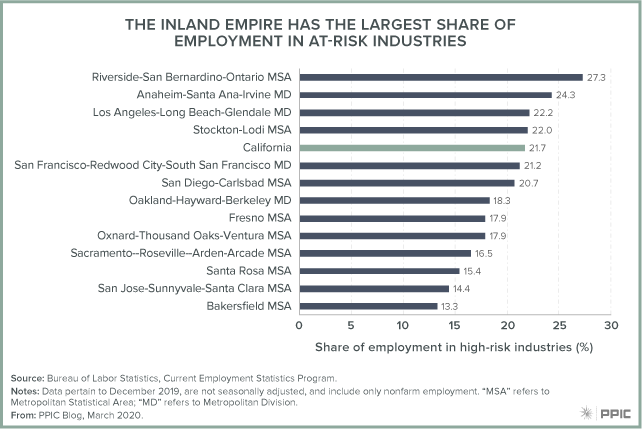
Because California’s industries are not evenly distributed, the initial impact on economic activity and on workers will likely vary across the state. Among major metro areas, Los Angeles, Anaheim–Santa Ana–Irvine, Stockton, and Riverside–San Bernardino have larger shares of jobs (ranging from 22% to 28%) in at-risk sectors than the state as a whole.

As one might imagine, these areas differ from one another in many ways. While Stockton has a relatively large share of employment in transportation and warehousing, Anaheim–Santa Ana–Irvine has a large share in accommodation and food services. Not surprisingly, given its population, the Los Angeles metro area has by far the largest number of workers in at-risk sectors: 1,043,000. Riverside and Anaheim follow with 433,000 and 417,000, respectively.

figure - The Inland Empire Has the Largest Share of Employment in At-Risk Industries

The longer-term economic impact of the coronavirus on these and other sectors will depend on how long the crisis lasts. Policy responses can play a critical role in mitigating the economic damage. State and federal leaders face the challenge of helping businesses weather the crisis and rebound quickly, while also addressing the tangible needs of workers who may be losing income, especially those who are already in or near poverty.

A host of economic interventions—many of which aim to help dislocated workers—have already been announced, and more will be implemented as the economic consequences of this pandemic become clearer. As they develop these interventions, policymakers will want to take into account industries and workers across all of California’s regions.

Occupational Shifts Favor California’s High-Skill Workers

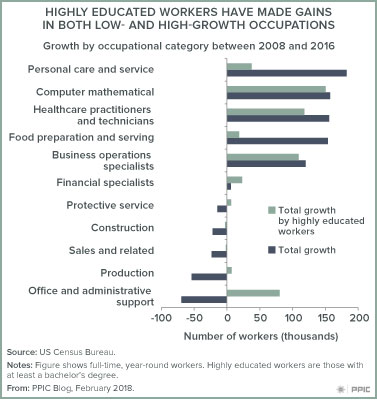
[vc_row][vc_column][vc_column_text]The recession and recovery have reshaped California’s workforce. Between 2008, when employment peaked, and 2010, when it bottomed out, the state lost three quarters of a million jobs. Since then, the state has experienced sustained job growth; according to US Census Bureau data, by 2016 there were 1 million more workers in California than there had been in 2008. This job growth has not been evenly distributed. Some occupations experienced large losses during the recession and have not fully recovered, while others experienced small losses and now have much higher employment levels than they did at their pre-recession peak. While there are some high-growth occupations that do not require high levels of education, workers with at least a bachelor’s degree have prospered the most over the past several years.

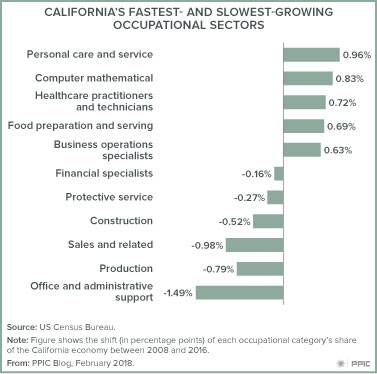
Overall, California’s workforce is becoming more educated: the share of the full-time year-round workforce with at least a bachelor’s degree grew from 31% in 2008 to 35% in 2016. Highly educated workers got more than half of the jobs created in the five fastest-growing occupational categories (based on increases in the share of total full-time year-round workers) between 2008 and 2016:
  1. Personal care and service
  2. Computer and mathematical
  3. Healthcare practitioners and technicians
  4. Food preparation and serving
  5. Business operations specialists

All of these occupations experienced small declines during the recession and strong growth during the recovery. The number of full-time year-round workers increased 28%—from 2.5 million in 2008 to 3.2 million in 2016. Workers in some of these occupations, such as food preparation and serving, earn relatively low wages and tend to have low levels of educational attainment, while workers in other areas, such as computer and mathematical, collect high wages and tend to be college graduates. Altogether, workers with at least a bachelor’s degree made up 433,000 (56%) of the 770,000 jobs gained between 2008 and 2016 by the top five categories.

Workers with at least a bachelor’s degree also made gains in the five slowest-growing occupational categories:

  1. Protective service
  2. Construction
  3. Production
  4. Sales and related
  5. Office and administrative support

These occupations experienced sharp losses during the recession and have not returned to their pre-recession peaks. The number of full-time year-round workers in these occupations declined from 5.3 million in 2008 to 5.1 million in 2016. On average, educational attainment levels are low in these occupations, but workers with at least a bachelor’s degree fared relatively well: the number with at least a bachelor’s degree grew by 89,000, even though these categories have experienced a net loss of 184,000 jobs.

In short, the recession and recovery have accelerated some long-term trends in California’s economy. High-skill occupations and highly educated workers have fared well, while less-educated workers in lower-skilled jobs have faced declining employment opportunities.

[/vc_column_text][/vc_column][/vc_row]

Examining the Federal EITC’s Impact on Poverty

The federal Earned Income Tax Credit (EITC) plays an important role in keeping Californians out of poverty. The credit supplements earnings for low-income workers at tax time, providing $2,400 on average to qualified tax filers.

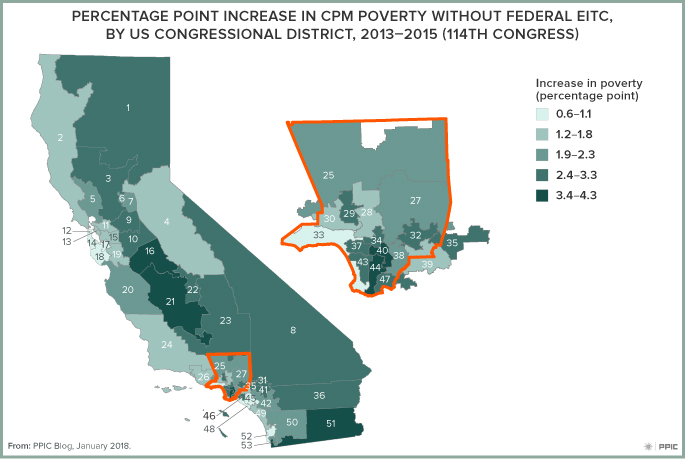
Without the EITC, we estimate an additional 814,000 Californians would live in poverty, according to the latest data from the California Poverty Measure (CPM), an ongoing collaboration between PPIC and the Stanford Center on Poverty and Inequality. This reduction in poverty makes the EITC nearly comparable to CalFresh (formerly known as food stamps), the safety net program that keeps the most Californians out of poverty. Our estimates reflect data from 2013 to 2015 and do not include the state EITC, which was introduced in 2015 and expanded in 2017. The state EITC lowers poverty by very little because the largest credits go to workers with very low earnings, whose families mostly live well below the poverty line.

The role that the EITC plays varies widely across regions. Statewide, the poverty rate would be 2.2 percentage points higher without the EITC (22.6% instead of 20.4%). But in Lake and Mendocino Counties (combined), the poverty rate without the EITC would be 4.1 percentage points higher than it is currently, reaching 26.8%. Poverty in Marin County, on the other hand, would increase only 0.2 points, to 16.5%. Such differences could be due to several factors—for example, the share of eligible families who take advantage of the credit and the local availability of jobs.

PPIC recently released data showing poverty rates, poverty thresholds, and the effects of safety net programs not only by county, but also by state assembly and senate district and by US congressional district. These data provide an opportunity to dig more deeply into the varying roles of safety net programs across the state.

The EITC, for example, has the largest effect in some of the highest-poverty congressional districts, including District 40 (Rep. Roybal-Allard) and District 44 (Rep. Barragán). But in some relatively high-poverty districts it plays a smaller role (District 46, Rep. Correa). The data we provide can be a starting point for investigating—and potentially remedying—incomplete access to the EITC.


Video: Gavin Newsom’s Priorities

Gavin Newsom, California’s lieutenant governor and a candidate for governor in 2018, was asked in a San Francisco forum last week to name the three issues that will make the biggest difference in California’s future. Newsom, who is also a former mayor of San Francisco, predicted that both California and the nation will be grappling with these issues over the next ten years:

  • Debt and demographics. With California’s population aging rapidly, the state and its cities face growing public employee pension and health care liabilities. “As a progressive Democrat, I’m not naïve about the commitments we’ve made and the commitments we must fulfill,” Newsom said. “Nor am I naïve, as a former mayor, about the challenge of meeting those commitments . . . Cities like Richmond are facing the prospect that by 2021, by one estimate, upwards of 40% of their general fund will go to retiree contributions.”
  • Energy and climate change. The state has set ambitious goals to reduce greenhouse gas emissions and increase energy efficiency. “The next governor has to deliver,” he said.
  • Information technology and globalization. “The issue that animates my anxiety: work, the future of work.” The days of having a job or career have given way to something radically different, forcing us to think in terms of portable benefits and retirement security, he said. Further, workers in retail, food and beverage, and clerical jobs—the top employment categories—are on the “edge of automation.” Displacement of these workers will require us to have a different conversation about skills, education, and social mobility, Newsom said.

The conversation with Newsom was part of the PPIC Speaker Series on California’s Future. PPIC is inviting all major candidates for governor to participate in a public event if they reach a certain threshold in the polls. The goal is to give Californians a better understanding of how the candidates intend to address the challenges facing our state.

Watch all candidate videos.

Housing Costs and Higher Education

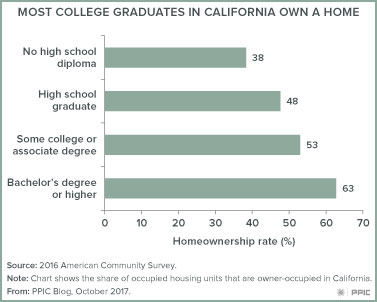
Homeownership FigureOwning a home has long been part of the American dream. But with the state’s high housing costs, homeownership is difficult for many Californians to achieve. In a recent PPIC Statewide Survey, more than half of renters say the cost of housing is making them seriously consider moving away from the part of California they live in now, with most of those indicating that they are thinking of leaving the state.
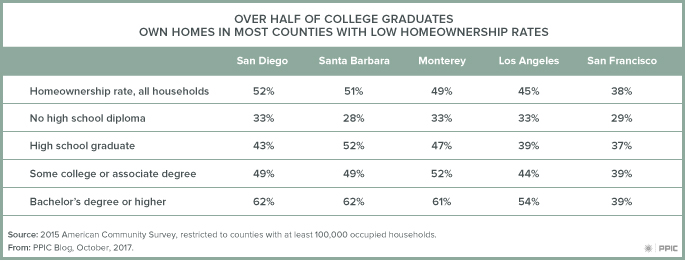
Homeownership rates are substantially lower in California than in the rest of the United States (54% vs. 63% in 2016, according to the American Community Survey). But one group in California fares relatively well with respect to homeownership: college graduates. Among heads of household with at least a bachelor’s degree, almost two-thirds own rather than rent, compared to less than half of high school graduates. The higher rates of homeownership among college graduates are a consequence of their economic success. As shown in other PPIC research, college graduates have much higher incomes and lower unemployment rates than other Californians, enabling many of them to purchase a home.  Owning a home, in turn, often leads to greater wealth. Indeed, the higher net worth of college graduates in California is strongly tied to homeownership.

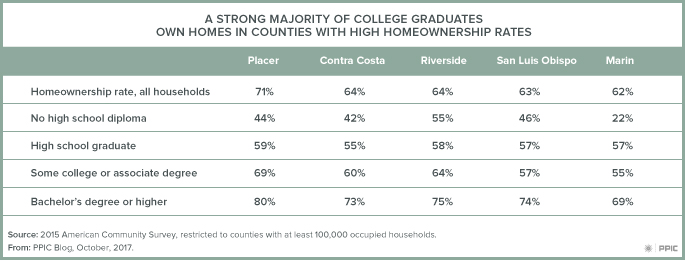
Of course, housing markets are regional, and the coastal areas of California are less affordable for everyone. The five counties with the lowest homeownership rates are all in coastal areas with high housing prices. But even in those counties—with the notable exception of San Francisco—over half of college graduates own a home. At the other extreme, counties with the highest homeownership rates are primarily suburban counties, including some with high housing costs. About 70% or more of college graduates in these areas own a home.


California policymakers have recently enacted a series of measures designed to increase the supply of housing, with a focus on affordable housing units. Certainly, the state’s housing crisis cannot be alleviated without building more housing. But while higher education is not often considered part of a housing agenda, it has played an important role in shielding many Californians from the state’s dramatic increases in housing costs. Because of the labor market advantages experienced by college graduates, many have been able to purchase a home, giving them more stability in their housing costs and allowing many of them to build wealth.

Is College Worth it? What Graduates Say

As college registration deadlines approach, thousands of Californians are making important decisions to invest in their education and long-term career prospects. The vast majority of parents (85%) hope their child earns at least a bachelor’s degree, according to the PPIC Statewide Survey. But how do graduates see it? And how well-informed are their decisions?

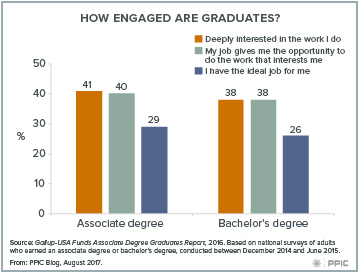
The good news is that most people who earn degrees believe their investment was worth it. According to national survey data, 71% of those who earned an associate degree and 73% of those with a bachelor’s degree agree their education was worth the cost. Going beyond the economic value, a large share also find engagement in the work they do. In fact, a sizeable share of associate- and bachelor’s-degree holders report deep interest in their work (41% and 38%, respectively) or say that they have the ideal job (29% and 26%, respectively).

Although having an “ideal job” may be a very high bar to achieve, these results suggest that a majority of degree earners are not terribly satisfied or engaged with their work. Indeed, in a wider-ranging national survey conducted recently, a majority of college graduates indicate that they would change their degree, their college, or their major if they could do it again. Among associate-degree holders, 23% would seek a different degree—more than double the share of bachelor’s-degree holders who say the same. But graduates with bachelor’s degrees are not entirely satisfied with their choices either: 40% would study a different major (compared to 36% among associate-degree holders). And the survey finds curiously similar responses regardless of a person’s income level. Though higher-income Americans are slightly less likely to regret their college choices, a large fraction of them (35–45% for those with income over $100,000) would still make a different choice.

These results confirm that while college pays off, there is room to improve how well-informed prospective students are about their colleges, majors, and degrees. On this blog, we’ve written about the economic value of college credentials and how it varies across fields of study. We’ve also highlighted the need for data to inform student choices, given the sizeable financial commitment entailed.

Among the state’s public colleges and universities, California’s community colleges are ahead of the curve in providing information online about institutional performance, future salary, and more. Other institutions should follow suit. However, the survey results above suggest it is perhaps equally important to design courses and programs that ensure students can efficiently and effectively identify the degrees and majors best suited to them. Indeed, this is one of the tenets of the guided pathways movement taking place at community colleges across the country and in California. To inform and improve the college decisions of Californians, it is critical that these practices expand beyond community colleges, so that K–12 schools and four-year universities are also working to ensure students have comprehensive information when choosing their pathway into a career.

Learn more

Visit the PPIC Higher Education Center