Counting Californians and Holding Elections in a Pandemic

Today is Census Day, the day to count everyone living in the country in 2020. It’s not the deadline for responses—you have until August 14 to complete your census form—just the “anchor day” for counting those living in your household. We talked to California Secretary of State Alex Padilla about the challenges the COVID-19 pandemic brings to counting Californians—and for holding elections in November.
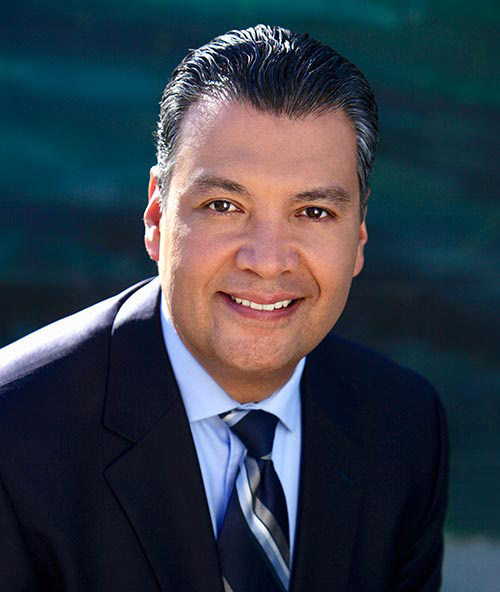
Photo - Alex PadillaPPIC: What challenges does the pandemic bring to conducting the census?

ALEX PADILLA: Ensuring a fair and accurate count is tough under normal circumstances, and it’s made more challenging by this global health pandemic. A lot of the state and local strategies for engaging the public on the census have had to be modified or replaced with ones that are more effective when people are staying at home. The good news is, this is the first time it’s been possible to do the census online, as well as by phone or paper. We’re seeing people get more creative at staying in touch while keeping their distance, whether through video chats with their coworkers or using teleconferencing to stay in touch with family and friends. We can also use these methods to remind everyone to do the census.

It’s really important to remember that participation in the census is how we ensure our communities receive their fair share of federal dollars for critical needs such as public health, education, public safety, housing, and infrastructure. This message is really striking a chord right now.

PPIC: As they shelter in place, what can Californians do to help ensure an accurate census count?

AP: Every Californian should participate in the census, but also remind people they’re in touch with to do so. Assuring a complete and fair count depends on everyone doing the census. It’s not just a count of adults or voters or citizens; it’s for everybody living here.

California has an especially high number of hard-to-count populations—for example, communities of color, young people, and immigrant families and communities. More than 70% of Californians fit into a hard-to-count category. It already takes extra effort to ensure participation by these groups. The pandemic is not making the job any easier—at a time when the job is more important than ever for ensuring the state gets its share of federal funding for critical needs over the next decade.

Based on the prior census 10 years ago, California’s most undercounted population were kids under five years old. My youngest just turned five, and especially now with all the kids at home, it’s hard to imagine forgetting to include him as he’s the loudest member of our household! Today, kids who weren’t counted in 2010 are now teens who’ve been in school for years, but their schools haven’t been getting their full share of federal education dollars. It’s a very tangible way to think about it, and it shows the importance of the census for our quality of life.

There are many options for participating in the census. Go online or call in today. Once you’ve submitted your information, help us by spreading the word with neighbors you’re checking in on and friends and family.

PPIC: Talk about the administration of the upcoming election.

AP: To put it in context, we should recognize that throughout the nation’s history, Americans have gone to the polls—in times of war, during the Great Depression, and even during the deadly 1918 flu pandemic. So it’s not a matter of if or when we’ll hold the election. We have a date: it’s Tuesday, November 3. It’s a matter of how we hold the election in a way that is accessible, secure, and healthy for everyone—voters, elections personnel, poll workers. Many things California has championed to get more people voting really make a lot of sense in an era of public distancing. You can register to vote online. Voting by mail and in-person early voting are good ways to avoid crowds. We’re diligently working on expanding those opportunities.

COVID-19 and California’s Census Count

The COVID-19 crisis has upended the carefully laid plans for the 2020 Census in ways that might have disproportionate effects on California’s count. The Census Bureau is making important adjustments, but California needs to be particularly vigilant about the potential consequences.

The Bureau began its self-response period on March 12, when it started mailing out invitations to participate in the census to virtually every household in the country. Self-response remains the safest and simplest way to gather census data because, unlike in-person interviews, it does not raise the risk of coronavirus exposure.

The virus has altered almost every other effort the Bureau had planned. The Bureau always does extensive follow-up with households that fail to self-respond. More people are likely to need follow-up in California than in the average state, so problems with that process will be felt more acutely here. Follow-up is generally in person, which raises risks that didn’t exist just a few weeks ago; at least one census worker has even tested positive for the virus. To accommodate some of these challenges, the Bureau has delayed hiring and pushed back both the start of the follow-up (from May 13 to May 28) and the cutoff date for completed self-response forms (from July 31 to August 14).

The Bureau’s plans for counting those in less conventional living arrangements have been upended as well. The original plan for group quarters such as college dorms and senior living facilities was to send out a census worker to collect information for the entire facility from a contact person. College students are supposed to be counted as if at school, but many have been sent away from their campuses. And senior facilities are protecting their highly vulnerable residents by strictly limiting access. The Bureau is exploring alternative approaches.

People who are homeless, particularly those living on the street or in cars, are especially difficult to count. Estimates suggest that homelessness is a bigger and faster-growing problem in California than in almost any other state. The Bureau had planned to count homeless people wherever they happened to be from March 30 to April 1. But the homeless population is especially vulnerable to the virus, and sending census workers out to count in person would put the workers and their communities at risk. The Bureau has delayed this effort by a month to lower the risk of contagion.

Finally, the Bureau does a wide range of communications work just to get the message out that the census is happening and is important. The Bureau’s carefully developed media campaign is likely to be overwhelmed by news about the pandemic. Moreover, a significant amount of outreach was to be conducted in physical spaces by trusted messengers in each community. All of that will need to be rethought. Not only are large gatherings generally banned, but most community spaces are closed.

Though there is some scheduling flexibility, a hard deadline looms. By law, the Bureau must submit total state populations to the president by December 31 so that congressional representation can be adjusted to reflect changes in population over the previous 10 years. This is the most basic constitutional function of the census. Changing that deadline would require congressional approval and could complicate the process of redrawing the lines of representational districts.

These challenges are significant, but a strong performance during the self-response period will mitigate them. PPIC will be monitoring and providing key analysis of the self-response process to help ensure that the state is in the best possible position before the follow-up period begins.

California’s Population Slowdown

The decennial census is fast approaching. Starting this Thursday, March 12, most households in the country will be sent an invitation to fill out a census form online. Over the next several months, the US Census Bureau will prod those who have not responded to make sure they are counted. The count will have important implications for political representation, federal funding, and a wide range of research.

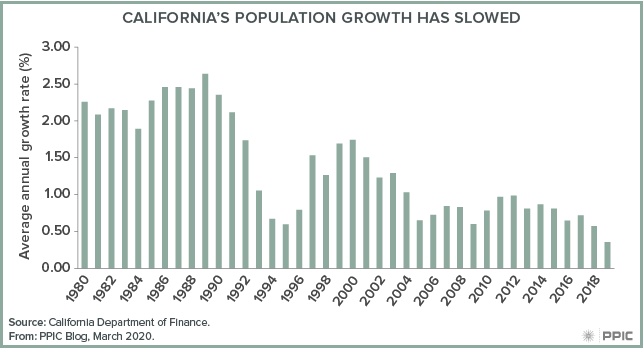
Thanks to yearly estimates from both the Census Bureau and our state’s Department of Finance, we already know a lot about how the state population has changed, even before the census count begins. The latest numbers suggest a marked slowdown since the early 2010s. The California Department of Finance estimates annual growth of just 0.35% in 2018 and 2019, down from nearly 1% from 2010 through 2012.

figure - California’s Population Growth Has Slowed

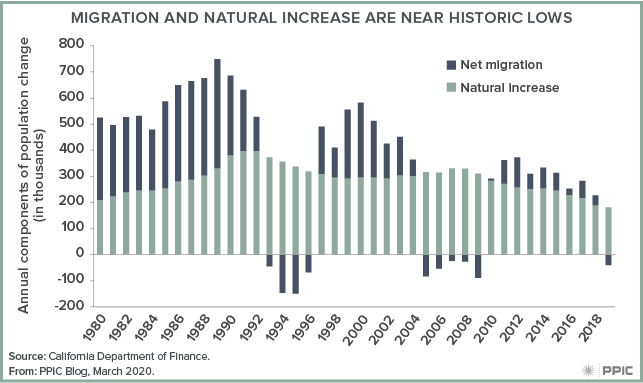
California is now a net loser in overall migration—that is, migration to and from both other states and other countries—for the first time since the Great Recession. The state has long experienced net losses in domestic migration—it has had net gains in only 3 of the past 30 years—but the losses have risen from 116,000 in 2017 to 198,000 in 2019.

International migration used to make up for domestic losses, but it has also slumped in recent years. The California Department of Finance estimates that net immigration from other countries has dropped from a gain of 217,000 in 2017 to a gain of 181,000 in 2019. The US Census Bureau reports an even bigger drop in international migration, enough for a total population estimate that is 447,000 people smaller than the one from the Department of Finance.

California’s population is also getting older, and the state’s young adults are having fewer children. Natural increase—the difference between births and deaths—has been falling since the early 1990s. It remained above 280,000 each year from 1991 to 2010, but since 2015 it has fallen from 247,000 to just 181,000. This decline mostly comes from a downward trend in births. In 2019, California had 11.3 births for every 1,000 residents, its lowest rate in well over a century.

figure - Migration and Natural Increase Are Near Historic Lows

Natural increase is essential to understanding California’s future. Net migration may rebound, as it has in the past. But the state’s birth and death trends indicate that California’s population will grow slowly for years to come.

Video: Countdown to Census 2020

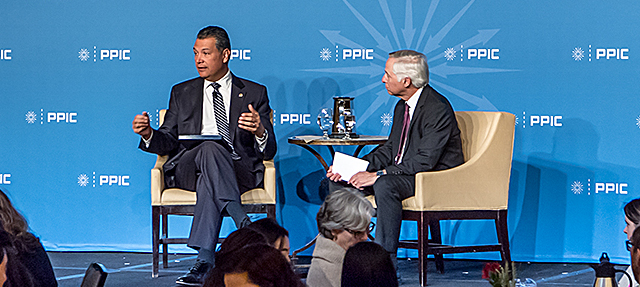
Census Day 2020 is fast approaching, and results from the population count will determine political representation and federal funding for California for the next 10 years. Speaking at a PPIC event in Sacramento last week, Alex Padilla, California secretary of state, joined Mark Baldassare, president and CEO of PPIC, to reflect on the importance of counting the country’s most populous state.

Padilla stressed that along with billions in funding for education, health care, and other critical areas, the count affects the state’s representation in Congress as well as lines drawn at all district levels. “It affects you regardless of the issues you care about, regardless of where you live,” Padilla said. He further emphasized that the census is a population count, not a citizen or adult count. In 2010, California undercounted children under five, which led to underfunded schools over the next 10 years. “Here is a way to make sure schools get the funding they deserve without raising taxes.”

Following the conversation with the secretary of state, Sarah Bohn, PPIC vice president of research and senior fellow, convened an expert panel that expanded on strategies at the frontlines for reaching hard-to-count communities.

Assemblymember Marc Berman discussed the investment by California— which has directed $187 million toward census infrastructure at state, regional, and local levels—that sets the groundwork for outreach and coordination. Partner organizations are now pushing a public awareness and information campaign. “Nobody has ever tried anything like this in a state of 40 million people at the level of specificity and detail that we really need to be successful,” Berman said.

Success depends on participation, however, and trust in government can influence participation in the census—especially among hard-to-count groups who may feel suspicion of the federal government. Apathy is another obstacle. Carolyn Coleman, executive director for the League of California Cities, described how the census returns funds to communities: “We send a lot of dollars to Washington, DC, every year via the tax code, and this is one of the most important ways we get those dollars reinvested back into our communities.”

It takes coordination by trusted messengers to reach hard-to-count groups and communicate this idea. Ditas Katague, director of California Complete Count, said, “We have amazing partners on all levels—whether we’ve contracted them, whether they are foundations, whether they’re state agencies.” Katague outlined efforts by a Sacramento organization mapping territory from the Oregon border to Yolo County, and San Diego ambassadors doing outreach in Arabic, Kurdish, Farsi, Vietnamese, and Somali. Regions are playing to their strengths: Silicon Valley is emphasizing tech; the San Joaquin Valley is partnering with faith-based organizations.

Californians can participate in the census starting in March, and assistance centers around the state will offer help through April. Katague emphasized the importance of motivating others to complete it, saying, “There are 9 questions on the census. It takes 10 minutes to secure the future for the next 10 years.”

Video: Counting the Central Valley

The 2020 Census is fast approaching, and the stakes are high for California—political representation and federal funding are on the line. The San Joaquin Valley, with a population of 4.3 million, may be one of the state’s hardest-to-count regions. In Sacramento last Friday, PPIC convened a discussion about how valley communities are preparing for the census.

California has long been home to high numbers of “hard to count” residents—including young children, renters, and immigrants. In 2020, the difficulty of counting all Californians will be greater than ever. PPIC researcher Joe Hayes outlined the challenges, which range from uneven internet access to a lack of trust: “Individuals are less likely to respond out of privacy concerns, on the one hand, but also out of distrust for the federal government.”

The good news is that state and local governments have invested heavily in outreach. Complete Count Committees have been established counties across the state, and community-based organizations are spearheading outreach efforts. To help guide these efforts, PPIC created interactive maps that show hard-to-count communities across the state. Maria Jeans, program coordinator for the Maddy Institute, moderated a panel discussion about the factors that make counting the Central Valley so challenging—and how challenges are being addressed.

Jesus Martinez, executive director of Central Valley Immigrant Integration Collaborative, highlighted the challenge of organizational capacity. As local preparations for the census got under way in 2018, he realized that “only a handful” of those who wanted to get involved “had any type of personal or institutional experience with the census.”

Don Saylor, a Yolo County supervisor, cited the difficulty of reaching remote rural settings across the Central Valley and the large numbers of farmworkers, language minorities, young children, and residences with multiple households. He included students enrolled at UC Davis and other colleges in the Central Valley—especially those “who are renters, living in different kinds of group settings”—as a hard-to-count population.

The panelists agreed that the fear generated by federal immigration rhetoric and policies are particularly challenging for the Central Valley. As a result, census outreach must focus on more than just making sure California gets its fair share of federal funding. As Martinez put it, “This is a human rights and civil rights issue for us now. It is the right of immigrants to be included in the 2020 Census.” Much of the outreach involves person-to-person conversations—canvassing and phone banking, “house meetings” among neighbors, and interactive media.

Cindy Quezada, senior program officer at Sierra Health Foundation, noted that encouraging people to participate is not the only challenge. “Sometimes people might want to participate but they don’t have a way to,” she said. “Either you’re living in a trailer in a backyard so you’re not going to get the invite and you’re not going to get an enumerator visit, or you may not speak a language that’s supported.” These structural barriers “are something we should really be paying attention to.”

Video: Californians and the Environment

In the wake of the devastating wildfires over the past few years, a record-high share of Californians are very concerned about wildfires becoming more severe as a result of global warming, and majorities support the newly established wildfire insurance fund. At a lunchtime briefing in Sacramento last Thursday, PPIC researcher Alyssa Dykman outlined these and other key findings from the latest statewide survey.

Eight in ten likely voters see environmental issues as very important in the 2020 presidential election. With the California presidential primary seven months away, Kamala Harris (19%), Elizabeth Warren (15%), Bernie Sanders (12%), and Joe Biden (11%) have the highest levels of support among Democratic and Democratic-leaning likely voters; a quarter of these voters are unsure about how they will vote.

More than half of Californians see the state’s leadership on climate change as very important, and majorities support state and federal efforts to address climate change—from renewable energy to land-use and transportation planning that reduces greenhouse gas emissions.

Other survey highlights:

  • Two in three Californians oppose allowing more oil drilling off the coast; seven in ten support offshore wind power and wave energy projects.
  • Majorities view pollution of drinking water as a more serious problem in low-income communities and support the state’s creation of a clean drinking water fund.
  • Many Californians value ocean and beach conditions and say plastics and marine debris are a big problem.
  • There are wide partisan differences on climate change and what the state should do about it.


Motivating Californians to Fill Out the 2020 Census

The 2020 Census will determine the distribution of billions of dollars in federal funds and the accuracy of political representation at the local, state, and federal levels. Emphasizing the benefits to local communities is likely the best way to encourage participation and counteract the concerns many Californians have about confidentiality.

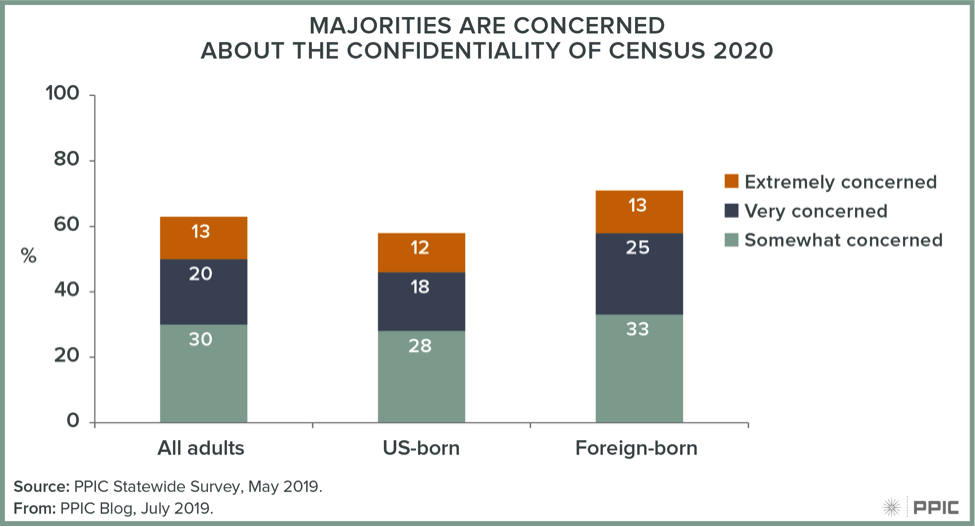
The latest PPIC Statewide Survey shows that 63% of Californians are concerned about whether the Census Bureau will keep their responses confidential, as the law requires. The concern is more acute among Latinos (74%) and African Americans (74%) than among Asian Americans (64%) or whites (52%). Immigrants are also much more likely to be concerned than US-born residents.

Figure: Majorities Are Concerned About the Confidentiality of Census 2020
The Census Bureau conducted an extensive survey and a set of focus groups to identify key reasons for people’s possible reluctance to participate in the census, as well as potential motivating factors that could improve participation. The focus groups revealed that merely informing people of the Census Bureau’s data protection policies was unlikely to assuage concerns.

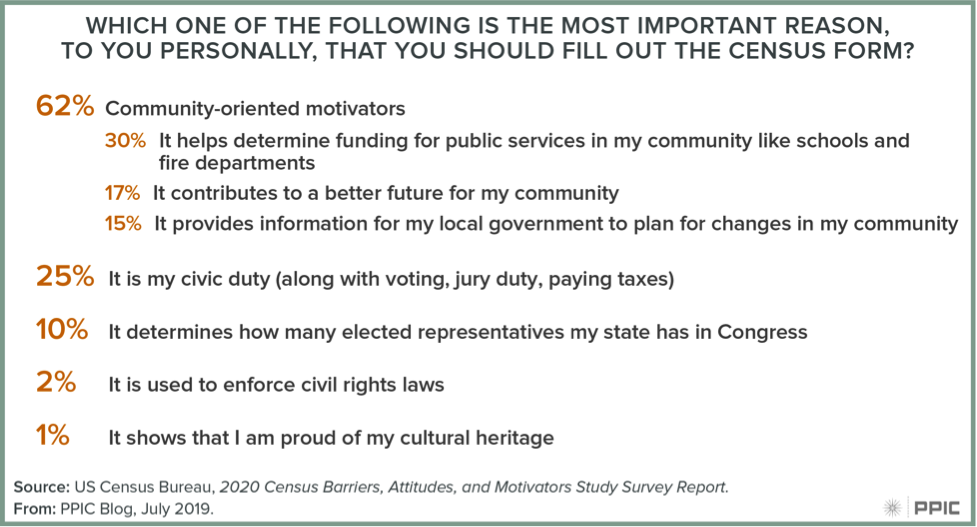
Focus group participants across all demographic groups identified the census’s role in providing federal funding for communities as the main motivator for responding to the census. And 62% of survey respondents said that benefits to the community—determining funding (30%), contributing to a better future for the community (17%), and providing information for local planning (15%)—are the most important reason to fill out the census.

Figure: Most Important Reason to Fill Out the Census Form

But fewer than half of survey respondents knew that the census is used to determine local funding levels, suggesting that this information could go a long way toward motivating participation. Focus group participants—who were chosen from demographic groups deemed likely to respond at low rates—also indicated that hearing directly from trusted voices in their own communities would be important.

Community organizations and elected officials are already acting on this information. On April 1, Los Angeles city and county officials convened a rally to promote the census, emphasizing the link to federal tax dollars for local programs. The Hispanic Federation’s messaging also highlights the census’s role in allocating federal funds.

More efforts are underway. Governor Newsom has pledged an investment of $187 million for outreach activities to boost participation. Meanwhile, the California Complete Count Office has begun issuing grants to help local organizations communicate directly with hard-to-count populations.

Focusing on local funding and community benefits is a promising approach, but a strong outreach strategy will have to go further. A complete and accurate count will likely depend on hard-to-count populations working to develop and deliver the most effective messages for their own communities.

Interview: Citizenship and the 2020 Census

This post is part of a series examining challenges involved in the 2020 Census and what’s at stake for California. 

photo - Eric McGheeAfter a heated legal battle, the Supreme Court has ruled that the Trump administration cannot for now include a question on the 2020 Census asking if residents are US citizens. We spoke with PPIC senior fellow Eric McGhee about what this decision means for California.
PPIC: Why is the citizenship question controversial?

Eric McGhee: First, the question could significantly discourage responses among immigrants, who might fear the data would be used to target them. It didn’t go through the normal testing process for new questions, and many Census Bureau employees recommended against adding it because of concerns about data quality.

Second, the Trump administration says the question is necessary to properly enforce the Voting Rights Act. But advocates for immigrant communities dispute this justification and argue that current citizenship data is sufficient to protect against voting discrimination.

Third, it could have a huge impact on political representation and how congressional and state legislative districts are drawn. Districts are currently drawn based on total population. But this question could make it possible for states to use citizens or voting-eligible residents instead, which would tilt representation in favor of those groups.

PPIC: What does all this mean for California?

EM: Response rates will likely be better if the question is not added. But there’s also concern that the damage has already been done—immigrants still might not be inclined to respond. Immigrants make up about a quarter of California’s population, so we’re particularly vulnerable.

A large undercount could result in less federal funding for California. We’re also the only state at risk of losing a congressional seat from an undercount—other states with high immigrant populations like Arizona and Texas might not gain as many seats, but they probably won’t lose a seat they already have, even if there’s a bad count.

Households with undocumented members are the most likely to be undercounted. PPIC research looked at the possibility of a 10% undercount of these households, a reasonable assumption based on existing research. It would mean missing about half a million Californians.

The reality is that census data is thoroughly protected, even from law enforcement agencies like the FBI and ICE. But our May PPIC survey—conducted before the Supreme Court decision—found 63% of Californians were concerned the Census Bureau will not keep responses confidential. Latinos (74%), immigrants (71%), and African Americans (70%) were especially likely to be concerned.

There are other uncertainties too. The 2020 Census will use a new internet-based approach, which hasn’t been comprehensively tested. And people in general are becoming more reluctant to respond to the census. This means the bureau has to do more follow-up, which is expensive and increases the likelihood of problems arising.

PPIC: What can California do to ensure a complete and accurate count?

EM: California is way ahead of other states in terms of funds it has dedicated to census outreach. The state has already appropriated about $100 million to support a better count, and Governor Newsom has proposed another $50 million or so. Philanthropic organizations have chipped in about $30 million. There’s been a great deal of planning at the state and local levels to get the best count possible.

Addressing concerns about confidentiality could go a long way toward encouraging people to respond. Research also suggests that raising awareness about the census’s role in funding public services like health care, roads, highways, and fire and police departments is another promising approach.

Video: Mobilizing the Inland Empire for the Census—and for the Future

As California’s diverse regions prepare for the 2020 Census, community-based organizations and local leaders are playing key roles. An event last week in Riverside offered insights on the Inland Empire’s outreach strategies for the Census and beyond. Cosponsored by PPIC and the Center for Social Innovation at the University of California, Riverside, the event featured a panel of state and local experts.

The discussion was moderated by Michelle Decker, president and CEO of the Community Foundation. She began by asking Eric McGhee, PPIC senior fellow, to explain the importance of an accurate census count in California. The census helps determine the distribution of federal funding to the states; gathers information about the population that is valuable to policymakers and businesses alike; and is the basis for reapportionment and redistricting. As McGhee pointed out, an undercount of California’s population could be costly in all of these areas.

McGhee noted that California has large shares of “the kinds of groups that tend to be undercounted—Asian Americans, African Americans, Latinos, renters, very young children, noncitizens.” Finally, he outlined concerns about inadequate funding, which has prevented a thorough testing of the process, and the climate of fear in immigrant communities, which could result in lower response rates even if the Supreme Court rules against the inclusion of a question on citizenship later this month.

But there is some good news: “It wouldn’t take that much for California to overcome some of these challenges,” McGhee said. California is arguably more mobilized than any other state, and the Inland Empire is one of the state’s most mobilized regions.

Deborah Phares, Census 2020 project manager at the Community Foundation, sees the census as a great opportunity for policymakers and organizations across Riverside and San Bernardino Counties. The region’s collaborative efforts were galvanized by a state request for information about innovative census outreach strategies. “We decided that we were going to pursue and support and advocate for allocation of resources based on need,” said Phares, adding that the regional plan is designed to avoid overlapping efforts and to integrate data so that organizations could work together “in a very deep way.”

Karthick Ramakrishnan, founding director of the Center for Social Innovation, underscored the significance of a two-county approach to census outreach that draws from a wide range of communities-—geographic sub-regions and demographic groups. “I think the kind of work that’s happening in the Inland Empire is the envy of the rest of the country. . . .We’re building some pretty amazing tools that will stand the test of time.”

Kathleen Kelly Janus, the newly appointed senior advisor on social innovation in the Governor’s Office, agreed: “I think there’s a huge opportunity to invest in capacity building through all these census dollars that are coming in.” She added that the cross-sector approach involving foundations, community-based organizations, policymakers, and other groups “is a model that we can use not just for the census but for all of these other issues that Governor Newsom wants to address.”


Video: Californians and Their Government

Less than a year before California’s presidential primary, likely voters who are Democrats or who lean Democratic are divided on strategy: is it more important for the party to nominate the candidate who seems mostly likely to defeat President Trump or the candidate whose positions align most closely their views? But almost all Californians see voting in the 2020 elections as very important. At a lunchtime briefing in Sacramento last Thursday, PPIC researcher Dean Bonner outlined these and other key findings from the latest statewide survey.

Two in three California likely voters say they will definitely or probably choose a candidate other than Trump. There is a huge partisan divide on this question: 93% of Democrats and 66% of independents would definitely or probably vote for another candidate if the election were held today, while 82% of Republicans would definitely or probably vote for Trump.

Most Californians say that the investigation by special counsel Robert Mueller did not clear the president of wrongdoing, and Californians are more likely that the nation as a whole to say impeachment proceedings should begin. But here, too, there is a partisan divide: 66% of Democrats say Congress should begin the process, compared to only 39% of independents and 9% of Republicans.

Other survey highlights:

  • A majority of Californians say their housing costs cause a financial strain; six in ten favor the governor’s plan to allocate $1 billion to address homelessness, and similar shares favor proposed new rules intended to create more affordable housing.
  • Three-quarters of Californians see participation in the 2020 Census as very important—but most have concerns about confidentiality.
  • An overwhelming majority are concerned about rising electricity bills in the wake of the PG&E bankruptcy.
  • Californians are concerned that the recent outbreak of measles could spread; most believe that vaccines are very safe and an overwhelming majority say vaccination against measles and other diseases should be required.