
California’s water-dependent ecosystems are stressed even in normal times, and the latest drought has made matters worse. We talked to Mike Sweeney—the executive director of the Nature Conservancy’s California chapter and a member of the PPIC Water Policy Center’s advisory board—about the troubled condition of our natural environment and how to improve it.
 PPIC: How much water does nature need?
Mike Sweeney: In most places, the answer is “more than it’s getting now.” But it’s as much about timing and temperature as it is about quantity. Research shows that taking more than 20% of a river’s natural flow at any given time can negatively impact the river’s function and ecosystem. Today, our rivers receive about half of their historic natural flow. Clearly, we have a problem.
That said, there isn’t a simple answer to the question, “How much water does nature need?” Nature’s needs are dynamic, not static. Many species need surges of water at precise times and places. We’ve heavily engineered our water system to store water during wet periods and to move it to where people need it. This changed not only how much water flows through our river basins but also when it flows, often undermining conditions most favorable to native species.
We need to get specific about when and where nature needs water and build solutions that address these needs. That can include things like leasing water at key times of year from other water users or managing a dam so that water flows when it is needed and in the right amounts—rather than at a set volume all the time, which is often the current practice.
PPIC: What kinds of solutions might help resolve the conflict over water for the environment?
MS: Fish are in trouble: 88% of the state’s native fish species are already extinct, threatened, or endangered and at risk of extinction. But these days, farmers are often at odds with the people trying to protect nature, whether that’s in the Central Valley or up north along the Shasta River. Farmers are frustrated because regulators cut back their access to water.
What if we create solutions that work for both? There are ways to meet the needs of farmers and fish. Farmers can be part of the solution by helping to find ways to change the timing of water use—such as storing water in the winter for agricultural use during summer, rather than tapping rivers and streams when fish need it most. We need to get smarter about managing the wet times and dry times to provide water for both farms and fish.
PPIC: If you could change one thing about how California water is managed, what would it be?
MS: In California, we don’t do a good job of measuring how much water is flowing in our rivers and streams. That makes it hard to know how much really needs to be there for nature and when you should cut back water use on farms and ranches to provide water for fish. So the most important thing to change is to proactively manage water to meet nature’s needs using the best, state-of-the-art information we can get. To do that, we have to measure water in real time so that we have accurate data about where water is flowing. This would make it far easier to optimize water for cities, farms, and nature.
Read “California’s Environment Needs a Water Budget” (PPIC blog, December 14, 2015)
Visit the PPIC Water Policy Center’s ecosystems resource page
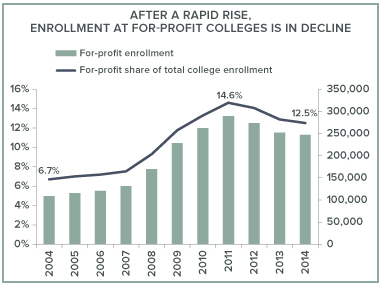 Enrollment at for-profit colleges in California almost tripled between 2004 and 2011, growing from 109,000 students to 289,000 students (as measured by full-time equivalent enrollment). Over the same period, enrollment in other colleges changed very little (increasing only 12%). By 2011, one in seven college students attended a for-profit institution. For-profit colleges enrolled more students than the University of California system and all private nonprofit colleges in the state.

 How does guaranteed tuition in Illinois compare to year-to-year tuition in California? A University of Illinois Urbana–Champaign student starting in 2008 and finishing in four years knew in advance that tuition would be $9,242 for all four years, leaving the student with an overall bill of $36,968. For an incoming UC Berkeley student, tuition was a relatively low $6,262 in 2008, but that student did not know that tuition would increase 79% by the fourth year and would add up to more than $34,000.



 We found another example of this divide when we asked about the mood of the California electorate in 2016. Most Republican likely voters (78%) said the state is going in the wrong direction while most Democratic likely voters (67%) said it is going in the right direction in our May PPIC Statewide Survey. We found a similar divide in views about the direction of the US and about whether California and the US are headed into good economic times or bad ones next year.
 Similar partisan differences are evident when Californians are asked about gun laws, government regulation, and economic inequality. While 64% of Republicans say the government goes too far regulating guns, 79% of Democrats say it does not do enough. A majority of Republicans—66%—say government regulation does more harm than good, while 76% of Democrats say government regulation is necessary to protect the public. And 68% of Republicans say the government should not be doing more to reduce the gap between the rich and poor, while 79% of Democrats say it should be.
 If we look at the share of voting-eligible residents who have registered in time for each of the last 18 primary elections, California’s registration rate has always fallen within a fairly narrow band—from a low of 66% in 1988 to a high of 75% in 1996. In this context, the 2016 registration rate might be seen as a disappointment. Compared to the same point in the 2012 primary election cycle, the registration rate has remained largely unchanged, though it is still comparatively high when viewed in the context of the past several decades.
 More to the point, these registrants turned out to vote at a higher rate than we have seen in any primary since 2008. The estimated 8.9 million ballots translates to a turnout rate of about 50% among registered voters. That sits comfortably in the broad average of California’s presidential primary turnout, and marks a considerable improvement over 2012.
 PPIC:
PPIC: