Video: California’s Voter Turnout Challenge

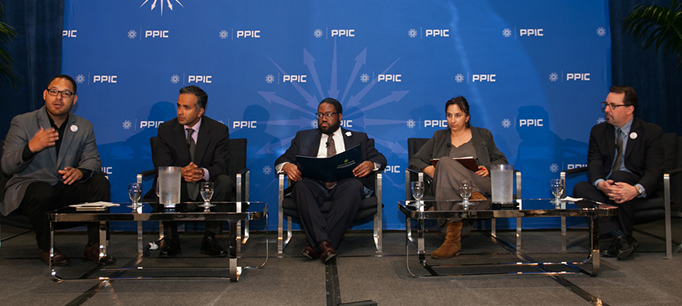
California has a voter turnout problem with two distinct elements. Registration is falling compared to other states, and turnout among those who are registered in midterm elections is down. A new PPIC report examines the state’s challenge and suggests some solutions. Report author and PPIC research fellow Eric McGhee presented it at a briefing in Sacramento last week. He found that each element of the state’s turnout has a different origin in the state’s demographics:

  • Registration. The composition of California’s electorate has been changing quickly. Latino and Asian American communities have become eligible to vote at faster rates in California than in other states. But these groups register to vote at lower rates than other Californians, leading to an overall decline in California’s registration rate relative to other states.
  • Turnout. One group of the state’s registered voters has become less likely to turn out in midterm elections: young people. The issue here is one of consistency, McGhee said. “Young people are showing up for presidential elections—they’re just not voting in the following midterm,” he said.

What are the solutions? McGhee said that while the state has passed a number of laws to ease voter registration, changes to the process will not necessarily solve the problem. He said these reforms will need to be coupled with aggressive outreach targeting each group—Latinos, Asian Americans, and young voters—to inspire them to participate in elections.

Read the report California’s Missing Voters: Who is Not Voting and Why.

Video: Rolling Out the New Motor Voter Law

California’s New Motor Voter Act has the potential to change the composition of the electorate, making it younger, less educated, more mobile, and poorer—in other words, more representative of the state’s population as a whole.

These are among the key findings of a new PPIC report by research fellow Eric McGhee and Mindy Romero, founder and director of the California Civic Engagement Project at the UC Davis Center for Regional Change. McGhee presented the report, What to Expect from California’s New Motor Voter Law, in Sacramento last week. Passed to address the state’s lagging voter participation rates, the new law simplifies the registration process.

When it takes effect next year, all Department of Motor Vehicles (DMV) customers who attest to being eligible to vote and do not opt out—that is, do not actively decline to register—will be added to the voter rolls. Because of the sheer volume of DMV customers, the law has the potential to increase registration very quickly—by more than 2 million people in the first year, McGhee said.

Its success depends on how many DMV customers agree to be registered, and that hinges on the way the system is designed, he said. The report recommends that customers be required to say whether they are eligible to vote before they are allowed to complete their DMV transactions—rather than having the option of not answering the eligibility question at all.

“For the maximum impact, the solution is pretty straightforward: make the eligibility question required,” McGhee said.

He cautioned that even if implementation is highly successful, the New Motor Voter Act alone will not solve the state’s problem of low voter turnout. To significantly boost turnout—and ensure that voters are more representative of the state’s population—targeted and ongoing efforts to reach out to newly registered voters will be needed.

Learn more

Read What to Expect from California’s New Motor Voter Law

Video: California’s Voter Turnout Problem

Voter turnout in California has been declining—it reached record lows last year, raising concerns about the state’s democratic process. PPIC research fellow Eric McGhee told a Sacramento audience last week that turnout in California has not only dropped in absolute terms but has fallen behind that of other states. While participation in fall presidential elections has been holding steady, turnout is on the decline in midterm elections—when the state elects a governor and other statewide officials—and, to some extent, in presidential primaries.

A big part of the problem is California’s voter registration rate, said McGhee, who coauthored the new report Putting California’s Voter Turnout in Context. It has not changed significantly, though it should have been climbing, as it has in other states.

California has been working hard to make the voting and registration processes as easy as possible, and other policy changes are under discussion. Will they result in higher turnout? They may help, but they aren’t panaceas, McGhee said. Ongoing mobilization efforts will be needed to motivate more people to cast a ballot.

Commentary: California Leads in Voting Reform

When Gov. Jerry Brown recently signed Assembly Bill 1461, the New Motor Voter Act, he ushered in a new chapter of California electoral history. The law seeks to boost California’s recent record-low election turnout rates with a new system of automated registration.

Under existing law, citizens must register to vote before they can cast a ballot. The new law all but eliminates this step by registering anyone who applies for a new driver’s license, renews an old one or updates an address with the DMV, unless they opt out. With the stroke of a pen, California is now at the vanguard of American voting reform.

(Continue reading on sacbee.com.)

Inspiring Civic Engagement

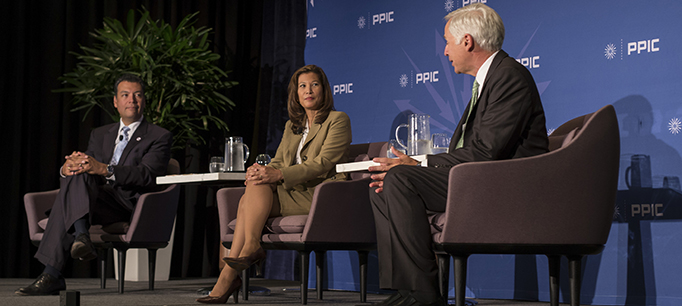
Many eligible Californians don’t register to vote, turnout in statewide elections has reached record lows, and PPIC surveys show many residents are disengaged from state government. What can be done to increase participation in elections and engage residents more broadly in all aspects of civic life? Tani G. Cantil-Sakauye, California’s chief justice, and Alex Padilla, California secretary of state, offered their responses last week in Los Angeles at an event co-sponsored by PPIC and the California Community Foundation.

In a conversation with Mark Baldassare, PPIC president and CEO, both emphasized the contribution schools can—and should—make to civic engagement.

Cantil-Sakauye noted that her teen-agers were taught civics in the second semester of his senior year in high school. “Now, think back where you were mentally in your second semester of senior year,” she told the audience. “Not the best place.”

She described Power of Democracy, a judicial branch initiative that includes Padilla and is an effort to elevate the status of civics education. Rather than focusing on teaching civics as a stand-alone subject, the group helps to integrate it into all school subjects, school projects, and community service. Partnering with Tom Torlakson, state superintendent of public instruction, as well as organizations and school districts, Power of Democracy provides schools the resources to do so, she said.

Padilla and Cantil-Sakauye each described personal experiences that sparked their interest in government and the people who had been influential along the way. Padilla said that after his freshman year at MIT, he returned to Los Angeles and visited his high school government teacher, who told his former student, “You’re 18 years old now. Have you registered to vote?” Then the teacher pulled out a voter registration form from his desk. “He wouldn’t let me leave until I filled it out,” said Padilla. That teacher, Alex Reza, was in the Los Angeles audience at last week’s event.

Cantil-Sakauye said she developed an interest in how decisions are made and who makes them after hearing adults in the Filipino community talk about their frustrations with government. When she was 9 years old, her family lost their home in an eminent domain proceeding. Cantil-Sakauye said her mother went to court and came back feeling “disrespected and humiliated.” Later on, her mother took her to see the pioneering Filipina lawyer, Gloria Megino Ochoa. “My mom threw me an elbow and said, you could do that!”

Automatic Voter Registration Is No Panacea

This commentary was published on Tuesday, May 5, 2015, in the Sacramento Bee.

California voter turnout has reached record lows. Only 18 percent of 24 million eligible adults cast ballots in the June 2014 primary and only 31 percent last November. As a result, state lawmakers and good government groups are searching for new ways to increase participation in elections.

One proposal that is gaining traction—and was discussed at a recent Public Policy Institute of California event with Secretary of State Alex Padilla and other officials—is to import an automatic voter registration system from Oregon.

There’s no question that such a system would swell California’s voter rolls. But would it significantly increase turnout? That’s much less clear.

(continue reading at sacbee.com)