Skip to content

Public Policy Institute of California

Informing and improving public policy through independent, objective, nonpartisan research.

  • About PPIC
    • President’s Message
    • Mission, Vision & Values
    • Staff
    • Board of Directors
    • Statewide Leadership Council
    • Adjunct Fellows
    • Employment Opportunities
    • Bechtel Conference Center
  • Publications
  • Topics
    • Climate Change/Energy
    • Criminal Justice
    • Economy
    • Fiscal & Governance Reform
    • Health & Human Services
    • K-12 Education
    • Political Landscape
    • Population
    • PPIC Higher Education Center
    • PPIC Statewide Survey
    • PPIC Water Policy Center
    • COVID-19
    • 2020 Census
    • 2020 Election
    • Immigrants in California
    • Poverty in California
  • News and Events
    • Blog
    • Events
    • Video
  • Support PPIC
    • Giving
    • Grants
    • Sponsorships

Categories

  • 2020 Census
  • 2020 Election
  • Access
  • Affordability
  • Climate Change/Energy
  • Completion
  • COVID-19
  • Criminal Justice
  • Delta
  • Drought
  • Economy
  • Ecosystems
  • Equity
  • Finance
  • Fiscal & Governance Reform
  • Floods
  • Health & Human Services
  • Immigrants in California
  • K-12 Education
  • Political Landscape
  • Population
  • Poverty in California
  • PPIC Higher Education Center
  • PPIC News
  • PPIC Statewide Survey
  • PPIC Water Policy Center
  • San Joaquin Valley
  • Water Quality
  • Water Supply
  • Workforce Needs

Recent Posts

  • Low Crime Numbers Leveling off Under Shelter-in-Place
  • What COVID-19 Budget Cuts Mean for Public Safety Spending
  • Special Elections Preview Fall Voting during COVID-19
  • Public Higher Education in California Faces a Fiscal Crisis
  • The Economic Toll of COVID-19 on Small Business

Archives

  • May 2020
  • April 2020
  • March 2020
  • February 2020
  • January 2020
  • December 2019
  • November 2019
  • October 2019
  • September 2019
  • August 2019
  • July 2019
  • June 2019
  • May 2019
  • April 2019
  • March 2019
  • February 2019
  • January 2019
  • December 2018
  • November 2018
  • October 2018
  • September 2018
  • August 2018
  • July 2018
  • June 2018
  • May 2018
  • April 2018
  • March 2018
  • February 2018
  • January 2018
  • December 2017
  • November 2017
  • October 2017
  • September 2017
  • August 2017
  • July 2017
  • June 2017
  • May 2017
  • April 2017
  • March 2017
  • February 2017
  • January 2017
  • December 2016
  • November 2016
  • October 2016
  • September 2016
  • August 2016
  • July 2016
  • June 2016
  • May 2016
  • April 2016
  • March 2016
  • February 2016
  • January 2016
  • December 2015
  • November 2015
  • October 2015
  • September 2015
  • August 2015
  • July 2015
  • June 2015
  • May 2015
  • April 2015
  • March 2015
  • February 2015
  • January 2015
  • December 2014
  • November 2014
  • October 2014
  • September 2014
  • August 2014
  • July 2014
  • June 2014
  • May 2014
  • April 2014
  • March 2014
  • February 2014
  • January 2014

Meta

  • Log in
  • Entries feed
  • Comments feed
  • WordPress.org

Tag: civic engagement

Video: Expanding the California Electorate

Video: Expanding the California Electorate

Unlike many states, California has been taking steps to encourage voter participation, making it easier to register to vote and to cast ballots. Nevertheless, only half of California adults can be expected to vote in this year’s presidential election, and they are likely to be very different from those who do not vote—in their demographic and economic backgrounds and in their political attitudes, according to a PPIC report, California’s Exclusive Electorate: Who Votes and Why it Matters. What more can the state do to expand?

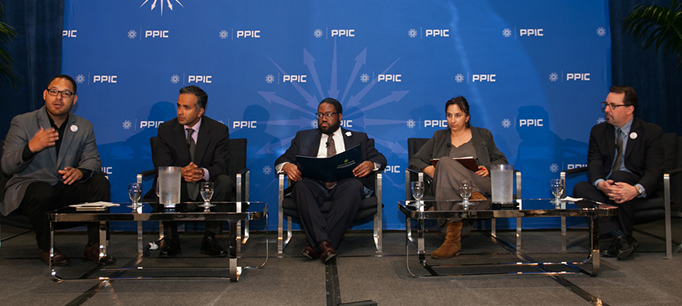
A group of leaders and experts gathered to discuss the question at a PPIC event in Los Angeles last week. Some emphasized that there is still much to do to make the mechanics of voting easier.

California’s secretary of state, Alex Padilla, said the new “motor voter” law—which will register eligible adults to vote when they go to the Department of Motor Vehicles unless they opt out—may have a simple but profound effect when it goes into effect. This more automated registration process will trigger a series of communications—the voter information guide and sample ballot—that will go to large number of Californians new to elections and serve as invitations to get involved.

But Padilla and other speakers also said the social component is important when engaging Californians in elections and the reason he regularly visits high schools, community colleges, and youth groups. “There’s still no substitute for a personal invitation to get involved,” he said.

Padilla’s conversation with Mark Baldassare, PPIC president and CEO, was followed by a discussion in which panelists picked up the theme of outreach to Californians who are underrepresented in the electorate.

Karla Zombro, field director for California Calls, noted that candidate campaigns focus on likely voters, perpetuating a cycle in which the same unrepresentative group of voters cast ballots year after year. Her group works to bring people into the process by consistently communicating with the Californians the campaigns don’t reach.

“What’s most important is what we do the day after they vote. Or if they don’t vote, that we still go back to them,” she said.

“We talk to people two or three times a year,” she said. “It’s neighbors talking to each other. The message matters, but the messenger matters just as much.”

Other panelists included Dean Logan, Los Angeles County registrar-recorder; Karthick Ramakrishnan, associate dean of the UC Riverside School of Public Policy; and Sebastian Ridley-Thomas, California assemblymember. The moderator was Efrain Escobedo, vice president for civic engagement and public policy at the California Community Foundation.

Posted on May 19, 2016July 13, 2017Author adminCategories Fiscal & Governance Reform, Political LandscapeTags civic engagement, registration, voter turnout, votersLeave a comment on Video: Expanding the California Electorate
Video: Civic Engagement and Voter Turnout

Video: Civic Engagement and Voter Turnout

What can we do to increase voter participation in California? The secretary of state, Alex Padilla, says Oregon’s automatic voter registration—an opt-out, rather than opt-in, registration system—could add 6 million people to the voter rolls if adopted in California. In a conversation with Mark Baldassare, PPIC president and CEO, he talked about other changes that would make voting simpler and more convenient. His goal as secretary of state? A million new regular voters by the time his term ends.

Following the conversation, a panel of experts and elected leaders offered wide-ranging views of the problem: insufficient media coverage of local elections, professional campaign organizations that speak only to frequent voters, and increased poverty that is correlated with lower rates of voting.

Panelists also offered potential solutions, from “crazy” ideas (declare election results valid only if a mandatory minimum number of votes are cast) to smaller fixes (sending pre-postmarked ballots to all registered voters). The participants were Kathay Feng, executive director of California Common Cause; Mike Madrid, principal of GrassrootsLab; Bruce McPherson, Santa Cruz County supervisor; and Sebastian Ridley-Thomas, an assemblymember who represents parts of Los Angeles County. John Myers, KQED’s senior editor for California politics and government, moderated the discussion.

Posted on April 17, 2015October 13, 2017Author adminCategories Political LandscapeTags automatic registration, civic engagement, elections, votersLeave a comment on Video: Civic Engagement and Voter Turnout
Proudly powered by WordPress