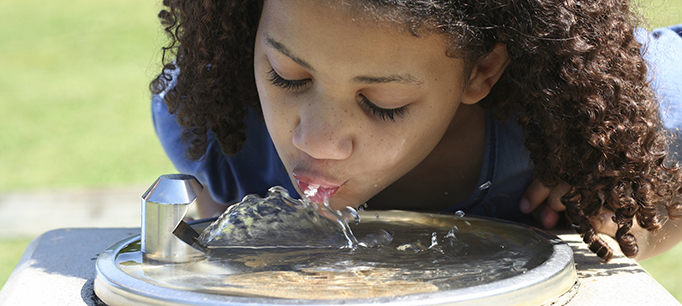
Flint, a Water Quality Reminder for California

The ongoing public health crisis in Flint, Michigan is a reminder that exposure to dangerous contaminants in drinking water is still a challenge in the US, more than 40 years after the enactment of the 1974 Safe Drinking Water Act. Flint began drawing water from a new source, the Flint River, in early 2014. It corroded pipes and carried harmful lead to residents’ taps. Although California does not face this specific problem, we are still failing to provide safe drinking water to some of the state’s most vulnerable residents.

In general, California’s large urban and suburban drinking water systems—which serve roughly 95% of the population—are in good shape. These systems occasionally exceed regulatory standards for pollutants, but they have the resources and oversight needed to address the problem quickly. In contrast, for roughly 400 small rural communities and schools, the water coming from the tap contains unsafe levels of nitrate, arsenic, and other contaminants. This issue is not new; these communities—whose residents are among the poorest in the state—have been relying on contaminated water for years.

The good news is that after years of neglect, this issue is now front and center in California’s water policy agenda. In 2012 legislation was enacted that recognizes the human right to water, formalizing the state’s commitment to guaranteeing affordable, accessible, and safe water to all of its residents. Progress has been made in documenting the extent of the state’s water-quality problem, dedicating funds to help address it, and changing governance structures to improve oversight. Actions taken include merging the state’s water quality programs under the State Water Board, creating a special office to focus on the problems of disadvantaged communities, and enacting legislation that authorizes the board to require consolidation of water systems when it is the best way to sustainably and affordably provide access to safe drinking water.

California’s rural communities have small customer bases, making it more costly for them to provide safe drinking water. Consolidation—the physical or administrative merging of drinking water systems—can be a cost-effective solution to providing a higher level of service and safer supplies. But it also requires willingness of both small and large communities to merge, and parties both large and small often resist this kind of change.

Although the types of contaminants and the scale of the problems differ, California can draw some lessons from Flint’s experience. In both places, contaminated water is being delivered to poor communities for whom affordability is a major concern. In Flint, water managers were trying to save money by switching to a cheaper source, but they didn’t sufficiently analyze the water quality implications of this switch. Flint managers also refused the offer to hook back up to the safer Detroit water —because of cost. What they neglected to consider was the long-term cost of unsafe water to the community.

Learn more

Visit the PPIC Water Policy Center water quality resource page
Read “Building a Better Water Safety Net” (PPIC blog, October 21, 2015)
Read California’s Water: Paying for Water (from California’s Water briefing kit, April 2015)

Calculating High School Graduation Rates

We are republishing this blog post to correct the number of students in the Class of 2014 who are not counted in a school graduation rate and the graduation rate of alternative high schools. As a result, the impact of including alternative school student data in the graduation rates of regular high schools also changes.

The federal Every Student Succeeds Act (ESSA), which was recently signed into law by President Obama, aims to offer states more flexibility in designing K–12 accountability programs than they had under No Child Left Behind. But one of ESSA’s lesser known provisions—a requirement that states identify and assist high schools with graduation rates below 67 percent—might force California to revise the way it deals with graduation rates at alternative high schools. Currently, the California Department of Education (CDE) excludes students attending most of the 640 alternative high schools across the state from its graduation rate calculations. Alternative schools—also known as district continuation schools, county community schools, and district and charter alternative “schools of choice”—are designed to help dropouts, students with behavior problems, pregnant or parenting teens, and truants. About 75 percent of the students at alternative high schools are juniors and seniors, according to CDE data.

ESSA requires states to calculate “cohort” graduation rates—which involve tracking students from 9th through 12th grade. The cohort graduation rate means something different at alternative schools than it does for regular schools. Students often transfer to alternative schools because they are struggling in school. CDE also reports that students attend alternative schools for an average of less than four months. Even so, CDE assigns students who transfer to alternative schools to those schools’ cohorts. Since CDE does not calculate graduation rates for most alternative schools, 59,300 high school seniors—or 12 percent of the Class of 2014—are excluded from statewide data (although these students are usually included in their districts’ graduation rates).

There are two main options for including all students in California’s school graduation rates. First, graduation rates for alternative schools could be published, although it is likely that their rates would be much lower than those of regular schools—and would fall below ESSA’s 67 percent threshold. According to PPIC estimates, alternative school graduation rates average about 37 percent, far below the statewide rate of 81 percent. The problem with this option is that, given the role alternative schools play in helping at-risk students, these low rates do not necessarily mean that alternative schools are underperforming.

The other option is to include alternative school students in the graduation rates of their “home” high schools. After all, students generally spend most of their high school years at their regular high school, attending alternative schools for short spells. In fact, excluding a large proportion of at-risk students from the calculation of school graduation rates does not accurately represent the performance of the state’s high schools. Using 2013–14 data, we estimate this option would reduce “regular” high school graduation rates an average of 6 percent. CDE’s current graduation rate methodology appears to be at odds with the federal approach to accountability. It also makes it more difficult for educators, parents, and other interested community members to get accurate information about the success of local schools. Moreover, the methodology creates an incentive for educators to send low-performing students to alternative schools. Thus, there are several important reasons to revisit the way CDE calculates school graduation rates.

A Strong Start for PPIC’s Water Policy Center

Nine months ago—serendipitously, just one day after Governor Brown announced a state of emergency in response to the drought—the PPIC Water Policy Center was launched with the goal of spurring water management innovations to support a healthy economy, environment, and society. Today, cities throughout the state remain focused on water conservation while simultaneously bracing for El Niño floods (it will take more than one wet year to recover from the drought).Through it all, our center—with its network of more than 40 researchers—has been contributing to important water policy debates with new research, publications, and public outreach.

In our first nine months, the Water Policy Center waded quickly into the depths of California’s most pressing water issues, starting with the ongoing drought. Our first major report, What If California’s Drought Continues?, documented the drought’s effects on different sectors and suggestions to improve drought response in the most urgent problem areas—particularly water for rural communities and the environment.

We also reviewed the performance of the state’s water market and water rights systems in response to drought. Allocating California’s Water: Directions for Reform describes ways to improve these systems’ efficiency and transparency, as well as their responsiveness to the environment and public health. We briefed the governor’s office, the State Water Board, California Environmental Protection Agency, and the legislature on the findings. The report generated a spirited conversation in the media and with decision makers about the need to reform water rights to improve water management across the state.

In addition to these major research efforts, we’ve been hard at work interpreting key water issues in “short form” as well. You can get quickly up to speed on key topics through our water blog (sign up for it here) and our growing library of fact sheets, which cover topics such as California’s water quality challenges and reforming groundwater management. Our briefing kit outlines nine pressing water issues facing the state. Our YouTube page hosts our videos on a range of key topics and events.

Another very important aspect of our work is public outreach. In its inaugural year, the Water Policy Center sponsored four regional outreach meetings in Fresno, Monterey, Los Angeles, and San Jose on locally important topics. We testified at hearings held by the state assembly and senate, and had numerous meetings with state, federal, and local water officials and key stakeholders. We gave many talks around the state and in other western states, including at a “Climate One” panel in San Francisco; a forum for environmental educators in San Diego; and meetings of Water Education for Latino Leaders, the Association of California Water Agencies, and the Western Growers Association, among others.

Looking ahead, we’re working on a number of exciting new projects, ranging from improving the federal response to western drought, to strengthening California’s water accounting and information systems, to applying lessons from Australia’s experience with environmental drought planning and management. We are beginning a three-year project funded by the US Environmental Protection Agency to examine the response by federal, state, and local institutions to drought, and develop recommendations to improve long-term drought management.

California’s water landscape is unpredictable and challenging—yet ripe for reforms that will help the state prepare for a changing climate and a growing population and economy. We’re already seeing progress on some of California’s toughest problems, from groundwater management to addressing water security in rural communities. We at the Water Policy Center are looking forward to tackling the state’s most pressing water challenges in the coming year—and to hearing your perspectives on these critical issues.

Ideology and California’s Independent Voters

Nearly one in four California voters are registered with “no party preference,” and the share of these voters—commonly known as independents—has more than doubled over the past twenty years. Does the growing number of independent voters mean that California’s electorate is becoming less polarized?

Data from the PPIC Statewide Survey suggests that independent voters do not speak with one voice, and they are not, as a rule, more moderate than partisans. In our 2015 surveys, the overwhelming majority of independents say they lean toward either the Democratic Party (41%) or the Republican Party (30%), and these voters often share the views of the party they lean toward.

For example, independents who say they lean toward the Democratic Party are about as likely as registered Democrats to call themselves politically liberal. Similarly, most Republican-leaning independents and registered Republicans call themselves politically conservative. The only group of independents who stand out as more politically moderate than partisan voters are the ones who lean toward neither party—a majority of these independents call themselves politically middle-of-the-road.

Political differences among independents also show up in responses to survey questions about specific issues. On immigration, Republican-leaning independents line up with registered Republicans in saying that overall, immigrants are a burden to California (55% and 61%), while solid majorities of both Democratic-leaning independents and registered Democrats say immigrants are a benefit to the state (80% and 72%). Regarding the taxation of oil extraction in California, Democratic-leaning independents and registered Democrats are in favor (61% and 55%), while Republican-leaning independents and registered Republicans are opposed (70% and 60%). Finally, majorities of Democratic-leaning independents and registered Democrats would prefer to use state budget surpluses to restore funding for social services (52% and 56%), while majorities of Republican-leaning independents and registered Republicans would prefer to pay down debt and build up reserves (73% and 76%).

These findings show that the 24 percent of California voters who are registered as independents do not all occupy the political center—and that these voters often diverge sharply from one another in their political ideologies and their opinions about specific issues.

Chart Source (TOP): Registration totals for Democrats, Republicans, independents, and other parties are from the California Secretary of State. The shares of independents who lean toward the Democratic Party, Republican Party, or neither party are estimated using PPIC survey data.

State’s Ecosystems Face a Flood of Changes

With El Niño making an impressive new year’s debut, talk of drought has turned to worries about floods. How will the state’s drought-starved ecosystems adapt to the taps being turned on again? We talked with Joshua Viers, an ecological engineer at UC Merced and a member of the PPIC Water Policy Center research network, about California ecosystems’ response to flooding.

PPIC: Are floods “natural disasters” for nature?

Josh Viers: Disturbances like floods, droughts, and fire are regular features in California, and our ecosystems are fairly well adapted to these extreme events. There has been a lot of evolutionary adaptation to these disturbances over time, and this is one reason California has such high biodiversity. What compromises our ecosystems’ ability to be resilient to extreme events is that many habitats and species populations have been degraded by human activities. That makes it harder to gauge an ecosystem’s ability to snap back after extreme drought or floods.

Flooding can be quite good for aquatic ecosystems, especially after years of drought, because it reorganizes the physical habitat by moving rocks, logs, and sediments. If water overflows into the floodplain, it can recharge shallow groundwater, replenish soil nutrients, distribute seeds from native plants, and create new habitat for animals and plants.

PPIC: How does California’s flood-control infrastructure affect the ability to manage water for the environment?

JV: California has one of the most elaborate water infrastructure systems in the world. Over the decades, it has had both positive and negative effects on our ecosystems. Our system of dams and canals has degraded habitat, and severely altered the natural variability of river flows, which can disrupt ecosystem functioning and species’ life cycles. But we’re increasingly able to manage the system to mimic rivers’ natural flows and improve long-term ecosystem functioning. As the climate warms, however, we will need to manage water flows to ensure downstream water temperatures don’t get too high for many of our native fish species.

PPIC: What changes to our flood management system could improve environmental conditions?

JV: We need better forecasting on the amount of water coming into reservoirs, so we can minimize the impacts of sudden high releases from dams, which can damage ecosystems downstream. Being able to “pre-wet” ecosystems dried from the drought can help reduce the effects of a sharp change. For example, in fall the Cosumnes River had many native fish waiting to swim upstream to spawn, but its dry channel forced them to wait longer than normal. The first rains just saturate the streambed. Pre-wetting it allows these rains to become streamflow and help get those fish moving upstream on time.

A longer term fix would be to set back more levees, which would give rivers room to flood. This can have ecosystem benefits and reduce property damage from floods. We’ve identified a number of aquatic ecosystem benefits from this approach. The wider channel slows floodwaters and supports growth of phytoplankton, which are the base of the food chain for a whole host of creatures. Juvenile salmon grow much bigger and more quickly in this environment. That means they can survive their ocean migration much better and are more likely to come back to spawn. Additional benefits include forest regeneration, nutrient and sediment deposition (which creates new habitat for riparian plants), and local groundwater recharge. These whole-ecosystem responses have human benefits as well.

Learn more


Read our policy brief California’s Water: Preparing for Floods (from California’s Water briefing kit, April 2015)
Visit the PPIC Water Policy Center ecosystems resource page

The Coming Groundwater Revolution

Pumping extra groundwater has gotten many California farmers through this drought, and if managed well, it can help the state weather future dry periods. Groundwater is our most important drought reserve, but overuse is a serious problem in some regions. We talked to Thomas Harter—a groundwater expert at UC Davis and a member of the PPIC Water Policy Center’s research network—about managing groundwater for the long term.

PPIC: What are some of the biggest challenges for California’s groundwater management?

Thomas Harter: Farmers are facing a lot of change. They have to address new laws on groundwater use and water quality. The agricultural community uses by far the most groundwater but has never been asked to actively manage and protect it. It’s a fundamentally new world, and it will take time for the industry to adjust.

The first step for farmers is to understand their groundwater resources. They’ll need to learn what drives their basin’s “water budget.” The state’s new groundwater law requires locals to form groundwater sustainability agencies and develop sustainability plans, and it will be important for farmers and rural communities to actively engage in that process. Locals have a lot of information and ideas that regulators in Sacramento may never come up with, so working on this issue together is key.

In areas with significant overuse, the first challenge will be to increase local recharge of groundwater. To the degree that regions can’t balance their groundwater budgets through recharge or by using more surface water, the toughest challenge will be to reduce groundwater use while minimizing the economic effects.

In Northern California, the most challenging piece is understanding how pumping affects groundwater flowing to rivers and streams. That’s a challenge for state and local agencies, consultants and scientists alike.

PPIC: What is the link between improving groundwater quality and quantity?

TH: Farmlands make up the largest landscape overlying our groundwater basins. Finding creative ways to use that landscape to put clean water underground—while also reducing groundwater pollution—are what we should focus on.

Farmers hold the key to maintaining water quality through their management practices. Excess fertilizers and pesticides can leach into groundwater. Pollution can be reduced through practices such as being very water efficient with crops that require lots of chemicals or, alternatively, by replacing fertilizer-hungry crops with crops that fix their own nitrogen or use little.

PPIC: What are some approaches to help us get to groundwater sustainability?

TH: Setting back levees allows some of the floodplain to act as a recharge area. Levee setbacks on the Cosumnes River raised the water table in just one storm last winter. Another option is to recharge groundwater during times when there is excess runoff. In parts of the Central Valley we’re looking at what crops can take flooding to increase recharge. Vineyards and alfalfa are promising candidates because they use very little fertilizer and pesticides. We’re also considering setting aside dedicated recharge basins. For example, farmers might be paid to fallow land short-term to allow groundwater recharge. We’re just beginning to find out how some of these solutions will work, what changes to infrastructure we’ll need to implement them, which are economically and agronomically feasible, and under what conditions they can be done.

Learn More

Read Harter’s article “Groundwater: The Crucial Challenge” (Capitol Weekly, November 20, 2015)
Read Reforming California’s Groundwater Management (PPIC fact sheet)
Read “Getting to Groundwater Sustainability” (PPIC blog, June 16, 2015)
Read Harter’s analysis “California’s Agricultural Regions Gear Up to Actively Manage Groundwater Use and Protection” (California Agriculture, September 2015).