COVID-19 Highlights the Need for Statewide Student Data

The pandemic makes it clearer than ever that California would benefit from a data system that links information across educational institutions. Without it, California policymakers will continue to lack important information—including insights into the impact of the coronavirus pandemic on our students and educational institutions.

Better data would help determine who is most affected by the pandemic, where to direct support, and how to prepare for future crises. For example, is the pandemic affecting key educational transitions of some students more than others? Some regions more than others? Where should the state best direct its resources to ensure students keep moving through the educational pipeline? Right now, these questions cannot be fully answered.

The governor’s office remains supportive of building a statewide data system, and the state’s Cradle to Career Workgroup is still aiming to deliver a proposal to the legislature by the end of 2020.  At its most recent meeting, the workgroup endorsed creating a multifaceted system, including data tools for the general public and researchers, as well as ways for practitioners, students, and families to link data regarding transitions to and between colleges.

The workgroup also endorsed including early childhood data, to focus on early determinants of educational success and align with the governor’s focus on early childhood care. Over the summer and fall, the workgroup will decide on proposals that define the scope of the system, ensure privacy and security, and govern access.

Balancing the state’s need for connected data with the current economic downturn may be difficult. However, forgoing all of the recent progress could indefinitely stall this important effort, not only hampering the flow of critical information but also leaving the state flying blind during the next crisis.

PPIC will continue to participate in an advisory capacity for the Cradle to Career Workgroup and will also convene the California Education Data Collaborative to aid and inform the state in creating a useful data system that helps students and provides valuable direction for the state—during good times and bad.

Without Testing, Challenges for School Districts Add Up

Distance learning due to COVID-19 is not going to be a temporary phenomenon. Now, with K–12 campuses closed since mid-March and likely to stay shuttered for the remainder of the school year, students will miss out on about a third of their 180 in-person instructional days. The timing of these closures means no statewide end-of-year standardized tests, posing significant difficulties for teachers and districts when schools reopen.

Even before most districts announced the end of in-person classrooms, most California public school parents expressed concerns over providing productive learning at home—70% say they are somewhat or very concerned, in PPIC’s April Statewide Survey.

And success at distance learning for some students is uncertain because access to the internet and devices, curriculum, the demands of home life, and learning needs—especially for English Learners and students with disabilities—can vary so widely. Differences are already being revealed—according to a survey of public school teachers in late April, 25% of students are not logging in or making contact with their teachers during distance learning. In districts where poverty rates exceed three-quarters of the student population, 36% of students are not in contact with their teachers.

When schools do reopen, teachers must determine how to accelerate the learning of students who fell behind—whether opening happens in July, as Governor Newsom has advocated, or through expanded summer school, or on planned fall start dates. And without results from spring 2020 standardized tests, helping students catch up may require a sustained effort.  Some local education agencies are making plans to use formative assessments to assist in reopening, given that California, like all other states, has received a waiver for the federally required statewide assessments.

Typically, students in grades 3–8 and in grade 11 take statewide standardized tests in the spring. These tests of English language arts, math, and science help measure student learning during the year and may be used to place students in fall math courses. Such end-of-year assessments to gauge student learning are essential to California’s accountability system.

The results can also give teachers more insight into the mix of students who show up in their classroom in the fall, as well as identify schools and districts in need of extra support.  For 11th graders, the assessments can signal how prepared they are for the rigors of college coursework: the results are later used to place students in English and math in the CSU system.

Furthermore, few districts completed the standardized tests that measure the English proficiency of English Learners before spring closures, tests that determine if students can exit English Learner status. In some districts, English proficiency test results determine the courses students take in the fall.

Given how rapidly the COVID-19 crisis unfolded, these test cancellations were unavoidable.  But the absence of test results compounds the challenges of reopening schools: teachers will lack vital knowledge about how distance learning has impacted their students.

Teachers and school staff will likely conduct plenty of assessing on their own, planning lessons for the diverse needs of their students. The hope is their efforts can smooth the way for students’ return to their classrooms; but we are at least a year away from understanding how the crisis has impacted our students systemwide.

COVID-19 Alters College Admissions

[vc_row][vc_column][vc_column_text]Admissions may look different for students entering college in fall 2021. Social distancing to protect communities during the COVID-19 outbreak will impact where students attend classes and where they will live—and recent policy updates around standardized testing and GPA requirements will impact how colleges determine eligibility and placement in courses. But even as admissions become more flexible, some students still struggle to get on the path to college.

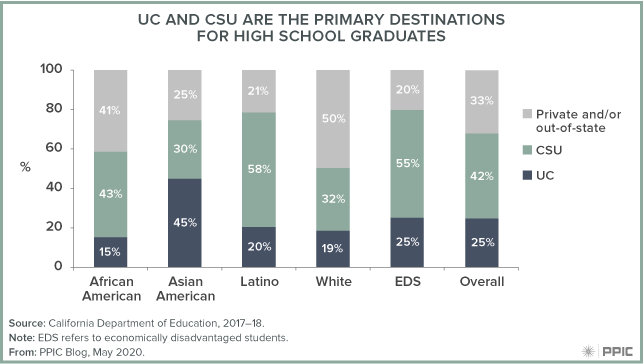
California’s public universities are the primary destination of the state’s high school graduates and community college transfers headed to a four-year college. In 2017–18, nearly 200,000 California high school graduates applied to the University of California (UC) or California State University (CSU), and 84,000 were enrolled.

figure - UC and CSU Are the Primary Destinations for High School Graduates

For students applying for admission to colleges in fall 2021, eligibility requirements and application processes are changing. Most standardized tests used for admission—such as SAT and ACT—and for placement purposes, such as the Smarter Balanced Assessment, are either postponed or cancelled.

In light of these cancellations, UC and CSU temporarily suspended testing requirements for fall 2021 applicants, meaning students do not need to include a test score on their application. In addition, UC and CSU systems are temporarily accepting pass/fail in lieu of a letter grade for courses completed in winter, spring, and summer 2020, as more K–12 districts and community colleges choose not to assign letter grades while students adjust to distance learning during the pandemic.

These adjustments are meant to ease anxiety over college admissions in a time of crisis, and there is some evidence that eliminating high stakes standardized tests could lead to more underrepresented students being placed in college-level courses and being eligible for college.

However, when high schools and community colleges lack sufficient resources, even with flexible grading in place, remote education may fail disadvantaged students. More than half of K–12 students from low-income households do not have broadband access at home. Notably, PPIC research found that online courses at community colleges exacerbated achievement gaps.

During their junior and senior years, high school students are more likely to fall off the college pathway, and disadvantaged students are even more likely to do so. And until recently, disadvantaged students were also more vulnerable to being diverted away from community college courses necessary for transfer admissions.

All students must cope with the changing college application process. But first-generation college applicants come from families who are new to the process; those with less internet/technology access may also be less familiar with how to apply. These students may see less support in the college application process than they would if they were still in school.

Now, more than ever, targeted outreach efforts and collaborations between K–12 and higher education will be critical to ensuring equitable access to a college education and economic mobility.[/vc_column_text][/vc_column][/vc_row]

Students Prepare for AP Exams during COVID-19

In response to disruptions from COVID-19, the 2020 AP exams will be open book/open note format and taken online at home, according to the College Board. The new exams are scheduled May 11–22. At 45 minutes each, the exams will be much shorter and cover less material—focusing on content covered prior to March school closures.

An increasing number of colleges, including those in the University of California system, have affirmed they will award college credit for 2020 AP exams that score a 3, 4, or 5. While these changes give flexibility to students still hoping to earn college credits, all students may not benefit equally.

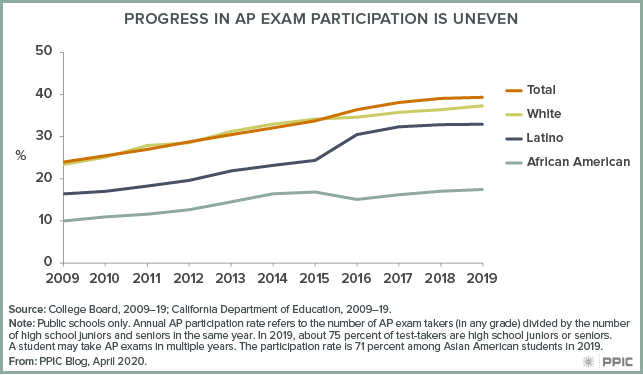
Nearly 380,000 students in California public schools took an AP exam in 2019, up 63% from a decade ago. Participation among Latino students grew from 16% in 2009 to 33% in 2019. However, participation by African American students plateaued in 2015.

figure - Progress in AP Exam Participation Is Uneven

For disadvantaged and vulnerable students, limited access to learning options at home may cause a dip in participation and performance. Nearly half of students from low-income families do not have broadband access at home; neither do a third of Latino or African American students. And broadband access remains problematic in rural areas, where 41% of school-aged children do not have access.

Students with special educational needs may face additional challenges. The pandemic and resulting school closures have had a disproportionate impact on this student population, with many losing access to special education support professionals and services.

Efforts to close these gaps are underway: the state Superintendent recently formed a new task force to close the digital divide, and the governor announced several cross-sector partnerships to support distance learning. The California School Board Association just announced its effort to push for a $2 billion broadband bond on the November ballot to address rural connectivity.

AP assessments begin in just a few weeks. The College Board has suggested that students without internet or a device contact them for assistance, but the scope of the organization’s ability to respond is untested. In addition, test preparation and participation may be difficult for students who are also caregivers at home and lack separate, quiet testing space.

It is unclear how many California students will take the 2020 AP exams, but they are still being encouraged to do so. In an April webinar, the College Board noted that 86% of AP teachers across the nation will still assign a letter grade to their courses during this school closure, with bonus points for completing an AP exam.

At 91%, the vast majority of AP enrollees still want to earn college credits. Schools and teachers across the state are helping students navigate the new system. As the state ramps up efforts to implement distance learning and maintain continuity of learning amid school closures, AP results should be closely monitored so that we understand the impact on socioeconomically disadvantaged students and special education students.

Video: Californians and Education

In the era of COVID-19, about eight in ten adults fear getting sick, and 80% expect bad economic times ahead. At a virtual briefing on Thursday, PPIC researcher Alyssa Dykman said the drop in consumer confidence “is unprecedented in the history of the PPIC survey.”

The event featured Dykman, who presented attitudes on K–12 education, funding, and policy preferences along with concerns over the coronavirus pandemic in the latest PPIC statewide survey. PPIC President and CEO Mark Baldassare supplied deeper context for key findings and responded to online questions.

Approval ratings have hit rare numbers: at 78%, approval has surged for Governor Newsom’s handling of K-12 education, and at 92%, public school parents express overwhelming support for school district handling of school closures. COVID-19, however, has shaken support for school bonds, with about half or fewer adults and likely voters saying it’s a good idea now for state government to fund school construction projects.

Baldassare underscored Californians’ concerns around health and finances, stating that two-thirds of adults are worried about both. Many say their lives are disrupted and about half say the stress is affecting mental health.

What do these concerns mean for California schools? “People are giving state leadership and local leadership a lot of leeway in how they respond to the public health and economic crisis,” Baldassare said. But the state will see its first test of this extraordinary support in May, when the governor submits a revised budget that will reflect revenue loss from a sharp economic downturn.

That may also lead to roadblocks for state and local school funding in November. In the March primary, “the defeat of most of the local school bond measures really caught a lot of people by surprise,” Baldassare said. “It was difficult to pass school funding measures.” At the moment Californians are hesitant to commit more funding to schools, which may impact voting on the split-roll property bond measure and others in the November election.

The survey offers several takeaways around planning for California public education. “We’ve never had anything like the school closures that are taking place,” Baldassare said. He reflected that Californians may reconsider the value of teachers going forward, including whether “teachers have the resources they need in order to do the job,” and noted that the public may have “a new understanding of the important and difficult role teachers play every day in the lives of public school children.”

Californians also may now recognize the struggles of vulnerable students, especially in terms of online access.

“It is going to be a test of Californians’ political will,” Baldassare said, “the degree to which we are committed to improving student outcomes, particularly among the large numbers of English language learners and low income students across the state.”

School Funding, COVID-19, and the 2020 Election Year

This post is excerpted from Mark Baldassare’s prepared remarks for the PPIC Statewide Survey virtual briefing on April 23, 2020.

State funding for K–12 public schools will take center stage when Governor Newsom unveils revisions to the state budget in a few weeks. The growing fiscal toll of the COVID-19 crisis is likely to affect school funding plans as a deep economic recession looms. K–12 schools have the largest share of the state General Fund, and many Californians say it is their top priority for state spending. Still, California voters seem to be pulling back their support for school funding on ballot measures.

One of the biggest surprises in the March 3 primary was the defeat of the Proposition 13 state school bond (53% voted no). The last time a state school bond failed to pass was back in 1994. Proponents have tried to explain away this loss as confusion caused by the number 13—the same as the notorious anti-tax initiative that passed in 1978.

However, outcomes of local school bond measures point to a different story. Bucking recent trends, 63% of local school bonds on the March primary ballot failed to reach the 55% threshold needed to pass. It may be that early anxieties about COVID-19 resulted in voter caution about extending debt. In the absence of exit polls to validate this theory, the April PPIC Statewide Survey sheds light on what may have happened. It also offers sobering news for efforts to convince voters to support school funding measures in the November election.

First, though, let’s dispense with the notion that views about school funding have fundamentally shifted. Today, 55% of California likely voters say that state funding for their local public schools is not enough. And 53% would vote yes on a state school bond while 50% would vote yes on a local school bond. Moreover, 53% percent would vote yes on a split roll property tax to fund local public schools—a measure that appears headed for the November ballot. All of these results today are similar to those last April, suggesting that basic attitudes about school funding are fairly stable.

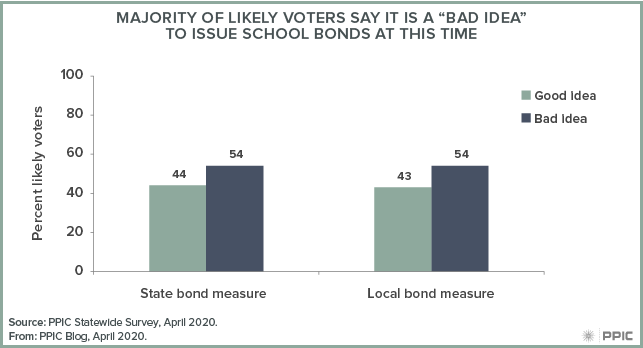
But current conditions appear to be having a strong effect on the timeframe for public support. Our survey was conducted from April 1 to 9—roughly a month from the primary and a few weeks into stay-at-home orders. We find that most likely voters say it is a “bad idea” to issue state (54%) or local (54%) school bonds at this time. Majorities of Californians without children in public school agree (bad idea: state 56%, local 57%). Fewer than half across the state’s regions say it is a good idea to issue these bonds now. Only those with children in public school think that it is a good time to issue state (57%) or local school bonds (58%).

figure - Majority of Likely Voters Say it is a “Bad Idea” To Issue School Bonds at this Time

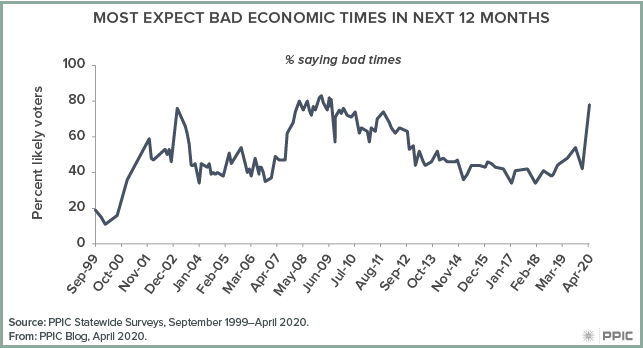
Why? Californians have had their world shaken by the COVID-19 crisis. Since January there has been a 36-point increase in expectations for bad economic times in California over the next 12 months (42% to 78%)—sending us to depths of consumer pessimism not seen since the Great Recession. And right now, 74% percent are worried about negative impacts of the coronavirus on their personal finances.

figure - Most Expect Bad Economic Times in Next 12 Months

This pessimism is likely to have profound implications for school funding measures on the November ballot. The state’s fiscal and economic problems will weigh heavily on voters’ minds when they are asked to make decisions on spending, taxes, and bonds. Many may be reluctant to ask taxpayers (like themselves) to foot the bill, or to increase commercial property taxes, to make up for shortfalls in school funding.

We can also expect a rocky road ahead for the governor and state legislature. Although our April survey found a steep rise in the governor’s and legislature’s approval ratings around handling K–12 public education, state leaders now face the prospect of having to cut back on popular plans to increase school funding. During the Great Recession, we saw the governor’s and legislature’s approval ratings tumble with state budget cuts to local schools.

Our surveys will be closely monitoring all of these dynamics as California heads toward a much-anticipated November presidential election.

The Coronavirus Pandemic Will Test the State’s Budget Reserves

As it grapples with the COVID-19 pandemic, California faces an uncertain fiscal future. This global crisis has caused a sharp decline in economic activity, exposing crucial sectors to heightened risk. As discussions continue about when and how to re-open the economy, it is clear that the state will have to respond to significant fiscal challenges.

The good news is that California has made important changes to its reserve policies since the Great Recession. The passage of Proposition 2 (2014) created the Budget Stabilization Account—the state’s rainy day fund—as well as the Public School System Stabilization Account, a separate reserve for K–12 districts and community colleges. In addition, Governor Brown and the legislature created the Safety Net Reserve Fund to shore up Medi-Cal and CalWORKs funding during downturns.

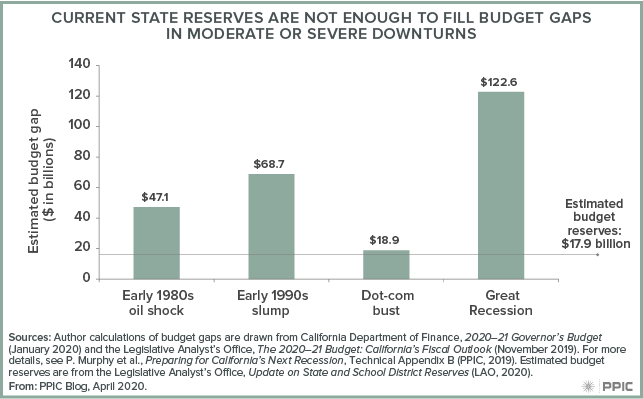
The bad news is that a severe recession is likely to pose significant budgetary challenges. Drawing from the state’s experience during several recent recessions, PPIC estimated the budget ramifications of mild, moderate, and severe recessions and the capacity of state reserves to fill gaps. We found that the state’s reserve balance—estimated to be $17.9 billion—is large enough to withstand a mild recession such as the dot-com bust in the early 2000s.

However, a long and/or severe recession like the early 1980s oil shock (which lasted four years), or the early 1990s slump and the Great Recession—both of which were much more severe and lasted five years—would create large budget gaps and require policymakers to make difficult decisions. (It is important to note that the estimated reserve balance relies on the 2019–20 enacted budget and that it will change when revenue estimates are updated in May.)

figure - Current State Reserves Are Not Enough To Fill Budget Gaps in Moderate or Severe Downturns

In the meantime, the federal government has stepped in. The Families First Coronavirus Response Act includes an increase in the federal share of Medicaid payments and reimbursements to states that are expanding public assistance programs. The Coronavirus Aid, Relief, and Economic Security (CARES) Act provides about $2.2 trillion; some aid goes directly to families, some goes to schools, and some to state and local governments. Additionally, two federal disaster declarations make many of California’s COVID-19 expenditures eligible for at least partial reimbursement.

Governor Newsom has requested additional federal assistance, including flexible aid to state and local governments, a further extension of unemployment insurance benefits, and expanded support for safety net programs, small businesses, K–12 and higher education systems, childcare, and broadband.

The state is also making significant changes to the 2020 budget process. The Department of Finance is drafting a “workload” budget for the May Revision that will set the baseline for the final budget to be enacted in June. This will limit spending increases while allowing for growth in programs—particularly safety net programs—that expect increased demand. The legislature will revisit the budget for an “August Revision” that reflects changes in the state’s financial condition. As these processes move forward, PPIC will continue to monitor California’s evolving fiscal challenges and steps being taken to address them.

High School Graduation during the COVID-19 Crisis

With schools closed for in-person instruction in California through the end of the school year, the state has asked districts to implement distance learning. As a result, many students—particularly high school juniors and seniors—are concerned about falling behind or failing to graduate.

Nearly half of students from low-income families do not have broadband access at home. Given this reality, along with the uneven distribution of learning opportunities within and outside of schools across the state, it will be important to address the equity implications of the shift to distance learning during the coronavirus pandemic.

In response to school closures, the California Department of Education is allowing districts to request waivers that exempt individual students from the state’s minimum graduation requirements, which include three years of English, two years of math and two years of science.

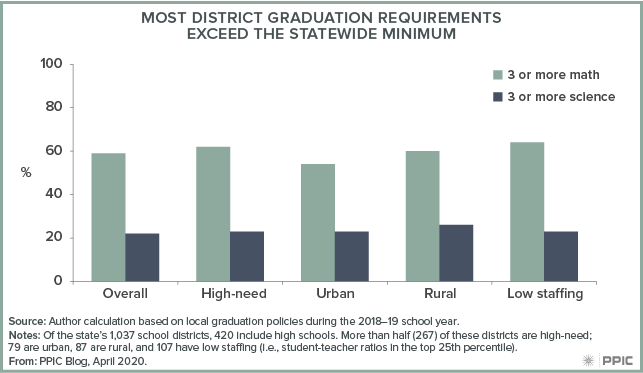
In addition, many districts have graduation requirements that exceed the state minimum. In the 2018–19 school year, 59% of districts required a third year of math, and 22% required a third year of science.

These requirements are prevalent across all types of districts—including high-need districts, in which more than 55% of students are low-income, English Learners, homeless, or foster youth; rural districts; and districts with high student-teacher ratios.

figure - Most District Graduation Requirements Exceed the Statewide Minimum

Moreover, students in six large districts—including Los Angeles Unified, San Diego Unified, San Jose Unified, and San Francisco Unified—must complete the entire A–G sequence required for admission to University of California (UC) or California State University (CSU) schools in order to graduate.

Districts with graduation requirements that exceed the state minimum will need to work with school boards to modify local policies. UC and CSU have already responded to school closures by temporarily suspending letter grade requirements for A–G courses completed in winter, spring, and summer 2020.

However, it will be challenging to help students stay on the A–G pathway. The waiver and temporary suspension of GPA requirements do not necessarily make it easier for students to take more A-G courses. PPIC research has shown that most students exit this pathway in the last two years of high school, and groups that are historically underrepresented in higher education are more likely to drop off at every stage. As districts develop distance learning plans and ways to provide flexibility to high school students, considerations of equity and access should be front and center.

Emergency Child Care for Essential Workers

Of the state’s estimated 5.1 million essential workers, about 1.9 million have children younger than 13. These parents may be having difficulty finding care for their children amid the COVID-19 crisis, with most schools closed and many child care providers shuttered.

To address this need, the California Department of Education issued guidelines last Thursday for temporarily restructuring state-provided child care services. Parents who are essential workers can apply for services during the pandemic even as the state continues to prioritize certain at-risk children regardless of parents’ occupations.

Child care programs that receive state funds are now encouraged to remain open—or to reopen—if they can safely do so in order to care for the children of essential workers. To be eligible, all parents in the household must be essential workers and require child care so they can continue working (for example, they do not have the option to work remotely).

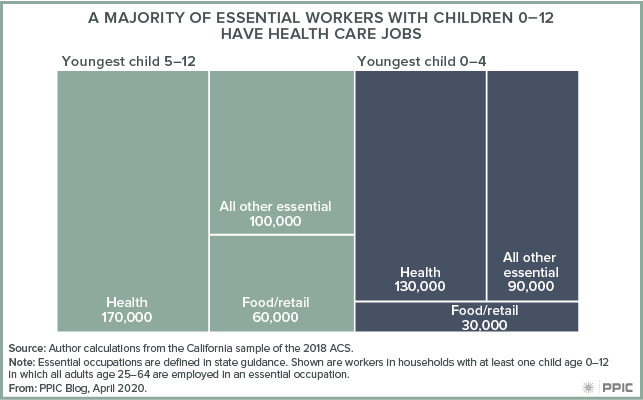
More than half a million essential workers with about 640,000 children younger than 13 could qualify. About 43% of these essential workers have a youngest child between 0 and 4 years old at home, while the rest have older children. Most of these parents work in health-related occupations, which are prioritized in the guidelines to receive child care services.

figure - A Majority of Essential Workers with Children 0-12 Have Health Care Jobs

On Monday, Governor Newsom announced that $100 million of the funds allocated in SB 89, emergency legislation to fight the coronavirus pandemic, will go toward funding up to 20,000 more short-term child care slots—and making child care programs safe for those children and their teachers. The CARES act provides federal funds to states for these purposes, so California will recoup these expenditures.

While we don’t know how many state-subsidized programs have remained open, even in the best of times the number of spaces is limited so most children—including those in low-income families—cannot access such care. However, demand for child care is indicated by the number of children in low-income, essential worker families. During this emergency, essential worker families do not need to show they are low income when they seek child care. However, programs are instructed to prioritize families.

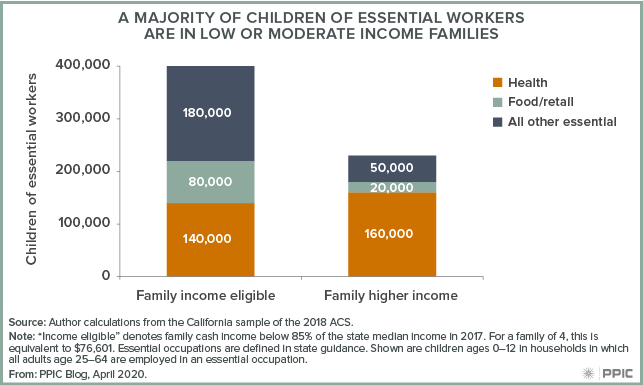
About 400,000 children in essential worker families live on incomes below 85% of the state median—the income cut-off for state preschool in normal times. While a majority of parents in essential jobs work in health occupations, most low-income children have parents working in other essential occupations. In other words, tension may arise between serving children of low-income essential workers and serving children of health workers.

figure - A Majority of Children of Essential Workers Are in Low or Moderate Income Families

In this time of uncertainty, the state has existing capacity to support child care, and it has shifted the goals of state-supported programs to help essential workers meet—and afford—their child care needs. By tracking the response, the state could gain insight into whether it is meeting the needs of essential workers in this difficult time, how to meet these needs in the longer term, and to what extent needs vary across the state.

Remote Learning for English Learners and Special Needs Students during COVID-19

[vc_row][vc_column][vc_column_text]For California’s most vulnerable students, including 1.2 million English Learners (EL) and over 700,000 students with special educational needs, remote learning in the wake of COVID-19 presents particular challenges. As districts across the state roll out distance learning plans to minimize disruption to K–12 students, educators must find alternate ways to meet all student needs.

English Learners and special education students typically require more in-person support, such as occupational and speech therapy, in their daily learning than students in general. Educators are struggling to devise and implement plans to address these requirements remotely. Access to internet and devices is one area of concern, but so is providing intensive learning experiences that can stand in for in-person services.

Most EL and special education students live in large urban areas with access to broadband, and school districts in these counties, such as in the Bay Area and coastal counties in Southern California, may be able to partner with philanthropy and technology providers to supplement households currently without broadband access. Rural areas, however, may not have the same supports.

In counties where broadband access is low—that is, over 18% of households with school-age children lack it—and where the share of EL or students with disabilities is high (over 26%), online learning is a hurdle. This includes Colusa, Yolo, Napa, San Joaquin, Stanislaus, Merced, Madera, Monterey, Kern, and Imperial, which together account for over 220,000 students who have special education needs or are English Learners.[/vc_column_text][/vc_column][/vc_row][vc_row max_width=”80″ visibility=”visible-desktop”][vc_column][vc_column_text][infogram id=”1p1qw10yewvk2dfmxmvky16prlb6pw1mvrm?live”][/vc_column_text][/vc_column][/vc_row][vc_row max_width=”80″ visibility=”visible-tablet-landscape”][vc_column][vc_column_text]

[infogram id=”1p1qw10yewvk2dfmxmvky16prlb6pw1mvrm?live”]

[/vc_column_text][/vc_column][/vc_row][vc_row visibility=”visible-tablet-portrait”][vc_column][vc_column_text]

[infogram id=”1p1qw10yewvk2dfmxmvky16prlb6pw1mvrm?live”]

[/vc_column_text][/vc_column][/vc_row][vc_row visibility=”visible-phone”][vc_column][vc_column_text]

[infogram id=”1p1qw10yewvk2dfmxmvky16prlb6pw1mvrm?live”]

[/vc_column_text][/vc_column][/vc_row][vc_row][vc_column][vc_column_text]There are an additional 50,000 such students in counties where we cannot estimate the share of families without broadband, but where concentrations of EL or students with special needs are disproportionately high. In these rural counties—which include San Benito, Mono, Tulare, Modoc, and Yuba—educators must determine how to compensate for lack of internet while offering intensive, though not in-person, instruction.

And it isn’t just students tested by the move to online instruction. In a typical school year, only 67% of teachers received professional development in using computers for instruction. Most received less than eight hours of training.

To fill the gap, more districts are providing training on how to teach students remotely. Courses cover online tools such as Zoom, Google Classroom, Canvas, and Seesaw; how to monitor and assess student learning; and how to manage and cater to student needs in an online environment. The California Department of Education also provided resources and idea banks to help districts accommodate students with varying learning needs, with guidance on options for delivering individualized education.

California continues to provide funding to districts to implement distance learning, through the governor’s executive orders and recent legislation. While distance learning cannot replace in-person instruction and services, educators are exploring alternatives, from reading assignments over the telephone to moving speech and occupational therapy online. Districts are also discussing extending the school year as they work to provide effective and equitable learning to the state’s most vulnerable students.[/vc_column_text][/vc_column][/vc_row]