Challenging Times for California

This is a time of global crisis. We are all living through a fast-moving, large-scale disaster that is having extraordinary public health and economic consequences. Here in California, public leaders and private industries took early action to mitigate the effects of COVID-19, putting policies in place to flatten the curve sooner than any other state. And while the full extent of the pandemic has yet to be realized, Californians should feel proud of our state’s ability to assess and respond rapidly to counteract this generational challenge.

The pandemic is touching every aspect of life today. Students, agricultural workers, health care practitioners—all Californians are struggling to adjust to enormous changes in their responsibilities and daily routines. At PPIC, we are thinking about the effects on our state’s most vulnerable populations: seniors living in areas with sparse medical care, children receiving free or reduced price lunches, essential workers struggling to stay above the poverty line.

We are also deeply concerned with what lies ahead. How will our economy—just recently in the longest growth cycle ever recorded—respond in the long term? How can the state improve opportunities for those hardest hit by this crisis? What can we observe, measure, and propose that will help California to rebuild itself efficiently, effectively, and equitably?

PPIC will be delving into these questions as this crisis plays out. For now, in these fluid and rapidly changing times, we are focused on bringing critical facts and information to the table—assessing the state’s economy, people, communities, and environment. Our blog series on COVID-19 provides wide-ranging analyses across key policy areas, from education to health care, from criminal justice to water policy. And the PPIC Statewide Survey will be offering perspectives on the pandemic and the economy from Californians across the state.

For 25 years, PPIC has worked hard to inform and improve public policy in California. 2020 may be one of our most challenging years yet, but we are ready and able to meet that challenge.

For PPIC’s full series on the coronavirus and California, visit our COVID-19 page.

How COVID-19 Closures May Disrupt Student Learning

All but one of California’s K–12 schools have closed in response to the COVID-19 pandemic, causing massive disruptions for the state’s 6.2 million students. This week, Governor Gavin Newsom announced that closures are expected to continue through the end of the school year, although the final decision rests with local officials.

School is technically still in session, but distance learning is unlikely to fully compensate for lost time. Assuming schools remain closed through the school year, how detrimental will this be to student learning?

First, learning time matters. In studies measuring how students performed based on differences in when they took exams, even a few days can have a large impact. We also know that missing school reduces academic performance and that chronic absenteeism is particularly damaging, tied to a variety of outcomes such as achievement, socio-emotional development, and dropout. However, the impact of missing school under normal, predictable conditions is less relevant to our current situation.

Disruption from weather-related closures may be a better gauge for how COVID-19 closures could impact students. Roughly 1.2 million K-12 students in California were affected by emergency closures last year, mainly due to wildfires and other weather-related events. According to data from Maryland, schools fare worse on state exams in years with more weather-related closures, despite these closures accounting for only a week of instruction on average.

However, when we consider the impact of individual student absences versus school-wide closures, the effects of closures are negligible. Educators may find it easier to compensate for school-wide closures by adjusting or delaying lesson plans. While this suggests a reason for optimism, mitigating entire months of lost instructional time will require more than reorganizing lesson plans.

Additional insights come from the long documented phenomenon known as “summer learning loss”: the typical student loses about one month’s worth of learning over the course of a summer. Importantly, summer losses tend to be larger for disadvantaged students who have access to fewer resources and learning opportunities while away from school.

This means that achievement gaps tend to grow during the summer, reversing gains achieved during the year. This is worrisome: if schools remain closed for the remainder of the school year, we may face an even larger “spring and summer” loss.

Notably, these effects would be on top of any effects from having fewer instructional days. Distance learning may help mitigate losses, but the state’s most disadvantaged students may fall even further behind because of inequities in access to computer equipment and internet connectivity.

Continued support for distance learning programs will be crucial as closures continue, as will efforts to give students better access to better online learning. Google’s plan to provide free Wi-Fi and laptops to thousands of students is a step in the right direction.

Policymakers could also consider options to recover lost time over the summer or in the following year, as evidence shows programs that offer more learning time—during the school year or the summer—can benefit students. While this strategy would be difficult and costly to achieve, the severity of the COVID-19 disruption to student learning may justify extraordinary options.

Feeding Children When Schools Are Closed for COVID-19

By state law, all public schools in California must provide at least one nutritionally adequate meal to students—however, many students eat more than one meal a day at school. Nearly four million students received meals from California’s public schools in the 2018–19 school year: close to 300 million breakfasts and well over 500 million lunches. With schools closed to reduce exposure to the new coronavirus, many students now lack ready access to these meals.

By federal law, low-income students (about $48,000 for a family of four in 2020) are eligible for free or low-cost school meals. Higher income students paid on average $0.98 for breakfast and $2.11 for lunch in 2017–18, according to the California Department of Education.

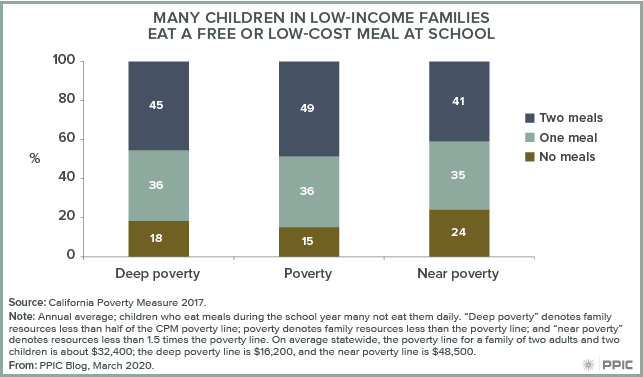
The vast majority of low-income students eat some or all breakfasts, lunches, or both at school. Free and reduced-price meals lower food insecurity, and according to the California Poverty Measure (CPM), meaningfully reduce poverty among families with public school students. Without school meals, the share of students living in deep poverty would be 17% higher; increases for students in less severe poverty would be 2% to 8%.

figure - Many Children in Low-Income Families Eat a Free or Low-Cost Meal at School

With school closures in place for several weeks, school districts have already designated sites where families can pick up meals for children. In higher poverty areas, all children can access meals regardless of enrollment in the local school or eligibility for meal programs because authorities have temporarily relaxed federal regulations.

During closures, Governor Newsom assured that schools will continue to receive state funds to operate and requested efforts focus on certain areas, including providing school meals. However, access remains a concern. For example, Los Angeles Unified School District lists 64 “grab-and-go” sites for its roughly 1,000 schools. San Diego Unified School District has 13 sites for 181 schools, as of March 16. Elk Grove, with 67 schools, has 34 sites for drive-through and grab-and-go meal services along with a mobile service for families with limited transportation.

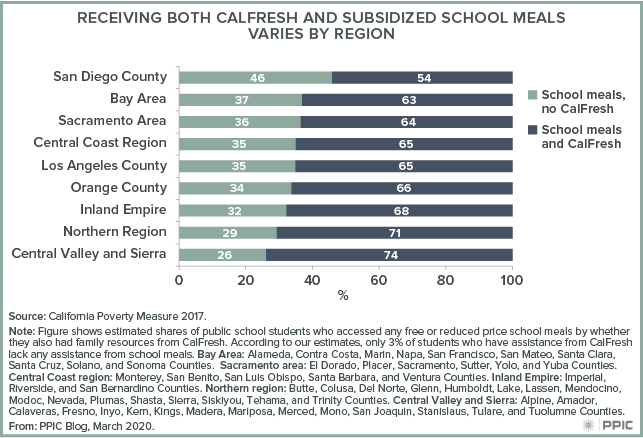
With pandemic EBT (P-EBT), ATM-like cards pre-loaded with funds for groceries, the federal government is also helping low-income students replace missed school meals. The cards will cover the expected number of days that schools will be closed. For students whose families already receive monthly CalFresh benefits on EBT cards, funds can readily be added. For low-income students who do not already receive CalFresh (34% statewide), families must complete some paperwork—mainly electronically—to obtain an EBT card.

Because the reach of CalFresh varies across the state, barriers to getting P-EBT funds to students will also vary. Fortunately, the state already matches student data with their CalFresh, CalWORKs, and Medi-Cal data to automatically determine students eligible for free and reduced-price school meals. If the state can use all existing sources of family income to provide P-EBT to students, they will reach more low-income students.

figure - Receiving Both CalFresh and Subsidized School Meals Varies by Region

Ready access to meals influences student health, learning, and economic wellbeing. Robust access to free and reduced-price meals can decrease the stress low-income families are facing as efforts to limit the spread of COVID-19 dampen economic activity.

Will Students without Home Internet Fall Behind During Coronavirus Shutdowns?

K–12 schools across California are preparing for closures due to the coronavirus outbreak, to protect students from unnecessary exposure and to sanitize facilities. As schools consider moving classes online to mitigate the disruption to student learning, broadband access at home presents a formidable challenge.

The good news is that K–12 schools have the means to deliver classes online. PPIC research has found that the overwhelming majority (90%) of California schools met the Federal Communications Commission’s (FCC) minimum threshold for digital learning in 2018, and 59% of schools met the FCC’s long-term targets.

However, internet access is a bigger problem for students in their homes. In 2017, close to 1 million (15.6%) school-aged children (ages 6–17) had no internet connection at home, while over 1.6 million (27.5%) did not have broadband access. About 9.5 percent of households with school-aged children reach the internet only via a cellular data plan, which can be slower and more expensive. For these same households, the devices available are limited as well, with 12.7 percent reporting no laptop, desktop, tablet, or other portable wireless computer at home.

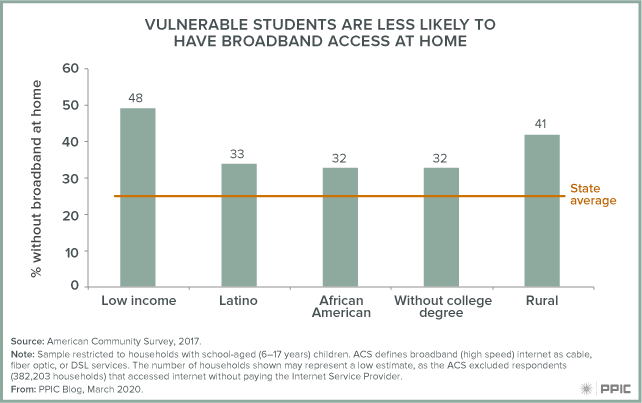
Underrepresented students are most at risk of falling further behind during school closures. About a third of Latino or African American students and students whose parents do not have a college degree lack a broadband subscription at home. Nearly half of low-income households with school-aged children have no broadband at home. Affordability remains a key barrier, as half of low-income households did not subscribe to broadband because of the cost.

In rural areas, access may depend on whether an area offers services. Forty-one percent of rural households with school-aged children do not subscribe to broadband at home, which is much higher than the state average (25%). For households with no internet access, 33.2 percent indicated internet was not available where they lived compared to 1.3 percent of respondents in metropolitan areas.

Households may not have internet or broadband for many reasons, including financial, technological, and topographical barriers.

figure - Vulnerable Students Are Less Likely to Have Broadband Access at Home

As the state and local authorities consider alternatives to in-person instruction, policymakers will need to consider how internet access will affect all students in the days and weeks ahead.

Video: Fiscal Challenges of Declining Enrollment in California Schools

Enrollment declines in California’s public K–12 school system are expected to intensify in the coming decade. Districts with falling enrollment face financial pressures, as state funding falls along with the number of students they serve. Lower enrollment also has important implications for the state budget. At a lunchtime event in Sacramento last week, PPIC researcher Paul Warren outlined a new report on declining enrollment and a panel of experts offered state and local perspectives.

Warren explained that enrollment is falling in about half of California’s school districts. In the coming decade, declines will be significant in coastal areas—and in many of the state’s largest school districts. The state budget cushions the fiscal impact of declines in enrollment by delaying attendance-based funding cuts for one year. But enrollment declines are almost always long term, and district costs do not fall at the same rate as district revenues.

Renee Arkus, executive director of fiscal services for the Long Beach Unified School District, said that adjusting to lower enrollment hinges on knowing the speed and the spread of declines. Long Beach, the state’s third-largest district, has been experiencing declines for 15 years. “We’ve lost 25% of our population,” she said, adding that the district has been losing 1,500 to 2,000 student each year, and those losses have been spread across a number of schools.

Sara Bachez, assistant executive director of governmental relations for the California Association of School Business Officials, noted that declining enrollment is one of many fiscal pressures districts are facing. She cited a growing demand for special education, pension and health care costs, aging infrastructure, and the challenge of offering proper compensation for district staff.

Claudia Davis, associate superintendent of the Calaveras County Office of Education, highlighted the challenges that small districts face. Like Long Beach, Calaveras County has been experiencing declines for the last 15 years. But because Calaveras is a small county, it is challenging to find ways to reduce spending. “We have district offices with three people in them,” she said, so cutting staff would have a big impact: “The work has to get done regardless of the size of your district.”

Mike Fine, chief executive officer of the Fiscal Crisis and Management Assistance Team, pointed out that the fiscal challenges that Calaveras County faces are typical, as more than half of the state’s districts serve fewer than 2,500 students. In his view, the best guide to addressing these challenges is the Local Control and Accountability Plan (LCAP) that each district is required to develop. “We have to clearly define what are our core services that we can’t do without, and then everything else is up for discussion,” he said.

Most districts could benefit from state assistance in forecasting and responding to declining enrollment. As Arkus put it, long-term planning is “the only way that some districts can survive this.” And Davis noted that small districts don’t have the human capacity for exhaustive planning. “Long-term planning is difficult when you’re . . . just trying to keep the doors open.”

Video: College Eligibility for the University of California

As the University of California (UC) and the California State University (CSU) consider changes to eligibility requirements, important questions are being raised about college admissions standards and educational equity. In Sacramento last Friday, PPIC researcher Niu Gao outlined the findings of a new report on the potential effect of an expanded science requirement on UC eligibility across the state, and a panel of experts addressed larger questions about college eligibility and access.

Gao explained that the potential impact of an expanded science requirement on college eligibility is tied to “the inequitable distribution of educational resources, and also opportunities both within and outside of schools.”

Varsha Sarveshwar, president of the UC Student Association, underlined the importance of institutional barriers that make it difficult for some students to take required courses. “When you’re a high school student you’ve got . . . a lot of things you have to worry about, particularly if you’re trying to apply to UC. And some of those institutional barriers, such as scheduling, or maybe not meeting all the prerequisites—those can have a really big impact on students.”

Yvette Gullatt, UC’s vice provost of diversity and engagement, said that “for UC, when we’re thinking about equity, we have to follow our land-grant mission, which is to ensure that every student in California has the opportunity to attend the university.” Instead of making top-down changes, “we need to consult, and we need to look at data, and we need to get feedback.” In short, she said, “we need to really understand, ground up, how these things actually work.” She added that this kind of consultation and analysis led UC to reject a change to its science requirement.

Improvements in course placement policies as well as course scheduling could lower barriers for many students. But teacher shortages make it challenging to provide access to courses, especially for schools in low-income areas. Blain Watson, principal of Dominguez High School in the Compton Unified School District, offered an example. At Dominguez—which has 1,800 students on campus and several hundred more in a continuation program—“the actual number of kids taking physics is limited to one teacher, and that one teacher teaches both physics and mathematics.”

More generally, Watson highlighted the need to keep kids in class and engaged, so that they can succeed in required courses and have access to a wide range of electives. For Watson, fostering this engagement involves helping teachers build relationships with students—“building capacity in teachers to teach from the heart.” Sarveshwar noted that helping students prepare for and get through college requires culturally competent counseling and support, starting as early as middle school. As she put it, “How much of college readiness is a matter of belonging?”

Video: Countdown to Census 2020

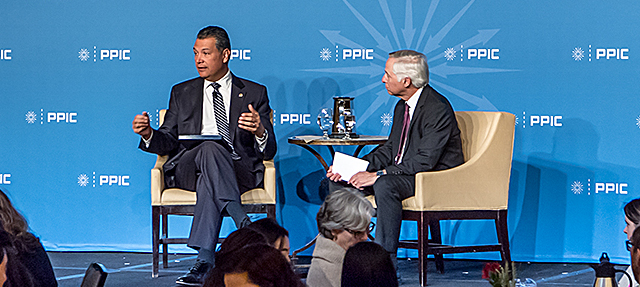
Census Day 2020 is fast approaching, and results from the population count will determine political representation and federal funding for California for the next 10 years. Speaking at a PPIC event in Sacramento last week, Alex Padilla, California secretary of state, joined Mark Baldassare, president and CEO of PPIC, to reflect on the importance of counting the country’s most populous state.

Padilla stressed that along with billions in funding for education, health care, and other critical areas, the count affects the state’s representation in Congress as well as lines drawn at all district levels. “It affects you regardless of the issues you care about, regardless of where you live,” Padilla said. He further emphasized that the census is a population count, not a citizen or adult count. In 2010, California undercounted children under five, which led to underfunded schools over the next 10 years. “Here is a way to make sure schools get the funding they deserve without raising taxes.”

Following the conversation with the secretary of state, Sarah Bohn, PPIC vice president of research and senior fellow, convened an expert panel that expanded on strategies at the frontlines for reaching hard-to-count communities.

Assemblymember Marc Berman discussed the investment by California— which has directed $187 million toward census infrastructure at state, regional, and local levels—that sets the groundwork for outreach and coordination. Partner organizations are now pushing a public awareness and information campaign. “Nobody has ever tried anything like this in a state of 40 million people at the level of specificity and detail that we really need to be successful,” Berman said.

Success depends on participation, however, and trust in government can influence participation in the census—especially among hard-to-count groups who may feel suspicion of the federal government. Apathy is another obstacle. Carolyn Coleman, executive director for the League of California Cities, described how the census returns funds to communities: “We send a lot of dollars to Washington, DC, every year via the tax code, and this is one of the most important ways we get those dollars reinvested back into our communities.”

It takes coordination by trusted messengers to reach hard-to-count groups and communicate this idea. Ditas Katague, director of California Complete Count, said, “We have amazing partners on all levels—whether we’ve contracted them, whether they are foundations, whether they’re state agencies.” Katague outlined efforts by a Sacramento organization mapping territory from the Oregon border to Yolo County, and San Diego ambassadors doing outreach in Arabic, Kurdish, Farsi, Vietnamese, and Somali. Regions are playing to their strengths: Silicon Valley is emphasizing tech; the San Joaquin Valley is partnering with faith-based organizations.

Californians can participate in the census starting in March, and assistance centers around the state will offer help through April. Katague emphasized the importance of motivating others to complete it, saying, “There are 9 questions on the census. It takes 10 minutes to secure the future for the next 10 years.”

Making Progress on Connecting Student Data across California

California students may fall through cracks in the state’s public education system because K–12 data and college data are not connected. For example, the state and its public universities are currently unaware of students who do not apply to UC or CSU despite being eligible, making it impossible to encourage these students to apply. Connecting education data can help California recognize and improve key transitions in student progress.

The current data system is fragmented across institutions, leaving California as one of eight states without a modernized approach to tracking its educational pipeline. By passing the 2019 California Cradle-to-Career Data System Act, the state is taking action toward linking education data across its many sectors.

As a first step, California has appointed a workgroup that will recommend a framework to the legislature and the Department of Finance within a year. This workgroup will determine relevant data elements to include—variables such as graduation, eligibility, and enrollment—along with when and how to combine data, where to store results, and who governs access to data.

So far the process has been inclusive and transparent, with representatives from all sectors of education, advocacy groups, researchers, technology experts, lawyers, and others stepping forward to serve on committees and advisory groups. Many member organizations of the California Education Data Collaborative, an organization convened by PPIC, are serving in advisory groups. Advisory group meetings are open to the public, and people can find information, meeting materials, and notes on the California Data System website. Public comments are encouraged at all meetings and on the website.

On January 16, PPIC attended its first meeting with the Policy and Analytics Advisory Group, where we discussed use cases around research and accountability, such as analyzing how financial aid offers to high school students impact college outcomes. The advisory group also agreed on a critical first step for the state: evaluation and analysis of student pathways from school to work. Advice from this advisory group and others will help the state’s workgroup make recommendations on January 30 to determine the scope and first phase of the data system.

PPIC will continue to participate in the advisory group and monitor the monthly workgroup meetings; notes and materials will be posted at California Data System, and we will update progress on this blog.

Video: A Conversation with Leon Panetta

Leon Panetta, former secretary of defense and CIA director, joined PPIC president Mark Baldassare in Sacramento last week for a wide-ranging conversation about leadership. Baldassare began by asking Panetta to “put on your CIA hat” and compare the targeting of Osama bin Laden during the Obama administration with the recent killing of Iranian general Qasem Soleimani. The main difference, Panetta said, is that bin Laden had directly attacked the United States, and that he and other Al-Qaeda leaders were almost certainly planning more attacks.

Panetta explained that the Obama administration “never seriously considered an attack on Soleimani,” because “the result would be that we would increase the chances of war with Iran.” The issue was not whether Soleimani was a “bad actor,” but whether the US wanted to escalate the conflict: “When you make those kinds of decisions, you ought to damn well consider the risks of war.”

For Panetta, the tense situation with Iran underlines the importance of leadership. “In a democracy we govern either by leadership or by crisis.” Leadership, he continued, involves actively addressing major challenges—and this, in turn, entails uncertainty and risk. “If you’re not willing to take the risks associated with leadership . . . , crisis will drive policy in this country.”

Panetta sees impeachment as “a reflection of our times”—we have “a president who doesn’t abide by moral boundaries” and a Congress that “can’t work together.” But he is hopeful that the Senate will deal with the trial “in a fair and impartial way.” Otherwise, he continued, “there is a danger that impeachment is going to become just another political tool.”

Asked to assess how things are going in California, Panetta identified three interrelated leadership challenges: political imbalance, economic inequality, and education. To have a chance of restoring political balance in Sacramento, he said, Republicans are “going to have to look at immigration . . . inequality . . . climate change.” At the same time, the state’s Democratic leadership will have to collaborate with a broad range of stakeholders to tackle economic inequality—and its efforts will need to include a focus on education, which “is absolutely critical to the future of California.”

While Panetta is clearly worried about the level of dysfunction in Washington, he is not entirely pessimistic. “I’ve seen Washington at its best and Washington at its worst. The good news is that I’ve seen Washington work!” More seriously, he stressed the need for people to engage in the political process: “They’ve gotta be willing to fight for what they believe is right.” He conceded that politics “has gotten tougher.” But, he added, the great satisfaction of being involved in our democracy is that “you can do things to make people’s lives better.”


Governor Newsom Proposes New Investments in Math and Science Teachers

The governor unveiled his proposed 2020-21 budget last week, which includes record-high levels of K-12 and community college funding—a $3.8 billion dollar increase over last year. This includes $900 million for K–12 educator recruitment and development, building on a nearly $150 million investment from last year’s budget.

These new investments are an attempt to address the statewide teacher shortage, which is most acute in the high-need subjects of math and science (special education is also a high-need area). The hope is that these investments will pay dividends in improving the size and the quality of the teaching force in these subjects, which are important for college success and for jobs in the 21st century economy.

Most notably, the proposed funding includes one-time increases to address teacher shortages in key ways:

  • $350 million in competitive grants for teacher professional development
  • $193 million to address teacher shortages in high-need subjects
  • $175 million for residency programs to prepare and retain teachers in high-need subjects
  • $100 million to fund $20,000 stipends for teachers in high-need subjects at a high-need school for at least four years

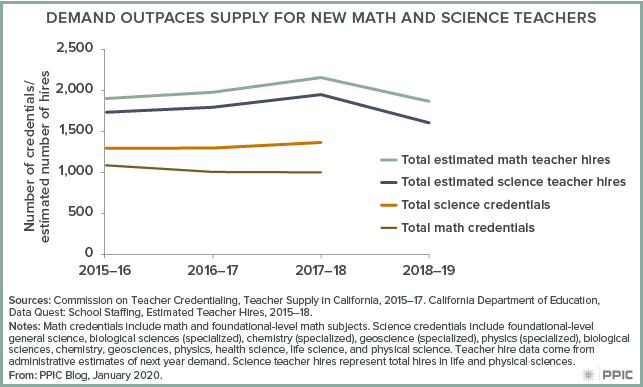
Schools across the state face critical teaching shortages in math and science, leading many schools to increase their reliance on less-credentialed and less-experienced educators. Difficulty in staffing these subjects also means that some schools must reduce course offerings, impeding student access to math and science coursework. Indeed, the number of new math and science teaching credentials has not matched demand for such teachers in recent years. In fact, the number of new math credentials has actually fallen over the past two years, constraining schools in both hiring and course offerings.

figure - Demand Outpaces Supply for New Math and Science Teachers

These continued shortages have important implications for student opportunities in STEM fields. For example, nearly one-third of high school graduates do not meet current UC and CSU requirements for science coursework, and many schools do not have the number of teachers required to offer three or four years of math and science to all interested students. Proposed increases to science eligibility requirements for UC admission—and for math requirements at CSU—mean that increasing the supply of qualified new math and science teachers is more essential than ever. Continued shortages will make it difficult to both accommodate this increased demand and to address equity gaps in the availability of high-quality math and science coursework.

In this light, the governor’s proposal provides reason for optimism. Increased funding for teacher recruitment and retention should help to encourage young adults to enter teaching and retain those who do. And more money for training and development should help to ensure that schools are able to choose among qualified teachers. Whether this will be enough to truly make a dent in the state’s teacher shortage remains to be seen; it depends crucially on whether these investments will be continued in future years or end up as one-time relics from a strong budget year.