Demand for UC and CSU Enrollment Remains Strong

The number of high school graduates has remained steady for several years, with no expectation of significant increases any time soon. And yet demand for admission to the state’s public universities continues to grow.

A quick look at trends among California’s high school graduates—in particular, their preparation for college—helps explain this paradox. Other sources of enrollment growth, including increases in transfer students and improved retention, also play an important role. Understanding these trends is critical, since annual state funding for the University of California (UC) and the California State University (CSU) depends partly on anticipated enrollment growth.

The good news is that more and more of California’s high school graduates have passed the college preparatory curriculum (known as the “A-G” courses) required by UC and CSU. Over the past five years, the number of high school graduates completing the A-G courses has increased 28%, even as the total number of high school graduates has remained largely unchanged.

By 2017–18 (the most recent data available), almost half (49%) of California’s high school graduates had completed the A-G courses, a remarkable increase from just ten years earlier when only about one-third (34%) did so. As a consequence, the number of high school graduates eligible for UC and CSU has reached record numbers.
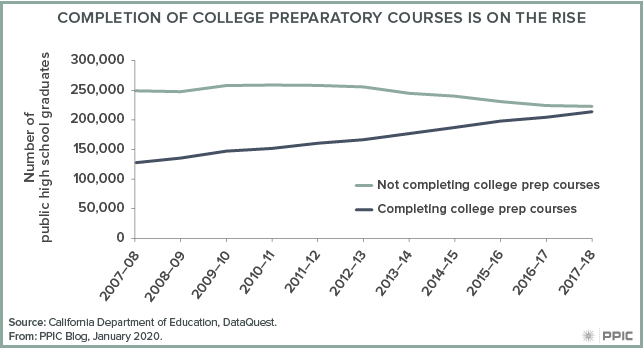
figure - Completion of College Preparatory Courses Is on the Rise

Of course, enrollment demand depends on more than just new freshmen. The number of students that transfer from the state’s community colleges also adds to enrollment growth. Over the past five years, that number has also grown (up 25% at UC and 14% at CSU).

Improvements in persistence and completion also lead to greater enrollment, as fewer students drop out. At both UC and CSU, persistence and graduation rates are increasing. For example, at CSU the share of freshmen that graduate within six years has increased from 54% (fall 2008 entering cohort) to 62% (fall 2013 entering cohort).

Accommodating this enrollment growth is good for the state. College graduates are in high demand in the state’s labor market and—on average—earn far higher wages than less educated workers. PPIC has projected that demand for highly educated workers will keep growing as the state’s economy continues to change. Finding ways for California students to attend and graduate from college improves their well-being—and that of the state.

The Democratic Presidential Primary: What Do Californians Care About?

Mark Baldassare, PPIC president and CEO, and director of the PPIC Statewide Survey, participated in a panel on election issues at the Pacific Chapter of the American Association of Public Opinion Research meeting on December 6, 2019 in San Francisco. This post is excerpted from his prepared remarks.

Californians are turning their attention to the March 3 Super Tuesday primary as they play a new role in deciding the next Democratic presidential nominee. This is unfamiliar territory for California’s Democratic primary voters, who have become accustomed to casting ballots in June after other states have already determined the winner of their party’s presidential sweepstakes.

The 2019 PPIC surveys have consistently identified three frontrunners—Joe Biden, Bernie Sanders, and Elizabeth Warren—with no clear favorite. At the same time, likely voters have signaled an openness to considering alternatives. In this context, the debates loom large, and eight in ten likely voters in the September PPIC survey say they are important (41% very, 43% somewhat) in deciding their vote.

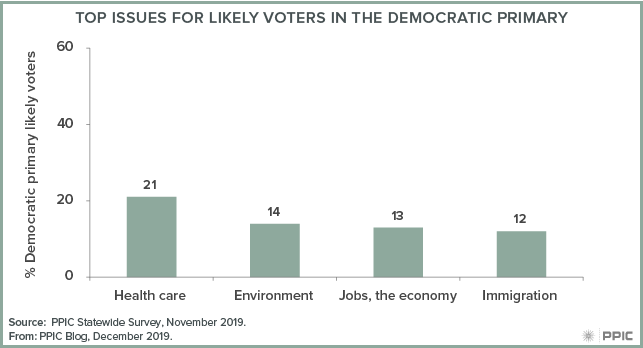
What do California’s Democratic primary likely voters most want to hear from the candidates as the stage is being set for a December 19 Democratic debate in Los Angeles? In an open-ended question in the November PPIC survey, the top four issues mentioned are health care (21%), the environment (14%), jobs and the economy (13%), and immigration (12%). Several other issues—such as education, homelessness, housing affordability, gun control, crime, and taxes—are each mentioned by less than one in ten likely voters.

figure - Top Issues for Likely Voters in the Democratic Primary

Across demographic groups, likely voters differ on the issues that matter the most. For instance, voters age 45 and older want to hear about health care more often than younger voters do (26% to 13%), while Latinos want to hear about immigration more often than whites do (24% to 5%), and whites want to hear about the environment more often than Latinos do (23% to 4%). Jobs and the economy is the only top issue generating a similar amount of interest across age, education, gender, income, race/ethnic, and regional groups.

The issues of greatest concern also vary according to candidate preference. Biden’s supporters name health care more often (25%), Warren’s supporters mention the environment more often (26%), and Sander’s supporters name immigration more often (22%). By contrast, supporters of the three leading candidates are similarly likely to mention jobs and the economy (13% Sanders, 11% Biden, 7% Warren).

One area of strong consensus? Views of President Trump. In the November PPIC survey, 91% of California Democratic primary likely voters say they disapprove of President Trump and 84% support his impeachment and removal from office.

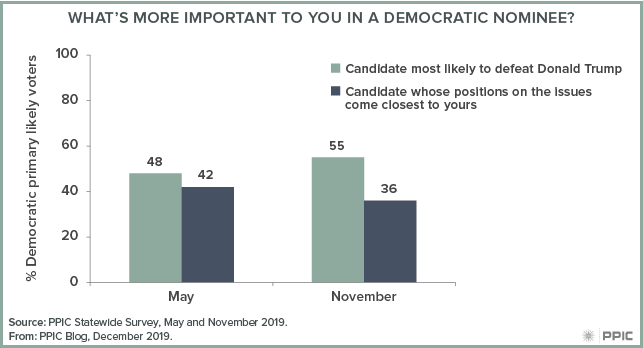
When asked what’s more important, nominating a candidate who seems most likely to defeat Trump or one whose positions on issues are closest to theirs, 55% want to defeat Trump, while 36% want alignment on positions. Since the May PPIC survey, support for impeachment (65% to 84%) and the importance of nominating an electable candidate (48% to 55%) has risen.

figure - What’s More Important to You in a Democratic Nominee?

Those who say that electability is most important, compared with those who say policy positions are most important, are more likely to mention health care (25% to 15%) and less likely to name immigration (7% to 18%) as the issue that they most want to hear about in the presidential debates. We find no differences between these two voter groups in the mention of the environment or jobs and the economy. Interestingly, education (11% to 2%) is noted more often among those who say that alignment on the issues is more important to them.

The Los Angeles debate is the next big opportunity for the presidential candidates to connect with California voters whose preferences are still being formed. Many Democratic primary likely voters already report that they are closely following the election news, but the debate could still result in an expanded electorate—and a scrambling of the race—if candidates connect with voters on issues that matter the most to them.

Throughout 2020, PPIC surveys will be monitoring what is likely to be an historic year for voter participation, as Californians engage in a consequential primary and a highly anticipated general election.

Video: Californians and Their Government

Joe Biden, Elizabeth Warren, and Bernie Sanders continue to lead the field in California’s primary race. Most Californians say President Trump should be impeached and removed from office, though views are mixed on how Democrats in Congress are handling the impeachment inquiry. In Sacramento last Wednesday, PPIC researcher Alyssa Dykman outlined these are other key findings from PPIC’s latest statewide survey, which was conducted before the November 20 debate.

Among Democrats and Democratic-leaning likely voters, support for Joe Biden (24%), Elizabeth Warren (23%), and Bernie Sanders (17%) is much higher than for Kamala Harris (8%), Pete Buttigieg (7%), and Andrew Yang (5%). No other candidate is preferred by more than 1%, while 9% say they don’t know which candidate they would choose.

Views on impeachment are divided along party lines: 83% of Democrats, 51% of independents, and 11% of Republicans think the president should be impeached and removed from office. Democrats are also much more likely than independents or Republicans to approve of the way the inquiry is being handled in Congress.

In other news, most Californians are concerned about wildfires (34% very, 29% somewhat) and power shutoffs (32% very, 27% somewhat). Governor Newsom gets mixed reviews for his handling of these issues: 46% of adults and 42% of likely voters approve, while 39% of adults and 46% of likely voters disapprove. Only about a third of Californians have either a great deal or quite a lot of confidence in their utility providers.

Other survey highlights:

  • Six in ten Californians (61% adults, 63% likely voters) say things in the US are generally going in the wrong direction, but about half think the nation will have good times financially over the next 12 months.
  • Nearly two-thirds of adults (63%) say California is divided into the “haves” and the “have nots”; 41 percent say they are haves, while 44 percent see themselves as have nots.
  • Most Californians are very concerned about homelessness in their communities; majorities across regions say the number of homeless people in their local community has increased over the past 12 months.
  • A potential citizens’ initiative that would raise state income taxes on the wealthiest Californians to fund K–12 public schools has majority support. Fewer than half of likely voters favor two other measures—a school construction bond and a “split roll” property tax—that would benefit the K–12 system.

College Applications Are Up and Admission Rates Are Down

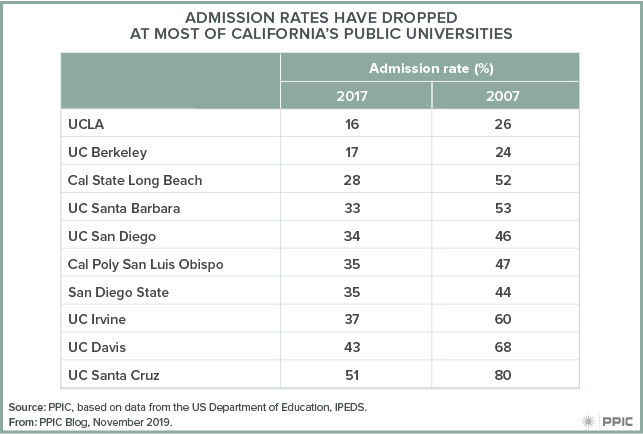
Across California, thousands of high school seniors are in the process of completing college applications. If recent trends continue, the number of applications this year should be staggering. Keeping up with demand has been a challenge; most colleges have reduced their admission rates in the face of large increases in student interest.

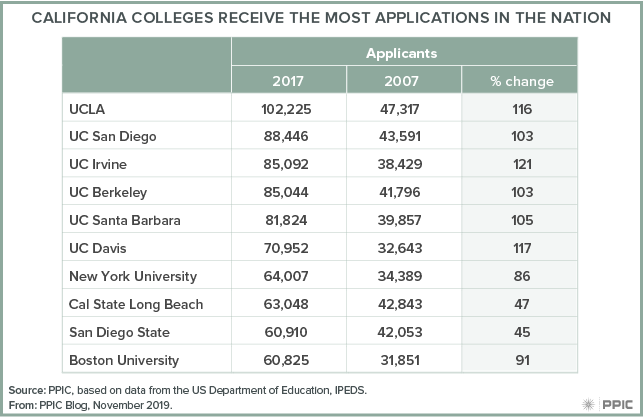
California colleges and universities garner the most applications in the nation. Of the top 10 most popular schools in the country, eight are in California (six UC campuses and two CSU campuses). UCLA has led the nation in applications every year for at least the past 17 years. In 2017, it became the first college in the country to receive more than 100,000 freshmen applications.

table - California Colleges Receive the Most Applications in the Nation

The popularity of UC campuses has surged over the past 10 years, with UC Irvine moving to 3rd in the nation in 2017, up from 7th in 2007. UC Davis moved to 6th from 11th, and UC Santa Cruz jumped to 15th from 32nd.

In the CSU system, Cal Poly San Luis Obispo has moved to 18th from 23rd. And even though other CSU campuses fell in the rankings, they still experienced large increases in applications.

Of course it makes sense that California colleges would lead the nation: the state has more high school graduates than any other and offers a robust system of public universities. And students are applying to more colleges than they did in the past, which contributes to the growth in applications.

But much of the increase is attributable to improvements in college preparation. Between 2007 and 2017, the number of California high school graduates completing the courses required for UC and CSU eligibility increased by almost 60%. In 2007, only about one third of high school graduates completed the required college preparatory courses, but by 2017 almost half had done so, a remarkable improvement in a relatively short time.

Unfortunately, California’s public universities have not been able to accommodate all qualified applicants. In fact, they lead the nation in turning applicants away.

table - Admission Rates Have Dropped at Most of California’s Public Universities

Each of the UC campuses except Merced are unable to admit all of the eligible students who apply. Seven CSU campuses (including Long Beach, San Diego, and San Luis Obispo) are impacted for all undergraduate programs, meaning they cannot admit all qualified applicants; all but one of the other campuses are impacted in certain majors. Both UC and CSU refer qualified applicants to campuses that have more room, but more needs to be done to expand capacity at campuses with high demand.

Proposition 187 and a Changing California

Twenty-five years ago, in the midst of the worst economic crisis since the Great Depression, 59% of Californians voted to pass Proposition 187. The landmark ballot measure sought to set up a state-run immigration system and deny most public benefits—including K–12 education—to undocumented immigrants. The measure was later found to be unconstitutional, but its impact was pivotal in transforming California into what it is today.

Most Californians now support policies to protect undocumented immigrants. A recent PPIC survey found 61% of Californians and 54% of likely voters are in favor of state and local governments making their own policies and taking actions, separate from the federal government, to protect the legal rights of undocumented immigrants. In addition, our April survey found 57% of Californians (54% likely voters) support public school districts designating themselves “sanctuary safe zones” to indicate they will protect undocumented students and their families from federal immigration enforcement efforts.

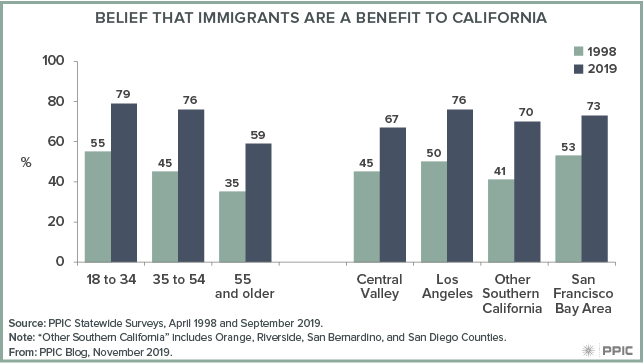
Californians’ overall views toward immigrants have also shifted. The PPIC Statewide Survey has monitored this issue since 1998. In April 1998, Californians were divided: 46% viewed immigrants as a benefit to California because of their hard work and job skills, while 42% viewed immigrants as a burden because they use public services. Since then, the share of Californians viewing immigrants positively has increased 25 points (71% benefit, 22% burden).

Across age groups and regions, the perception that immigrants are a benefit has risen by more than 20 points. Positive perceptions are also up across racial/ethnic groups, by 27 points among African Americans, 20 points among Latinos, 18 points among whites, and 12 points among Asian Americans. The share of Democrats viewing immigrants positively has increased 37 points, while the share of Republicans holding this view has decreased 2 points.

figure - Belief that Immigrants Are a Benefit to California

In recent years, Californians have supported policies to improve the lives of immigrants, such as providing health care for young undocumented Californians, taking state and local actions to protect immigrants, and supporting a pathway to citizenship. What role will immigration play in the upcoming election? Stay tuned to the PPIC Statewide Survey as we continue to examine Californians’ view of immigrants.

Do Californians Support the Proposed School Bond?

When Californians go to the polls in March, they will not only cast a vote in the presidential primary—they will also vote on an education bond to fund construction and modernization projects. Given differences in support for the bond across the state’s regions and demographic groups, turnout will play a pivotal role in whether this measure passes.

In the closing days of the legislative session, the legislature passed and the governor later signed a bill placing Proposition 13 (the Public Preschool, K–12, and College Health and Safety Bond Act of 2020) on the March ballot. If approved by voters, the measure would authorize $15 billion in general obligation bonds to pay for the construction and modernization of California’s public schools, community colleges, and four-year colleges.

The September PPIC Statewide Survey took an initial look at support for this proposition. While two-thirds of Californians (66%) are in favor, 54% of likely voters say they would vote yes—just slightly above the majority needed to pass.

Are some Californians more likely than others to support the bond measure? Unsurprisingly, there is a wide partisan divide, with three in four Democratic likely voters (76%) saying they would vote yes compared to just three in ten Republicans (29%). Overall, independent likely voters are divided (48% yes, 44% no). But among Democratic-leaning independents, nearly two in three (64%) are supportive.

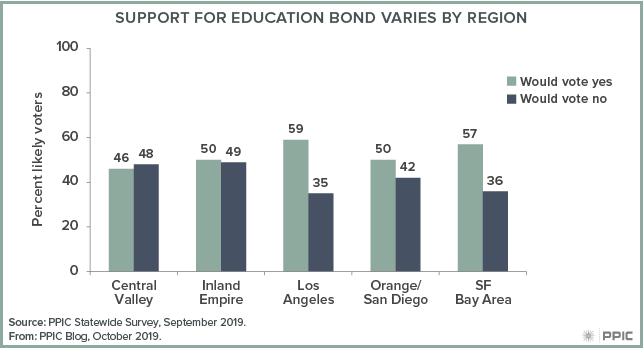
Support varies across regions, with Los Angeles (59%) and San Francisco Bay Area (57%) likely voters expressing the most support, compared to about half of likely voters elsewhere in the state.

figure - Support for Education Bond Varies by Region

While support is similar among likely voters with (55%) and without (53%) children in the house, there are differences across other demographic groups.

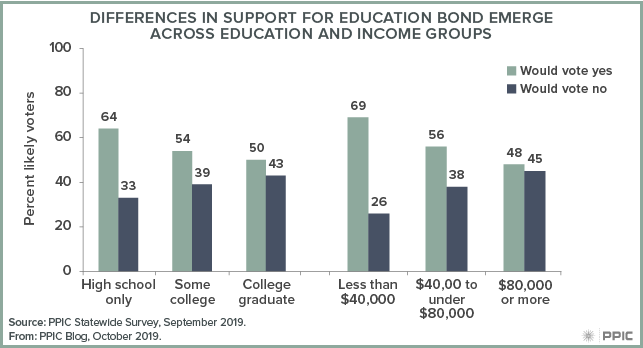
White likely voters (47%) are much less likely than Latinos (74%) and those of other racial/ethnic groups (62%) to say they would vote yes. And since school construction bonds are often paid off by property taxes, it’s notable that homeowners (44%) are far less likely than renters (71%) to say they would vote yes. Support is higher among younger likely voters (66% age 18 to 44, 48% age 45 and older). It declines as education and income levels increase.

figure - Difference in Support for Education Bond Emerge Across Education and Income Gaps

Overall, support for the education bond currently hovers at around half for likely voters, but there is much stronger support among many regional and demographic groups—suggesting that passage could depend on who shows up to vote. If Democrats and Democratic-leaning independents turn out in large numbers for the presidential primary, that could affect the fate of this bond. Stay tuned to the PPIC Statewide Survey as we continue to track this measure in advance of the March primary.

Video: Improving Educational Opportunity in California

What is the one thing that could be done to improve educational opportunity in California? Mark Baldassare, PPIC’s president and CEO, posed this question at the start of his conversation with Linda Darling-Hammond, president of the California State Board of Education, and Eloy Ortiz Oakley, chancellor of the California Community Colleges.

Darling-Hammond responded with a list of five major characteristics of school systems in other countries and states that have closed “opportunity gaps”: an equitable, adequate funding system; high-quality teachers and leaders; a thoughtful curriculum and assessment system; wrap-around support for students; and schools designed to allow for productive learning.

Then she circled back to California’s “number one thing”: “We’ve got to fix the teacher shortage—and we’ve got to do it quickly, purposefully, and soon.”

For Oakley, the “one thing” is to change “how we look at education, how we look at opportunity in California.” In short, we need to stop providing “the least amount of resources to the students, the communities that need them the most.”

A key part of this change involves “blurring the line” between the K–12 (or “TK–12”) and community college systems. Oakley noted: “There was a point in time when we felt that a high school diploma was the default to get into the workforce. Those days are gone. . . .We need to see the path to community college as the required path for everybody to get some sort of post-secondary credential.”

Darling-Hammond agreed that the two systems can and should work together. A good example of productive collaboration, she added, is concurrent enrollment, which allows high school students to take college courses (and earn college credit). These programs help students “find their passion” and move toward meaningful careers.

Funding is another key issue for both systems. Darling-Hammond pointed to the impact of significant post-recession increases in funding during the Brown and Newsom administrations and the potential impact of the governor’s commitment to early childhood education. But, she added, “just to get to the national average . . . we need about $12 billion more in the TK–12 system.”

Oakley agreed that “for those of us who managed our way through the recession, we’re certainly in a much better place.” The community college system could certainly benefit from more funding, he added, but state investments in early childhood education might be even more beneficial: “If we could prioritize the funding at the lowest level, for the youngest learners, that would make our job in the community colleges easier.”


Video: Californians and Their Government

As California’s 2020 Democratic presidential primary draws closer, Elizabeth Warren, Joe Biden, and Bernie Sanders lead the rest of the field by a wide margin. However, many voters say they would consider supporting a candidate other than their current choice. These and other key findings from PPIC’s latest statewide survey were outlined by Rachel Lawler in Sacramento last Thursday.

Likely voters identifying as registered Democrats or as Democratic-leaning independents support Elizabeth Warren (23%), Joe Biden (22%), and Bernie Sanders (21%) at levels well above Kamala Harris (8%) and Pete Buttigieg (6%). No other candidate is preferred by more than 3 percent, and 9 percent say they don’t know which candidate they prefer. More than half of voters who expressed a preference would consider supporting another candidate.

The survey asked about a $15 billion bond for school and college construction that has been approved by the legislature for the March 2020 ballot. It has the support of two in three adults—but only 54 percent of likely voters. This narrow margin of support coincides with concern about the state’s economic outlook. Fewer than half (41% adults, 37% likely voters) expect good times financially in California during the next 12 months.

A potential November 2020 ballot measure that would amend Proposition 13 to tax commercial properties at their current market rate and direct some of the new revenue to K–12 public schools is favored by 57 percent of adults. However, fewer than half (47%) of likely voters favor the measure, and this share is down somewhat from April 2019 (54%). A potential state bond measure to fund water infrastructure is favored by 68 percent of adults and 57 percent of likely voters.

Other survey highlights:

  • Californians are most likely to name homelessness (15% adults, 16% likely voters) and jobs and the economy (15% adults, 13% likely voters) as the top issue facing the state. Other issues named include housing costs, immigration, and the environment.
  • Most Californians view immigrants as a benefit to the state, and half are at least somewhat worried about someone they know being deported as a result of increased federal immigration enforcement.
  • Two in three Californians think the Supreme Court should not overturn Roe v. Wade; more than half think some states are making it too difficult to get an abortion.
  • Half of Californians say they have a disaster plan and six in ten have a disaster supplies kit. Six in ten are very (28%) or somewhat (32%) worried about personal injury, property damage, or a major disruption of their routine as the result of a disaster.


Should Applying for College Financial Aid Be a High School Requirement?

A majority (58%) of Californians consider affordability at the state’s public colleges and universities a big problem, according to a 2018 PPIC Statewide Survey. Requiring all high school students to apply for financial aid could help more students pay for college.

Currently, around 60% of high school students in California complete the federal application for financial aid (FAFSA)—a student’s gateway to receiving federal grants and loans, as well as state aid. The remainder of students are unlikely to receive aid, even though there’s evidence that many of them would probably have qualified.

Requiring students to apply for aid may result in greater numbers of high school graduates enrolling in college, which could increase California’s college-going rate of 64% (2017–18). Earlier this year, a bill was introduced in the California Legislature that would require students to complete a financial aid application before graduating from high school.

Louisiana was the first state to have such a requirement, starting in 2017–18. The state saw FAFSA completion rates increase from 48% to 84% between 2015 and 2018, and college-going numbers increased by 12.6% (from 22,200 to 25,000) in the same time frame. Texas and Illinois are following suit, with the requirement taking effect in those states in fall 2019 and fall 2020, respectively.

California needs more college graduates to meet the increasing demand for highly skilled workers—and the proposed bill could make a difference if it increases access to college, especially for lower-income students. In addition, better financial support during college can reduce students’ debt load and might help more students complete their programs. Improved access to college and higher graduation rates would set more students up for success in the workforce and benefit the state’s economy.

Californians Favor Funds for School Construction

With little time to spare, the legislature last week passed a $15 billion school construction bond. A signature from Governor Newsom will place the bond measure—called the Public Preschool, K–12, and College Health and Safety Bond Act of 2020—on the March 2020 primary ballot. Given Californians’ general support for funding education, how do they feel about bond measures for school construction projects?

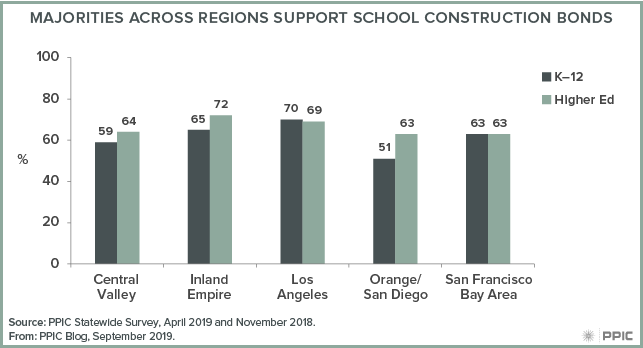
It’s important to note that the PPIC Statewide Survey has not yet asked Californians about this particular measure, which would provide funding across K–12 and higher education systems. However, we have consistently found that Californians are supportive of bonds for each system individually. (We did not ask about specific dollar amounts.)

In our April survey, about six in ten adults (62%) and likely voters (57%) said they would vote yes on a bond for K–12 school construction projects, while in November 2018 two in three adults (66%) and about six in ten likely voters (57%) supported a bond to pay for construction projects in California’s public higher education system. In both surveys, there was majority support across regions and demographic groups—except among whites (47%) for the K–12 bond. For both types of bonds, support was lower among whites than other racial/ethnic groups, and support decreased as age and income levels rose.

figure - Majorities across Regions Support School Construction Bonds

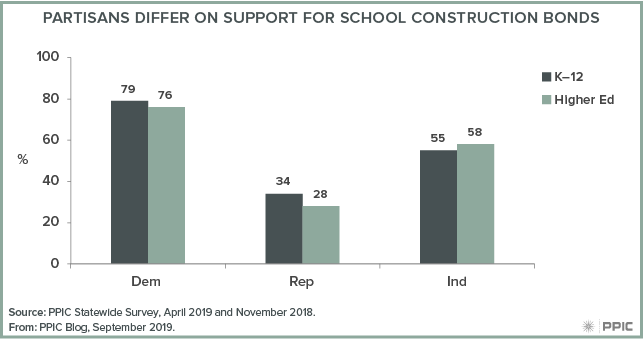
Despite this widespread support for these bonds, we found a significant partisan divide. For both bond questions an overwhelming majority of Democrats as well as smaller majorities of independents have been in favor; far fewer Republicans have been.

figure - Partisans Differ on Support for School Construction Bonds

With California set to play a prominent role in the March Democratic presidential primary—potentially drawing large numbers of Democratic voters—this partisan divide could play a role in passing the bond.

We still don’t know how Californians will perceive this particular bond—in terms of the dollar amount or the joint funding of K–12 and higher education. Stay tuned for more from the PPIC Statewide Survey as we will track support for this bond, as well as many other important 2020 election issues.