Survey Focuses on Historic Changes in California Schools

PPIC’s 10th annual survey on K–12 education focused on two historic changes in California schools: the transition to the Common Core math and English standards and the Local Control Funding Formula.

Sonja Petek, project manager for the survey, talked about the key findings last week at a lunchtime briefing at the Cathedral of the Blessed Sacrament in Sacramento.

As our recent report, Implementing the Common Core State Standards in California shows, Common Core is off to a challenging start so far in the state. However, the PPIC survey found that most Californians and public school parents support the standards—which have sparked controversy in other states. But most are also concerned that teachers are unprepared to implement the new standards.

While most Californians had heard at least a little about the Common Core standards, awareness of the new funding formula was much lower. After they were read a description, most Californians said they supported the Local Control Funding Formula, which gives school districts increased flexibility over spending and provides extra money for disadvantaged students.

The survey also asked whether the state should fund voluntary preschool for all 4-year-olds (73% said yes) and whether likely voters would support a local bond measure to benefit school construction bonds (55% would) or a local school parcel tax for schools (48% would).

Education Experts Focus on Common Core

The Common Core Standards are fundamentally altering the way students learn and have generated broad debate nationally. Their implementation in California was the focus of a panel discussion in Sacramento yesterday. PPIC sponsored the event in conjunction with the release of two reports, Implementing the Common Core State Standards in California and California’s Transition to the Common Core State Standards: The State’s Role in Local Capacity Building.

The reports show that California’s shift to the Common Core—which emphasizes conceptual understanding and problem solving—is off to a slow start. They also note that California has treated the transition as a district-level issue, with the state Department of Education reviewing instructional materials and providing a professional library of resources that can be downloaded by teachers. Speakers at yesterday’s event saw both points as positive.

Patricia Rucker, a member of the state Department of Education, said taking a thoughtful approach was more important than being out in front. California can learn from states like New York and, ultimately, lead by incorporating the lessons from others, she said. She also noted that California’s careful approach has helped avoid the backlash over the new standards that other states are experiencing.

David Gordon, superintendent of the Sacramento Office of Education, said the state’s decentralized approach to implementation offers opportunities. “A lot of our districts have great talent,” he said. “A lot of the counties have great talent. A lot of the private vendor providers have great talent. I think we need to use all of that to advantage.”

Patrick Murphy, PPIC’s research director and a co-author of the reports, said California has an opportunity to be “strategic late adopters.” Echoing a theme of the reports, he said the state is uniquely situated to take a different role in education. It could, for example, set up a site—similar to Yelp—to encourage educators on the ground to exchange information about teaching the Common Core.

The speakers noted two important lessons learned so far:

  • The experience of other states shows that California’s future test scores will drop—a development that educators and parents need to be prepared for.
  • The requirement to administer tests electronically has highlighted the need for updated technology in the state’s public schools and has sparked action to do so.

Moving English Learners to English Fluency

English learners (ELs) who have been reclassified as fluent English speakers perform very well, sometimes even surpassing the achievements of native English speakers. Moving ELs to English fluency is a high priority for educators and policymakers. As we describe in a commentary for EdSource, school districts across the state have different standards for reclassifying these students. This means that students with the same skills may be reclassified as fluent in one district, but not in another.

PPIC surveyed school districts about their reclassification policies and found that almost all districts use at least one reclassification criterion that is more rigorous than the State Board of Education’s guidelines. We also found that districts using more rigorous reclassification policies generally had lower reclassification rates. In many cases, setting the bar higher is linked to improved student outcomes for reclassified English learners, such as higher test scores. But these outcomes are not improved by much, and in some cases, outcomes are worse.

We concluded that the benefits to reclassified students of being held to higher standards are minimal—especially in light of the high performance of reclassified students in districts using the state guidelines.

Further, standardizing district reclassification policies into one uniform policy—for now, using the State Board of Education guidelines—would ease another concern: that districts have a fiscal incentive to set standards that maintain the supplemental funding they get for each EL student. Most important, standardizing reclassification policies would speed the transition of highly able English learners.

Changes to California’s school finance, testing, and accountability systems all have the potential to change outcomes for ELs over the coming months and years. New research on setting the state’s reclassification standards should wait until the new assessments aligned to the Common Core State Standards are fully implemented.

No-Stakes Testing

Beginning March 18, California’s schools will pilot a new type of standardized test for students in grades three through eight and grade eleven. (A small sample of students in grades nine and ten will also take some tests.) These tests represent a significant departure from the standardized exams that were administered in school classrooms in the past.

First, the examinations are aligned with the new Common Core State Standards; they will attempt to assess conceptual understanding and problem solving skills in mathematics and English. Second, they will be given on computers, replacing the infamous #2 pencil and bubble sheets. Third, and perhaps most important, this spring’s exercise is really a “testing of the test” that will have no consequences for students, teachers, or schools. In fact, the U.S. Department of Education removed the most significant consequence last week when it issued a letter stating that the pilot testing would satisfy the federal requirement that California test its students as part of the No Child Left Behind law.

California is a member of the Smarter Balanced Assessment Consortium (SBAC), one of two multi-state consortia to get federal funding to develop assessments aligned with the Common Core standards. Since 2011, SBAC has been working with teachers, college professors, testing experts, administrators, and technicians to develop a new generation of tests. Though there will be some multiple-choice elements, these new exams will feature open-ended questions as well as tasks for students to perform that involve showing their work. (Some of the open-ended and task-oriented questions will have to be hand-scored by professional readers.)

In theory, the SBAC tests represent a big jump forward in trying to measure learning. This pilot exercise will put that theory to the test, as students try out the questions and the technology used to deliver the tests.

This past summer, the state legislature made some important decisions regarding the transition to the new testing regime (AB 484) that we will now watch play out. One of the biggest was that the pilot tests would replace the old Standardized Testing and Reporting (STAR) assessments, saving time for teachers and money for the state.

Because the legislators decided that there would be “no consequences” to this pilot, no letters will appear in the mailboxes of parents over the summer with colored bar charts declaring whether or not their children are “proficient.” The results will not be used to develop accountability scores for schools; nor will they be associated with individual teachers. The purpose of this year’s testing is really to determine whether the tests are doing what they were designed to do: assess student learning.

The demise of the STAR tests will probably warm the hearts of more than a few students. There is a downside to this transition, however. First, it is likely that the results will be publicly reported in the broadest terms, which will limit the chances of anyone other than SBAC to learn from the exercise. Second, given that 2014–15 will be the first full year of SBAC testing, we will have to wait at least until the 2015–16 school year to begin measuring our progress.

Ready for College?

California needs more college graduates than it is currently producing. Part of the problem has been a lack of college readiness among the state’s high school graduates. Fortunately, recent trends in college preparation provide some good news. By several measures, a large and growing share of the state’s high school graduates are ready for college-level work. Indeed, many of them have successfully completed college-level courses even while still enrolled in high school.

New data on Advanced Placement (AP) exams are especially encouraging. AP courses are college-level courses in more than 30 subjects offered in high schools throughout the country. AP exams determine whether a student has attained college-level proficiency in the course, and AP exam passage rates are a meaningful measure of college preparation. Many colleges accept AP exams for college credit, and research shows that AP students outperform other students in college. Indeed, students who earn AP credits graduate at higher rates overall and often perform better in subsequent courses in the same field.

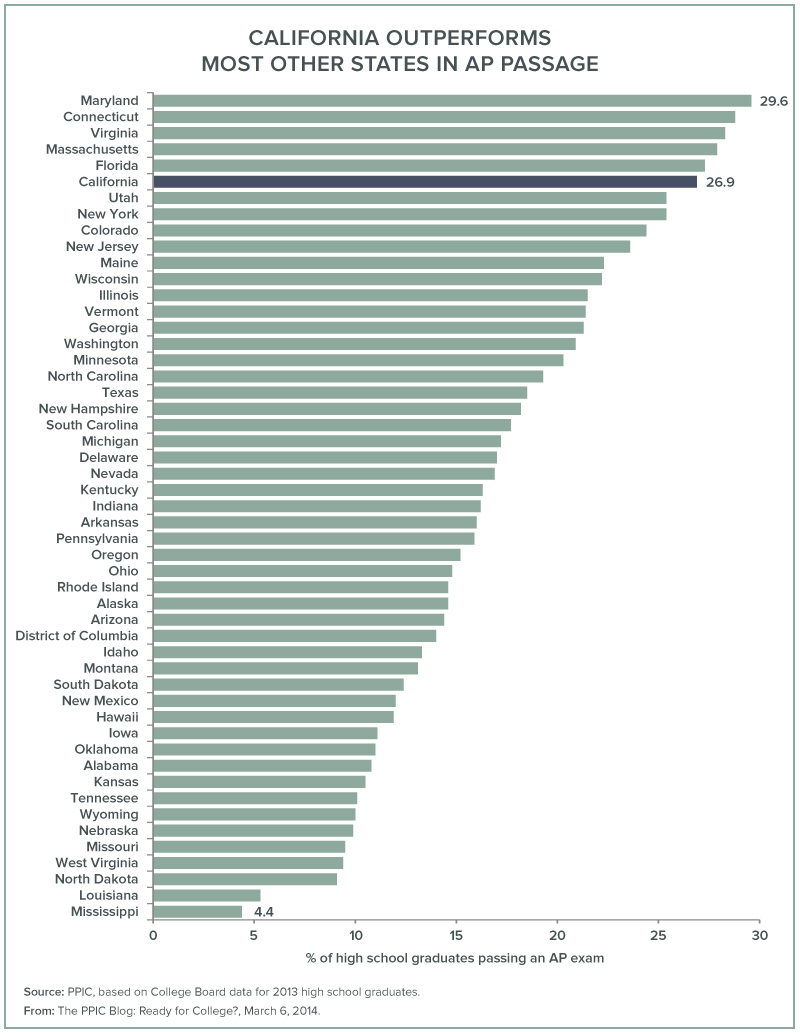
California’s high school graduates outperform their peers in the rest of the country on AP exams. In 2013, more than one in four California high school graduates (26.9%) passed at least one AP exam sometime during high school, compared to one in five in the nation as a whole. Among the 50 states and the District of Columbia, California high school graduates ranked sixth highest. Moreover, the share of graduates successfully completing an AP exam is going up fast in California—higher than in the rest of the nation. Between 2003 and 2013, the share of high school graduates passing at least one AP exam increased 9.6 percentage points in California, compared to 7.9 percentage points for the entire nation. California has a higher share of graduates taking AP exams than does the nation as a whole (45.6% versus 35.0%), with passage rates among AP exam takers slightly higher in California (59.0% versus 57.4%).
Other measures of college readiness also show progress. More students are taking the college preparatory courses (known as the “a–g” courses) required for admission to the University of California (UC) and the California State University (CSU). The latest data from the California Department of Education show that 38.3 percent of public high school graduates in California took the a–g courses in 2011–12, up from 34.6 percent in 2001–02 and from 32.3 percent in 1993–94. Gains in college prep work have been especially impressive among the state’s Latino high school graduates, who now make up almost half of all high school graduates. Among Latino graduates, the share taking a–g courses increased from 21.8 percent in 2001–02 to 28.0 percent in 2011–12. Increases in college readiness would be even better news if our state was responding with policies to meet the growing demand for college. But it’s not. Only the top eighth of high school graduates are eligible for UC and only the top third are eligible for CSU—according to eligibility thresholds that were set more than 50 years ago. Given the increasing shares of high school students who are well prepared for college, some reconsideration of those thresholds is long overdue.

If California is to meet the demand for educated workers, it needs to produce more college graduates. Making room for these highly capable students—by increasing the share of high school graduates eligible for the University of California and the California State University systems—would improve the well-being of our state and the lives of these young Californians.

Chart sources: PPIC calculations based on College Board data.