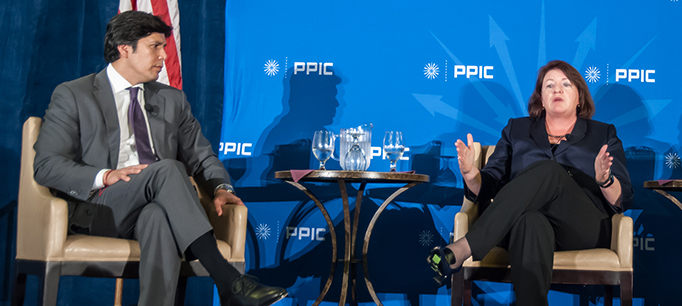
California–State of Change

As leaders from government, business, and philanthropy gathered last week to discuss California’s future, we were reminded once again that these are exciting times in our state. The discussions were part of PPIC’s full-day conference, California—State of Change, and they highlighted both the advantages our state enjoys and the major challenges ahead.

Speakers noted that the recovering state economy, newly elected state leaders, a richly diverse population, and a history of innovation provide much to build on—as well as a lot of building to do. For example, California has recently enacted sweeping changes in corrections and education finance. But, as the governor’s chief aide, Nancy McFadden, emphasized in her keynote address, most of the hard work of implementing these policies lies ahead.

Among other challenges noted in the subsequent panel discussions: a state tax structure that leads to extreme revenue volatility, a need for public employee pension reform, an uneven economic recovery that has left many Californians behind, government institutions that do not provide the tools for managing in the 21st century, and an electorate that is disengaged from the political process.

But, as other speakers reminded us, Californians are living in a time of reform. A change in term limits may lead to more stability in the legislature and result in more long-term policymaking. Recent initiatives to shift many school decisions from the state to the district level and to move state corrections responsibilities to the counties could make local governments labs for innovation—but only if we have the will and the data to evaluate the results.

Our final panel demonstrated that California still knows how to dream big. The discussion focused on three projects: a historic effort to combat climate change, the construction of high-speed rail, and the advancement of stem cell research. All have been controversial, but they show that California voters and elected officials embrace innovation, as they have throughout the state’s history. 

We invite you to watch the videos of each session. We hope you find the conversations as thought-provoking as we did.

California’s Future Challenges and Opportunities

PPIC hosted a day-long series of conversations this week about creating a better future for our state and highlighting the choices we need to make today to do so. After a keynote address by Nancy McFadden from the governor’s office, panelists from government, business, and philanthropy discussed California’s challenges and opportunities before a large audience in Sacramento and online. They tackled difficult topics, such as improving economic opportunity and increasing citizen engagement in government. And they discussed ways the state can build on its strengths—an improving economy, a diverse population, and a history of reform and innovation.

We will post videos of all of the sessions soon. In the meantime, we want to share the opening remarks prepared by PPIC researchers. They set the context each session:

We hope their insights will pique your interest and inspire you to watch the conference videos when they become available.

The Road Ahead for Superintendent Torlakson

In what was thought to be one of the most closely contested statewide races, incumbent Tom Torlakson defeated challenger Marshall Tuck to retain the job of state schools chief. In the post mortems, much will be made of the money that was spent on perhaps the most expensive race in this cycle. The conversation, undoubtedly, will focus in part on the significance that national groups attached to this race, which pitted the powerful teachers’ union against the “reformers.” Though there is some value to attempting to unpack the past, it is more important to look forward to the impact Torlakson could have on education in California in his second term.

Leading up to election day, commentators routinely described the state superintendent position as “powerless” or even “obscure.” And it is true that when it comes to making policy the state education chief plays a limited role. A great deal of policy has already been made, and what lies ahead is the difficult job of implementation. The superintendent could play a major part in deciding how these policies roll out. The California Department of Education (CDE) that Torlakson heads has more than 1,500 employees and a budget of $250 million dollars. How he chooses to allocate those resources could make a real contribution to supporting schools and districts as they grapple with major changes.

California has made more significant changes to K–12 education policy in the past four years than it made in the previous two decades:

  • In 2010, the state adopted the Common Core State Standards, a decision that affects nearly every element of what happens in the classroom.
  • In 2013, California scrapped its old system of distributing funds to schools and opted for a formula that directs additional dollars to districts with higher numbers of needy students. One consequence of this change was to put much more power in the hands of local decisionmakers.
  • Accompanying the new funding strategy is a new approach to holding districts accountable for the performance of their schools.
  • And if that isn’t enough, California has begun a new statewide testing regime that has, as yet, only been piloted. The first real round of tests will begin this spring, with results due out in the summer.

As my colleague Paul Warren and I recently observed, CDE has played a minimal role in guiding implementation of the new standards but there are several things it could do to ease the transition. There are also challenges ahead for the state when it comes to the new accountability requirements. Because the new rules were written broadly, they have probably raised more questions than they answered about what accountability looks like going forward. Finally, somebody needs to help students and parents prepare for the new test results. On average, scores are likely to be lower. That doesn’t mean that California’s children somehow became less smart over the past two years; it means that the tests are harder. This is an important distinction that will need to be communicated.

Policy implementation isn’t sexy. It is hard, roll up-your-sleeves work. If the superintendent embraces his role, he could have an impact on California education that goes far beyond symbolism.

PPIC’s Role in a Changing State

California is changing quickly and in ways that touch the lives of all of its residents. The state has enrolled millions of people in health insurance under the federal Affordable Care Act. It is moving ahead to expand the cap-and-trade program that is a cornerstone of AB 32, the landmark law mandating a reduction in greenhouse gas emissions.

In K–12 education, California is implementing two sweeping policy changes at the same time. New English and math standards, called the Common Core, require big changes in what is taught in the classroom. A new school funding formula, the Local Control Funding Formula, gives districts increased flexibility over spending and provides extra money for disadvantaged students.

Historic changes are playing out in the corrections system as well. Realignment, which shifted responsibilities for many offenders from the state to the local level, has had a significant impact on the state, counties, and communities.

Amid these policy shifts, California is coping with a major drought that has focused attention on the state’s need to improve its water management.

These changes are also taking place in an election year—and California’s elections have also undergone major changes. This is the first election in which state constitutional officers, such as governor and controller, will be elected under the top-two primary system.

At PPIC we are focused on monitoring and analyzing the impact of these changes—both short and long term—and examining other steps the state can take to meet its critical challenges. In recent months, we have delivered objective, nonpartisan research on all of these topics. We plan to release many more publications in the months ahead. Our PPIC Statewide Survey will continue to give California residents a voice in the policy changes that affect them, as it has since 1998. The PPIC blog provides regular updates on the impact of the drought, as well as news and analysis on a range of policy topics from our experts.

Through our extensive outreach, we have hosted discussions on these important topics and more. We invited California’s two top legislative leaders to share their priorities for the upcoming session. At another recent event, the two secretary of state candidates talked about how they would improve elections and increase voter participation, if elected. Both of these events were webcast live to engage Californians from all over the state.

We encourage you to sign up for our announcements to learn about future events. We hope you’ll stay up to date with our publications and videos by signing up for our monthly e-bulletin, following us on social media, and subscribing to the PPIC blog.

As always, we welcome your comments and suggestions.

California’s New Leaders Focus on Poverty

Assembly Speaker Toni Atkins and Senator Kevin de León, who will take over as senate president pro tem later this month, each told a Sacramento audience about growing up in poverty and the role it has played in their shared view of the state’s responsibility to those in need.

“We share similar values and similar stories that have made us care about the values and the issues that we’re talking about today,” said Atkins, who was raised in a poor, rural Virginia family and now represents the San Diego area. De León, who was born in San Diego and represents Los Angeles, said he is the youngest child of a single immigrant mother and the only family member to graduate from high school. Atkins and de León, both Democrats, were elected by their respective legislative chambers earlier this year to serve as leaders.

Both lawmakers cited a recent PPIC report — Child Poverty and the Social Safety Net in California by Caroline Danielson and Sarah Bohn — that said about 50% of California children live in poverty or near-poverty. The remarks, part of the PPIC 2014 Speaker Series, were made to a capacity audience of about 400 in the ballroom of the Sheraton Grand Hotel. The discussion was moderated by PPIC President Mark Baldassare and streamed live to hundreds more.

The wide-ranging conversation touched on a number of major issues—including health care, the drought, immigration, and taxes. Both leaders said that they believe the state should talk about changes to the state tax structure and consider whether to extend the temporary taxes that voters passed in Proposition 30. Atkins cautioned that it will be difficult to gain support from voters for an extension of the taxes.

De León expressed strong support for affirmative action, which he credited for his ability to attend college and become a legislator. He also said California should continue to lead on immigration issues because the federal government has been unable to pass a reform plan. And he noted that polls suggest Californians support health coverage for undocumented residents.

Atkins, meanwhile, encouraged more cities to follow San Francisco and San Jose, which recently increased the minimum wage. Both leaders also said they have worked together in the past and believe they will have a good working relationship going forward.

The High School Exit Exam: What’s Next?

The California High School Exit Examination (CAHSEE) is likely to be a topic of discussion in the next legislative session. Enacted in 1999, the CAHSEE involves tests in English and mathematics that high school students must pass in order to graduate. Testing started in 2001, but the graduation requirement was held up for several years by legal challenges that resulted in an exemption for special education students.

The immediate issue for the legislature has to do with the adoption of the Common Core State Standards, which take effect this school year. The state overhauled its testing program in 2013, eliminating most testing in high school except grade 11 English and math tests in that are aligned to the new standards. Because CAHSEE is based on the previous standards, the question is whether to update it so that it aligns better with Common Core, find an alternative measure, or eliminate the requirement altogether. For now, passing the CAHSEE continues to be a requirement for graduation.

The question of the CAHSEE’s impact on students and schools is also an important discussion item. The proportion of 10th graders who pass the test has increased significantly, suggesting that students are better prepared in math and English. The chart below shows that 10th grade pass rates on the math test by students in the four largest racial/ethnic groups has increased each year since 2004. Gains made by Latino and black students are especially significant—their passage rates have increased 18 percent and 20 percent, respectively.

Despite these gains, recent research suggests that exit examinations do little to boost student achievement but create costs in the form of lower graduation rates. In total, 95.5 percent of 12th graders in California passed both the English and math sections of the test, meaning that 4.5 percent of students did not graduate on time at least in part because they did not pass the test. This has a bigger impact on black and Latino students, whose 12th grade pass rates remain about 5 percent below those of white and Asian students. Moreover, because these rates do not include students who dropped out of school, they may understate the impact of the CAHSEE requirement on lower-performing students.

In a 2013 report, state education superintendent Tom Torlakson recommended a number of alternatives to the CAHSEE, including successful completion of specific high school courses, new tests that would be given at the conclusion of specific English and math courses, or the new Common Core tests given in 11th grade. Any discussion of updating the requirement would raise the question of the skills students should be expected to demonstrate. The current exam tests students at an 8th or 9th grade level; making the test more difficult would put more students at risk of finishing high school without a diploma. Thus, instead of focusing on aligning the exit exam to the new standards, the legislative discussion may revolve around the benefits and costs of minimum graduation standards to schools, students, and society.

Governor Proposes Minor Changes to K-12 Funding Levels

The governor released the May revision of his 2014-15 budget yesterday. All told, the news was good. Revenues were modestly better than forecast in January—up about $850 million in the coming fiscal year. But due to the complexities of Proposition 98—the constitutional funding guarantee for schools and community colleges—the amount proposed for K-12 education fell slightly.

The governor’s plan for schools is mostly unchanged, however. The chart below illustrates per-pupil funding levels proposed in the May revision. Schools would receive about $8,800 for each student—an increase of $780 from 2013–14. The current estimate of per-pupil funding in 2013-14 is up slightly from the level estimated in January, providing a healthy $430 per student more than in 2012–13.

Most of the new funding in 2014–15 goes to pay for the new Local Control Funding Formula. As in the January budget proposal, the budget includes $4.5 billion, or about $750 per student, for the new funding formula. The three-part formula distributes funding using a base grant (that differs by grade span), a supplemental grant for disadvantaged students (low-income, English Learner, and foster care students), and a concentration grant for districts that serve above-average proportions of disadvantaged students.


The budget also provides $27 million to help districts administer new state tests. With the transition to the Common Core State Standards, new computer-based assessments are currently being field tested in California. Students take the new tests on computers linked to the internet, and the additional funding would help schools develop higher speed internet connections.

One final note: Governor Brown proposes to establish a Proposition 98 reserve in the future to protect against volatility in General Fund revenues. His proposed constitutional amendment creates a rainy day fund that would help buffer schools from the extreme boom and bust cycle of state revenues.

In addition, the governor appears to have established an approach to K-12 budgeting that helps protect state and school district finances from uncertainties in the estimating process. Because revenues—and school funding levels—are estimated a year in advance, the amount of resources available to schools changes throughout the year as the revenue picture becomes clear. To reduce risks to state and district budgets, the administration: ·

  • Makes relatively conservative revenue forecasts. Moderating the administration’s revenue estimates helps prevent the state from spending more than Proposition 98 requires. If actual revenues are higher than assumed, it makes the additional Proposition 98 funds available on a one-time basis to retire debts or pay for other one-time costs. ·
  • Builds more flexibility into annual K-12 budgets. The administration, for instance, proposes to spend about $1.5 billion in ongoing 2014–15 funds to retire one-time K–12 debts that were created during the recession. These one-time expenditures help protect district budgets, because debt repayment can be downsized if Proposition 98 funding does not reach its expected level, while district base budgets are left intact.

This approach requires restraint on the part of state policymakers and local educators. But the dividends—repaid debts and one-time funding for things like computer infrastructure—are also becoming more evident.

Helping English Learners Succeed

Sacramento is paying considerable attention to California’s English Learners, who make up nearly 25 percent of the state’s public school students. A major overhaul last year of the way schools are funded now assigns more money for every student identified as an English Learner. This year, some policymakers would like to remove restrictions on bilingual education. Other legislation would seek a statewide policy about how to reclassify English Learner students as proficient in English—a process that varies widely across school districts.

PPIC Research Fellow Laura Hill and PPIC Bren Fellow Julian Betts addressed this topic in their recent report titled Pathways to Fluency: Examining the Link between Language Reclassification Policies and Student Success. The report, which was presented a public event in Sacramento last week, explores academic achievement among students who have been reclassified under the different policies in place at the Los Angeles and San Diego school districts.

Engaging Parents in School Funding Decisions

A policy enacted last year—the Local Control Funding Formula—changes the way the state allocates money for K–12 schools. The new system is designed to address the needs of disadvantaged students. It also gives local districts more authority over spending decisions and holds them accountable for results. Beginning this year, school districts must develop accountability plans every three years describing how they will meet the goals and priorities of the new system.

Districts are required to seek input from parents while developing their accountability plans, the first of which must be adopted by July 1. The requirement to involve parents is loosely defined. At a minimum, districts must hold a public hearing prior to plan approval and convene a parent advisory committee. And districts are supposed to ensure parent representation of the groups the new formula is designed to help—English Learners, foster children, and lower-income students. But the policy does not outline how the feedback will be gathered and used.

In the latest PPIC Statewide Survey, the vast majority of Californians, including 85 percent of public school parents, consider parent involvement in the development of these plans very important.

How effective have districts’ outreach efforts been so far?

Many districts have already held meetings and forums to seek parent input, but according to our survey, 45 percent of public school parents say they have not received information from their child’s school or school district about how to become involved (52% say they have received information). This is despite nearly all saying they are at least somewhat interested in becoming involved (53% very interested, 38% somewhat interested).

Still, there is some evidence in these early stages that outreach attempts to parents of disadvantaged students are working. Latino public school parents (67% of whom took the survey in Spanish) are much more likely than whites to say they have received information about how to become involved (61% to 42%). Similarly, immigrant parents (61%) are much more likely than U.S.-born parents (43%) to say they have received information. And the share reporting that they received information grows as household income levels decline.

An overwhelming majority of parents would like their youngest child to earn a college degree or graduate degree, including at least seven in 10 Latinos (70%), immigrants (77%), and parents earning less than $80,000 annually (75% under $40,000, 82% $40,000 to under $80,000). These parent groups are also among the most likely to believe the Local Control Funding Formula will improve the academic achievement of English Learners and lower-income students. Engaging these key groups in designing ways to meet the central goal of the Local Control Funding Formula (namely, to close the achievement gap between disadvantaged students and others) is critical—especially given the educational hopes they express for their children.

Chart source: PPIC Statewide Survey: April 2014.

Trouble Ahead for Local School Ballot Measures?

This commentary first appeared on EdSource.org on April 30, 2014.

The elections this year offer the first statewide look at Californians’ willingness to raise revenue for their local schools since passage of Proposition 30, the tax initiative to benefit education that voters passed in November 2012. While it’s too early to know how many local school districts will test the waters by placing a construction bond or parcel tax on the ballot, there are undercurrents in our new survey that spell trouble ahead for local school ballot measures. In short, the public’s sense that schools are in crisis has diminished.

Our annual PPIC Statewide Survey on Californians and Education shows that likely voters view fiscal conditions in education as generally improving. The proportion who say that the state budget situation is a “big problem” for California’s K–12 public education has dropped by 10 points—from 72 percent to 62 percent—between April 2012 and today. More importantly, the proportion of likely voters saying that the level of current state funding for their local public schools is “not enough” has also dropped by 10 points between April 2012 and today—from 59 percent to 49 percent. In other words, the likely voters who currently view state funding of their local schools as problematic now make up less than a majority.

In our recent poll, 55 percent of likely voters would vote yes if there was a local school bond on the ballot—just barely meeting the minimum passage level. By contrast, 48 percent of likely voters would vote yes on a local school parcel tax—falling far short of the two thirds needed to pass.

It is important to note that likely voters who are public school parents are bucking these statewide trends: a majority of them view state funding for their local public school as inadequate, and over 60 percent say they would support a local school bond and a local school parcel tax this year. But our poll finds that public school parents make up less than 30 percent of the likely voters who will determine the ballot outcomes.

Since 2001, the statewide passage rate for local school bonds has been 81 percent and for local school parcel taxes, 60 percent, as noted by CaliforniaCityFinance.com and EdSource. This year, those rates may fall. Alternatively, there may be fewer local school ballot measures this year as funding proponents focus on a smaller set of school districts with voter profiles that offer favorable odds for passing these measures. For instance, our poll finds majority support for local school bonds and local school parcel taxes among Democratic, Latino, lower-income, and Bay Area likely voters.

Meanwhile, some legislators have proposed lowering the vote threshold needed to pass these taxes from two-thirds to 55 percent, which requires changing Proposition 13. But since the Democrats lost their supermajority when three of their senators were suspended, the legislature is much less likely to send this change to the voters for approval. Californians are not inclined to make this change anyway. The proportion of likely voters who say that this change to Proposition 13 is a good idea has declined—from 46 percent in April 2011 to just 39 percent today.

It is possible that voter concern about school funding needs will surface later this year, as school districts implement two dramatic changes: the Common Core Standards in the classroom and the Local Control Funding Formula, which provides more money for districts with higher proportions of English Learners and lower-income students. These changes could offer two new avenues to engage voters about the need for local school funding. For now, though, we will be watching for signs that Proposition 30’s passage will make it harder for local school ballot measures to succeed in 2014.