LAUSD’s Measure EE and the Parcel Tax Vote Threshold

On June 4, voters in the Los Angeles Unified School District (LAUSD) will decide the fate of Measure EE, a historically large parcel tax that would generate about $500 million a year. Like all parcel taxes, Measure EE has a high bar to clear: two-thirds of voters must approve it. More than half of all proposed parcel taxes have cleared this bar since 2003.

The California Legislature is considering a constitutional amendment to lower the parcel tax vote threshold to 55%. If the legislature approves this proposal, California voters will weigh in. The amendment’s success at the ballot box is far from certain: the April 2019 PPIC Statewide Survey found that just 39% of likely voters would favor such a measure. But what might happen if the legislature and voters did ultimately approve the lower vote threshold? If the state’s recent experience with school bond measures is any indication, we would expect to see more parcel taxes placed on the ballot, with more of them passing.

The parcel tax is a California phenomenon. Proposition 13 (1978), which placed strict limits on commercial and residential property taxes, included a provision allowing cities, counties, and other districts to impose “special taxes” if two-thirds of voters approved. While the majority of parcel taxes levy a flat dollar amount per parcel—a lot or piece of property—Measure EE ties the dollar amount to the square footage of the building(s) on each parcel.

California voters lowered the approval threshold for school and community college bond measures to 55% when they approved Proposition 39 in 2000. The passage rate for K–12 bonds increased from 62% in the five-year period before Prop 39 to 79% in the five-year period after it was approved, and both the number of measures and rate of passage for K–12 bonds have been rising since 2011. This increase is especially striking given that the median bond amount has more than doubled (from $20 million to $45 million) since the threshold was lowered.

The trend has been similar for community college bond measures, though there are far fewer community college districts (73) than school districts (1,026) in the state. After Prop 39 passed, more colleges placed measures on the ballot—especially from 2001 to 2005—a higher share passed, and bond amounts increased. Passage rates increased from 42% before Prop 39 to 86% since 2011. The median amount has more than tripled since 1996 (increasing from $87 million to $350 million).
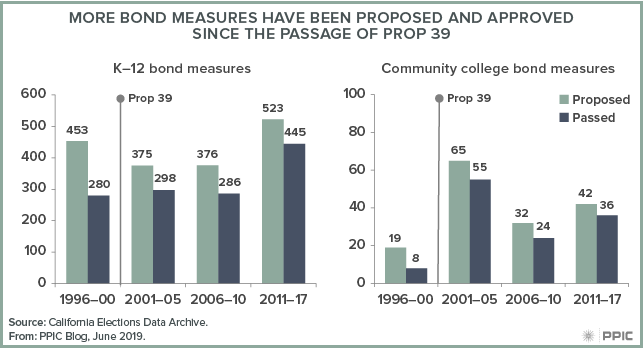
figure - More Bond Measures Have Been Proposed and Approved Since the Passage of Prop 39

The vote on Measure EE will be important for LAUSD—the resources that the parcel tax would generate are critical to the district’s future finances. The vote will also be worth watching with the pending constitutional amendment in mind. If the measure is approved, lawmakers may see less need for lowering the parcel tax threshold. If it is defeated, the amendment may gain momentum.

Money Measures and the November Ballot

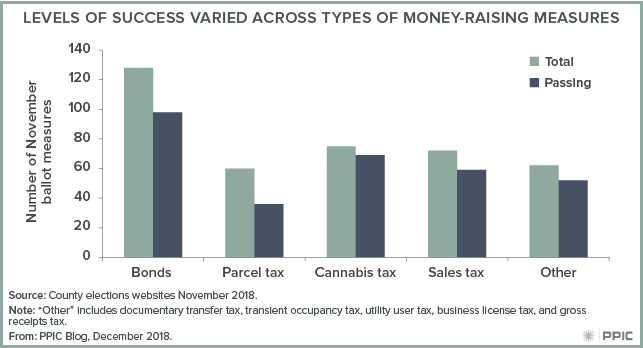
Earlier this year, we looked at how voters responded to the 107 money measures on the June ballot. The November election featured a considerably larger number of taxes, bonds, and fees: local governments asked voters to make decisions on 397 money-related questions, by our count. Most of these measures passed (314 or 79%), though success rates varied across types of taxation or borrowing.

Overall, most bonds passed (98 of 128), but the share of successful bonds for K–12 schools and community colleges (92 of 116, or 79%) was higher than the share of general obligation bonds in other spending areas (6 of 12, or 50%). Since Proposition 39 (which passed in 2000) lowered the passage threshold for school bond measures to 55%, more than 1,400 school bonds have been placed on ballots, and voters have approved more than 80% of them. Of the 92 school bonds that passed this year, 65 met the 55% threshold but fell short of a two-thirds majority.

Parcel taxes, California’s unique way of increasing property taxes in the Proposition 13 era, were the least successful type of taxes on the November ballot. However, voters did approve 60% of these measures (36 of 60), which is in line with their historical success rate. Most parcel taxes proposed by school districts passed (11 of 16, or 69%), while those placed on the ballot by fire districts were less successful (9 of 19, or 47%).

Through 2017, local governments had proposed 80 measures to tax cannabis businesses, generally based on gross receipts, size (measured in square footage), or some combination of the two. On the November ballot, there were 75 cannabis tax measures. As has been the case historically, voters approved the vast majority (69, or 92%).

Is California shedding its reputation as an anti-tax state? The fact that local measures have been successful nearly 80% of the time does not necessarily reflect voter support for taxes in general. According to recent PPIC Statewide Surveys, a majority of Californians feel that their tax burden is greater than it should be and see Proposition 13 as “mostly a good thing.” Also, savvy local leaders put money measures on the ballot only when polling or canvassing suggests the probability of passage is high.

A more precise interpretation of recent results might be that local governments have been very successful at identifying the type of taxes and purposes around which they can mount successful campaigns. Moreover, recent local measures have been put before voters during a period of economic growth. It will be interesting to see if they continue to succeed going forward.

Local Measures Address Water, Fire in the Midterm Elections

The biggest water news from the recent election was the failure of the $8.9 billion statewide water bond, Proposition 3. This was the first time voters have rejected a statewide water bond since 1990. But this wasn’t the only story for water-related measures on Californians’ ballots. The midterms saw 33 local measures go to the voters that addressed issues ranging from flood protection to fire resilience. Here we summarize a few key votes.

In Los Angeles County, Measure W passed. This measure allows the county to collect a parcel tax of 2.5 cents per square foot of impermeable surfaces (such as concrete sidewalks and pavement) to fund rain and stormwater capture and clean-up projects, in addition to projects addressing water quality and groundwater recharge. The measure exempts permeable surfaces from the tax, which could incentivize developers to incorporate more green solutions into development and renovation projects.

In the Bay Area, San Francisco and San Jose both passed local bonds to modernize infrastructure. San Francisco easily passed Measure A, which will issue $425 million in bonds to strengthen the Embarcadero seawall to better withstand earthquakes and rising sea levels. San Jose’s Measure T will allocate $650 million in bonds to repair the city’s aging infrastructure. Although almost half of this bond is dedicated to repaving streets, the measure also includes $85 million for flood protection—a response to the 2017 Coyote Creek flood that caused $100 million in property damage. The bond will fund “green infrastructure” projects in the local floodplain to reduce the risks of future floods and groundwater contamination.

Across the state, the rise in devastating wildfires resulted in nine measures addressing fire protection and intervention services in communities, to be paid for through utility taxes, sales taxes, and parcel taxes. Four of these measures passed, while five failed.

Sonoma County’s newly adopted park and ecosystem restoration bill―Measure M, a one-eighth cent sales tax increase―will collectively fund wildfire prevention, ecosystem restoration, and projects to safeguard water supplies, including rivers and streams. Measure FF passed in Alameda and Contra Costa Counties; it extended an existing parcel tax to fund wildfire prevention and water quality activities on East Bay Regional Park District lands, as well as park maintenance. But voters didn’t approve Measure P in Laguna Beach (Orange County), which proposed a sales tax to pay for wildfire safety measures. It would have funded projects such as undergrounding overhead power lines.

Although the failure of Proposition 3 caught some by surprise, it’s important to remember that state bonds play a relatively minor role in funding California’s water needs. Local revenues—from water and sewer bills to taxes—provide 85% of water funding. The newly passed ballot measures carry on that tradition, with Californians across the state voting to address their communities’ needs and priorities for water, fire safety, and the environment.

Funding Measures and the June Ballot

Last week’s primary election garnered considerable statewide and national attention, with much of the focus on the governor’s race and contested congressional seats. Further down the ballot, however, voters were asked to decide on millions of dollars of local tax, bond, and fee initiatives. On the whole, these measures enjoyed considerable success across the state.

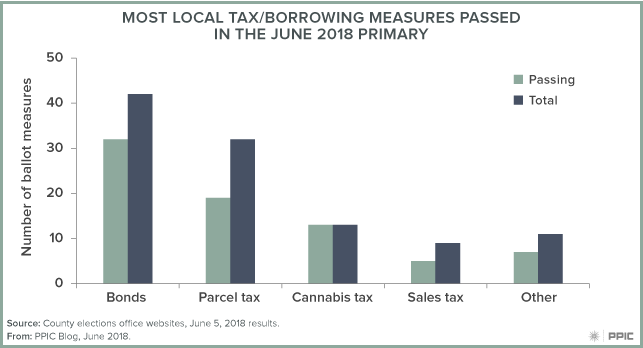
We found that Californians voted on 107 local tax, bond, and fee measures, representing the range of fiscal tools that local jurisdictions can use to raise revenue and borrow funds. Bond measures were the most popular, with 42 different local governments seeking voter approval (37 K–12 school districts; 2 community college districts; 3 cities). There were also 32 parcel tax measures; those related to K–12 schools (12) and fire/public safety (10) were most common. Ballots also included proposals to impose or increase taxes on cannabis (13) general sales (9), gross business receipts (2), and hotel stays (3). And there were proposals to raise utility fees (3), business license fees (1), and bridge tolls (1).

Most of the long list of funding proposals passed—but just putting a measure on the ballot did not guarantee success. Although counties are still counting some ballots, which could affect a race or two, at this time, we observe the following:

  • Overall, voters passed 76 of the 107 measures.
  • Of the 39 school bond measures, 30 passed. Proposition 39, passed in 2000, lowered the threshold for passing school bonds from a two-thirds majority to 55%. Had these measures been subjected to the previous standard, only 11 would have passed. The 19 measures approved under the current standard increased borrowing for investment in public schools by $1.8 billion.
  • On the heels of one of the states’ worst seasons of wildfires on record, California voters held the line on parcel taxes intended to support fire protection, with only 3 of the 9 measures passing.
  • All 13 of the cannabis tax proposals passed overwhelmingly.

California touched off a revolt against taxes 40 years ago. Primary voters in 2018 generally voted for increases but were relatively discriminating in their support, depending upon the type of tax and its intended purpose. This discernment comes at a time when the state’s economy is growing and unemployment is low. It will be interesting to see what happens in November, when we expect to see even more funding measures on the ballot.

Video: Californians and Education

In the wake of the Parkland, Florida, killings, the latest PPIC survey finds an overwhelming majority of Californians are concerned about a possible shooting in their local schools. But most oppose having teachers carry guns in school facilities.

Lunna Lopes, PPIC researcher, detailed these and other key findings at a Sacramento briefing last week.

When asked about school shootings, 73 percent of California adults and 82 percent of public school parents say they are very or somewhat concerned. Yet two-thirds of adults (67%) and public school parents (68%) oppose allowing more teachers and school officials to carry guns in schools. Strong partisan differences emerge on this issue. An overwhelming majority of Democrats (86%) and a strong majority of independents (69%) are opposed to arming teachers and school officials, while a solid majority of Republicans (60%) favor the idea.

A few other survey highlights include:

  • Californians (65%) support having local school districts declared sanctuary safe zones for undocumented students, but there are deep partisan divisions.
  • California adults and likely voters continue to see the state’s K–12 funding as inadequate. Solid majorities (60%) of likely voters favor local school bonds, while fewer (48%) support local parcel taxes for schools.
  • Across parties, majorities of likely voters agree that gubernatorial candidates’ positions on K–12 education are very important.
  • Among likely voters in the gubernatorial race, Democrat Gavin Newsom maintains his lead (26%), followed by Republican John Cox (15%) and Antonio Villaraigosa (13%). Nearly a quarter of likely voters (22%) remain undecided.

Three Bills Signal State of Education Policy

In this year’s busy legislative session, Governor Brown signed 316 of the nearly 800 education-related bills sent to his desk. The bills made relatively small changes on a range of issues from local parcel taxes to school disciplinary policy.

In recent years, a series of reforms—including passage of the Local Control Funding Formula (LCFF), adoption of the Common Core State Standards, and the shift to the new computer-based Smarter Balanced tests—have constituted a significant transition for the state’s 6.2 million public school students. These changes were designed to target K–12 funding for students with the greatest needs and focus teaching on the development of critical-thinking skills. Rather than signing off on legislative changes to these reforms, the governor has opted to continue their implementation while shifting some attention to challenges on the horizon.

A review of the fates of three bills, the state budget, and recent administrative actions helps illustrate the current state of education policy in California:

  • Aligning state and federal accountability rules. Earlier this year, the State Board of Education adopted a new accountability system for evaluating the progress of schools and districts in the eight priority areas—including parental involvement, school climate, and student achievement—laid out in the LCFF. The governor vetoed Assembly Bill (AB) 2548, which would have compelled the state board to align the accountability system with new federal regulations requiring the state to intervene in the lowest-performing 5% of schools. By using multiple measures, the state’s system takes a more holistic view of student achievement. But this approach makes it difficult to assign a number to each school in order to identify those that need the most help—putting it at odds with the federal government. The governor resisted changing course with his veto, but the state may need a waiver to meet the federal requirement.
  • Addressing the teacher shortage. The budget included several teacher workforce initiatives to address the state’s looming shortage, including financial assistance for classified employees interested in teaching and grants to universities encouraging four-year teacher credential programs. The governor signed AB 2248, allowing those with out-of-state credentials to teach English Learners in California. This relatively small change—which addresses one of the subject areas with an acute teacher shortage—stood out in contrast to related legislative efforts that failed, like a bill that would have provided student loan forgiveness for teachers who serve in schools with the most needs.
  • Preparing California’s students for the future. The governor also signed AB 2329, creating a 23-member advisory panel tasked with developing a strategic implementation plan to expand access to courses in computer science—a critical field for the 21st century economy. The plan would lay out the standards for a computer science curriculum and increase the number of computer science teachers, with the goal of ensuring access for all students.

These examples show that as the implementation of major education reforms continues, the governor has focused on making small tweaks to the state’s system and laying the groundwork for the coming years. As California’s leaders look toward the future, it is vital that they build a robust educational system that will be able to address both near- and long-term challenges.

Public School Parents See Education Differently

In our annual PPIC Statewide Survey on Californians and education, 40% of adults say that the quality of K–12 public education in the state is a big problem. Notably, the parents of public school children are more likely than others to have favorable opinions about public education in California: just 27% say quality is a big problem. Adults without children, those with children in private schools, and those with children too young to attend school are the ones who tend to hold a more negative view of the state’s public education system. This pattern is consistent with our findings in previous surveys.

Parents who don’t have children in public schools are twice as likely as those who do to say the quality of K–12 public education is a big problem. They are also twice as likely to give their neighborhood public schools a grade of D or F. (Adults without children age 18 or younger fall in between the two parent groups on these questions.)

In addition, when asked how their elected officials are handling K–12 education, public school parents are much more likely than others to approve of Governor Brown and the California Legislature in this area.

Regardless of whether they have children in public schools, many parents agree that school funding is inadequate. Two-thirds of both parent groups say that the level of funding for their local public schools is inadequate, while 58% of other adults say the same.

Most adults support K–12 funding proposals, and support among public school parents is particularly strong. At least two-thirds of adults say they would vote for either a local or state bond measure to pay for school construction projects, with over 80% of public school parents supporting these measures. Asked how they would vote on a local parcel tax for schools, 70% of public school parents would vote yes—exceeding the two-thirds majority needed to pass such a tax. Among other adults, about 60% would vote yes.

Certainly, it’s not surprising that parents who decided to send their children to private schools might have different opinions about educational quality compared to those with children in public schools. The differences that we find, though, extend beyond a difference between public school parents and private school parents. On several measures, parents with children in public schools stand apart from all other California adults in their assessment of the state’s K-12 public education system.

Learn more

Read the PPIC Survey: Californians and Education
Visit the PPIC Statewide Survey pages

Local School Funding & the Exclusive Electorate

State funding for K-12 public education has been rising, but 70 percent of public school parents say it is “not enough” in our April PPIC Survey. Are California voters likely to heed these parents’ calls and support local ballot measures for school funding?

It doesn’t look likely. To begin with, likely voters are much less likely (54%) than public school parents to say that the state’s funding for their local schools is not enough. More important, in our recent poll likely voters and public school parents have starkly different views about specific ways to increase funding—local bonds and local parcel taxes—for their local public schools. Specifically:

  • When it comes to local school bonds, 75 percent of public school parents would vote yes if their local school district had a bond measure on the ballot to pay for school construction projects. But only 53 percent of likely voters would do so—lower than the 55 percent required to pass a local school bond.
  • As for funding schools through local parcel taxes, 61 percent of public school parents would vote yes. But just 49 percent of likely voters would. A two-thirds majority yes vote is needed to pass a local parcel tax for schools.
  • What about lowering the majority needed to pass local parcel taxes—from two-thirds to 55 percent? This tax reform is rated as a good idea by 57 percent of public school parents. Only 44 percent of likely voters agree—less than the majority required to make this change.

The poll’s findings reflect the fact that California’s “exclusive electorate” controls the fate of ballot measures for local school funding. Today, many public school parents are nonvoters. And most likely voters are not public school parents. According to a PPIC report, likely voters are disproportionately white and tend to be homeowners, older, college graduates, and affluent.

Latinos, renters, and the younger, less educated, and less affluent are strong supporters of local bonds and local parcel taxes for local schools. They also favor lowering the vote threshold for passing local taxes. But these groups are outnumbered among those who cast ballots in elections.

It’s not impossible to pass local bonds and parcel taxes for school funding. CaliforniaCityFinance.com reported last December that eight in 10 local bonds and 6 in 10 local parcel taxes for local public schools have passed since 2001. But funding advocates have to carefully pick and choose the timing and location of these local school funding measures in deference to the higher vote thresholds required and the propensities of California’s exclusive electorate. A PPIC study concludes that the overall fiscal impact of parcel taxes has been fairly limited statewide.

School funding proponents want a state bond measure on the November 2016 ballot. The presidential election will attract the largest and most diverse electorate. It would take a simple majority vote to pass a state school bond. Our poll finds that 55 percent of likely voters and 77 percent of public school parents would vote yes on a state bond for school construction projects.

Meanwhile, the governor has stated that local voters should be deciding if they want more local school funding and that state voters should not be asked to pass state school bonds. This idea of local control resonates with Californians, who generally distrust the decisions made in Sacramento. But as our survey suggests, likely voters are unwilling to lower the local two-thirds threshold for passing local parcel taxes, leaving it easier to pass school funding measures at the state level than at the local one.

In other words, the state is likely to continue to play an oversized role in local school funding—until the California electorate reflects the will of the people who are relying on local public schools to improve their children’s futures.

Video: Californians and K-12 Education

The annual PPIC Statewide Survey: Californians and Education comes at a time when there are major policy changes underway in the state’s K–12 system. They include implementation of the Local Control Funding Formula, Common Core standards, and the Smarter Balanced standardized tests. The survey was released last week and presented at a briefing in Sacramento by research associate Lunna Lopes.

The survey offers a good look at public reaction to the changes and attitudes toward education more broadly. About three-quarters of adults said they knew nothing about the Local Control Funding Formula, which gives districts more flexibility in spending state funds and gives additional money to districts with more English language learners and lower-income students. When survey respondents were read a description of the funding formula, most favored the idea.

About 58% said they had heard about Common Core, the new set of English and math standards. But only 47% favored the idea and 31% opposed it. The poll also found a high level concern more generally about the quality of K–12 education and funding.

Video: The Future of Local Taxes

The parcel tax is unique to California, said economist Jon Sonstelie, because it is a revenue alternative that navigates the constraints of Proposition 13. Sonstelie, PPIC Bren Fellow and a professor at UC Santa Barbara, evaluated the tax in his new report Parcel Taxes as a Local Revenue Source in California and presented the results last week in Sacramento. He noted that between 2003 and 2012, cities, school districts, and local districts put 691 parcel tax proposals to fund services on the ballot, and 53 percent received the two-thirds vote required for passage. Most of these taxes were relatively small. The median was $60 for cities, $96 for school districts, and $68 for special districts.

Following the presentation, a panel discussed the future of local taxes in an era of increasing local authority. Patrick Murphy, PPIC research director, moderated the discussion. Participants included Michael Coleman, principal fiscal advisor to the League of California Cities; Robert Gutierrez, director of the California Tax Foundation; and Marianne O’Malley, managing principal analyst on state and local finance at the Legislative Analyst’s Office