California Needs More College Prep Courses

Most California high school graduates are not ready for college. Despite the steady improvements over the past decade, less than half of graduating seniors in the class of 2016 completed the a–g requirements, the set of courses high school students must complete to be eligible for admission to the University of California (UC) or California State University (CSU). The completion rate is substantially lower among Latino (37%), African American (34%), economically disadvantaged (37%), and English Learner (10%) students.

PPIC’s new report looks at the role of several institutional factors that may improve the completion rate, including high school graduation requirements, course placement policies and practices, and academic counseling and advising. But there is another significant barrier: not every high school in California offers the full a–g course sequence.

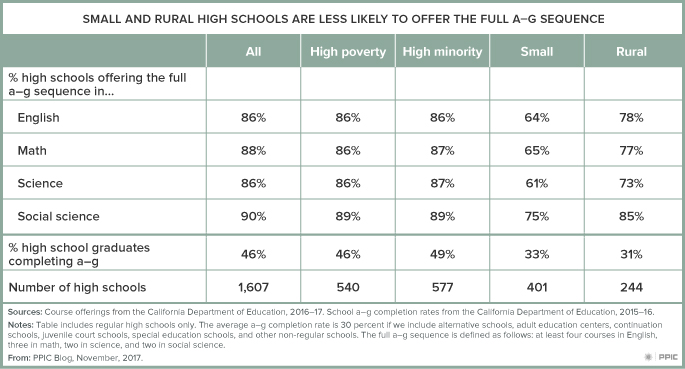
During the most recent school year (2016–17), 12% of California high schools did not offer the full math sequence, which includes algebra 1, geometry, and algebra 2. Similarly, 14% of high schools did not offer four years of a–g approved English courses. High-poverty schools (where more than 75% of students are eligible for free or reduced-price lunch) and high-minority schools (where more than 75% of students are African American or Latino) were just as likely as schools overall to offer the full sequence. But small schools (those at the bottom 25th percentile of the enrollment distribution) and rural schools were much less likely to do so. Close to 40% of small schools did not offer the full science sequence, which includes two years of approved science courses, and more than a third did not offer the full math or English sequence.

The difference in course offerings has contributed to low a–g completion rates at small and rural schools. For instance, the average a–g completion rate is 46% among all high schools, but only 30% or so among small or rural schools.

College Prep Blog Table

To improve student readiness for college, districts and schools need to increase the number of a–g approved courses. However, some schools may face capacity and resource limitations, such as not having enough qualified teachers. One solution is to establish a regional or statewide virtual school network so students in small or rural schools can enroll in online courses offered by other districts. Several states—including Florida (Florida Virtual Education), Wisconsin (Wisconsin Digital Learning Collaborative), Texas (Texas Virtual School Network), and Georgia (Georgia Virtual School)—have in recent years partnered with school districts to provide academic courses and test prep for all middle and high school students. California’s UC Scout program is a step in the right direction, providing a full set of online a–g courses accessible at no cost to students at participating schools.

The Unintended Consequences of Indoor Water Conservation

High rates of water conservation helped California manage limited supplies during the 2012–16 drought. But conservation can have a downside. New research shows that indoor water conservation can reduce the quality and quantity of wastewater, making it harder for local agencies to use treated wastewater to augment their water supply.

We talked to two members of the research team about their findings: David Jassby, associate professor of civil and environmental engineering at UCLA; and Kurt Schwabe, professor of environmental economics and policy at UC Riverside and an adjunct fellow at the PPIC Water Policy Center.

Jassby summarized the problem: “In general, as people conserve water inside their homes, the concentration of contaminants in the wastewater goes up—organic matter, nitrogen, detergents, and more. All of these things have to be treated.”

Schwabe noted that in the past, recycled water was mostly used for irrigating nearby cropland and median strips—not drinking. But as treatment processes have improved and demand for water increased, recycled water has become an integral part of the drinking water supply in some areas, where it is used to replenish groundwater basins. In many communities, treated wastewater is discharged into rivers and streams and used by downstream entities that treat the water again.

Salinity is a particular challenge. “Most wastewater treatment plants can treat higher levels of nutrients, but they’re not designed to treat higher levels of salinity,” Schwabe said. “What this means is the water that is discharged into streams or to farms or into aquifers for groundwater recharge will be saltier, which reduces water quality and crop yields.”

Schwabe noted that while utilities can employ technical fixes to address drought-related wastewater quality issues, this doesn’t address the problem of quantity. Indoor conservation results in less treated water flowing into streams or available for reuse.

On average, only about 10% of municipal wastewater is reused in the US. Israel reuses 85–90% of its wastewater—perhaps the highest rate in the world, Schwabe said. California is adopting new rules on “direct potable reuse” of treated wastewater, which would enable cities to add treated wastewater directly into their water supply.

“Farmers in some parts of California are becoming increasingly reliant on treated municipal wastewater from neighboring urban areas. This is an effective strategy for dealing with water scarcity. But it also reveals that conservation—another effective drought strategy—might in some instances work at odds with wastewater reuse.”

Urban areas are also affected. For example, recycled wastewater is a significant portion of stream flow in the Santa Ana River in Southern California. Indoor conservation reduces water supply for communities in downstream reaches of the river.

Does this mean that people abandon conservation? The researchers say no. “Our results are intended to illustrate how different drought mitigation actions are related so agencies can plan, communicate, and coordinate in the most informed and cost-effective manner possible,” said Schwabe. “Conservation mandates that don’t recognize these linkages can have significant and negative consequences on the effort to reuse wastewater.”

Jassby noted that the place conservation happens is key: “When people are asked to conserve water, they should be encouraged to conserve water outside the home.”

More broadly, having water supply and wastewater treatment agencies cooperate in how they manage their systems can also help, Schwabe said.

Video: Strategies for Reducing Child Poverty

High housing costs and low-wage work make it hard for low-income Californians to meet their basic needs. The result? Nearly a quarter of California’s youngest residents live in poverty—a fact with profound educational, health, and economic repercussions now and in the future. Social safety net benefits help low-income families supplement their incomes but do not reach the working poor in high-cost areas and the very poor across the state.

A new PPIC report examines how high housing costs and low wages contribute to child poverty. It also looks at additional policy approaches: an expansion of the Earned Income Tax Credit, establishment of a state child credit, and an overhaul of the state renter’s credit. Each approach holds promise, and each involves trade-offs.

Researcher Caroline Danielson presented the report in Sacramento last week. She also demonstrated an interactive tool that allows for a deeper exploration of how policy changes could affect California’s diverse counties. It underscores the need for policymakers to be strategic in determining how best to help families in need throughout the state.

Explore the accompanying tool Interactive: Reducing Child Poverty in California.

Commentary: A New Approach to Protecting Rivers

This commentary was published in the Sacramento Bee on November 20, 2017.

California’s native freshwater fish—salmon, steelhead, sturgeon and others—continue to decline, and regulations to reverse this trend have fanned controversy. A new approach to environmental stewardship is needed. We should start by granting the environment a water right, as detailed in a new report by the PPIC Water Policy Center.

Read the full commentary on sacbee.com.

College Graduates and California’s Future

The University of California Board of Regents invited Mark Baldassare, PPIC president and CEO, and Hans Johnson, PPIC senior fellow and director of the PPIC Higher Education Center, to present their perspectives on the role of higher education in California’s future, November 16, 2017. Here are their prepared remarks:

Good morning, I am Mark Baldassare, president and CEO of the Public Policy Institute of California (PPIC). I am here with my colleague and PPIC’s higher education center director Hans Johnson to present the institute’s research findings on the need for college graduates in California’s future economy. To kick off this session, I am going to make a few remarks about public opinion to place this issue in perspective.

The November PPIC Statewide Survey points to the importance of this topic for most Californians. Eighty percent of California adults say that the state’s higher education system is very important to the quality of life and economic vitality of the state, and another 14% say it is somewhat important. Strong majorities across political, regional, racial/ethnic, and demographic groups say that the state’s higher education system is very important. In fact, strong majorities of Californians have been saying that higher education is very important to the state’s future since we first asked this question in 2007.

In the context of the 2018 governor’s race, 63% of California adults say that candidate positions on higher education are very important, and another 28% say they are somewhat important to them. Majorities across political, regional, racial/ethnic, and demographic groups hold this view.

When asked about the current workforce, 83% of Californians say that a four-year degree from a college and university prepares someone very well (30%) and somewhat well (53%) for a well-paying job in today’s economy. Fifty percent of Californians think that a college education is necessary for a person to be successful in today’s work world, with majorities of Latinos (67%), Asian Americans (54%), and African Americans (51%) and fewer whites (35%) holding this view. Moreover, about half of Californians, with pluralities across the state’s major regions, say that California will not have the college-educated residents needed for the jobs and skills likely to be in demand 20 years from now.

In sum, the importance of a higher education and the need for college graduates are issues on the minds of many residents today. Hans will provide the demographic and workforce analysis that demonstrates why the state’s higher education system is essential for a better future for all Californians.

PPIC has produced a series of reports on California’s future population and economy. Our report Will California Run Out of College Graduates? provides projections of the demand for and supply of workers across all levels of educational attainment to 2030. Our primary finding is that California faces a shortage of highly educated workers. Specifically, economic projections to 2030 show that about two in five jobs will require at least a bachelor’s degree, while demographic projections suggest only about one in three Californians will have at least a bachelor’s degree. This shortfall equates to 1.1 million workers.


In this presentation, I first describe how California’s population and economy are changing and then identify how the state and its higher education institutions can increase college enrollment and completion to produce more college graduates.

California’s economy increasingly demands highly educated workers

To develop our economic projections, we apply trends in educational attainment levels to occupational projections developed by the California Employment Development Department. We examine changes in labor market demand that are occurring due to shifts both in occupational structure and changes in educational attainment within occupations. Our primary finding is that the state’s economy will continue along a well-established trajectory, with a growing share of jobs requiring at least a bachelor’s degree.
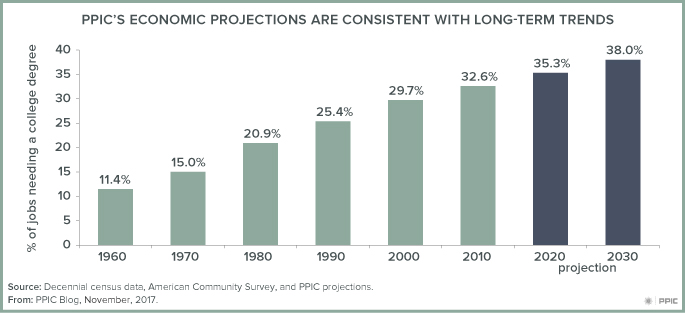

There are two key drivers of increasing demand for college graduates: (1) faster growth in occupations that commonly require a college degree (e.g., computer technology), and (2) increases in demand for highly educated workers within occupations (e.g., nursing). In recent years, most (74%) of the increased demand for highly educated workers has occurred because of faster job growth in occupations that commonly require a college degree. Among occupations with at least 100,000 full-time year-round workers, there have been especially rapid growth rates for software developers (56% increase between 2010 and 2015), computer scientists and systems analysts (42% increase), and managers (35% increase). These and other highly skilled occupations have experienced faster growth than most occupations that require lower levels of education.


That said, the increase in educational attainment within occupations has been significant. For example, the share of registered nurses with a bachelor’s degree has grown from 57% in 2000 to 68% in 2015. From 2010 to 2015, about 26% of the increase in jobs for college graduates was attributable to growing demand for highly educated workers within specific occupations.

Are college degrees really necessary for these jobs? To answer this question, we examined a number of labor market outcomes. Within and across occupations, we find that workers with bachelor’s degrees have higher labor force participation rates, lower unemployment rates, and higher wages than those without—and that, in general, as educational attainment increases, wages also increase. Overall, the wage premium for college graduates relative to less-educated workers has grown. By 2015, the average annual wage for full-time year-round workers was more than twice as high for workers with a bachelor’s degree than for those with only a high school diploma.
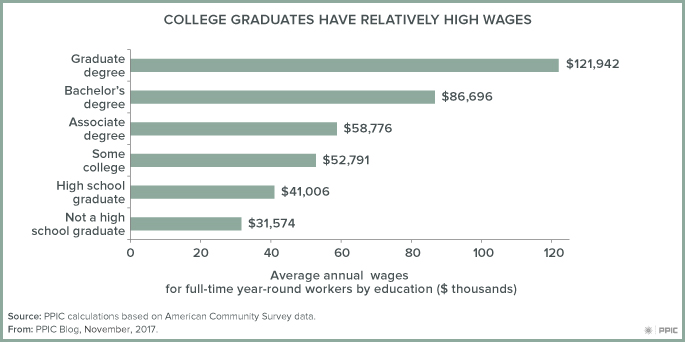
Within each of 51 occupational groupings we see higher wages for college graduates than for high school graduates. Among registered nurses, for example, those with a bachelor’s degree earned 12% more than those with an associate degree.

California’s educational institutions are not keeping up with demand

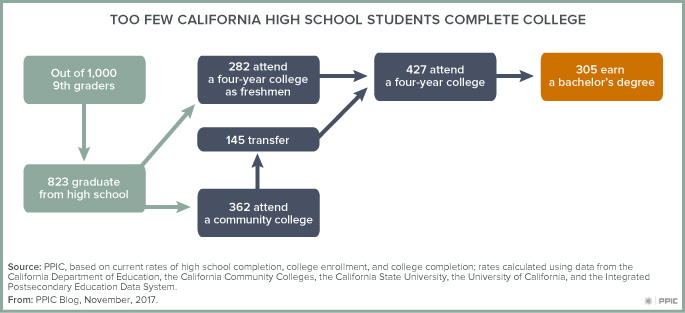
Too few Californians are graduating from college. At current college enrollment and completion rates, only 30.5% of 9th graders in California will eventually earn a bachelor’s degree either in California or elsewhere in the United States. Among all states, California ranks 47th in the share of high school graduates who enroll in four-year colleges and 5th in the share who go to community colleges. Low rates of transfer from community colleges to four-year colleges exacerbate the problem.

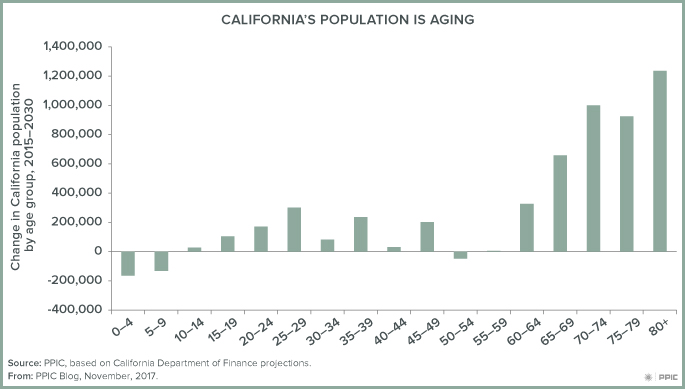
A critical challenge is the retirement of the baby boom generation. Called the “silver tsunami” by some, this is the first time in California’s history that such a large and well-educated group is exiting the labor force. In contrast, the number of young adults in California is projected to increase only modestly.

Not all degrees are equal

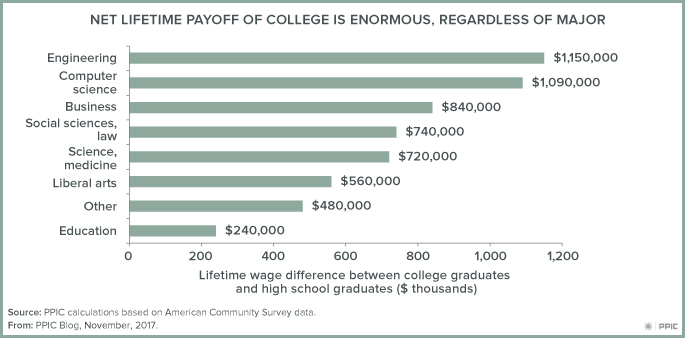
On average, college graduates have very strong labor market outcomes. At any point in time, some college graduates are working in jobs that do not necessarily require a college degree, but over the course of their careers the vast majority of college graduates will move into occupations that reward their educational training. Our estimates show that students who earn bachelor’s degrees in engineering and computer science fare very well in the labor market, but even those with less remunerative majors, such as education and the liberal arts, will earn far more in wages than less-educated workers, even after taking into account all the costs of going to college.

How to close the degree gap

To close the degree gap, California and its higher education institutions need to establish new policies and practices to enroll more students, especially in our four-year colleges and universities, and improve graduation rates among students already in college. In previous testimony, PPIC has identified targets for each of the state’s public systems with respect to admission, transfer (from community colleges to four-year colleges), and improved graduation rates.

The University of California (UC) will play a central role. In our scenario, UC would need to award approximately one-quarter of the additional degrees necessary to close the gap. This is an ambitious target, but the increase over current levels (and over the baseline projection) would not be without precedent. For example, between the 1999–2000 and 2016–17 academic years, the number of bachelor’s degrees awarded by UC increased 62% (from slightly more than 33,000 to almost 54,000). Our closing-the-gap scenario would require UC to award about 81,000 degrees by 2029–30, a 51% increase over current levels.
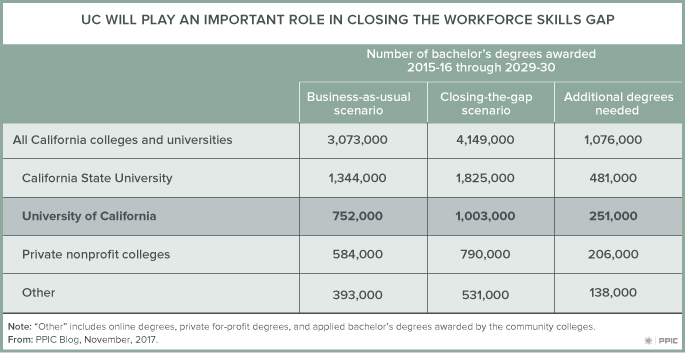

Improving access and success among groups historically underrepresented in higher education—including low-income students, first-generation college students, Latinos, and African Americans—is essential if we are to close the degree gap. Compared to other public research universities, UC has an impressive record in enrolling low-income and first-generation students.

The California State University (CSU) system and the California Community College system have adopted new goals that are entirely consistent with PPIC’s targets. New initiatives, including remediation reform at the community colleges and at CSU, have the potential to substantially improve student success rates. CSU’s new graduation initiative aims to increase graduation rates and eliminate gaps between groups of students. College preparation among the state’s high school graduates has also increased, with the share of students completing the college preparatory requirements of UC and CSU reaching an all-time high. Strong demand for UC is likely to continue as college preparation continues to improve and the transfer pathway is better articulated. UC has seen consistent increases in graduation rates for many years, and new efforts to improve on-time graduation are likely to continue this trend.

Finding ways to accommodate all these students remains a central challenge, but one we must meet in order to ensure a better future for all Californians.

Video: Gavin Newsom’s Priorities

Gavin Newsom, California’s lieutenant governor and a candidate for governor in 2018, was asked in a San Francisco forum last week to name the three issues that will make the biggest difference in California’s future. Newsom, who is also a former mayor of San Francisco, predicted that both California and the nation will be grappling with these issues over the next ten years:

  • Debt and demographics. With California’s population aging rapidly, the state and its cities face growing public employee pension and health care liabilities. “As a progressive Democrat, I’m not naïve about the commitments we’ve made and the commitments we must fulfill,” Newsom said. “Nor am I naïve, as a former mayor, about the challenge of meeting those commitments . . . Cities like Richmond are facing the prospect that by 2021, by one estimate, upwards of 40% of their general fund will go to retiree contributions.”
  • Energy and climate change. The state has set ambitious goals to reduce greenhouse gas emissions and increase energy efficiency. “The next governor has to deliver,” he said.
  • Information technology and globalization. “The issue that animates my anxiety: work, the future of work.” The days of having a job or career have given way to something radically different, forcing us to think in terms of portable benefits and retirement security, he said. Further, workers in retail, food and beverage, and clerical jobs—the top employment categories—are on the “edge of automation.” Displacement of these workers will require us to have a different conversation about skills, education, and social mobility, Newsom said.

The conversation with Newsom was part of the PPIC Speaker Series on California’s Future. PPIC is inviting all major candidates for governor to participate in a public event if they reach a certain threshold in the polls. The goal is to give Californians a better understanding of how the candidates intend to address the challenges facing our state.

Watch all candidate videos.

Reforming Water Management for the Environment

A longer version of this piece was recently published by Water Deeply.

It’s time for California to rethink how it manages water for the environment. Despite decades of effort, many of the state’s aquatic native species are in decline. Controversy over water for the environment remains high. The latest drought left lasting effects on already-stressed species and their ecosystems and highlighted the need for a change of course.

Our new research identifies shortcomings in current practices and lays out three reforms that could reduce conflict while improving freshwater ecosystems.

Better accounting. During the latest drought, state and federal agencies found their decision making hampered by information gaps on water availability and use and ecosystem conditions. For example, weaknesses in accounting and monitoring systems—and poor operational choices at Shasta Reservoir—pushed endangered winter-run Chinook salmon to the brink of extinction.

These management challenges were made more contentious by public perceptions about the uses of environmental water. The state lumps many things into the “environmental water” category, including flows required by regulations to maintain water quality for urban and agricultural uses. For example, during the drought, environmental water that flowed from the Delta into San Francisco Bay was widely criticized as “wasted to the sea.” Yet most of this water was needed to prevent high salinity in Delta water supplies.

We must do a better job of measuring and tracking water and ecosystem conditions—and make this information timely and transparent. The state also needs to clearly define what purposes “environmental water” serves, and separate water that benefits both water users and the environment from that used solely to support ecosystems. Better accounting will improve efficiency and provide a common understanding of water use for policy debates.

Better planning. The drought revealed major weaknesses in how California plans for and responds to water scarcity in ecosystems. While urban water managers routinely plan for drought, no such planning exists for ecosystems. With a few exceptions, fish and wildlife agencies react to—rather than plan for—severe drought.

California needs to shift from reacting to drought to anticipating and mitigating its effects on ecosystems. This can be achieved through the development of watershed ecosystem plans that set management goals and priorities for actions.

In addition, California needs annual contingency plans to prepare for uncertainty over how wet the winter and spring will be. A good model is that of Victoria, Australia, where water managers vet their plans and priorities with stakeholders. This allows water users to know what to expect, and tensions are reduced.

Ecosystem water budgets. California also needs a new way to allocate water to protect ecosystems. The over-reliance on minimum flow and water quality standards—often set for individual endangered species—limits the capacity of water managers to adapt to changing conditions.

A more nimble approach would also provide assurances to all interests about allocation of ecosystem water. This can be accomplished by granting the environment a water budget that can be flexibly managed, much as urban and agricultural water-right holders do. These ecosystem water budgets could be stored in reservoirs or groundwater basins, and even traded. The budget would be administered by a trustee guided by the watershed plan and good accounting systems. The trustee could manage the water budget to maximize benefit for ecosystem functions and, where possible, reduce impacts on other water users.

Management of California’s freshwater ecosystems—particularly during drought—is not working well for anyone. These reforms would improve conditions and reduce tensions over allocation of water–and enable freshwater ecosystems to adapt to a warmer and more variable climate.

The State of Groundwater Recharge in the San Joaquin Valley

When strong winter rains finally ended the recent five-year drought, many water districts seized the opportunity to recharge depleted aquifers. How did they do, and what barriers did they face? A public forum brought more than 30 experts together to discuss the benefits, opportunities, and barriers to groundwater recharge. The event was hosted by the California State Board of Food and Agriculture and the state Department of Water Resources.

My presentation focused on recharge in the San Joaquin Valley—a region that is home to more than four million people, half the state’s agricultural output, and most of its critically overdrafted groundwater basins, where pumping exceeds replenishment. Consequences include dry wells, sinking lands, and reduced supplies to weather future droughts.

As part of our ongoing work to explore practical and effective solutions to the region’s water challenges, the PPIC Water Policy Center recently surveyed local water districts about their groundwater recharge efforts. Although such efforts have been underway for decades in some parts of the valley, the state’s 2014 groundwater law has increased interest in using recharge to bring basins into long-term balance.

About 75% of respondents to our survey said they were actively recharging this year. Large water districts with formal recharge programs are doing the lion’s share of recharge, but there’s lots of interest from smaller agencies in getting in on the act.

Agricultural districts are already employing a broad mix of recharge tools, and many see potential for expansion. In contrast, urban districts—most of which rely heavily on groundwater—are much less active. The most widespread methods—used by two-thirds of agricultural districts surveyed—include allowing water to seep through unlined canals and irrigating crops with surface water instead of groundwater, which enables basins to recharge naturally (a method known as “in-lieu” recharge). Other popular options—used by half of agricultural districts—include directing water to dedicated “recharge basins” and applying extra water on irrigated cropland. Some districts also spread water on fallowed land and open space. Of these tools, recharge basins are being used most intensively, storing more than half of total recharge reported (roughly four maf). One caveat to this last finding is that many districts have been using some popular methods (cropland irrigation, in-lieu recharge, and unlined canals) without formally accounting for how much recharge occurs.

Kern County is “recharge central,” accounting for more than half of total recharge volumes reported. It is also the hub of recharge partnership programs that enable water users to store water off-site, by districts that have especially good recharge conditions.

Survey respondents also noted the biggest barriers for their districts. Perhaps reflecting the very large volumes of surface water available this year, respondents were much more likely to flag problems related to infrastructure (72% of respondents) than to regulatory issues (30%). Infrastructure challenges included capacity constraints in several areas: recharge basins, “system” conveyance to get water to the district (e.g., through the Friant-Kern Canal or the California Aqueduct), and conveyance within the district to deliver water to good recharge lands. Many respondents also noted problems with the timing of water availability—a big issue in this very wet year, when storms brought large amounts of water all at once. Other constraints include challenges of expanding recharge on croplands because of farm-related issues (42%)—including unsuitable irrigation systems and uncertainties about the impacts on crop health—and difficulties raising funds for recharge projects (23%).

Survey findings also highlight the opportunities to expand recharge to help close the valley’s water deficit. In particular, the new groundwater sustainability agencies will need to develop better water accounting—which can help improve incentives and funding opportunities for recharge. And as water districts and water users work together to develop basin-wide sustainability plans, there’s potential to develop joint programs between surface water “haves” and “have nots.” Importantly, this includes opportunities to involve more cities and towns in groundwater banking projects and to encourage partnerships to expand off-site recharge.

For more details on these preliminary findings, see the slides linked below. And stay tuned for a report with complete survey findings in early 2018.

In Memoriam: Arjay Miller

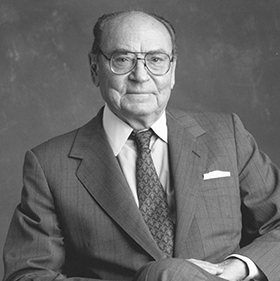
Photo of Arjay Miller

With the passing of Arjay Miller last week at 101, our nation lost a giant. Arjay defined the Greatest Generation and built a life and legacy through his service to others. Organizations across the United States—PPIC among them—owe an enormous debt of gratitude to this visionary and determined leader. It is our obligation now to fulfill that vision of leadership—private and public—for the common good.

Along with William Hewlett and Roger Heyns, Arjay co-founded PPIC in 1994. He served as the chair of PPIC’s board of directors from 1995 to 1998 and remained a member of the board until 2006. In 2000, he and his wife gave a generous gift to PPIC to create the Arjay and Frances Fearing Miller Chair in Public Policy. He was responsible for helping to secure a solid financial foundation for PPIC and for establishing many of the principles and policies that guide us to this day. Why focus on California, rather than the nation? “The rest of the country follows us,” he said at the time, citing issues ranging from clean air to affirmative action. His prescience was a gift to the people of California.

Arjay’s resume is the stuff of legend. He was one of the ten “whiz kids” who left the Pentagon after World War II and played a major role in reversing the fortunes of the Ford Motor Company. He was president of Ford from 1963 to 1968 and vice chair until 1969, when he was appointed dean of the Stanford Graduate School of Business. There, he established the Public Management Program that has trained thousands of public sector managers and has also educated private sector leaders about public needs. Explaining his desire to instill public service values in the MBA worldview, he said, “Making money is the easy part. Making the world a better place in which to live is the hard part.” He served as dean for ten years. Under his guidance, the business school appointed its first women and ethnic minority faculty members and greatly magnified its prestige.

Arjay’s civic achievements are enduring. He was also the founding chairman of the board, and a life trustee, of the Urban Institute. He was an honorary trustee of the Brookings Institution; a board member of the Mellon Foundation, the William and Flora Hewlett Foundation, and SRI International; and a chairman of the Bay Area Council. Over the years, he also served on the boards of numerous corporations, including Ford, the Washington Post Company, Wells Fargo Bank, Levi Strauss & Company, and Burlington Northern.

Our thoughts and deepest sympathies go out to Arjay’s children, Ken and Ann, and the entire family. On a personal note, I feel deeply fortunate to hold the Arjay and Frances Fearing Miller Chair in Public Policy at PPIC and to have spent time with Arjay and his family over the years. I have been the lucky beneficiary of his storytelling—life lessons delivered with trademark modesty and wicked humor. He has been a friend, mentor, and trusted advisor to me.

During Arjay’s last visit to PPIC in April of this year, he celebrated the success of the institute he helped build and asked us to do more. We intend to honor his request.

New Laws Expand Criminal Justice Reforms

Governor Jerry Brown recently signed a number of bills that extend the state’s efforts to reform California’s adult and juvenile criminal justice system. This legislative package supplements previous reforms; several of the new laws could further reduce the state’s prison population, which remains subject to a court-ordered population target. The bills cover issues at all levels, including arrest, conviction, incarceration, and parole.

Arrest and conviction

  • SB 395 strengthens protections for arrested minors under the age of 16 by requiring that they confer with an attorney prior to waiving their Miranda rights and being interrogated by police. AB 529 allows juveniles to have their records sealed if they are not convicted. SB 312 allows juvenile offenders convicted of serious or violent offenses committed after the age of 14 to have their records sealed.
  • SB 393 allows adults to request that the court seal their records if they are arrested but not convicted.

Sentence enhancements

  • Sentence enhancements allow prosecutors to seek additional prison time in certain circumstances—such as the use of a firearm or gang involvement. The number of enhancements has increased dramatically over the past 30 years. SB 180 eliminates the three-year sentence enhancement for certain circumstances related to selling drugs, though it leaves in place the enhancement for using minors in the sale of illegal drugs. SB 620 allows judges the discretion to dismiss or strike sentence enhancements for offenders who are in possession of a firearm while committing a crime.

Parole

  • AB 1308 and SB 394 raise the age limit for youth parole from 23 to 25, and grant the possibility of parole for juvenile offenders serving life sentences after they serve at least 25 years.
  • AB 1448 allows certain offenders older than 60 who have been incarcerated for more than 25 years to be released to parole. It is worth noting that AB 1448 codifies a practice that has been helping the state reduce overcrowding: a total of 557 offenders were released under this program between February 2014 and August 2017.

Impact of supervision on juveniles and families

  • SB 625 reinstates honorable discharges for juvenile offenders who have “proven their ability to desist from criminal behavior.” An honorable discharge removes long-term penalties, such as the ban on juvenile offenders working as police officers.
  • SB 190 limits the financial liability of families for the housing, transport, or supervision of juvenile offenders.

The goal of these laws is to improve offender outcomes by emphasizing rehabilitation and reentry to the community—and possibly reducing pressure on the state budget. State lawmakers believe these bills are grounded in evidence-based practices. For example, the reduction of long-term penalties for juveniles and young adults is grounded in neuroscientific evidence that decision-making ability does not mature fully until the mid-20s.

Two bills that aim to reform the state’s bail system, AB 42 and SB 10, did not reach the governor’s desk this legislative year. However, the debate over bail reform will most likely continue in 2018. Advocates for reform believe that evidence-based practices that base pre-trial release decisions on an offender’s likelihood of appearing in court or reoffending—not his or her financial means—could significantly reduce the number of pre-trial offenders held in county jails. Opponents believe that the current bail system is the best way to make pre-trial release decisions while protecting public safety.