Video: Keeping Students on Track for College

Only about 30% of California 9th graders are expected to earn a bachelor’s degree—a startling statistic in a state that faces a shortfall of college graduates. A new PPIC report finds that the vast majority fall off the path to a college degree in the last two years of high school or the first two years of college.

Report coauthor Niu Gao presented the analysis in Sacramento last week, along with recommendations for tackling the problem. Among them: updating high school graduation requirements, offering more of the college preparatory courses required for admission to California State University (CSU) or the University of California (UC), and improving placement policies in both high schools and community colleges to ensure that students take the classes needed to progress.

Gao’s presentation was followed by a panel discussion among experts who work in this area. In a conversation moderated by Hans Johnson—report coauthor, and director and senior fellow at the PPIC Higher Education Center—participants touched on challenges, as well as potential solutions.

Jorge A. Aguilar, superintendent of the Sacramento City Unified School District, noted that while more students are completing college prep courses—known as a–g courses—many aren’t making it to or through college. Part of the problem, he said, is the “fundamental disconnect between K–12 and higher education.” Having worked in both sectors, he noted there are insufficient incentives for school districts to focus on persistence in higher education and for higher education to work with K–12 on the issue.

Kimberly Rodriguez, chief education advisor to Kevin de León, state senate president pro tempore, addressed one of the report’s key recommendations: increasing state high school graduation requirements in math. She noted that requiring a–g courses for graduation has been much discussed at the state level.

“The biggest barrier has always been money,” she said. “Because once you require it, the state is on the hook.” Implementation is also complicated, she said, requiring planning and attention to infrastructure—as districts that have already adopted these requirements have found.

The third panelist, Jim Dragna, talked about a promising initiative. Known as the “graduation czar” at CSU Sacramento, he supervises the Finish in Four program. Students are asked to pledge to take 15 credits a semester—the number needed to graduate in four years—and are provided extra resources to ensure they stay on track.

“Student progression problems have been with us so long that they’ve become part of the culture,” he said. So, he continued, “we tackled the culture.”

California Needs More College Prep Courses

Most California high school graduates are not ready for college. Despite the steady improvements over the past decade, less than half of graduating seniors in the class of 2016 completed the a–g requirements, the set of courses high school students must complete to be eligible for admission to the University of California (UC) or California State University (CSU). The completion rate is substantially lower among Latino (37%), African American (34%), economically disadvantaged (37%), and English Learner (10%) students.

PPIC’s new report looks at the role of several institutional factors that may improve the completion rate, including high school graduation requirements, course placement policies and practices, and academic counseling and advising. But there is another significant barrier: not every high school in California offers the full a–g course sequence.

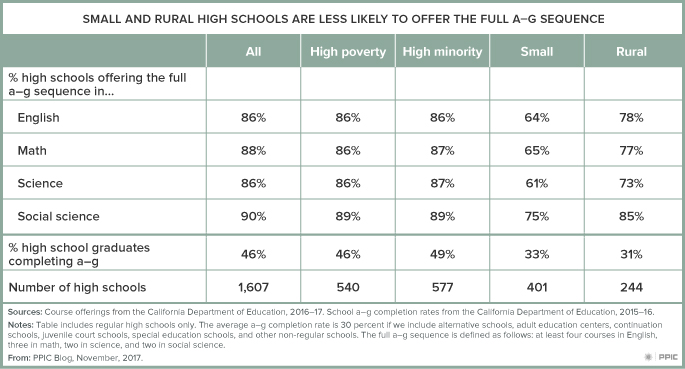
During the most recent school year (2016–17), 12% of California high schools did not offer the full math sequence, which includes algebra 1, geometry, and algebra 2. Similarly, 14% of high schools did not offer four years of a–g approved English courses. High-poverty schools (where more than 75% of students are eligible for free or reduced-price lunch) and high-minority schools (where more than 75% of students are African American or Latino) were just as likely as schools overall to offer the full sequence. But small schools (those at the bottom 25th percentile of the enrollment distribution) and rural schools were much less likely to do so. Close to 40% of small schools did not offer the full science sequence, which includes two years of approved science courses, and more than a third did not offer the full math or English sequence.

The difference in course offerings has contributed to low a–g completion rates at small and rural schools. For instance, the average a–g completion rate is 46% among all high schools, but only 30% or so among small or rural schools.

College Prep Blog Table

To improve student readiness for college, districts and schools need to increase the number of a–g approved courses. However, some schools may face capacity and resource limitations, such as not having enough qualified teachers. One solution is to establish a regional or statewide virtual school network so students in small or rural schools can enroll in online courses offered by other districts. Several states—including Florida (Florida Virtual Education), Wisconsin (Wisconsin Digital Learning Collaborative), Texas (Texas Virtual School Network), and Georgia (Georgia Virtual School)—have in recent years partnered with school districts to provide academic courses and test prep for all middle and high school students. California’s UC Scout program is a step in the right direction, providing a full set of online a–g courses accessible at no cost to students at participating schools.