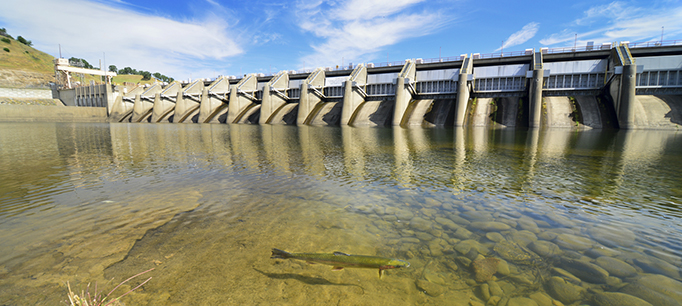
California’s Ecosystems in Perpetual Drought

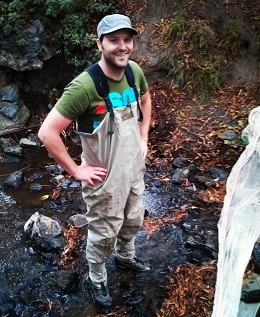
Freshwater species—especially fish—are in trouble, and it’s not just the latest drought that put them there. We talked to Ted Grantham, a river scientist at UC Berkeley and a member of the PPIC Water Policy Center’s research network, about the status of the state’s freshwater ecosystems.
PPIC: Drought has really hurt populations of native fishes. Aren’t these fishes adapted to drought?

Ted Grantham: California’s native fish have been in steady decline for at least 50 years—in part due to dams, habitat degradation, and the introduction of non-native species. Drought is an added stressor. California has a highly variable climate, with dramatic changes in rainfall and stream flow from year to year. Native fishes have developed several strategies to cope, but key to their long-term survival is their ability to recover from drought during wet years. It’s a “boom and bust” ecosystem. The problem is that we capture and divert a significant portion of available water in wet years, making it harder for the fishes to recover. Since 1975 the state has had about 15 years that were above-normal or wet years. But in the Delta, for example, the ecosystem only experienced about half that many wet years because of water diversions. During this same period, California has had fewer than five extreme dry years, but the Delta experienced about 20 from the ecosystem’s perspective. Essentially, our freshwater ecosystems are now experiencing a perpetual drought. The boom and bust ecology has lost its boom.

PPIC: A number of California fish populations hit new lows in this drought. What can we do to prevent extinctions?

TG: There are at least three strategies that would help us better manage our native freshwater fishes. First, we need to better define the amount of water needed to sustain healthy fish populations. The ability to protect flows for ecosystem benefits also depends on an accurate accounting system for tracking water availability and use; we have a long way to go on this. And we need to recognize that not all streams are created equal—some streams are disproportionately important for supporting biological diversity. Currently, the state doesn’t have a plan to identify and protect those areas. We need to be more strategic in conserving the places that matter most.

PPIC: What kinds of problems will climate change pose for California’s ecosystems, and what can we do about it?

TG: For many of our native fish species—especially salmon—California is the southern extent of their natural range. So we’re already at the limits of their tolerance for warm temperatures. As the climate gets warmer, life will be increasingly difficult for these species. We’re already seeing that species dependent on cold water are responding to climate warming by moving to cooler streams, such as those at higher elevations. The problem is we’ve constructed so many dams on our rivers that fish might not be able to migrate to these preferred locations—the dams act as barriers to fish movements. California has at least 1,400 large dams and thousands of smaller ones. We need to start identifying critical barriers to fish movement and take a closer look to determine if modifying these structures—or in some cases removing dams—is a feasible strategy to restore connectivity in our rivers and streams.

The second adaption strategy is protecting “climate refugia”—areas naturally buffered from climate change—to support cold-water species. Some rivers and streams appear to be more resilient to climate change and provide sustained, cool flows despite warming air temperatures—because they are fed by groundwater springs or have a northern exposure, for example. Identifying and protecting these kinds of refugia could help minimize the loss of species in a warmer future.

I am actually optimistic about the future. Although the drought has severely affected California’s freshwater ecosystems, it also has raised awareness about the need to improve water management and better prepare for climate change. We’ve begun to address longstanding problems, such as poor groundwater management. We’re also starting to realize that the health of our ecosystems is tied to the reliability and quality of our water supply, which is leading to creative and more integrated solutions that balance human and ecosystem needs.

Learn more

Read “How Much Water Does Nature Need?” (PPIC blog, June 29, 2016)
Read “Lessons on Sustaining the Environment During Drought” (PPIC blog, June 23, 2016)
Visit the PPIC Water Policy Center’s ecosystems resource page

Commentary: Coping with 17 State Ballot Propositions


This commentary was published in the Los Angeles Times today. Thursday, August 18, 2016.

This fall, Californians will face the daunting task of determining the fate of 17 state propositions. Local ballots will add their own initiatives to this burden. It’s been a dozen years since a ballot was as challenging. How will voters respond?

Read the full commentary on latimes.com.

Learn more

PPIC Statewide Survey: Californians and Their Government (May 2016) 

Improving On-Time Completion: Year-Round Pell Grants

California and the nation as a whole are pushing for more students to graduate from college in four years. This would not only open up more spots for new students, but also allow students to spend less money on tuition and fees and enter the workforce sooner―creating benefits for both students and the state.

In the graduating class of 2015, 64% of UC and 19% of CSU students graduated within four years. While both systems have made commendable gains since the graduating class of 2005―UC’s on-time graduation rate is 10 percentage points higher and CSU’s has increased by 6 points―there is room for improvement.

We recently looked at the University of Hawai‘i’s 15 to Finish campaign, which has shown early success in encouraging students to take more units per semester and improving on-time graduation rates. However, not all students can take 15 units every semester—and this inability can increase their time to completion. For example, a student who takes 12 or 13 units each semester needs an additional year to complete a four-year degree.

One possible way to help lower-income students graduate on time is to bring back the year-round Pell Grant, which was introduced in the 2009–10 academic year to supplement the original Federal Pell program. The year-round grant allowed students who had exhausted their academic-year Pell awards to pay for summer courses as long as at least one of the units counted toward the next academic year. Funding was also available to students who had not completed the standard unit load due to unforeseen circumstances, allowing them to catch up during the summer. Either way, the year-round Pell provided students unable to take 15 units a semester a pathway to graduate on time.

The year-round Pell was cut in 2011 in response to rising costs—a result of more students becoming eligible and enrolling in college. This cut was part of a compromise that prevented proposed reductions in the maximum award amount from occurring. Because the year-round program was short-lived, we can’t assess its impact. Congress has shown some interest in reviving the year-round Pell, but lawmakers have not passed a bill restoring it, as the Senate and House have differing views on bringing it back.

Given the current focus on improving both student completion and institutional efficiency, it may be time to take another look at a year-round Pell Grant program. Providing more opportunities, especially affordable ones, for summer coursework could help more students graduate on time, make better use of campuses, and help California—and the rest of the nation—meet future demand for educated workers.

Learn More

Visit the PPIC Higher Education Center

Climate Change and Partisanship

Ten years ago, California led the nation in climate change policy when it passed the Global Warming Solutions Act of 2006, landmark legislation that required the state to reduce greenhouse gas emissions to 1990 levels by 2020. While passed largely along partisan lines, Assembly Bill (AB) 32 was signed into law by Republican Governor Arnold Schwarzenegger. Notably, the law enjoyed the support of a strong majority of Californians—including two in three adults across parties—in our July 2006 Statewide Survey.

Today, the state is prepared to meet the reduction targets set forth in AB 32. As policymakers debate how to further reduce emissions, a strong majority of Californians continue to favor these targets. But now there is a wide partisan divide. An overwhelming majority of Democrats (80%) are in favor, compared to a majority of independents (56%) and fewer than half of Republicans (44%).

The evolving partisanship can also been seen in Californians’ views about the state’s role as a leader in global warming policy. In 2006, solid majorities of Californians across parties were in favor of California making its own global warming policies separate from the federal government. Today, a solid majority of adults are still in favor, but the partisan divide has widened. Democratic support has held steady (73% in 2006, 70% today), but support among Republicans (62% in 2006, 49% today) and independents (70% in 2006, 55% today) has declined by double digits.

What’s changed since 2006? In California, Republican Governor Arnold Schwarzenegger has been replaced by Democratic Governor Jerry Brown, who has been a vocal leader on climate change and made the issue a major component of his agenda. At the national level, there is a contentious debate about global warming, as well as a growing partisan and ideological divide.

Democrats and Republicans in our surveys have also become more ideologically divided. Democrats describing themselves as “very liberal” made up 14% of Democrats in our July 2006 survey, while that group encompasses 30% of Democrats today. Similarly, Republicans describing themselves as “very conservative” made up 21% of Republicans in July 2006. The “very conservative” constitute 31% of Republicans today.

Despite a widening partisan divide, Californians’ support for state policies to address global warming has been consistent in the 10 years since passing AB 32. Indeed, a strong majority of Californians (68%) favor a proposal to further reduce greenhouse gas emissions to 40% of 1990 levels by 2030. An overwhelming majority of Democrats (78%) support the proposed goals, compared to fewer than half of Republicans (39%). Independents are in the middle, with 59% in favor of the expanded goals.

Does the partisan divide on global warming policy mean that there is intraparty cohesiveness? Not necessarily. Among Democrats, there is strong majority support regardless of ideology and other demographics. But Republicans as a group are less cohesive. In fact, support for further reducing greenhouse gases exceeds 50 percent among nonwhite Republicans. Among independents, support for global warming policy mirrors that of the party that these nonpartisans lean toward.

Further reducing greenhouse gas emissions will be a real test for California as it seeks to address climate change. The ongoing political debate over global warming may well continue, and once more, the nation will be watching to see what California does next.

Three Lessons on Water Accounting for California

Californians are known to take pride in the state’s many exceptional characteristics. But in at least one important area, we’d be wise to learn a thing or two from our neighbors. Not only are the Golden State’s water management challenges shared by other western states, but many of these places use more advanced practices to understand how much water is available, who has claims to it, and how much is being used.

A new report by the PPIC Water Policy Center reviewed how California compares to other dry regions—11 other western states and Australia and Spain—in integrating water information into critical management functions. We found ample room for improving the state’s systems—especially for managing groundwater overdraft, defining environmental water needs, and stimulating water trading.

These three overarching lessons, drawn from our comparison study, have particular value for California:

  • Management of groundwater can be improved by adopting common standards for evaluating its availability and use. In most regions, including California, groundwater management is locally driven. Getting users to agree on long-term goals can be difficult when local agencies that share groundwater resources use different accounting methods to assess availability and use. Recognizing the need for better coordination, Australia developed accounting standards that ensure consistency across agencies. And Texas developed “authoritative” groundwater models that serve as an accepted standard for determining allocations and settling disputes, and are used as the default for local agencies. As a result, both places improved their cooperation and coordination over shared resources, and reduced costs. Establishing a set of standards could help California facilitate basin-wide planning as the state the Sustainable Groundwater Management Act.
  • Clearly defining environmental water needs makes decision-making easier for all water users. California still needs to consistently define the quantity, timing, and quality of water for environmental uses in most watersheds throughout the state. This will not only benefit the environment but also reduce uncertainty for other water users who rely on watershed resources. For instance, Washington is defining water budgets that clarify environmental needs for each sub-basin in the state. A pragmatic path for California is to develop watershed-based environmental water budgets that integrate local watershed goals such as ecosystem health and water supply objectives.
  • A well-functioning water market stands on three legs: clarity on water claims, certainty on water use, and strong systems to manage and share information. Water trading is a key tool for shifting water from less critical uses during times of scarcity. Trading opportunities in California are limited by a lack of information. Improving our understanding of how much water is used under each water right (and how much returns to streams and aquifers) is critical for determining the volumes of water that can be traded without harming other users. Idaho and Colorado have made great strides in this area. California would also benefit from more detailed, publicly disseminated information on volumes, prices, and locations of water trade agreements. The water market in Victoria, Australia, leads the way in providing timely and accessible information on water rights, allocations, and trading.

Investing in water accounting can stretch supplies during times of scarcity, as has been demonstrated in other dry regions. Making a commitment to comprehensive, authoritative, and user-oriented water accounting now, as other states and countries have already done, will help California become more resilient to the challenges posed by future droughts and climate change.

Learn more

Read the report Accounting for California’s Water (July 2016)
Visit the PPIC Water Policy Center

Spending on Corrections and Higher Education

California has long been criticized for its growing corrections expenditures, especially as General Fund spending on higher education has declined. The beginning of a new budget year is a good time to examine where the state now stands on spending in these two key areas.

California’s legislature recently adopted a budget for 2016–2017 that devotes $14.5 billion of General Fund revenue to higher education institutions, including the University of California, California State University, and California’s community college system. It allocates $10.6 billion for operations of the California Department of Corrections and Rehabilitation (CDCR), which is responsible for adults in state custody and parolees under state jurisdiction.

These budget allocations reflect a striking shift from California’s budget of forty years ago, when the state spent a larger share on higher education and a much smaller share on corrections. But by the 2008–2009 budget year, allocations to higher education (11.1%) and corrections (10.7%) were almost identical. In the years since, higher education spending has outpaced corrections in relative terms, largely because recent criminal justice reforms have drawn down the number of adults in state custody and on parole. Nonetheless, California spends more on corrections and less on higher education today, in relative terms, than at nearly any point in the past thirty years.

Despite these dramatic trends, spending in each area has actually increased alongside of growth in the populations served. Enrollment in higher education institutions has increased roughly 50% since the 1977–78 academic year; the budget has increased 65% (according to CPEC Fiscal Profiles). Until 2011’s realignment of California’s corrections responsibilities, the number of adults in CDCR custody had increased 555% and the budget increased 526% (CDCR Monthly Population Reports).

Clearly the costs of serving these two populations are different. On average, the cost of the CDCR population is much higher than the cost of students in higher education. Within each area, costs per person vary as well. The cost of educating a student at UC far exceeds the cost of doing so at a community college. Similarly, the cost of incarceration far exceeds the cost of supervising a parolee in the community. Although the per person cost of delivering services has risen over time, the dramatic increase in the prison population has been the key driver of the dramatic shift.

To reverse these trends, the state must identify and disseminate cost-effective strategies to reduce recidivism, further diminish California’s crime rates, and ultimately reduce the prison population enough to allow for the closure of state facilities or the elimination of in-state and out-of-state contract prison beds used to relieve overcrowding. Corrections realignment reduced state prison and parolee populations, but the anticipated savings from this policy shift have yet to materialize. Moreover, the most recent reports show a small uptick in the corrections population (CDCR Monthly Population Reports). ​

In the meantime, California needs to find ways to accommodate more students in its higher education systems—which it could do at relatively low cost by reducing time to degree, or at higher cost by increasing financial aid or expanding the number of slots for students. At the end of the day, ensuring that more of California’s youth attend and complete college will reap positive long-term benefits for the state, helping to meet the needs of the state’s future economy and create a brighter future for all Californians.

Chart source: California Department of Finance Chart C-1 Program Expenditures by Fund.

Learn more

Will California Run Out of College Graduates?
“California’s State Budget”
California’s Future: Corrections

Video: Assessing California’s Global Warming Law

Ten years ago, California enacted a law to combat global warming that set an ambitious goal: reducing greenhouse gas emissions to 1990 levels by 2020. Today, the state is poised to reach this target, and policymakers are discussing aiming for a new one.

Each year since the law—AB 32—took effect, the PPIC Statewide Survey has examined Californians’ views on climate change and the state’s actions to address it. The survey has consistently found that most Californians believe that the effects of global warming have begun and that majorities support the state taking action to address it.

But a partisan split has emerged since the law took effect. AB 32’s goals no longer have the bipartisan support they did in 2006. Today, Democrats and independents are much more likely than Republicans to support the goals of AB 32. This divide is reflected in a number of findings in the 2016 Californians and the Environment Survey.

Research associate David Kordus presented the survey at a briefing in Sacramento last week.

How Green Is My Water?

Harmful plumes of algae in waterways have been much in the news lately, in California and nationally. We talked to James Cloern, a senior scientist at the US Geological Survey and a member of the PPIC Water Policy Center’s research network, about this pressing water quality issue.

PPIC: What are algal blooms, and how big a problem are they for California?

James Cloern: Our waterways are home to many thousands of species of microscopic algae, but only a few dozen can develop into harmful blooms. They become harmful when they either produce toxic chemicals, which can make people and animals sick, or disrupt biological processes like animal feeding or bird flight—some species excrete goo that can gum up birds’ wings.

There’s growing evidence that harmful blooms are increasing because we are over-fertilizing our lakes, rivers, and estuaries such as the Bay-Delta. This over-fertilization comes largely from the discharge of treated sewage or runoff of nutrient-rich water from farms, cities, gardens, and animal lots. Two nutrients are causing these problems: nitrogen and phosphorus.

Algal blooms can grow very rapidly when they have the right conditions: warm water, high sunlight, and high concentrations of nutrients. California’s latest drought coincided with record-high temperatures, which warmed waterways and was a contributing factor to a number of algal blooms around the state.

One really nasty algae—Microcystis—seems to be increasing globally. It has an advantage as the climate and waters warm. Microcystis has become a challenge in California. In recent years we’ve seen it bloom in the Sacramento-San Joaquin Delta, Pinto Lake, Pyramid Lake, Shasta Lake, and reservoirs of the Bay Area’s East Bay Regional Parks.

PPIC: Could climate change worsen this problem?

JC: There is still much to learn about the ecology of these blooms, but we know these events are strongly tied to climate and especially to extremes such as heat waves and drought as well as El Niño/La Niña cycles. One grand challenge is to understand the interactions between climate variability, including climate change, and over-fertilization. Developing that knowledge is critical for establishing the quantities of nutrients that cause more frequent or intense harmful blooms.

PPIC: How well prepared are we to manage these water quality challenges?

JC: Water managers today are asking three essential questions of the scientific community. First, at what point do we have to take action? Second, which nutrient do we tackle first? And third, what level of action is required?

These are challenging questions, and they have global implications. They’re important in densely populated urban areas, where we dispose of treated sewage in water bodies, and in areas where water bodies drain large agricultural areas.

California’s Regional Water Quality Control Boards are tackling these issues. They have two new programs on nutrient management—one for San Francisco Bay, one for the Delta. The technical solutions are very different for dealing with land runoff and sewage. The sewage issue can be solved technically, but the fix is expensive. The San Francisco water board is now trying to determine what level of impairment should trigger mandated water treatment to reduce nutrients coming into the Bay. Since the problem could cost on the order of $5–$10 billion to solve, board members don’t want to mandate unnecessarily strict changes.

The land-runoff challenge is much harder to address, because the source of pollution is the application of fertilizers on land, feedlots, and septic systems. Solving the problem will require substantial behavioral changes such as new farming practices. But it has been done elsewhere—for example, Denmark mandated national-scale action to reduce both nitrogen and phosphorus.

We have a clear understanding of how nutrient pollution can make our waters unswimmable, unfishable and undrinkable. Solutions to the nutrient pollution problem exist, but they have costs. Californians must decide if the benefits justify the expense.

Learn more

Read “California’s Water Quality Challenges” (PPIC Water Policy Center fact sheet, October 2015)
Visit the PPIC Water Policy Center water quality resource page