
Understanding California’s balance sheet for water—how much there is, who has claims to it, and what is actually being “spent”—is key to effective and sustainable water management, especially during droughts. But the state’s system of accounting is outdated and ineffective for managing some of our biggest water challenges, according to new research from the PPIC Water Policy Center.
A group of water management experts gathered to discuss the topic at a PPIC event last week.
“The drought has spotlighted weaknesses in California’s water accounting,” said PPIC researcher Alvar Escriva-Bou. These weaknesses make it harder to manage groundwater, water for the environment, surface water allocations, and water trading, he said.
Better information about groundwater use and claims is an especially urgent need. Lance Eckhart, director of basin management and resource planning for the Mojave Water Agency (which relies 100% on groundwater), said, “It’s probably going to take a generation” to bring the state’s over-drafted basins into balance. “The way you do that is by collecting good data…to quantify how much you have going in and how much is going out.” A lack of good information increases conflict over the resource, he said.
Tom Howard, executive director of the State Water Resources Control Board, noted that California has made “huge improvements” in managing information about water rights in the past six years. “But there are still a lot of blank spots” in the state’s water accounting system—for example, understanding how much water returns to the system from farms.
The drought revealed major weaknesses in how the state accounts for environmental water. Maurice Hall, associate vice president of water for the Environmental Defense Fund, said tightening the system of environmental water management through better information would allow managers to “specifically put the water where it needs to be for the fish and wildlife” and enable them to “defend the actions we are making for those wildlife.”
The issue of cost prompted a lively conversation about how we currently value water and how to fund the modernization of the system. Ellen Hanak, director of PPIC’s Water Policy Center, put the cost in context: “California annually spends $31 billion on our water system overall… And then look at the size of our economy—over $2 trillion. In the scheme of things, we ought to be able to find a little more money to do these kinds of things.”
Escriva-Bou and Hanak are coauthors of a new report that compares California’s water accounting systems to those of 11 other western states, Australia, and Spain. The authors identify gaps in California’s water information systems, and propose a dozen ways to bridge them.
Read the report, Accounting for California’s Water (July 2016)
Visit the PPIC Water Policy Center

 Since 1980, personal income has grown at vastly different rates across the state. Workers in the Bay Area and Orange County earn substantially more (on an aggregate, per capita basis) than the average Californian. Residents in the Central Valley and Sierras, the Inland Empire, and the far north earn substantially less than the statewide average. These disparities have grown over time. In 1980, per capita regional income ranged from 80% to 111% of statewide per capita income. Today, this range is wider, with the Inland Empire at 66% and the Bay Area at 138% of the statewide average.
 However, the value of post-secondary degrees has been increasing even in occupations that traditionally have not required college education—including the jobs that comprise a larger share of the economy in lower-income regions of the state. So we might expect regional disparities in college degree attainment to be narrower today. But this is not the case.
 Both measures hold promise for raising significant funds and represent an alternative source of revenue in a state that is heavily dependent upon personal income taxes. Together, they could bring in more than $2 billion in state revenue. This would be significantly more than the state’s other sin tax on alcohol, which raised about $350 million in 2014.
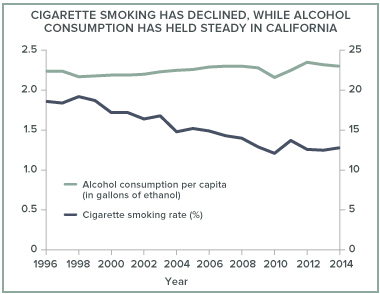 Nationally, California had the second-lowest cigarette smoking rate in 2014 (after Utah). But it’s worth noting that e-cigarette use nearly doubled among California adults from 1.8% in 2012 to 3.5% in 2013, complicating estimates of future revenue. If passed, the tax would also apply to e-cigarettes. If Californians use e-cigarettes as a substitute for cigarettes, then the measure will also capture revenue due to increased e-cigarette use. As we noted in our recent report, the additional revenue generated by taxing marijuana could be as much as $1 billion a year for the state. In the first full year after legalizing recreational marijuana, Colorado raised just over $120 million in state revenue, and Washington collected slightly less than $130 million. Given California’s larger population, the $1 billion figure is in the right ballpark. But since much is still unknown about the marijuana market, any estimate should be treated with caution.
 The proposed taxes would be comparable to those currently in place in other states. If the tobacco tax passes, it would boost per capita revenue from $21 per resident to $50 per resident. This would still be below the national average of $57 per resident, though it would be much closer. For marijuana, the estimate of $1 billion in revenue would translate to about $26 per resident. Though there isn’t a national reference point for marijuana taxes, this number would be higher than the per capita amounts raised in Colorado and Washington. Interestingly, California’s alcohol tax revenue is less than most other states. On a per capita basis, California ranks 40th of the 50 states in alcohol revenue collected. In 2014, California collected only $9 per resident in alcohol taxes compared to the rest of the country, which raised $21 per resident. Doubling this rate—which would still be below the national average—could add another $350 million to state revenues.
 Californians with education credentials beyond high school, from an associate’s degree up to a doctoral degree, have lower than average unemployment rates in general – and had smaller spikes in unemployment during the recession. Even workers with just some schooling beyond high school, but less than an associate’s or bachelor’s degree, fare systematically better than those without any college experience. The following figure shows how unemployment varied according to education levels since 2008. These estimates rely on detailed Census Bureau survey data, which is produced with a significant lag, so the most recent information we have pertains to calendar year 2014.


 The data strongly indicate that Proposition 47 is a major factor in these changes. First, monthly arrest data show abrupt changes in drug and property arrests in November 2014, the month Proposition 47 went into effect. Second, the drop in felony arrests was almost exclusively for drug and property offenses, while the increase in misdemeanor arrests was almost entirely for drug and property offenses. Arrests for motor vehicle theft, which continues to be a felony after Proposition 47, is the only area of increase. Possibly in response to the 13% increase in auto thefts in 2015, motor vehicle theft arrests went up by 26%.

 In 2015, about 38% of California’s high schools (480 total) were high need based on high rates of enrollment for English Learner, low-income, and foster care students. These schools educate about 34% of all high school students in the state. High-need schools also serve higher proportions of students traditionally underrepresented at UC: about 43% of the African American students in the state and about 51% of California’s Latino students.
 On average, students from high-need schools are slightly less likely to enroll in a UC. About 5.4% of all graduates enroll in a UC at a typical high-need school, compared to 6.5% for a typical regular school.
