Do Californians Support the Proposed School Bond?

When Californians go to the polls in March, they will not only cast a vote in the presidential primary—they will also vote on an education bond to fund construction and modernization projects. Given differences in support for the bond across the state’s regions and demographic groups, turnout will play a pivotal role in whether this measure passes.

In the closing days of the legislative session, the legislature passed and the governor later signed a bill placing Proposition 13 (the Public Preschool, K–12, and College Health and Safety Bond Act of 2020) on the March ballot. If approved by voters, the measure would authorize $15 billion in general obligation bonds to pay for the construction and modernization of California’s public schools, community colleges, and four-year colleges.

The September PPIC Statewide Survey took an initial look at support for this proposition. While two-thirds of Californians (66%) are in favor, 54% of likely voters say they would vote yes—just slightly above the majority needed to pass.

Are some Californians more likely than others to support the bond measure? Unsurprisingly, there is a wide partisan divide, with three in four Democratic likely voters (76%) saying they would vote yes compared to just three in ten Republicans (29%). Overall, independent likely voters are divided (48% yes, 44% no). But among Democratic-leaning independents, nearly two in three (64%) are supportive.

Support varies across regions, with Los Angeles (59%) and San Francisco Bay Area (57%) likely voters expressing the most support, compared to about half of likely voters elsewhere in the state.
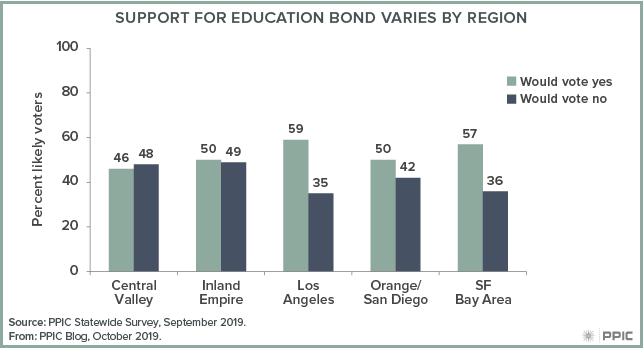
figure - Support for Education Bond Varies by Region

While support is similar among likely voters with (55%) and without (53%) children in the house, there are differences across other demographic groups.

White likely voters (47%) are much less likely than Latinos (74%) and those of other racial/ethnic groups (62%) to say they would vote yes. And since school construction bonds are often paid off by property taxes, it’s notable that homeowners (44%) are far less likely than renters (71%) to say they would vote yes. Support is higher among younger likely voters (66% age 18 to 44, 48% age 45 and older). It declines as education and income levels increase.
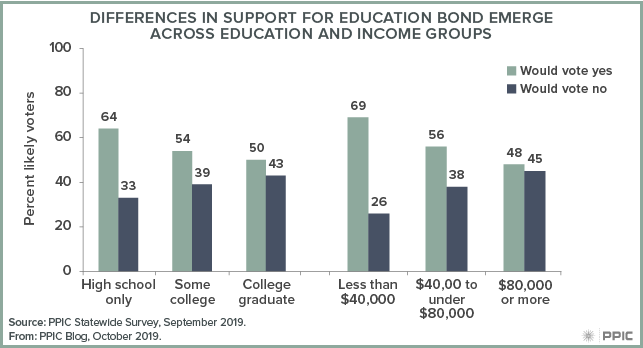
figure - Difference in Support for Education Bond Emerge Across Education and Income Gaps

Overall, support for the education bond currently hovers at around half for likely voters, but there is much stronger support among many regional and demographic groups—suggesting that passage could depend on who shows up to vote. If Democrats and Democratic-leaning independents turn out in large numbers for the presidential primary, that could affect the fate of this bond. Stay tuned to the PPIC Statewide Survey as we continue to track this measure in advance of the March primary.

Video: Improving Educational Opportunity in California

What is the one thing that could be done to improve educational opportunity in California? Mark Baldassare, PPIC’s president and CEO, posed this question at the start of his conversation with Linda Darling-Hammond, president of the California State Board of Education, and Eloy Ortiz Oakley, chancellor of the California Community Colleges.

Darling-Hammond responded with a list of five major characteristics of school systems in other countries and states that have closed “opportunity gaps”: an equitable, adequate funding system; high-quality teachers and leaders; a thoughtful curriculum and assessment system; wrap-around support for students; and schools designed to allow for productive learning.

Then she circled back to California’s “number one thing”: “We’ve got to fix the teacher shortage—and we’ve got to do it quickly, purposefully, and soon.”

For Oakley, the “one thing” is to change “how we look at education, how we look at opportunity in California.” In short, we need to stop providing “the least amount of resources to the students, the communities that need them the most.”

A key part of this change involves “blurring the line” between the K–12 (or “TK–12”) and community college systems. Oakley noted: “There was a point in time when we felt that a high school diploma was the default to get into the workforce. Those days are gone. . . .We need to see the path to community college as the required path for everybody to get some sort of post-secondary credential.”

Darling-Hammond agreed that the two systems can and should work together. A good example of productive collaboration, she added, is concurrent enrollment, which allows high school students to take college courses (and earn college credit). These programs help students “find their passion” and move toward meaningful careers.

Funding is another key issue for both systems. Darling-Hammond pointed to the impact of significant post-recession increases in funding during the Brown and Newsom administrations and the potential impact of the governor’s commitment to early childhood education. But, she added, “just to get to the national average . . . we need about $12 billion more in the TK–12 system.”

Oakley agreed that “for those of us who managed our way through the recession, we’re certainly in a much better place.” The community college system could certainly benefit from more funding, he added, but state investments in early childhood education might be even more beneficial: “If we could prioritize the funding at the lowest level, for the youngest learners, that would make our job in the community colleges easier.”


Taking on Tough Challenges at the State Water Board

The State Water Board is central to addressing many of California’s major water challenges, including protecting water quality for drinking and for the environment, addressing drought and water conservation, and managing the allocation of surface water. We talked to Sean Maguire, a civil engineer who was appointed to the board by former governor Brown in December 2018, about priority issues.

Photo of Sean MaguirePPIC: What are the big challenges the board is grappling with right now?

Sean Maguire: At the top of our list is the Bay Delta water quality control plan. The plan, which covers the Sacramento–San Joaquin watershed and Delta, must ensure a reliable water supply and protect the basin’s fisheries and ecosystems. We’re working through a process that is very complex and has a lot of moving pieces—and right now it’s unclear if we’re on track to meet all of these goals. But it’s exciting to think there is a stakeholder-devised solution at hand—the voluntary agreement process—which would set out a plan to manage multiple rivers in a coordinated way, coupled with large-scale habitat restoration and science programs. There is still a long ways to go, but I have hope that voluntary agreements will prove to be the best path forward.

At the same time, we’re preparing for climate change. It’s clear that going forward we have to be incredibly efficient in our water management. The last drought resulted in legislation to establish indoor and outdoor water use efficiency targets and to require urban suppliers to develop stronger drought contingency plans. Many small water systems rely on a single source—most often groundwater—and we’re helping them find opportunities to connect to larger communities and identify new supplies. This is where water portfolios can help build resilience to drought and get us ready for a changing climate.

And finally, the most exciting news is the establishment of the Safe and Affordable Drinking Water Fund earlier this year. California has 7,000 water systems and hundreds of thousands of residents using domestic wells—a situation that presents a lot of challenges because many struggle to meet drinking water standards. The fund is a high priority for us, and we’re committed to coming up with a plan and policies to implement it, while also working on projects that can get started right away.

PPIC: Talk about contamination challenges.

SG: Water contamination is a huge challenge for the whole state. There are so many different sources, and many contaminants of emerging concern. The board is at the beginning of tackling PFAS contamination. This is a class of “forever chemicals” used in a wide range of products—for example, nonstick coatings, water repellants, take-out containers, and fire retardants. We’re moving quickly to better understand the risk by requiring testing wells in close to possible source sites (such as defense facilities, landfills, and airports), and also requiring those facilities to test local groundwater. We are also working to understand the human health effects, which will take some time.

PPIC: What gives you hope?

SG: In the past year, there’s been incredible collaboration surrounding really controversial water issues that have lingered for decades. I’m very hopeful about the stakeholder-informed solutions that are arising out of these processes. In addition to the Bay Delta process, we now have a strong wetlands policy—a collaborative solution that was a decade in the making. We have another stakeholder plan to address legacy pollution from farming and other discharges in the Central Valley. I hope we can repeat this type of collaboration with other issues and in other watersheds across the state. I have a lot of hope for the groundwater sustainability plans that are being developed now in the state’s overdrafted basins. And I believe the governor’s upcoming water resilience portfolio will give us a roadmap to help California prepare for the climate changes to come.

The state has a lot of complex water problems, and we can’t untangle them all with one brilliant policy change. But we’re making progress on many difficult issues, and I’m committed to keeping up the momentum.

Video: Poverty and Opportunity in California

Although California has seen strong job growth in recent years, poverty remains persistently high. In many inland regions, the prevalence of unemployment or low-wage work is a key driver of economic hardship, while elsewhere—especially in coastal areas—the high cost of housing and other necessities plays a major part.

At an event in Sacramento last week, PPIC researcher Tess Thorman discussed the latest findings from the PPIC-Stanford California Poverty Measure (CPM), and a panel of experts discussed the role that policymakers, community organizations, and other stakeholders can play in reducing poverty and broadening economic opportunity.

Poverty has declined—slowly—in California, Thorman said. Also, while nearly 7 million people in California (17.8%) are in poverty, a roughly equal number are living just above the CPM poverty threshold. Certain groups are more likely to be living in poverty, such as young children, Latinos, and families without any college graduates.

Panelists discussed the key role that housing stability plays in achieving financial security. Richard Raya, director of Mission Promise Neighborhood in San Francisco, said his organization connects families with a range of supports, including below-market rental housing. He explained how the city has partnered with local foundations to create “an ‘accelerator fund’ that allows affordable housing developers to identify existing apartment buildings that are rent-controlled” and purchase them in order to keep them affordable – an approach Raya says could be a model for other communities.

Kimberley Johnson, director of the California Department of Social Services (CDSS), underscored how housing and financial stability are fundamental to meeting educational and career goals. Johnson noted that the governor has boosted investments in key elements of the social safety net, such as CalFresh food assistance and the California Earned Income Tax Credit. An important focus for CDSS currently is creating linkages across “a very robust array” of programs and services to make them more accessible to those in need.

California Bridge Academies, launched in Fresno and now active in six counties, offers a voluntary, 18-month program designed to help families exit poverty. According to founder Pete Weber, each household has a “career and family navigator” who assesses needs, skills, and interests. The navigator ensures that “each client is connected to the right on-ramps” so that parents as well as their children receive all necessary services and supports.

The panel highlighted the importance of coordinating services with an eye toward improving family well-being. Caroline Danielson, PPIC policy director and senior fellow, discussed the importance of creating linkages “across different kinds of programs” because “it can be a fragmented safety net.” Danielson pointed out that California has made progress in this effort, while also noting that further efforts to “connect these dots” for children could make a substantial difference in poverty.


2020 Primary: Funding Higher Education Facilities

The state legislature recently passed a $15 billion bond measure to fund upgrades to education buildings and facilities. Voters will decide whether to support this bond as part of the March 2020 primary ballot.

For higher education, the measure would provide $6 billion to the state’s three higher education systems, the University of California (UC), the California State University (CSU), and the California Community Colleges (CCC). These funds would be distributed equally ($2 billion each)—even though the systems enroll significantly different numbers of students.

The legislature will approve specific projects as part of the annual budget process. As a condition of making funds available, the bill requires UC and CSU to develop affordable housing plans for their students.

figure - Proposed Bond Funding Varies on a per Student Basis

The last time the state proposed and passed a ballot measure supporting higher education was more than a decade ago. Proposition 1D (2006) passed with almost 57% support. The total amount of funding for higher education in that initiative was about half of what is proposed in the current measure ($3.1 billion compared to $6 billion).

figure - 2020 Initiative Proposes Much More Funding for CSU and CCCs than the 2006 Measure

During the Great Recession funding for UC, CSU and the community colleges fell. One of the ways the systems responded was to defer maintenance on buildings, foregoing repairs and upgrades as a way to save money in the short run. Our estimate of the cost of addressing the resulting backlog of capital projects tops $30 billion for the UC and CSU systems. The proposed ballot initiative would provide bond authority to cover a little more than 10% of that.

The state’s community colleges are in a slightly different position. Local community college districts can issue their own bonds and make most of their own capital finance decisions. Since passage of Proposition 39 (2000), which made it easier for community colleges to pass bond measures, community college districts have been relatively successful in funding their capital needs. From 2001 to 2016, voters approved $35 billion in borrowing for local community college capital projects. In addition, Proposition 51 (2016) provided community colleges with $2 billion in state bond funding.

We know that bond measures for education generally have the support of voters, and recent PPIC polling suggests that a $15 billion education bond has a slim margin of support. Time will tell whether voters will be persuaded this time around.

Approval Ratings in a Hyper-Partisan Era

One of the most surprising findings in our PPIC Statewide Surveys this year has been the consistency of the approval ratings of the California governor and US president during a very eventful year. It’s yet another sign of deep divisions between Republican and Democratic voters—and a split in partisan preferences within the growing ranks of independent (also known as no party preference or NPP) voters in California.

The latest PPIC survey shows Governor Gavin Newsom’s approval rating to be statistically unchanged among California’s likely voters over the course of his first year in office (43% January, 45% March, 47% May, 47% July, 43% September). Despite low unemployment and a multi-billion dollar budget surplus, Newsom’s approval rating is still falling short of 50 percent—even as he has become more widely known.

Meanwhile, President Trump’s approval rating has also held steady in 2019 (36% January, 34% March, 38% May, 38% July, 35% September). Trump’s approval may be low, but it has been rock solid in the wake of numerous controversies and political setbacks, including the current impeachment inquiry.

One of the major contributors to the ceiling on the Democratic governor’s approval rating is his very weak support among Republicans (12% January, 14% March, 13% May, 14% July, 12% September), even while strong majorities of Democrats approve of the job that he is doing (65% January, 68% March, 69% May, 72% July, 68% September).

Similarly, the floor on President Trump’s approval rating is largely explained by overwhelming approval from Republican voters (82% January, 82% March, 84% May, 87% July, 83% September) even while his Democratic support has mostly been in single digits (7% January, 5% March, 8% May, 10% July, 7% September).

Behind these disparate views of two starkly different political figures is a growing inclination to see the world through a highly partisan lens. About seven in ten Republicans now call themselves “strong” Republicans (63% January, 69% March, 72% May, 65% July, 72% September)—up sharply in a decade (55% September 2009). Similarly, about seven in Democrats now say they are “strong” Democrats (69% January, 66% March, 69% May, 60% July, 68% September)—again, much higher than 10 years ago (58% September 2009).

How does hyper-partisanship impact approval ratings? In our latest survey, only 5% of “strong” Republicans approve of the governor, compared to 76% of “strong” Democrats. And 94% of “strong” Republicans approve of the president, compared to just 1% of “strong” Democrats. The “not so strong” Republicans and Democrats give more mixed reviews—but their diminishing ranks means that approval ratings are more polarized and static.

One would expect that the growing number of independent voters—now about a quarter of the California electorate—would be a reliable source of volatility in the governor and president’s approval ratings. But most nonaligned voters are clearly taking sides in the partisan conflict. In our recent survey, we find that most independent likely voters are split fairly evenly between the two parties, with seven in ten saying either that they lean Democrat (36%) or Republican (35%). Of those who lean Republican, 18% approve of the governor while 69% approve of the president. Of those who lean Democratic, 63% approve of the governor while 2% approve of the president.

Most Californians have made up their minds about whom they do and do not trust in government. Many view their federal and state officeholders through party labels rather than ideas and actions. It would take extraordinary circumstances for Governor Newsom to rise much higher in public esteem—or for President Trump to fall much lower.

The emergence of hyper-partisanship has significant implications for California’s democracy. Will California voters be reluctant to cross party lines in the top-two primary in March? Will independent voters continue to side with one of the two major parties or are they open to a third party alternative? Will California’s elected leaders be able to find common ground and bipartisan solutions?

The answers to these questions will have far-reaching impacts on the 2020 election and the future of the state. The PPIC Statewide Survey will continue to track partisanship throughout this highly contentious and consequential time.

New Laws Address Safe Drinking Water, Groundwater Recharge, River Health

It’s been an eventful year for California water policy. A milestone law to address the state’s drinking water challenges, which was signed by Governor Newsom earlier this year, established a $1.3 billion Safe and Affordable Drinking Water Fund. In line with its broader policy focus on climate resilience, the administration is also creating a Water Resilience Portfolio Initiative, a collaborative effort by various state agencies to ensure water resilience in the face of a changing climate. A number of bills recently signed into law build on the progress made in this area. Here are some highlights:

  • Safe drinking water: Continuing the forward momentum of the drinking water fund, two new laws tackle water quality and supply, especially in rural, disadvantaged communities. Assembly Bill (AB) 508 authorizes the State Water Board to order water system consolidations in communities with domestic wells that consistently fail to provide safe drinking water. The bill also requires the board to ensure the consolidation is financially and technically possible, and to compensate for financial losses experienced by the water system that takes over the small system. And Senate Bill (SB) 513 authorizes the State Water Board to provide immediate relief for households whose wells have gone dry due to droughts or other disasters.
  • Groundwater recharge: A new law will also make it easier for water users to bring their groundwater basins into balance—another key to long-term water resilience. AB 658 seeks to enable more recharge of depleted basins, one of the most promising approaches for addressing groundwater overdraft. The bill streamlines the permitting process for groundwater sustainability agencies (GSAs) and other local agencies to divert surface water for groundwater recharge. This tool is timely for the GSAs; those in the most overdrafted basins are now finalizing plans to manage their basins under the Sustainable Groundwater Management Act.
  • Health of rivers, lakes, and streams: Challenges with freshwater quantity and quality for ecosystems were addressed by two new laws. SB 19 addresses a key data gap that makes it harder to manage water for ecosystems, especially during droughts. California currently lacks stream gages—which help monitor water levels—on half of the rivers and streams that support critical habitats. The bill requires the Department of Water Resources and the State Water Board to develop a plan to modernize and expand the state’s stream gage network. And to address a growing water quality threat, AB 834 establishes a program to mitigate harmful algal blooms in California’s rivers, lakes, and estuaries, which pose a health threat to people and animals. The program will assess and monitor algal blooms, and publish the incidents and the resulting action online.

There is no one-size-fits-all solution for California’s complex water challenges. This legislative cycle brought a range of solutions, from those with a broad scope, like data collection, to more targeted tools to address groundwater recharge and dry wells. Both types of approaches are needed to strengthen existing policies and take our water management forward.

Are Californians Prepared for the Next Natural Disaster?

Today marks the 30th anniversary of the Loma Prieta earthquake that shook Northern California. There’s a high probability that California will experience another major earthquake in the next 30 years. Given this threat—not to mention wildfires and floods—how worried are Californians about future disasters?

When asked about the potential impact of a disaster, six in ten adults are either very (28%) or somewhat (32%) worried that a household member will experience injury or property damage, or that a disaster will result in a major disruption of their household routine, according to PPIC’s latest statewide survey

Residents in Los Angeles (33%) and the Inland Empire (32%) are the most likely to be very worried, although majorities across regions are at least somewhat worried. Californians earning under $80,000 a year (35%) are twice as likely as those earning $80,000 or more (13%) to say they are very worried. Across racial/ethnic groups, Latinos (46%) are much more likely than African Americans (32%), Asian Americans (21%), and whites (16%) to be very worried.

figure - Los Angeles and Inland Empire Residents Are the Most Worried about a Natural Disaster

Despite high levels of concern, only three in ten Californians (29%) say they are very knowledgeable about the steps they can take to prepare for a disaster, while slightly more than half (54%) claim to be somewhat knowledgeable. Knowledge of disaster preparedness is similar across regions.

Yet differences emerge across demographic groups, with higher-income Californians (37% $80,000 or more) and homeowners (36%) more likely than lower-earning residents (25% under $80,000) and renters (24%) to say they are very knowledgeable.

How prepared are Californians for a natural disaster? Residents are more likely to have a disaster supplies kit (61%) than a definite disaster plan (50%). The share of Californians who report having a supplies kit or a definite plan is slightly higher than in 2014.

Residents in Los Angeles are the most likely to report having a supplies kit (65%) or a definite plan (53%). Across racial/ethnic groups, Asian Americans are the most likely to report having a supplies kit (65%) and African Americans are the most likely to have a definite plan (64%). Californians age 18 to 34 are less likely than older residents to have a supplies kit or a definite plan.

With the ever-present threat of earthquakes, wildfires, and flooding, Californians have to be prepared for an array of natural disasters. Stay tuned to the PPIC Statewide Survey as we track residents’ perceptions on this issue.

Video: Broadening Access to Transfer-Level Courses at California’s Community Colleges

The majority of California community college students never complete their education. For many students, the biggest barrier to success has been the traditional approach to remedial education. Until recently, the vast majority of entering students were placed in remedial—or developmental—courses, and relatively few of them went on to receive a degree or transfer to a four-year institution. In recent years, several colleges have responded to this longstanding challenge by experimenting with placement and curricular reforms, and state legislation enacted in 2017 aimed to accelerate the pace of change.

A new PPIC report examines what happened at colleges that were early in implementing large-scale reforms, focusing on student access to and completion of transfer-level courses in English and math. Marisol Cuellar Mejia, PPIC senior research associate and report coauthor, reported on the findings at a briefing in Sacramento last week, followed by a panel discussion of higher education experts moderated by coauthor Hans Johnson, PPIC senior fellow and director of the PPIC Higher Education Center.

Panelists included Julianna Barnes, president, Cuyamaca College; Laura Metune, vice chancellor for external relations, California Community Colleges Chancellor’s Office; and John Stanskas, president, Academic Senate for California Community Colleges.

The three panelists emphasized the equity implications of placing students in transfer-level classes, as opposed to remedial courses.

Barnes said that “we cannot deny the data” showing that placement and curricular reforms are particularly helpful to students who are historically underrepresented in college. Making these changes became “an equity imperative” at Cuyamaca College.

Thoughtful leadership and a commitment to addressing equity gaps are particularly important in managing change, according to Metune. She noted that “we need to just be careful that it’s not our own implicit bias that’s resulting in differences in student outcomes.”

All community colleges now have a plan for implementing reform, Stanskas said. He pointed to the importance of tailoring programs to specific student populations. Colleges should be ready to “get down to being more nuanced about who [their] students are and what they need from us to be successful.”

Waning Confidence in the Electoral Process

Just ahead of the next Democratic presidential primary debate, and as California heads into a particularly consequential election year, residents express the lowest confidence in the state’s electoral system ever recorded by the PPIC Statewide Survey.

In our most recent survey, 36% of all adults and 42% of likely voters say that they have either a great deal (18% adults, 22% likely voters) or quite a lot (18% adults, 20% likely voters) of confidence in California’s electoral system. Confidence has continually declined since we first asked this question in October 2004.

figure - Confidence in the Electoral Process Has Declined Significantly

Levels of confidence in the electoral system differ across partisan lines. Today, Democrats (52%) are slightly more likely than they were in 2004 (45%) to say they have either a great deal or quite a lot of confidence in the system. But confidence has declined somewhat among independents (35% today; 47% 2004) and significantly among Republicans (27% today; 76% 2004).

Since 2004, confidence has declined across nearly all age, education, income, and racial/ethnic groups—with the exception of African Americans, who express similar levels of confidence today (37%) as they did in 2004 (32%).

Much recent debate has centered on two opposing concerns about elections: some are concerned about voter fraud, in which ineligible people vote, while others are concerned about voter suppression, in which eligible voters are unable to cast a ballot.

Currently, voter fraud is the stronger concern. A slight majority of Californians (54%) and likely voters (57%) are either very or somewhat concerned that it is too easy for ineligible people to vote. But many still consider voter suppression to be an issue, with 45% of all adults and 42% of likely voters either very or somewhat concerned that it is too hard for eligible people to vote.

Views on these issues differ across party lines. Republicans (79%) are far more likely than independents (53%) or Democrats (43%) to be either very or somewhat concerned about voter fraud. In contrast, Democrats (50%) are more likely than independents (43%) or Republicans (34%) to say voter suppression is either very or somewhat of a concern.

figure - Partisan Differences in Concerns about Voting in California Elections Are Sizeable

Concern about voter fraud has increased among certain groups since we last asked this question in 2017. In particular, we see increases among likely voters (57% today; 50% 2017), as well as among those age 55 and older (63% today; 53% 2017), Asian Americans (54% today; 43% 2017), and college graduates (48% today; 40% 2017).

Concern about voter suppression has grown among African Americans (66% today; 49% 2017), residents of the Inland Empire (54% today; 35% 2017), and Republicans (34% today; 22% 2017).

Governor Newsom recently signed legislation that will allow voters to register and vote on Election Day anywhere ballots are cast. This is the latest in a number of reforms meant to broaden voter access in the state. Stay tuned as we monitor Californians’ perceptions on these issues throughout this important election season.