New Laws Help Prepare Communities for Wildfire

California has taken a number of steps over the past two years to reduce the pervasive threat of wildfires to the state’s communities and mountainous forests. Last year, Governor Brown focused on fostering more active management of headwater forests to improve their resilience to fire, drought, and pests. CalFire has begun spending the $1 billion allocated for forest health and fire prevention on projects across the state. These efforts are especially important to improve the health of headwater forests, which have become overly dense as a result of fire suppression.

This year, the legislature and Governor Newsom have shifted the focus to making communities more resilient to wildfire, including efforts to improve prevention, response, and mitigation. For example, the governor’s budget included nearly $1 billion in additional funding to bolster wildfire emergency response and mitigate threats to communities. The governor also signed several new laws to address community wildfire risks. Here are some highlights:

  • Help homeowners and communities become more fire resistant: New laws will increase the number of homes, businesses, and other properties that are resistant to damage from wildfires. Assembly Bill (AB) 38 creates a new program that will direct state and federal money to modify buildings and manage vegetation around properties. Senate Bill (SB) 190 requires the State Fire Marshal to develop model “defensible space” guidelines that local governments can use to enforce rules on reducing flammable vegetation around at-risk homes.
  • Improve wildfire emergency preparedness: Several bills will improve communication about impending wildfire threats and help communities prepare, including by setting up clean air centers. SB 209 creates a centralized state office for predicting and communicating wildfire weather threats to electric utilities, firefighters, and communities. SB 670 improves local emergency operations by requiring the Office of Emergency Services to share information about outages with 911 telephone services in threatened areas.
  • Manage flammable vegetation: Governor Newsom’s state-of-emergency proclamation in advance of this year’s fire season temporarily streamlined environmental review for CalFire fuel reduction projects in fire-prone communities. But CalFire will need to obtain environmental permits to continue that work under non-emergency conditions. SB 632 accelerates the approval of permits for fuel reduction to mitigate wildfire risk.
  • Increase oversight of electric utilities: A suite of new laws increases oversight of electric utilities. SB 70 requires utilities to justify decisions not to bury power lines, which can reduce wildfire risk. Vegetation management activities required by utilities’ annual wildfire mitigation plans will be subject to increased oversight by the California Public Utilities Commission under SB 247. And SB 167 requires those plans to also evaluate how power system shutdowns can affect vulnerable populations (such as people with medical conditions) and consider ways to mitigate these impacts. SB 560 requires utilities to provide advance warning about power shut-offs to entities that are essential to wildfire response, including public safety offices, health care facilities, and mobile telephone carriers.

Reducing wildfire risk in California’s many wildfire-prone landscapes is a multifaceted issue. Improving community safety and forest health are both key components of living with wildfire. Recent state policies have expanded the tools we can use to build resilience in our communities and forests. Going forward, much more can be done to improve our ability to live with wildfire.

Video: Californians and Their Government

As California’s 2020 Democratic presidential primary draws closer, Elizabeth Warren, Joe Biden, and Bernie Sanders lead the rest of the field by a wide margin. However, many voters say they would consider supporting a candidate other than their current choice. These and other key findings from PPIC’s latest statewide survey were outlined by Rachel Lawler in Sacramento last Thursday.

Likely voters identifying as registered Democrats or as Democratic-leaning independents support Elizabeth Warren (23%), Joe Biden (22%), and Bernie Sanders (21%) at levels well above Kamala Harris (8%) and Pete Buttigieg (6%). No other candidate is preferred by more than 3 percent, and 9 percent say they don’t know which candidate they prefer. More than half of voters who expressed a preference would consider supporting another candidate.

The survey asked about a $15 billion bond for school and college construction that has been approved by the legislature for the March 2020 ballot. It has the support of two in three adults—but only 54 percent of likely voters. This narrow margin of support coincides with concern about the state’s economic outlook. Fewer than half (41% adults, 37% likely voters) expect good times financially in California during the next 12 months.

A potential November 2020 ballot measure that would amend Proposition 13 to tax commercial properties at their current market rate and direct some of the new revenue to K–12 public schools is favored by 57 percent of adults. However, fewer than half (47%) of likely voters favor the measure, and this share is down somewhat from April 2019 (54%). A potential state bond measure to fund water infrastructure is favored by 68 percent of adults and 57 percent of likely voters.

Other survey highlights:

  • Californians are most likely to name homelessness (15% adults, 16% likely voters) and jobs and the economy (15% adults, 13% likely voters) as the top issue facing the state. Other issues named include housing costs, immigration, and the environment.
  • Most Californians view immigrants as a benefit to the state, and half are at least somewhat worried about someone they know being deported as a result of increased federal immigration enforcement.
  • Two in three Californians think the Supreme Court should not overturn Roe v. Wade; more than half think some states are making it too difficult to get an abortion.
  • Half of Californians say they have a disaster plan and six in ten have a disaster supplies kit. Six in ten are very (28%) or somewhat (32%) worried about personal injury, property damage, or a major disruption of their routine as the result of a disaster.


Managing Urban Water During Dry Times: The California Example

This article was posted on Meeting of the Minds on October 7, 2019.

California’s drought-prone climate, diverse and decentralized landscape of urban water suppliers, and complex water system make it something of a laboratory for testing ways to manage water scarcity. The state’s urban water suppliers have become particularly adept at managing drought, and this sector has become a leader in water use efficiency, recycling, supply diversification, and integrated management.

But the 2012–16 drought revealed that California’s urban areas must continue innovating to ensure water systems are resilient to climate change. Unusually severe, this drought included the driest four-year stretch in 120 years of record keeping. Record-high temperatures and record-low precipitation reduced water stored in mountain snowpack and intensified drought conditions in other ways—making it more like droughts of the future that are expected to result from a changing climate. The lessons learned from this research have relevance for other urban areas facing drought.

Read the full article on meetingoftheminds.org

The Mood of California Voters and the 2020 Election Cycle

This post is excerpted from my speech at the Sacramento Seminar on October 4, 2019 in San Francisco.

Pollsters often say that a public opinion survey is a snapshot in time. The latest PPIC Statewide Survey was conducted in the days after the California Legislature finished its work in 2019 and while startling news was breaking that the president called a foreign leader for a political favor—which has resulted in the launch of an impeachment inquiry. The mood of California voters in this timely survey—especially their level of unhappiness and anxiety—is noteworthy because of its far-reaching implications for the March primary and the November election.

Let’s start with President Trump’s approval rating, which now stands at 35% among California likely voters. This is unchanged from the last reading in our July survey and has been remarkably stable over time. Today, 83% of Republicans approve of his job performance, compared to just 38% of independents and only 7% of Democrats. Given its partisan makeup, California is a reliably blue state on the Electoral College map. Still, low approval ratings for the president will increase turnout, influence the Democratic presidential primary choice, and affect all of the legislative races next year.

Meanwhile, approval ratings for Congress remain low even in the wake of Democratic control of the US House of Representatives. Today, just 24% of California likely voters approve of the way that Congress is doing its job. This is unchanged from the start of the year—as well as from a year ago when Republicans controlled the House. In California, likely voters across party lines give low approval ratings to Congress. If this trend continues, incumbents will have to work harder to keep their seats in 2020.

Closer to home, Governor Newsom and the legislature are getting mixed reviews in their first year of making policy together. Among likely voters, 43% approve and 44% disapprove of the governor, while 38% approve and 51% disapprove of the legislature. Since the beginning of the year, disapproval has increased significantly for the governor (+15 points) and the legislature (+8 points). Today, more than six in ten Democrats approve of the job that the governor and legislature are doing, compared to fewer than four in ten independents, and less than two in ten Republicans. If their ratings remain in the doldrums, the governor and legislators will have little sway over Californians’ ballot choices next year.

figure - Approval Ratings of State Elected Officials

Equally important, California’s likely voters are in a negative frame of mind about the state of their state—even in the midst of low unemployment and budget surpluses. Fifty-four percent say that things in California are going in the wrong direction (41% say right direction). When asked about economic conditions in California for the next 12 months, a similar 54% expect bad times (37% say good times). Pluralities across party lines are now expecting bad economic times in the next 12 months—a timeframe that includes most of the 2020 election campaign season.

figure - Likely Voters Expect Bad Economic Times in the Next 12 Months

State bonds and tax measures will face headwinds if this level of economic unease continues. This is already evident in the modest support for the $15 billion school bond (54%) and the split-roll property tax initiative (47%) in our recent survey.

figure - Modest Support for Likely 2020 State Ballot Measures

Digging deeper into the survey, more than six in 10 likely voters worry about being able to afford the cost of their health care, six in ten are concerned about the threat of a mass shooting where they live, half are worried about experiencing natural disasters such as wildfires, and four in ten worry about someone they know being deported. Candidates’ promises and plans to address these fears will likely impact the standing of current frontrunners Joe Biden, Bernie Sanders, and Elizabeth Warren—and their challengers—in a Democratic presidential primary which is very much up for grabs, as our recent survey shows.

How will voters’ views change over the next 12 months? Clearly, the political wildcard is the impeachment inquiry and how it will impact perceptions of the president, Congress, and the major parties. Uncertainty about the economy is another unknown factor. In the short run, the impeachment inquiry is likely to increase polarization, lead to more political gridlock in Washington, and heighten expectations for the governor and legislature to do more to solve the problems facing California.

PPIC Statewide Surveys will continue to monitor the broader political and economic attitudes, as well as voters’ preferences for presidential candidates and ballot measures, throughout what will be a consequential 2020 election.

How Community College Reforms Could Help English Learners

[vc_row][vc_column][vc_column_text]Due in large part to their mission of access and affordability, community colleges play a key role in educating immigrant students, especially those who are English Learners. In 2016–17, more than 58,000 first-time community college students in California enrolled in English as a Second Language (ESL) courses.

For many students, taking ESL courses may be linked to the desire to improve their socioeconomic prospects. Indeed, community college students who earn a credential or transfer to get a four-year degree are well positioned to climb the economic ladder. In an economy that increasingly demands skilled workers, there is tremendous untapped potential in increasing the educational attainment—and economic trajectories—of ESL students.

California’s community colleges have undertaken several reforms that aim to improve student success and close equity gaps. These reforms—spurred by AB 705 and the new Guided Pathways framework—present a ripe opportunity to help more ESL students get on the path to completing college composition, a requirement to earn a college credential or transfer.

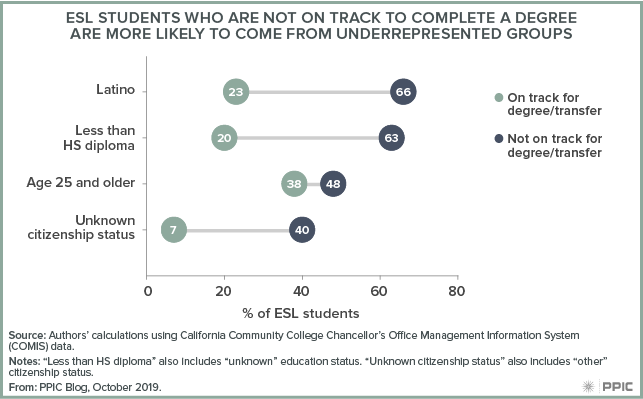
These initiatives are primarily focused on addressing the needs of students who intend to pursue a degree or transfer. However, our most recent research finds that about two-thirds of ESL students (66%) are not on track to do so—and may consequently be left out of the reforms. (We consider students on track if they take any ESL course required to access college composition and at least one course other than ESL or English.)

ESL students who are not on track are more likely to come from historically underrepresented groups. For instance, we find that compared to students taking ESL courses needed for college composition, those not taking these courses are more likely to be older and Latino. They are also more likely to have unknown citizenship status (a possible signal of being undocumented) and to have not graduated high school.

figure - ESL Students Who Are Not on Track To Complete a Degree Are More Likely To Come from Underrepresented Groups

As colleges across the state reform their ESL sequences and programs of study, it will be critical to ensure that all students have the opportunity to earn a degree or transfer. The two-thirds of ESL students currently not on track to do so are the most vulnerable. These students have already taken the major step of enrolling in college. To improve their likelihood of advancing, colleges could provide clearer and more effective ESL sequences and degree and transfer pathways, as well as stronger student supports, including advising, placement, and information about available degrees and certificates.

Some colleges are already working on these issues. Initiatives like the Guided Pathways ESL Milestone certificates at Cypress College—the result of AB 705 and Guided Pathways efforts—present a unique example of how colleges can structure ESL programs and certificates to help English Learners get on a pathway toward a college credential.

Finally, it is important to acknowledge that there are some ESL students who take ESL coursework for reasons unrelated to a degree. As colleges redesign their ESL programs, working alongside non-credit ESL programs, adult education schools, and community-based ESL programs could help ensure that colleges are keeping the diverse needs of ESL students in mind.[/vc_column_text][/vc_column][/vc_row]

How the USDA Helps California Farmers Steward Water and Land

The US Department of Agriculture (USDA) is the largest federal agency in charge of food and farm policy in the US. But the agency also has a lesser known role: it runs a large portfolio of programs to promote conservation of soils, water, and wildlife habitat on farms.

California gets on average $150 million a year from the USDA’s suite of resource stewardship programs. The programs are operated by two of the nineteen agencies within the USDA: the Farm Service Agency (FSA) and the Natural Resource Conservation Service (NRCS).

USDA’s conservation programs can be broadly grouped into three categories: (1) temporary land retirement programs, (2) longer-term or permanent “easement” programs to protect farmland, and (3) working land programs that focus on resource stewardship of lands in agricultural production. NRCS also provides technical assistance to support these efforts.

The temporary land retirement programs are underutilized in California. These programs pay landowners to take land out of production to implement conservation practices, such as planting cover crops to improve soil quality. These programs accounted for 3% of the USDA resource stewardship funding in California from 2012–17, versus 32% nationally. Low enrollment in these programs in California reflects a variety of factors, including low payments and high land values for irrigated cropland in the state.

Landowners who enroll in longer-term or permanent easement programs retain legal title but commit the land to a specific use—for instance, converting croplands to wetlands—or commit to prevent commercial development on farmland. These programs also account for a small share of the USDA stewardship portfolio. Nonetheless, USDA easements support important conservation efforts across the state. For instance, NRCS was a major partner in the restoration of Dos Rios Ranch, a project adjacent to the San Joaquin National Wildlife Refuge that converted agricultural lands to habitat and helped an endangered species, the riparian brush rabbit, make a comeback.

Working land programs are especially popular in California, accounting for almost 70% of USDA agricultural conservation funding in recent years. The majority of these funds have been used to install more efficient irrigation systems and replace old diesel engines on farms to protect air quality. Programs also support a variety of other activities, including managing manure on dairies to protect water quality or installing hedgerows to create habitat for pollinators on farms.

Generally speaking, the USDA conservation programs support conservation practices on a farm-by-farm basis. But to realize broader benefits, investments often need to be on a larger scale. The Regional Conservation Partnership Program (RCPP)—introduced in 2014—encourages landowners to join forces on resource concerns. To date, RCPP has funded 21 projects in California, including helping rice producers extend their watering season to support migratory birds and supporting development of a traditional land management plan by the Yurok Tribe.

There is considerable potential to use USDA’s stewardship programs in new ways to help address changes on the horizon for California’s agriculture. Across the state, farms face growing requirements to address water scarcity and quality problems. Ending the long-term overuse of groundwater is a huge challenge. In the San Joaquin Valley, closing the gap will likely involve idling some cropland. It will also require finding cost-effective ways to recharge groundwater basins.

To assist in these efforts, working lands programs could support on-farm recharge as well as management practices to prevent dust, pests, and weeds on fallowed lands. Temporary land retirement programs could fund multiple-benefit management of lands that are transitioning out of irrigation, supporting efforts to conserve water, recharge groundwater, improve soil health, and restore habitat.

The 2018 Farm Bill increased the USDA’s capacity to provide this help. Funding for the largest working lands program in the valley has been increased, and it is now available to support projects by local water management agencies as well as individual farmers. Funding has tripled for the innovative RCPP program, which leverages public and private dollars to tackle regional conservation challenges. And throughout the farm bill, conservation programs now cover soil health and carbon sequestration as targeted outcomes.

By working together with the USDA, the state’s farmers and their local and state partners could make better use of these programs and address new challenges at hand.

figure - USDA’s Working Lands Programs Are Popular in California, but Temporary Land Retirement Programs Are Underused