The Mood of California Voters and the 2020 Election Cycle

This post is excerpted from my speech at the Sacramento Seminar on October 4, 2019 in San Francisco.

Pollsters often say that a public opinion survey is a snapshot in time. The latest PPIC Statewide Survey was conducted in the days after the California Legislature finished its work in 2019 and while startling news was breaking that the president called a foreign leader for a political favor—which has resulted in the launch of an impeachment inquiry. The mood of California voters in this timely survey—especially their level of unhappiness and anxiety—is noteworthy because of its far-reaching implications for the March primary and the November election.

Let’s start with President Trump’s approval rating, which now stands at 35% among California likely voters. This is unchanged from the last reading in our July survey and has been remarkably stable over time. Today, 83% of Republicans approve of his job performance, compared to just 38% of independents and only 7% of Democrats. Given its partisan makeup, California is a reliably blue state on the Electoral College map. Still, low approval ratings for the president will increase turnout, influence the Democratic presidential primary choice, and affect all of the legislative races next year.

Meanwhile, approval ratings for Congress remain low even in the wake of Democratic control of the US House of Representatives. Today, just 24% of California likely voters approve of the way that Congress is doing its job. This is unchanged from the start of the year—as well as from a year ago when Republicans controlled the House. In California, likely voters across party lines give low approval ratings to Congress. If this trend continues, incumbents will have to work harder to keep their seats in 2020.

Closer to home, Governor Newsom and the legislature are getting mixed reviews in their first year of making policy together. Among likely voters, 43% approve and 44% disapprove of the governor, while 38% approve and 51% disapprove of the legislature. Since the beginning of the year, disapproval has increased significantly for the governor (+15 points) and the legislature (+8 points). Today, more than six in ten Democrats approve of the job that the governor and legislature are doing, compared to fewer than four in ten independents, and less than two in ten Republicans. If their ratings remain in the doldrums, the governor and legislators will have little sway over Californians’ ballot choices next year.

figure - Approval Ratings of State Elected Officials

Equally important, California’s likely voters are in a negative frame of mind about the state of their state—even in the midst of low unemployment and budget surpluses. Fifty-four percent say that things in California are going in the wrong direction (41% say right direction). When asked about economic conditions in California for the next 12 months, a similar 54% expect bad times (37% say good times). Pluralities across party lines are now expecting bad economic times in the next 12 months—a timeframe that includes most of the 2020 election campaign season.

figure - Likely Voters Expect Bad Economic Times in the Next 12 Months

State bonds and tax measures will face headwinds if this level of economic unease continues. This is already evident in the modest support for the $15 billion school bond (54%) and the split-roll property tax initiative (47%) in our recent survey.

figure - Modest Support for Likely 2020 State Ballot Measures

Digging deeper into the survey, more than six in 10 likely voters worry about being able to afford the cost of their health care, six in ten are concerned about the threat of a mass shooting where they live, half are worried about experiencing natural disasters such as wildfires, and four in ten worry about someone they know being deported. Candidates’ promises and plans to address these fears will likely impact the standing of current frontrunners Joe Biden, Bernie Sanders, and Elizabeth Warren—and their challengers—in a Democratic presidential primary which is very much up for grabs, as our recent survey shows.

How will voters’ views change over the next 12 months? Clearly, the political wildcard is the impeachment inquiry and how it will impact perceptions of the president, Congress, and the major parties. Uncertainty about the economy is another unknown factor. In the short run, the impeachment inquiry is likely to increase polarization, lead to more political gridlock in Washington, and heighten expectations for the governor and legislature to do more to solve the problems facing California.

PPIC Statewide Surveys will continue to monitor the broader political and economic attitudes, as well as voters’ preferences for presidential candidates and ballot measures, throughout what will be a consequential 2020 election.

How Strong Is the Trump Effect in California?

Was the 2016 presidential election a sign of things to come—presaging an ever-bluer California? Or was it a one-off result driven by the personalities of the candidates?  These are important questions in California, which voted more Democratic for president in 2016 than it had in 2012, even as the rest of the country moved in the opposite direction.  Even more important, parts of the state that had been reliably Republican—most notably Orange County—suddenly shifted Democratic. Based in part on this result, California’s Democratic candidates fought hard in yesterday’s midterm for several US House seats held by Republicans.

Did the anti-Trump/pro-Clinton vote reliably predict the 2018 outcome? To answer this question, the figure below compares California’s 2016 presidential vote to the 2018 US House vote in all districts with both a Democrat and a Republican running. The solid black diagonal line marks the point where the 2016 presidential vote perfectly matches the 2018 US House vote. Points above the line mark seats where the Democrats outperformed the 2016 presidential vote, and points below show where they underperformed. The competitive seats mentioned above are identified in orange.

The first thing to note is that the 2016 presidential vote predicts the 2018 US House vote quite well.  Higher Democratic presidential votes reliably translate into higher Democratic House votes, so knowing the presidential vote tells us a lot about how a district is going to vote for other offices. This is true even for the competitive races in which the 2016 presidential vote was a surprise.

At the same time, virtually every seat falls below the solid diagonal line. That means the Democratic House candidates in these districts consistently failed to match the support shown for Hillary Clinton in 2016. Though the Democrats are poised to pick up at least three House seats in California, support for the Democratic Party is softer in these races than it was two years ago.

On balance, however, the 2016 outcome was not a one-off:  the areas that voted more Democratic than expected are continuing to vote more Democratic.  At the same time, Democrats would have picked up more seats in the midterm had the US House vote this cycle matched the 2016 presidential vote exactly. Despite what was generally a good Democratic night, the overall outcome fell short of the 2016 benchmark.

The 2020 Census and Political Representation in California

California’s political representation will be affected by the 2020 Census—but an accurate count is far from guaranteed. Inadequate funding and fear in the state’s large immigrant population are heightening concern about an undercount. At a briefing in Sacramento last week, PPIC researcher Eric McGhee outlined a new report that draws on population trends and research on past undercounts to develop plausible scenarios for 2020.

“I think it’s fair to say that we are unlikely to lose a congressional seat if there is an accurate count,” said McGhee. However, California is more vulnerable to an undercount than most other states. Three in four Californians belong to at least one of the populations that are difficult to count: children, young men, Latinos, African Americans, immigrants, and renters.

An undercount could cause the state to lose one of its 53 seats in the House of Representatives. It could also have an impact on political representation within California. If the state does a poor job of reaching hard-to-count populations, it might end up drawing congressional and state legislative districts that shift representation from poorer areas with larger communities of color to areas that are wealthier and less diverse.

Privacy concerns have increased both the difficulty and the cost of conducting census surveys. The current political climate is likely to exacerbate these concerns, especially now that a question on citizenship status has been added to the 2020 survey. (The addition is being contested in the courts.) Moreover, the 2020 Census will be the first to collect a majority of responses online. The Census Bureau is testing the Internet survey but lacks the resources to test outreach and follow-up. Because California has a disproportionate share of historically undercounted residents, these challenges are of particular concern.

But, as McGhee pointed out, “California’s fate is still in its own hands.” This year’s state budget allocates about $90 million for census outreach, which should help community organizations and state and local governments educate residents about the importance of the census and the security of the information collected. Californians need to know that “a better count in California could make a big difference.”

Will California’s Red Districts Turn Blue in November?

One of the important questions hanging over California politics this election cycle is the impact of Donald Trump. In the 2016 presidential race, support for Trump was soft, with some parts of the state voting Democratic for the first time in more than a generation.

This shift encouraged Democrats to target congressional seats that had previously been considered out of reach for the party. The seven Republican-held US House seats considered most competitive all voted for Clinton over Trump. Yet many of these places haven’t voted Democratic for higher office in decades. Is this Democratic optimism warranted, or was 2016 a fluke?

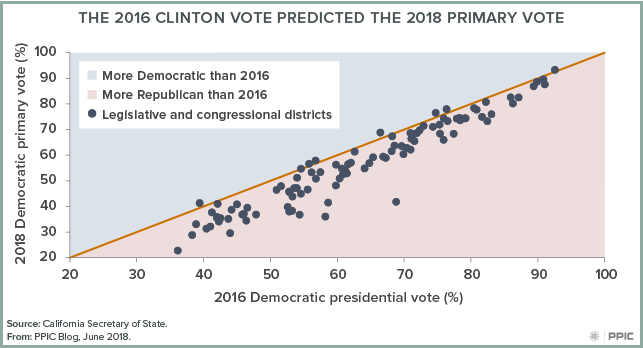
Tuesday’s primary can help answer this question. California’s top-two system—in place since 2012—offers a view into the partisan sentiment in these districts in a year when Donald Trump is not on the ballot. It’s more like a first-stage general election because it lets voters choose any candidate they like regardless of party.

The figure below compares the share of the two-party primary vote for Democratic candidates to the 2016 two-party presidential vote in the same district (primaries without at least one candidate from each major party have been omitted). Each point is a state legislative or US House seat. The more the points cluster in the shape of a line, the stronger the correlation between the two votes. But any point above the line has a 2018 primary vote that is more Democratic than its 2016 presidential vote, while any point below is more Republican.

This figure tells us two things. First, the 2016 presidential vote predicts the 2018 results quite well. As the Democratic presidential vote increases, the Democratic primary vote in 2018 climbs as well. Moreover, the slippage in this relationship (and there is some) is about as large as in previous top-two years.

Second, the Democrats underperformed Clinton’s 2016 vote in almost every district. This too is consistent with the past. Democrats have underperformed the presidential vote in every primary under the top-two system. In fact, the underperformance was actually a little smaller this year than the average. This suggests it’s normal for Democrats to look bad in the primary season, and that it’s no reason for Democrats to be worried or Republicans to be excited.

However, this tells us less about the fall outcome than it might appear. The party vote in the general election usually shifts Democratic, but the magnitude of this shift varies a great deal. It was quite large in 2012: a seat with a 50 percent Democratic outcome in the primary on average voted 56 percent Democratic in the general. But in 2014 there was almost no change at all, and in 2016 the fall outcome was slightly more Republican.

Thus, for Democrats these results are a mixed bag. On the one hand, there are signs that the Trump effect in California has staying power. On the other hand, the consequences for this fall’s election are not altogether clear. The Democrats probably won’t do much worse on average than they did on Tuesday. But beyond that it’s difficult to say, and the consequences for individual seats will have to wait until Election Day.