
Was the 2016 presidential election a sign of things to come—presaging an ever-bluer California? Or was it a one-off result driven by the personalities of the candidates? These are important questions in California, which voted more Democratic for president in 2016 than it had in 2012, even as the rest of the country moved in the opposite direction. Even more important, parts of the state that had been reliably Republican—most notably Orange County—suddenly shifted Democratic. Based in part on this result, California’s Democratic candidates fought hard in yesterday’s midterm for several US House seats held by Republicans.
Did the anti-Trump/pro-Clinton vote reliably predict the 2018 outcome? To answer this question, the figure below compares California’s 2016 presidential vote to the 2018 US House vote in all districts with both a Democrat and a Republican running. The solid black diagonal line marks the point where the 2016 presidential vote perfectly matches the 2018 US House vote. Points above the line mark seats where the Democrats outperformed the 2016 presidential vote, and points below show where they underperformed. The competitive seats mentioned above are identified in orange.

The first thing to note is that the 2016 presidential vote predicts the 2018 US House vote quite well. Higher Democratic presidential votes reliably translate into higher Democratic House votes, so knowing the presidential vote tells us a lot about how a district is going to vote for other offices. This is true even for the competitive races in which the 2016 presidential vote was a surprise.
At the same time, virtually every seat falls below the solid diagonal line. That means the Democratic House candidates in these districts consistently failed to match the support shown for Hillary Clinton in 2016. Though the Democrats are poised to pick up at least three House seats in California, support for the Democratic Party is softer in these races than it was two years ago.
On balance, however, the 2016 outcome was not a one-off: the areas that voted more Democratic than expected are continuing to vote more Democratic. At the same time, Democrats would have picked up more seats in the midterm had the US House vote this cycle matched the 2016 presidential vote exactly. Despite what was generally a good Democratic night, the overall outcome fell short of the 2016 benchmark.
 California is a battleground state in the 2018 midterm election. When it comes to determining the party that will lead the next US Congress, all eyes are on the 14 US House seats that are currently held by Republicans in the deep-blue state of California. Democrats would need to “flip” several of these seats if they have any chance of taking control of the US House, where Republicans currently now have a 26-vote margin. The party in power has typically lost some of its congressional seats in national midterm elections. Whether it is a few seats or many is closely tied to the president’s popularity. So, how is Donald Trump viewed in California at the end of his first-year anniversary in office?
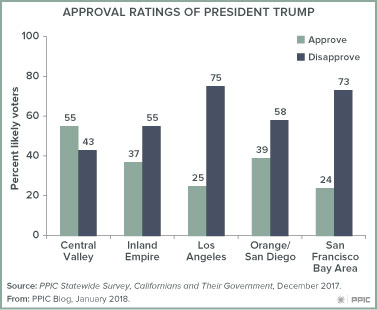 Regional trends in presidential disapproval ratings also point to a challenging environment for Republicans running in House elections this year. Predictably, there is overwhelming disapproval of President Trump in the Democratic strongholds of Los Angeles (75%) and San Francisco (73%) in the December 2017 PPIC survey. More surprisingly, over the course of 2017 disapproval of Trump’s performance increased to majority levels in Orange/San Diego (50% to 58%) and the Inland Empire (39% to 55%), where several of the House seats that are now held by Republicans are located. Coincidentally, two Republican House members in Orange/San Diego decided not to run for reelection.
