The Economic Toll of COVID-19 on Small Business

[vc_row][vc_column][vc_column_text]Fifty-six percent of California small businesses experienced “large negative” effects from the pandemic, according to a recent Census survey—a survey that includes businesses with up to 500 employees. Sectors hit hardest by initial job loss face the most severe setbacks. As small businesses weather closures brought on by COVID-19, policy efforts to support them will be important for the state’s economic recovery.

Ninety-five percent of businesses are very small businesses with less than 50 employees, and these businesses employ one-third of California’s workers. Unemployed Californians will need workplaces to return to after the state recovers—small and very small businesses are a common place for workers to land.

In response to the pandemic, about three-quarters of small businesses in hard-hit sectors, such as food service and entertainment, have had to take dramatic measures. That is, today business owners in these sectors are much more likely to have laid off employees, decreased employee hours, or suffered revenue losses since mid-April, compared to other sectors.

Compounding these struggles, many small businesses have already missed scheduled payments such as rent, utilities, or payroll. The impact has been particularly stark in accommodation and food services, where nearly two-thirds of business owners have missed payments since March 13.
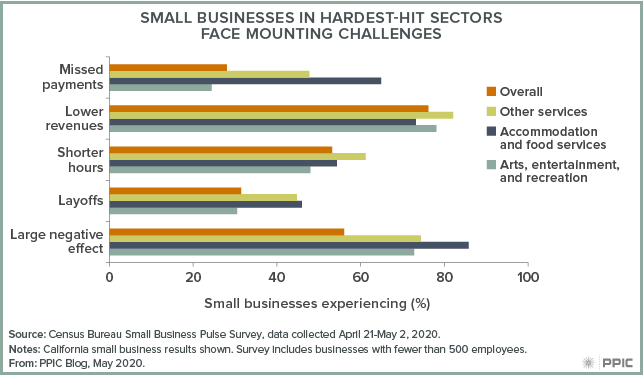
Figure - Small Businesses in Hardest-Hit-Sectors Face Mounting Challenges

Very small businesses are more likely to be owned by women and nonwhite Californians than larger businesses.  Latinos own 11% of these businesses but only 2% of larger businesses. Similarly, Asians own 23% of very small businesses versus roughly 10% of larger businesses. In California, women run 22% of such businesses, compared to 7% of larger businesses.

Within the industries hit hardest by COVID-19, very small businesses with less than 50 employees have even higher rates of Asian, Latino, and women ownership. In particular, one-third in this heavily affected sector—for example, restaurants and retail—are Asian-owned. Women also own 26% of very small businesses in these industries; another 20% are jointly owned by men and women.[/vc_column_text][/vc_column][/vc_row][vc_row max_width=”80″ visibility=”visible-desktop”][vc_column][vc_column_text][infogram id=”1pj99903epwez1i6zzgjry1njeamvd0vkmz?live”][/vc_column_text][/vc_column][/vc_row][vc_row max_width=”80″ visibility=”visible-tablet-landscape”][vc_column][vc_column_text]

[infogram id=”1pj99903epwez1i6zzgjry1njeamvd0vkmz?live”]

[/vc_column_text][/vc_column][/vc_row][vc_row visibility=”visible-tablet-portrait”][vc_column][vc_column_text]

[infogram id=”1pj99903epwez1i6zzgjry1njeamvd0vkmz?live”]

[/vc_column_text][/vc_column][/vc_row][vc_row visibility=”visible-phone”][vc_column][vc_column_text]

[infogram id=”1pj99903epwez1i6zzgjry1njeamvd0vkmz?live”]

[/vc_column_text][/vc_column][/vc_row][vc_row][vc_column][vc_column_text]Despite policymaker concerns about the survival of small businesses, initial efforts to provide assistance have fallen short of expectations. Over 88% of California small businesses in accommodation and food services applied for federal assistance through the Paycheck Protection Program (PPP), yet only 27% received any support. For other federal programs like Economic Injury Disaster Loans (EIDL) and Small Business Administration (SBA) Loan Forgiveness, less than half of the businesses in hard-hit industries that requested funding received any.

Policies to help these businesses manage the current downturn will influence the state’s economic recovery. Small businesses employ many of California’s workers, and small business ownership offers a path to economic mobility and success. In addition, young businesses—many of which are small—play a particularly important role in job creation.

While federal assistance will remain critical, state and local efforts can help fill the gap. Because some communities lack sufficient resources, state efforts to provide financial assistance through the Small Business Loan Guarantee Program are a step in the right direction.[/vc_column_text][/vc_column][/vc_row]

Overcrowded Housing and COVID-19 Risk among Essential Workers

[vc_row][vc_column][vc_column_text]Some Californians face substantial risk of illness within their own households under the state’s shelter-in-place order. Physical distancing and self-isolation can be virtually impossible in crowded homes, threatening the health of entire households. In crowded living conditions, individuals are at higher risk of transmitting infectious diseases, a factor that may challenge the state’s efforts to manage the pandemic while reopening the economy.

As the high cost of housing is a stark reality for nearly two-thirds of Californians, finding affordable housing can mean cohabiting with several other people. California’s overcrowding rate is well above the national average; the share of housing units with more than one occupant per room is 8.3% compared with 3.4% across the nation. Furthermore, overcrowding is much more common among renters than homeowners (13.4% vs. 4.0%), and in Latino households (18.4% vs. 2.4% of white households).

While most Californians have been staying home to reduce coronavirus transmission, essential workers do not have the option to shelter in place. Over one-third of California’s labor force works in essential occupations that require being physically present. Compared to nonessential workers, they are at higher risk of infection because they continue to circulate among others despite the shutdown.

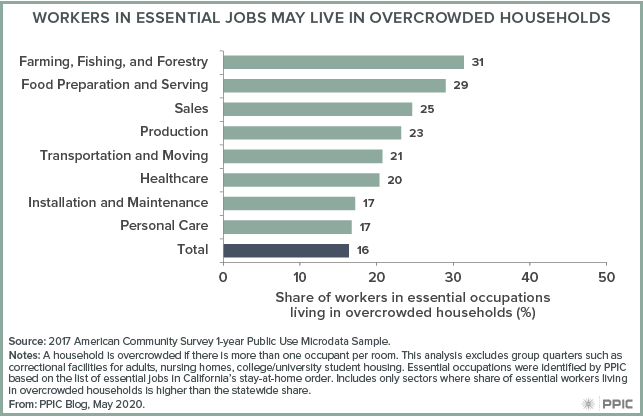
Essential workers are more likely than nonessential workers to live in overcrowded housing—16 percent versus 12 percent. That share is almost double for workers in farming (31%), and food preparation/serving (29%).

Figure - Workers in Essential Jobs May Live in Overcrowded Households

A recent study confirms that essential workers and those in larger households do face a higher risk of contracting coronavirus. It would be ideal to explore the relationship between COVID-19 cases and workers living in crowded conditions. However, inconsistent testing availability across regions makes cases an unreliable measure of the virus’s geographic spread; deaths, which are better measured, are a valuable proxy.

There is a clear link between COVID-19 deaths and essential workers who live in overcrowded homes, though the relationship is muddied by regional differences in terms of the age structure of the population,  underlying health conditions, and other factors. Santa Barbara (25%), Madera (23%), Los Angeles (21%), Orange (20%), and Tulare (19%) counties have the highest shares of essential workers in overcrowded homes. Los Angeles and Tulare are experiencing large numbers of deaths per capita, at 14 and 9 deaths per 100,000 people, but the other counties are not.[/vc_column_text][/vc_column][/vc_row][vc_row max_width=”80″ visibility=”visible-desktop”][vc_column][vc_column_text][infogram id=”1p375951mzw3k9c0mex60d30kdidymqxjlx?live”][/vc_column_text][/vc_column][/vc_row][vc_row max_width=”80″ visibility=”visible-tablet-landscape”][vc_column][vc_column_text]

[infogram id=”1p375951mzw3k9c0mex60d30kdidymqxjlx?live”]

[/vc_column_text][/vc_column][/vc_row][vc_row visibility=”visible-tablet-portrait”][vc_column][vc_column_text]

[infogram id=”1p375951mzw3k9c0mex60d30kdidymqxjlx?live”]

[/vc_column_text][/vc_column][/vc_row][vc_row visibility=”visible-phone”][vc_column][vc_column_text]

[infogram id=”1p375951mzw3k9c0mex60d30kdidymqxjlx?live”]

[/vc_column_text][/vc_column][/vc_row][vc_row][vc_column][vc_column_text]California will lift some shelter-in-place restrictions in the coming days, and more people will leave their homes to work. Examining work and living conditions together can identify areas where people are least able to take effective actions against the spread of the coronavirus. Designing policies to protect the health of workers and their households will be critical to managing COVID-19 while restarting the state’s economy.[/vc_column_text][/vc_column][/vc_row]

Early Insights on California’s Economic Downturn

California’s unemployment rate jumped from a historically low 3.9% to 5.3% in March. For comparison, it took a full year from the official start of the Great Recession for unemployment to increase by 1.4 percentage points (although the levels were higher: 5.9% in December 2007 to 7.3% in December 2008). Notably, the March rate is based on data from the middle of the month, so it does not fully reflect the massive layoffs that occurred as the COVID-19 pandemic took hold.

Between March 15 and April 18, 3.4 million Californians applied for unemployment insurance. There has been much forecasting (including by us) about the sectors and workers that will feel the immediate effects of the downturn. We do not have demographic breakdowns and we don’t know which industries employed these workers. But recently released labor market data can provide some new insights.

By mid-March, California had recorded a net loss of 100,000 jobs, comprising about one-seventh the decline nationwide and reflecting the state’s early response to COVID-19 crisis. That’s less than 1% of the state’s 17 million jobs. The lion’s share of job loss (more than 80%) occurred in three service sectors: arts, entertainment, and recreation; accommodation and food; and “other services” (a category that includes automotive repair, personal care, and dry cleaning).

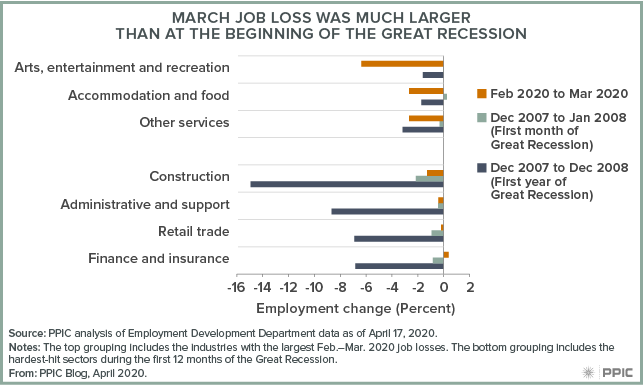
A comparison with the Great Recession highlights the severity of the current situation. Between February and March this year, employment in arts, entertainment and recreation fell 6.4%. Over the first year of the Great Recession, employment in this sector fell 1.6%. The number of jobs lost in the accommodation and food service sector was much higher between February and March, but these losses represented only 2.7% of the workforce in this much-larger sector.

A look at job losses in the industries that were hit hardest during the Great Recession shows that jobs are being lost much more quickly during the COVID-19 crisis. In the first month, construction—the recession’s most severely affected industry—saw a 2.2% decline, and no other sector experienced losses greater than 2%.

figure - March Jobs Loss Was Much Larger Than at the Beginning of the Great Recession

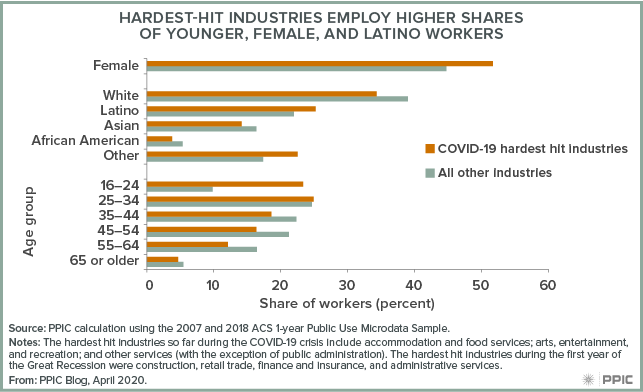
These initial data clearly show that the current crisis is hitting a different set of sectors than the Great Recession. It also shows that workers in the initially affected industries are more likely to be women (52% versus 45%), Latinos (25% versus 22%), and young adults (23% versus 10%) compared to workers in other sectors—and to workers in the hardest-hit industries during the first year of the Great Recession.

figure - Hardest-Hit Industries Employ Higher Shares of Younger, Female, and Latino Workers

As the current crisis continues to unfold, a more complete picture of the workers and industries affected will emerge. The staggering number of recent unemployment claims indicates that the losses in the March data are only the tip of the iceberg. April data will no doubt show deeper declines and a widening impact across sectors.

Unemployment insurance will provide an important economic backstop for many workers over the next several months. However, it will be important to monitor the workers and industries being affected by this crisis, both to ensure that policy efforts are directed where they are most needed and to inform additional measures to mitigate the economic damage.

Essential Workers and COVID-19

California is grappling with the dual threats of a public health crisis caused by the coronavirus and the additional economic fallout of necessary social distancing measures.  In the past week, we have seen unemployment claims skyrocket and policymakers forge supports for workers and businesses.

Meanwhile, there is a workforce that is tackling the public health crisis, keeping the economy going, and supporting Californians who are sheltering in place. While this essential workforce supports the state’s health and basic economic needs, many of these workers are not well equipped to weather the economic challenges of the COVID-19 crisis.

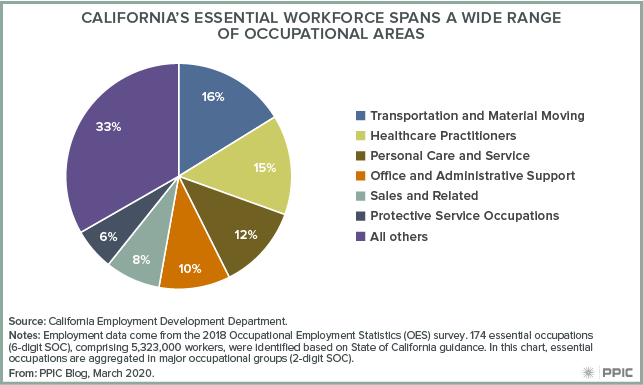
We estimate that in a typical year, roughly one-third to one-half of California’s labor force is employed in essential occupations. Essential workers fulfill a wide variety of roles in our economy, including in health care services, energy provision, food service, agriculture, and transportation. Some workers in these areas may be seeing layoffs and hours reductions depending on their industry, firm, or region.

figure - California’s Essential Workforce Spans a Wide Range of Occupational Areas

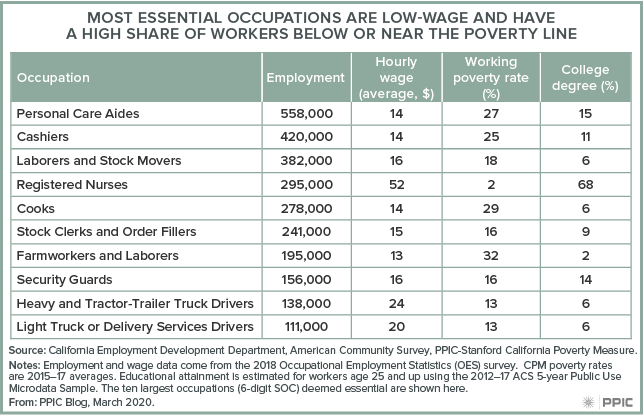
Some essential jobs are obvious, as they are on the front lines of the public health crisis. For example, registered nurses (the largest occupation within the healthcare practitioner category) are essential, have two- or four-year degrees (68% have a college degree, according to our analysis of American Community Survey data), and earn relatively high wages ($52.32 an hour).

However, workers outside of the health care sector are also on the front lines. Personal care aides—those who assist the elderly and others in their homes or personal care facilities—are the single largest essential job category. These workers earn $13.50 an hour on average and 85% do not have a college degree.

Differences in skills and pay translate into notable differences in economic well-being for these workers and their families. A slightly higher share of essential workers than non-essential workers are poor or nearly poor, according to the California Poverty Measure: 14% of essential workers live in poor families compared to 11% of non-essential workers (the comparable estimates for near poverty are 19% and 14%, respectively).

figure - Most Essential Occupations Are Low-Wage and Have a High Share of Workers Below or Near the Poverty Line

Grocery store cashiers, store clerks, farmworkers, and delivery and truck drivers make up sizeable shares of the essential workforce.  Given the low hourly wage rates for these workers, some may face hardships in caring for children or family members with schools and care facilities shuttered.

In addition, many essential workers experience the cost and risk of maintaining their own health while interacting with the public. In low wage essential jobs, access to health benefits and paid sick leave is limited, even in normal times. During the COVID-19 crisis, expanding access to personal protective gear could reduce the health risks among workers whose job requires some level of contact with the public.

Mandated lockdowns are now slated to continue through at least May 1 in some parts of the state and  may last even longer. Ensuring the ability of essential workers to continue their jobs safely and effectively will be crucial over the coming months. As policymakers implement support for unemployed Californians, it is important that they also consider ways to assist and protect the many essential workers on the front lines. Paid sick leave, adequate health coverage, income support, access to child care, and sufficient personal protective gear should all be part of the policy discussion.

The Democratic Presidential Primary: What Do Californians Care About?

Mark Baldassare, PPIC president and CEO, and director of the PPIC Statewide Survey, participated in a panel on election issues at the Pacific Chapter of the American Association of Public Opinion Research meeting on December 6, 2019 in San Francisco. This post is excerpted from his prepared remarks.

Californians are turning their attention to the March 3 Super Tuesday primary as they play a new role in deciding the next Democratic presidential nominee. This is unfamiliar territory for California’s Democratic primary voters, who have become accustomed to casting ballots in June after other states have already determined the winner of their party’s presidential sweepstakes.

The 2019 PPIC surveys have consistently identified three frontrunners—Joe Biden, Bernie Sanders, and Elizabeth Warren—with no clear favorite. At the same time, likely voters have signaled an openness to considering alternatives. In this context, the debates loom large, and eight in ten likely voters in the September PPIC survey say they are important (41% very, 43% somewhat) in deciding their vote.

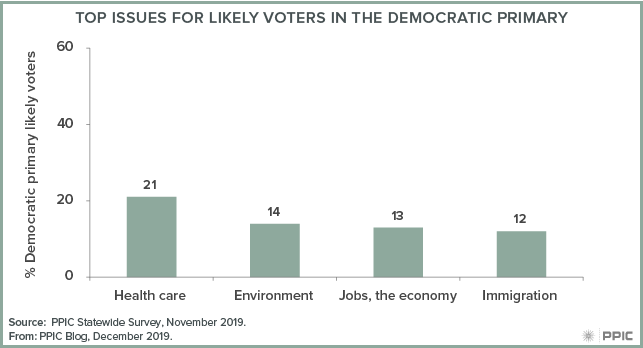
What do California’s Democratic primary likely voters most want to hear from the candidates as the stage is being set for a December 19 Democratic debate in Los Angeles? In an open-ended question in the November PPIC survey, the top four issues mentioned are health care (21%), the environment (14%), jobs and the economy (13%), and immigration (12%). Several other issues—such as education, homelessness, housing affordability, gun control, crime, and taxes—are each mentioned by less than one in ten likely voters.

figure - Top Issues for Likely Voters in the Democratic Primary

Across demographic groups, likely voters differ on the issues that matter the most. For instance, voters age 45 and older want to hear about health care more often than younger voters do (26% to 13%), while Latinos want to hear about immigration more often than whites do (24% to 5%), and whites want to hear about the environment more often than Latinos do (23% to 4%). Jobs and the economy is the only top issue generating a similar amount of interest across age, education, gender, income, race/ethnic, and regional groups.

The issues of greatest concern also vary according to candidate preference. Biden’s supporters name health care more often (25%), Warren’s supporters mention the environment more often (26%), and Sander’s supporters name immigration more often (22%). By contrast, supporters of the three leading candidates are similarly likely to mention jobs and the economy (13% Sanders, 11% Biden, 7% Warren).

One area of strong consensus? Views of President Trump. In the November PPIC survey, 91% of California Democratic primary likely voters say they disapprove of President Trump and 84% support his impeachment and removal from office.

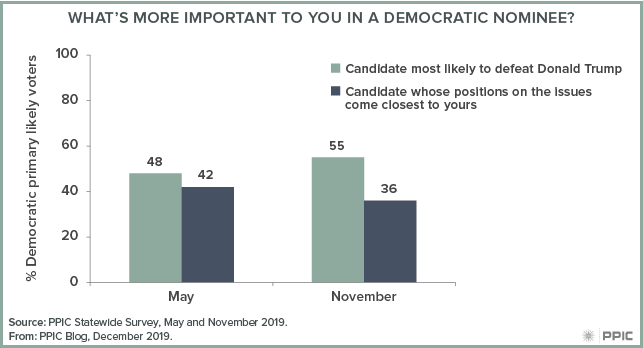
When asked what’s more important, nominating a candidate who seems most likely to defeat Trump or one whose positions on issues are closest to theirs, 55% want to defeat Trump, while 36% want alignment on positions. Since the May PPIC survey, support for impeachment (65% to 84%) and the importance of nominating an electable candidate (48% to 55%) has risen.

figure - What’s More Important to You in a Democratic Nominee?

Those who say that electability is most important, compared with those who say policy positions are most important, are more likely to mention health care (25% to 15%) and less likely to name immigration (7% to 18%) as the issue that they most want to hear about in the presidential debates. We find no differences between these two voter groups in the mention of the environment or jobs and the economy. Interestingly, education (11% to 2%) is noted more often among those who say that alignment on the issues is more important to them.

The Los Angeles debate is the next big opportunity for the presidential candidates to connect with California voters whose preferences are still being formed. Many Democratic primary likely voters already report that they are closely following the election news, but the debate could still result in an expanded electorate—and a scrambling of the race—if candidates connect with voters on issues that matter the most to them.

Throughout 2020, PPIC surveys will be monitoring what is likely to be an historic year for voter participation, as Californians engage in a consequential primary and a highly anticipated general election.

Video: Poverty and Opportunity in California

Although California has seen strong job growth in recent years, poverty remains persistently high. In many inland regions, the prevalence of unemployment or low-wage work is a key driver of economic hardship, while elsewhere—especially in coastal areas—the high cost of housing and other necessities plays a major part.

At an event in Sacramento last week, PPIC researcher Tess Thorman discussed the latest findings from the PPIC-Stanford California Poverty Measure (CPM), and a panel of experts discussed the role that policymakers, community organizations, and other stakeholders can play in reducing poverty and broadening economic opportunity.

Poverty has declined—slowly—in California, Thorman said. Also, while nearly 7 million people in California (17.8%) are in poverty, a roughly equal number are living just above the CPM poverty threshold. Certain groups are more likely to be living in poverty, such as young children, Latinos, and families without any college graduates.

Panelists discussed the key role that housing stability plays in achieving financial security. Richard Raya, director of Mission Promise Neighborhood in San Francisco, said his organization connects families with a range of supports, including below-market rental housing. He explained how the city has partnered with local foundations to create “an ‘accelerator fund’ that allows affordable housing developers to identify existing apartment buildings that are rent-controlled” and purchase them in order to keep them affordable – an approach Raya says could be a model for other communities.

Kimberley Johnson, director of the California Department of Social Services (CDSS), underscored how housing and financial stability are fundamental to meeting educational and career goals. Johnson noted that the governor has boosted investments in key elements of the social safety net, such as CalFresh food assistance and the California Earned Income Tax Credit. An important focus for CDSS currently is creating linkages across “a very robust array” of programs and services to make them more accessible to those in need.

California Bridge Academies, launched in Fresno and now active in six counties, offers a voluntary, 18-month program designed to help families exit poverty. According to founder Pete Weber, each household has a “career and family navigator” who assesses needs, skills, and interests. The navigator ensures that “each client is connected to the right on-ramps” so that parents as well as their children receive all necessary services and supports.

The panel highlighted the importance of coordinating services with an eye toward improving family well-being. Caroline Danielson, PPIC policy director and senior fellow, discussed the importance of creating linkages “across different kinds of programs” because “it can be a fragmented safety net.” Danielson pointed out that California has made progress in this effort, while also noting that further efforts to “connect these dots” for children could make a substantial difference in poverty.


Video: Californians and Their Government

As California’s 2020 Democratic presidential primary draws closer, Elizabeth Warren, Joe Biden, and Bernie Sanders lead the rest of the field by a wide margin. However, many voters say they would consider supporting a candidate other than their current choice. These and other key findings from PPIC’s latest statewide survey were outlined by Rachel Lawler in Sacramento last Thursday.

Likely voters identifying as registered Democrats or as Democratic-leaning independents support Elizabeth Warren (23%), Joe Biden (22%), and Bernie Sanders (21%) at levels well above Kamala Harris (8%) and Pete Buttigieg (6%). No other candidate is preferred by more than 3 percent, and 9 percent say they don’t know which candidate they prefer. More than half of voters who expressed a preference would consider supporting another candidate.

The survey asked about a $15 billion bond for school and college construction that has been approved by the legislature for the March 2020 ballot. It has the support of two in three adults—but only 54 percent of likely voters. This narrow margin of support coincides with concern about the state’s economic outlook. Fewer than half (41% adults, 37% likely voters) expect good times financially in California during the next 12 months.

A potential November 2020 ballot measure that would amend Proposition 13 to tax commercial properties at their current market rate and direct some of the new revenue to K–12 public schools is favored by 57 percent of adults. However, fewer than half (47%) of likely voters favor the measure, and this share is down somewhat from April 2019 (54%). A potential state bond measure to fund water infrastructure is favored by 68 percent of adults and 57 percent of likely voters.

Other survey highlights:

  • Californians are most likely to name homelessness (15% adults, 16% likely voters) and jobs and the economy (15% adults, 13% likely voters) as the top issue facing the state. Other issues named include housing costs, immigration, and the environment.
  • Most Californians view immigrants as a benefit to the state, and half are at least somewhat worried about someone they know being deported as a result of increased federal immigration enforcement.
  • Two in three Californians think the Supreme Court should not overturn Roe v. Wade; more than half think some states are making it too difficult to get an abortion.
  • Half of Californians say they have a disaster plan and six in ten have a disaster supplies kit. Six in ten are very (28%) or somewhat (32%) worried about personal injury, property damage, or a major disruption of their routine as the result of a disaster.


Occupational Shifts Favor California’s High-Skill Workers

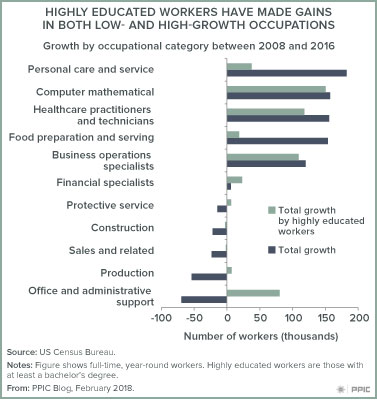
[vc_row][vc_column][vc_column_text]The recession and recovery have reshaped California’s workforce. Between 2008, when employment peaked, and 2010, when it bottomed out, the state lost three quarters of a million jobs. Since then, the state has experienced sustained job growth; according to US Census Bureau data, by 2016 there were 1 million more workers in California than there had been in 2008. This job growth has not been evenly distributed. Some occupations experienced large losses during the recession and have not fully recovered, while others experienced small losses and now have much higher employment levels than they did at their pre-recession peak. While there are some high-growth occupations that do not require high levels of education, workers with at least a bachelor’s degree have prospered the most over the past several years.

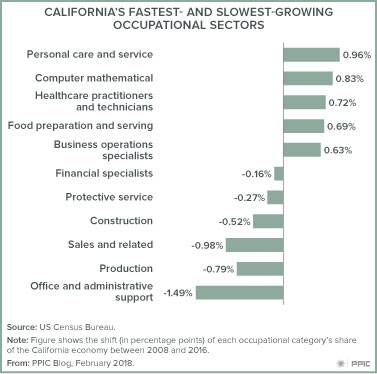
Overall, California’s workforce is becoming more educated: the share of the full-time year-round workforce with at least a bachelor’s degree grew from 31% in 2008 to 35% in 2016. Highly educated workers got more than half of the jobs created in the five fastest-growing occupational categories (based on increases in the share of total full-time year-round workers) between 2008 and 2016:

  1. Personal care and service
  2. Computer and mathematical
  3. Healthcare practitioners and technicians
  4. Food preparation and serving
  5. Business operations specialists

All of these occupations experienced small declines during the recession and strong growth during the recovery. The number of full-time year-round workers increased 28%—from 2.5 million in 2008 to 3.2 million in 2016. Workers in some of these occupations, such as food preparation and serving, earn relatively low wages and tend to have low levels of educational attainment, while workers in other areas, such as computer and mathematical, collect high wages and tend to be college graduates. Altogether, workers with at least a bachelor’s degree made up 433,000 (56%) of the 770,000 jobs gained between 2008 and 2016 by the top five categories.

Workers with at least a bachelor’s degree also made gains in the five slowest-growing occupational categories:

  1. Protective service
  2. Construction
  3. Production
  4. Sales and related
  5. Office and administrative support

These occupations experienced sharp losses during the recession and have not returned to their pre-recession peaks. The number of full-time year-round workers in these occupations declined from 5.3 million in 2008 to 5.1 million in 2016. On average, educational attainment levels are low in these occupations, but workers with at least a bachelor’s degree fared relatively well: the number with at least a bachelor’s degree grew by 89,000, even though these categories have experienced a net loss of 184,000 jobs.

In short, the recession and recovery have accelerated some long-term trends in California’s economy. High-skill occupations and highly educated workers have fared well, while less-educated workers in lower-skilled jobs have faced declining employment opportunities.

[/vc_column_text][/vc_column][/vc_row]
Video: John Chiang’s Priorities

John Chiang, the state’s treasurer and a candidate for governor this year, was asked last week to name the top three issues that will make the most difference for the state’s future. The question is the first one Mark Baldassare, PPIC president and CEO, asks of all gubernatorial candidates appearing before PPIC audiences. Chiang said his priorities are

  • Education
  • Housing
  • Jobs, climate change, health care—issues Chiang lumped together as the “things that are absolutely critical in everybody’s life.”

Chiang praised Governor Jerry Brown for the state’s K–12 finance formula that targets extra resources toward lower-income students, English Learners, and those in foster care. He said he would target more money toward students with special needs.

Referring to the state’s housing situation as an “extraordinary crisis,” Chiang said that even if an affordable housing bond measure passes in November, the state will need to return to the voters to get more money. He advocated reviving local redevelopment agencies, which the governor eliminated in 2011, to give local governments an economic tool to build housing.

Chiang referred to his background as treasurer, state controller, and member of the state Board of Equalization in emphasizing the need to ensure a way to pay for proposals such as single-payer health care—an idea he said he favors in concept. While describing the current system as inefficient, he said that the state can’t achieve single payer health care immediately. How long will it take? Chiang said more clarity from the federal government is crucial to understanding what the state can afford. “Let’s build what we can build. We don’t have to build a mansion at the beginning. Let’s build a starter house.” Chiang also said that the state needed to figure out how to insure an additional 2.9 million Californians who are currently uninsured.

The conversation with Chiang is part of the PPIC Speaker Series on California’s Future. PPIC is inviting all major candidates for governor to participate if they reach a certain threshold in the polls. The goal is to give Californians a better understanding of how the candidates intend to address the challenges facing our state.

Watch all candidate videos


Video: Legislative Leaders Look Ahead

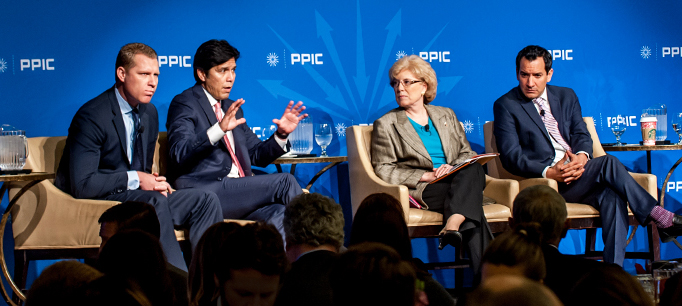
Despite their political differences, California’s legislative leaders have similar views of the state’s most pressing challenges. In a conversation facilitated by PPIC this week in Sacramento, the two top legislators from both major parties provided a preview of the issues they expect to tackle this session. With the impact of federal policy changes still unclear, the legislative leaders focused on longstanding challenges.

Asked to list the top issues the legislature and governor need to work on this session, Anthony Rendon, the Democratic speaker of the state assembly, named housing and transportation—topics he heard about repeatedly as he campaigned around the state. He said he saw the impact of a housing and transportation crisis first hand when walking precincts in the Inland Empire. “If you knock on someone’s door at 7:00, 7:30 p.m., they’re not home yet. They’re still on the freeway.”

Jean Fuller, the Republican leader of the state senate, sees the top issues as affordability in California generally and jobs. “We are concerned about housing, but we are also very concerned about jobs.” She noted that in her district, which stretches from Visalia to Twenty-Nine Palms, there is double-digit unemployment.

Kevin de León, the Democratic state senate president pro tem, said the past legislative session had been particularly productive; he highlighted minimum wage, gun safety, and climate change legislation. In this session, he said, “we have to deliver on the issues of housing and transportation and the issue of economic growth.”

For Chad Mayes, Republican leader of the assembly, poverty is the number one issue in the state, which has the highest poverty rate in the nation. “If you use that as a performance measure for how well our board of directors—the state legislature—is doing, I think you’d have to say we have been failing.” He added: “We’re failing, in large part because of housing costs.”

The speakers acknowledged major policy differences. But they pointed to past successes in bridging them as a sign that they can do so again.

“Things are not broken here, in comparison to DC,” said de León.