Video: John Chiang’s Priorities

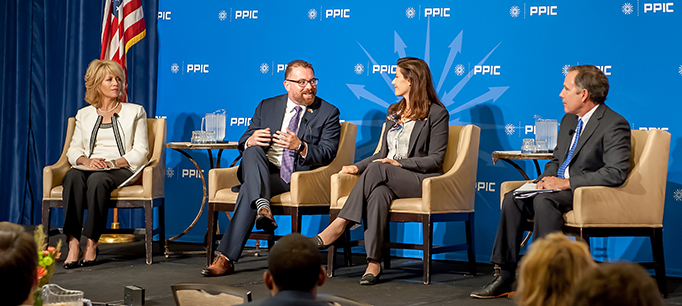
John Chiang, the state’s treasurer and a candidate for governor this year, was asked last week to name the top three issues that will make the most difference for the state’s future. The question is the first one Mark Baldassare, PPIC president and CEO, asks of all gubernatorial candidates appearing before PPIC audiences. Chiang said his priorities are

  • Education
  • Housing
  • Jobs, climate change, health care—issues Chiang lumped together as the “things that are absolutely critical in everybody’s life.”

Chiang praised Governor Jerry Brown for the state’s K–12 finance formula that targets extra resources toward lower-income students, English Learners, and those in foster care. He said he would target more money toward students with special needs.

Referring to the state’s housing situation as an “extraordinary crisis,” Chiang said that even if an affordable housing bond measure passes in November, the state will need to return to the voters to get more money. He advocated reviving local redevelopment agencies, which the governor eliminated in 2011, to give local governments an economic tool to build housing.

Chiang referred to his background as treasurer, state controller, and member of the state Board of Equalization in emphasizing the need to ensure a way to pay for proposals such as single-payer health care—an idea he said he favors in concept. While describing the current system as inefficient, he said that the state can’t achieve single payer health care immediately. How long will it take? Chiang said more clarity from the federal government is crucial to understanding what the state can afford. “Let’s build what we can build. We don’t have to build a mansion at the beginning. Let’s build a starter house.” Chiang also said that the state needed to figure out how to insure an additional 2.9 million Californians who are currently uninsured.

The conversation with Chiang is part of the PPIC Speaker Series on California’s Future. PPIC is inviting all major candidates for governor to participate if they reach a certain threshold in the polls. The goal is to give Californians a better understanding of how the candidates intend to address the challenges facing our state.
Watch all candidate videos


Video: 3 Cities Address Economic Challenges

When Uber officials announced the company was moving to Oakland, there was a wave of fear and anger that well-paid tech workers would push longtime residents out of the city. Fresno, with its high concentration of poverty, struggles to attract the kind of private investment that caused angst in Oakland. In South Gate, housing is relatively affordable, which should be good news. But there are few homes for residents to buy because most are rentals owned by outside investors.

These stories, told by leaders of these communities at a recent PPIC event, were different. But common across the agendas of all three leaders was an emphasis on education as a key part of the solutions they are working on to address income inequality and poverty.

Jorge Morales, councilmember and former mayor of South Gate, said business owners told him that city residents didn’t have the education needed to get jobs beyond the entry level. Now, thanks to a partnership with the Los Angeles Community College District, a new campus will open in South Gate. The focus will be on jobs that become careers, Morales said.

“One of the mistakes we made as policy makers is that when manufacturing jobs started to leave, we all got excited about the revenue—about the sales taxes size—and we started building shopping centers everywhere.””What did that do? That provided the jobs that didn’t provide a living for folks.”

Ashley Swearingen, mayor of Fresno, said that missing the dot com boom of the late 1990s was a wake-up call for her city.

“We were not as a city and a region prepared to ride that wave of expansion,” she said. “That tidal wave of prosperity hit the state, but not a drop hit the ground in the places I was living and working.” The city partnered with Fresno State University to “undo and redo everything about our community” from its public systems to its civic environment, and entrepreneurship education is woven through school curriculums beginning in elementary school.

Libby Schaaf, mayor of Oakland, said she is most passionate about a program she is raising money to start, the Oakland Promise. She said that among this year’s ninth-graders, only 10% will have a college degree by the time they are 23 years old. The Oakland Promise is a “cradle-to-career strategy to triple that number in 10 years.” Each baby born into poverty will get a $500 college savings account, and parents will get another $500 in direct support for home visits and literacy training. Every kindergartener will receive a $100 college savings account. Students will be connected with internships, mentors, peer support groups, and help with financing college.

“You have got to intervene at every moment, from birth until college completion,” she said.

Schaaf says she has raised $23 million for the program and needs $15 million more.

Learn more

Read the PPIC report Income Inequality and the Safety Net in California