How Community College Reforms Could Help English Learners

[vc_row][vc_column][vc_column_text]Due in large part to their mission of access and affordability, community colleges play a key role in educating immigrant students, especially those who are English Learners. In 2016–17, more than 58,000 first-time community college students in California enrolled in English as a Second Language (ESL) courses.

For many students, taking ESL courses may be linked to the desire to improve their socioeconomic prospects. Indeed, community college students who earn a credential or transfer to get a four-year degree are well positioned to climb the economic ladder. In an economy that increasingly demands skilled workers, there is tremendous untapped potential in increasing the educational attainment—and economic trajectories—of ESL students.

California’s community colleges have undertaken several reforms that aim to improve student success and close equity gaps. These reforms—spurred by AB 705 and the new Guided Pathways framework—present a ripe opportunity to help more ESL students get on the path to completing college composition, a requirement to earn a college credential or transfer.

These initiatives are primarily focused on addressing the needs of students who intend to pursue a degree or transfer. However, our most recent research finds that about two-thirds of ESL students (66%) are not on track to do so—and may consequently be left out of the reforms. (We consider students on track if they take any ESL course required to access college composition and at least one course other than ESL or English.)

ESL students who are not on track are more likely to come from historically underrepresented groups. For instance, we find that compared to students taking ESL courses needed for college composition, those not taking these courses are more likely to be older and Latino. They are also more likely to have unknown citizenship status (a possible signal of being undocumented) and to have not graduated high school.
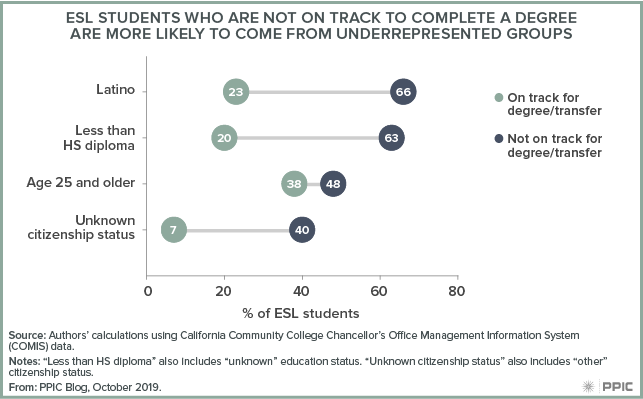
figure - ESL Students Who Are Not on Track To Complete a Degree Are More Likely To Come from Underrepresented Groups

As colleges across the state reform their ESL sequences and programs of study, it will be critical to ensure that all students have the opportunity to earn a degree or transfer. The two-thirds of ESL students currently not on track to do so are the most vulnerable. These students have already taken the major step of enrolling in college. To improve their likelihood of advancing, colleges could provide clearer and more effective ESL sequences and degree and transfer pathways, as well as stronger student supports, including advising, placement, and information about available degrees and certificates.

Some colleges are already working on these issues. Initiatives like the Guided Pathways ESL Milestone certificates at Cypress College—the result of AB 705 and Guided Pathways efforts—present a unique example of how colleges can structure ESL programs and certificates to help English Learners get on a pathway toward a college credential.

Finally, it is important to acknowledge that there are some ESL students who take ESL coursework for reasons unrelated to a degree. As colleges redesign their ESL programs, working alongside non-credit ESL programs, adult education schools, and community-based ESL programs could help ensure that colleges are keeping the diverse needs of ESL students in mind.[/vc_column_text][/vc_column][/vc_row]

Video: English as a Second Language in California Community Colleges

While the educational goals of students who enroll in ESL courses at California’s community colleges may vary, the economic benefits of effective ESL programs are clear: English proficiency can facilitate social and economic mobility for non-native speakers. But little is known about ESL programs across the state, or about the trajectories of ESL students. Now that a new law—Assembly Bill (AB) 705—is motivating colleges across the state to assess and reform their ESL programs, we need to better understand the ESL student population and the programs that serve them.

At an event in Sacramento earlier this week, PPIC researcher Bonnie Brooks outlined the findings of a new report on ESL in the community colleges and a panel of experts discussed AB 705’s impact on ESL in the community college system.

Kathryn Wada, who has taught ESL for 30 years at Cypress College, noted that the fact that AB 705 distinguishes ESL from developmental (or remedial) English and recognizes that ESL students are working toward proficiency in a foreign language is “huge for our field.”

AB 705 requires colleges to reform “credit” ESL programs—which offer credit-bearing courses for which students pay tuition—so that they do not deter or delay educational progress. By fall 2020, colleges must implement policies that maximize the chances that students complete a transfer-level English course within three years.

A look at the length of ESL course sequences across the system indicates that students at many colleges could, theoretically, complete transfer-level English in three years. In reality, however, most students don’t get this far. As Brooks noted, simply offering a sequence that is short enough to allow students to get through transfer-level English in three years “isn’t necessarily enough to maximize the probability of completion.”

Fortunately, many colleges are taking new approaches to ESL instruction that do increase the likelihood of completion. Courses that take an integrated approach—teaching more than one English skill at a time—and policies that allow students to move directly from ESL to transfer-level English instead of requiring them to enroll in developmental courses are likely to be key to fulfilling AB 705’s mandate. And, as Wada noted, new policies that make credits from advanced ESL courses transferable to UC and CSU moves credit ESL programs beyond the goals of AB 705: “If students are able to fulfill CSU and UC general education requirements directly with ESL courses . . . that’s huge.”

These new instructional approaches usher in a new era for ESL students. As Alice Perez, vice chancellor of academic affairs in the California Community Colleges Chancellor’s Office noted, “Many of our faculty and our institutions are set up to receive students assuming a major deficit: ‘You’re not college ready, and this placement test shows us this.’” Melissa Reeve, an English and ESL professor at Solano College, echoed Perez’s call for a “mindset shift,” citing the importance of “all of us having a belief in our students and what they are able to do, and sharing that with them in every facet of what we do.”