Examining the Federal EITC’s Impact on Poverty

The federal Earned Income Tax Credit (EITC) plays an important role in keeping Californians out of poverty. The credit supplements earnings for low-income workers at tax time, providing $2,400 on average to qualified tax filers.

Without the EITC, we estimate an additional 814,000 Californians would live in poverty, according to the latest data from the California Poverty Measure (CPM), an ongoing collaboration between PPIC and the Stanford Center on Poverty and Inequality. This reduction in poverty makes the EITC nearly comparable to CalFresh (formerly known as food stamps), the safety net program that keeps the most Californians out of poverty. Our estimates reflect data from 2013 to 2015 and do not include the state EITC, which was introduced in 2015 and expanded in 2017. The state EITC lowers poverty by very little because the largest credits go to workers with very low earnings, whose families mostly live well below the poverty line.

The role that the EITC plays varies widely across regions. Statewide, the poverty rate would be 2.2 percentage points higher without the EITC (22.6% instead of 20.4%). But in Lake and Mendocino Counties (combined), the poverty rate without the EITC would be 4.1 percentage points higher than it is currently, reaching 26.8%. Poverty in Marin County, on the other hand, would increase only 0.2 points, to 16.5%. Such differences could be due to several factors—for example, the share of eligible families who take advantage of the credit and the local availability of jobs.

PPIC recently released data showing poverty rates, poverty thresholds, and the effects of safety net programs not only by county, but also by state assembly and senate district and by US congressional district. These data provide an opportunity to dig more deeply into the varying roles of safety net programs across the state.

The EITC, for example, has the largest effect in some of the highest-poverty congressional districts, including District 40 (Rep. Roybal-Allard) and District 44 (Rep. Barragán). But in some relatively high-poverty districts it plays a smaller role (District 46, Rep. Correa). The data we provide can be a starting point for investigating—and potentially remedying—incomplete access to the EITC.


Video: Strategies for Reducing Child Poverty

High housing costs and low-wage work make it hard for low-income Californians to meet their basic needs. The result? Nearly a quarter of California’s youngest residents live in poverty—a fact with profound educational, health, and economic repercussions now and in the future. Social safety net benefits help low-income families supplement their incomes but do not reach the working poor in high-cost areas and the very poor across the state.

A new PPIC report examines how high housing costs and low wages contribute to child poverty. It also looks at additional policy approaches: an expansion of the Earned Income Tax Credit, establishment of a state child credit, and an overhaul of the state renter’s credit. Each approach holds promise, and each involves trade-offs.

Researcher Caroline Danielson presented the report in Sacramento last week. She also demonstrated an interactive tool that allows for a deeper exploration of how policy changes could affect California’s diverse counties. It underscores the need for policymakers to be strategic in determining how best to help families in need throughout the state.

Explore the accompanying tool Interactive: Reducing Child Poverty in California.

Testimony: Measuring Poverty

The Assembly Human Services Committee held a hearing on Tuesday, July 14, to consider a joint resolution regarding official poverty measurement tools. PPIC research fellow Sarah Bohn provided background on official poverty statistics and explained how different measurement tools affect our understanding of poverty in California. Here are her prepared remarks.


My name is Sarah Bohn, I am a research fellow at the Public Policy Institute of California. PPIC is a nonpartisan, independent research institute and as such does not take positions on bills before the legislature. I am here today to inform the committee on facts related to Assembly Joint Resolution 22 (AJR 22). As some of you know, PPIC, in collaboration with the Stanford Center on Poverty and Inequality, has been deeply involved in research on alternative poverty measurement for the past three years. I will provide background on the shortcomings of official poverty statistics and offer an updated view of poverty measurement—and poverty in California.

According to official statistics, poverty is significantly higher (50% higher) than it was 50 years ago, when the War on Poverty began. As we shall see, this finding should be taken with a big grain of salt. Poverty status, as you know, is based on how family income compares to the “federal poverty line.” This was developed in the early 1960s as the first working definition of poverty in the U.S. It is based on family budgets of that time, when a typical family spent one-third of its income on food. So the threshold was (to simplify a bit) three times the cost of food a family would need to meet basic needs. While this was a novel use of the facts and information available then and was hugely important in creating a standard metric to inform policy, it’s hard to apply the same metric to modern families and derive a clear understanding of how families—and policy—are doing. There are two main reasons for this: (1) the cost of living and family budgets have shifted considerably, with families spending more on housing, work expenses (like commuting and child care), and medical care and less on food overall (2) several government programs have changed and expanded, but are not counted in family income data in the official poverty measure. For these reasons, official poverty statistics are hard to interpret; they essentially compare a part of family resources to an outdated benchmark.

Two current measures—the Census Bureau’s “Supplemental Poverty Measure” and the PPIC-Stanford “California Poverty Measure” (which uses a similar methodology)—update and realign the basic poverty concept that is now more than 50 years old. There is quite a lot of momentum and agreement around the benefits of these “supplemental” measures. In summary, the methodology aims to improve on official poverty measurement in the following ways. First, both measures use detailed data on what families actually spend to meet basic needs, rather than relying on a 1960s-era approximation. Second, these metrics allow for the cost of living to vary (conservatively), depending on where one lives. Third, they make use of a comprehensive estimate of resources families have on hand, which includes cash income, program benefits, taxes paid or credited, net of medical and work expenses.

The Supplemental and California Poverty Measures provide new insights to poverty. I’ll highlight a couple that are especially related to the impact of policy. First, I’ll return to the effects of the War on Poverty. Using supplemental measures, researchers find a clear downward trend in poverty—specifically, that government programs reduced poverty by 15 percentage points since the mid-1960s. These are facts that cannot be uncovered by official poverty data, which, you may recall, suggests that poverty rates rose 50 percent despite policy efforts. Second, poverty in California today would be much higher were it not for the safety net. Without major programs like CalWORKs, CalFresh, the federal Earned Income Tax Credit, and housing subsidies (among others) nearly 40 percent of children in California would be poor—or 30 percent of state residents overall.

It’s possible that the safety net in California could have an even longer reach than it already does. For one, increasing program participation among eligible families could reduce poverty. Also, because many poverty programs are not scaled to cost of living, their ability to materially affect families in poverty varies substantially across the state. In high-cost areas, safety net benefits reduce poverty by about 30 percent, but they reduce it by 50 percent in the Central Valley and far north. Poor families in coastal (and the most populous) parts of the state face costs $7,000 to $12,000 higher than the federal poverty line accounts for. Although we find that poor families in high cost areas are more likely to be working—and earning more—than their counterparts elsewhere, their earnings are not enough to boost them above the more realistic cost-adjusted supplemental poverty threshold. But their slightly higher earnings (which are still low by California standards) make them less likely to qualify for some safety net programs.

These examples scratch the surface of what is possible using the tools of improved measures like the Supplemental and California Poverty Measure. We also hope to use our research to assess how proposed changes to programs could move families out of poverty. But beyond these efforts, I would argue that simply tracking poverty in and across California and the U.S.—using truly comprehensive and accurate metrics—should be a regular contribution to the policymaking process. For those of us at PPIC and for other researchers involved in poverty research across the country, including those at the Census Bureau, alternative measures of poverty are still in their early phases, and, as such, rely on policymaker awareness and on funding to continue to produce. Thank you for your interest in the topic and your time today.


High Poverty Rate Persists

Although the state’s economy has rebounded, the latest poverty statistics suggest there’s been little improvement in the share of Californians struggling to make ends meet.

More than 1 in 5 Californians—or 8.1 million people—were living in poverty in 2012, the most recent year for which we have data. This is according to the California Poverty Measure, a comprehensive metric developed by PPIC and the Stanford Center on Poverty and Inequality. This share is about the same as it was in 2011. Rates were highest among children, with about 1 in 4, or 2.3 million, living in poverty—virtually unchanged from 2011.

Why? Although California’s overall economy is growing, not all have shared equally in the recovery. The reasons for this are both specific to this economic recovery and true more generally of economic upturns. The unemployment rate remains higher than it has been since 2004 and a high share of workers—by historical standards—have given up looking for work or are underemployed (working part time when they would prefer full time, for example). As is typical of past patterns of recession and recovery, high-income families tend to rebound most quickly, followed by middle-income and finally low- income families. This means that improvements in poverty metrics tend to lag behind other indicators of how the economy is faring.

The good news is that the social safety net—programs like CalFresh and the federal Earned Income Tax Credit—helped many families through the recession and still plays an important role in keeping families out of poverty. Without it, more families—including 1.3 million children—would be poor. We estimated that without these and other safety net programs, poverty would be roughly a third higher in the state as a whole. This cushioning effect of the safety net decreases swings in poverty, meaning that a slowly changing poverty rate is partly an indication that the safety net is working.

A California Earned Income Tax Credit

Governor Brown has proposed a state Earned Income Tax Credit (EITC) for low-income families, similar to the federal tax credit. This adds to the mix of strategies policymakers are considering to address the state’s poverty rate, which is the highest in the nation when cost of living is accounted for. The governor’s proposal is aimed at workers who have earnings well below poverty. For example, a parent of two children would be eligible if she filed a tax return and earned no more than $13,870—equivalent to the annual pay for about 30 hours a week at a minimum-wage job. Because it depends on earnings and the number of dependents, the credit would vary widely. The maximum credit of $3,121 would go to families with three or more children and earnings below $7,000 per year, but the governor’s proposal estimates the average credit to be $460. About a quarter of the 3.1 million California filers who can claim the federal EITC would also be eligible for the proposed state EITC.

While a state EITC would increase the cash resources of millions of Californians, the resources families need to make ends meet are substantial. A family of four needs about $29,000 a year to stay above poverty, according to our California Poverty Measure (CPM), a comprehensive yardstick of poverty that accounts for regional variation in the cost of living and the impact of social programs.

How would the proposed EITC affect Californians? Using CPM research, we estimate that the proposed credit would:

  • Move 70,000 Californians, including 31,000 children, above the CPM poverty line.
  • Help about 1.28 million Californians experience less severe poverty.
  • Benefit 1.83 million Californians who already live above the CPM poverty line. (Many of those with low earnings are nonetheless above the poverty line because they receive benefits such as food stamps and/or live and share resources with other family members.)

The governor’s state EITC proposal focuses on augmenting low wages—an acknowledgment of the importance of earnings even for families in poverty. Research has shown that the federal EITC encourages work, and a state credit promises to do the same.

Testimony: Poverty and the Safety Net

The Assembly Budget Subcommittee for Health and Human Services is considering the level of financial support to CalWORKs, California’s cash assistance program for families with children. The panel held a hearing on Wednesday that began with testimony from PPIC research fellow Sarah Bohn about recent poverty trends and the impact of anti-poverty programs. Here are her prepared remarks.


My name is Sarah Bohn. I am an economist and research fellow at the Public Policy Institute of California. I hope most of you are familiar with PPIC, but for those who are not, we are a nonpartisan, independent research institute focused on major policy issues in the state. I will present the most recent facts on poverty in California and discuss their implications.

In the midst of the slow recovery from the Great Recession, attention has turned to the causes, consequences, and possible solutions to growing poverty in California and the nation as a whole. These have been topics of importance to researchers for a long time. In fact, today’s economic realities are largely the result of long-term trends. But the recession and the 50th anniversary of the War on Poverty have brought these issues into focus for the wider community and offers an opportunity for reassessment. For example, last December, the PPIC Statewide Survey found that a record-high share of Californians—66 percent—believe the state is divided into “the haves and the have nots.” Well below a majority identify themselves as part of the “haves”—a much higher share did so a decade ago.

The latest official poverty estimates suggest that about 16 percent of Californians are poor, and that as many as 22.5 percent of children in the state are poor. These numbers are an improvement over the year before, and are the first sign of a turnaround since the beginning of the Great Recession. But poverty rates today are 50 percent higher than they were five decades ago, when the War on Poverty began. Do today’s high rates of poverty mean that public investments aimed at mitigating poverty have not had their intended effect?

Unfortunately, official poverty statistics don’t give us the information we need to answer this question. The official poverty measure is based on a very simple formula developed in the 1960s. This formula has a number of shortcomings. First, it does not account for many of safety net programs—so it entirely misses the poverty-reducing effect of SNAP (food stamps) and the EITC (Earned Income Tax Credit), for example. Second, the formula has not kept up with sweeping changes in the cost of living since the 1960s. It does not reflect the increase or variation in housing costs across different places. And it doesn’t account for the fact that many families face different sorts of expenses than they did in the 1960s—like higher medical out of pocket expenses and child care costs.

These shortcomings prompted a national effort to develop alternative measures of poverty, which began to coalesce in the 1990s. In 2011, this effort produced the Census Bureau’s Supplemental Poverty Measure, which provides detailed new estimates of poverty for the U.S. In 2013, a collaborative effort between PPIC and Stanford Center on Poverty and Inequality produced the California Poverty Measure, which provides similar detail for California. Both measures use the same underlying methodology to address the shortcomings I just described in the official poverty statistics. And I’d like to note that the creators of both measures are engaged in ongoing efforts to refine and improve the methodology, and for that reason—among others—their measures do not replace the official statistics but supplement them (hence the name of the Census measure).

Both the California Poverty Measure and Census’s Supplemental Measure account for the resources that families actually have to meet very basic needs and the actual costs of doing so. The California Poverty Measure finds that more Californians are poor than we thought, as of 2011. The California Poverty Measure estimate of 22 percent (or 8 million people) is higher than the official rate of 16.2 percent—this translates to an additional 2 million people in poverty. More people of all ages are poor under this new, better measure. Of particular interest is the child poverty rate, which is 25 percent, or 2 points higher in our measure. In other words, a quarter—or more than 2 million—of our children are poor.

These higher poverty rates stem from a combination of factors. Most important, the California Poverty Measure uses higher thresholds than the official poverty measure does—that is, a higher poverty line. This is because housing costs for the vast majority of Californians are significantly higher than what the federal poverty line accounts for. On average, a single parent with two kids needs $24,600 to be considered out of poverty and a four-person family needs $29,000 to be considered out of poverty under the California Poverty Measure. That’s about $6,000 above the federal poverty line, and about $4,000 more than a similar family would need to be above poverty level in other states under the Census Supplemental Measure. These higher costs of living explain in large part why California’s Supplemental Poverty Rate is higher than that of any other state in the country.

Cost of living differences also change the narrative about how poverty varies within California. As you can see from the map I’ve provided, in many ways our measure flips the official measure’s picture of poverty. The California Poverty Measure finds that coastal areas—where housing costs are generally higher—have among the highest poverty rates in the state, much higher than the official estimates. Our measure places inland areas like the Central Valley, where official poverty rates are typically the highest, in the middle to low range statewide. In some counties with relatively low costs of living, the California Poverty Measure estimates are lower than official poverty rates. In these areas, safety net benefits to low-income families more than offset the cost of living, driving down poverty rates. But the vast majority of Californians live in higher-cost counties, where safety net resources, despite playing an important role in family budgets, are not large enough to offset high costs of living.

The California Poverty Measure allows us to look closely at the role safety net programs play in mitigating poverty. And our research suggests that this role is powerful—especially for children. We find that without CalWORKs benefits the child poverty rate jumps 2.5 points—equivalent to about a quarter million more children in poverty. Similarly, without CalFresh benefits, the child poverty rate would jump 4 points—that is an additional 375,000 children. Of course, many families use both of these programs, as well as others that we’ve accounted for—including housing subsidies, SSI, school meals, and the EITC/CTC. When we look at the combined effect of all of these need-based safety net programs, we find that without them a stunningly high 39 percent—or 3.6 million—of California’s children would be poor. That is, the child poverty rate would jump nearly 14 points. This shows that low-income and poor families are making use of the social safety net and that it has a substantial effect on their poverty status.

These poverty-reducing effects could be even larger if changes were made to the safety net. For example, the USDA estimates that slightly more than half of eligible Californians participate in CalFresh—this is one of the lowest statewide participation rates in the nation. Participation also varies across California’s counties. This begs the question of how much lower poverty rates would be—would they still be the highest in the country?—if participation rates were higher. As this example shows, housing costs are not the only area in which California stands out. And, while policy clearly plays an important role in offsetting the higher cost of living in California (it more than offsets cost of living in families with children), it has the potential to move the needle on poverty even further.

As it stands, our estimates suggest that the safety net kept nearly 1.3 million children out of poverty in 2011. This matters a lot because research increasingly links poverty to adverse outcomes in many arenas—nutrition, health, education, even brain development—in addition to long-term economic opportunity and mobility. It’s my hope that our research can be used to inform the important decisions you make on policies that address family economic need and its consequences. Thank you for your time.
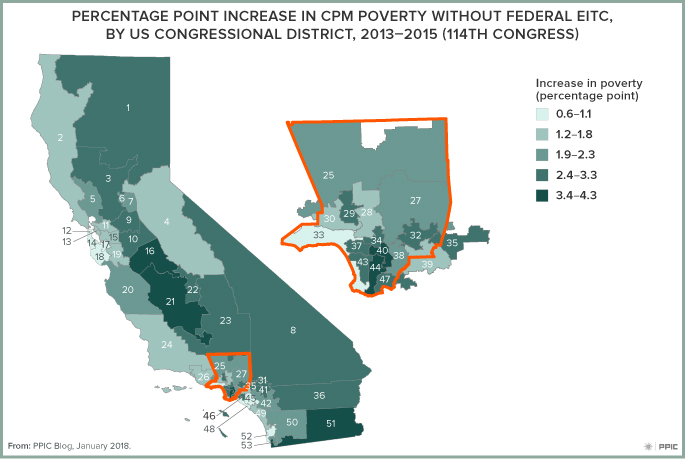
 

Chart source: The California Poverty Measure: A New Look at the Social Safety Net.