Feeding Children When Schools Are Closed for COVID-19

By state law, all public schools in California must provide at least one nutritionally adequate meal to students—however, many students eat more than one meal a day at school. Nearly four million students received meals from California’s public schools in the 2018–19 school year: close to 300 million breakfasts and well over 500 million lunches. With schools closed to reduce exposure to the new coronavirus, many students now lack ready access to these meals.

By federal law, low-income students (about $48,000 for a family of four in 2020) are eligible for free or low-cost school meals. Higher income students paid on average $0.98 for breakfast and $2.11 for lunch in 2017–18, according to the California Department of Education.

The vast majority of low-income students eat some or all breakfasts, lunches, or both at school. Free and reduced-price meals lower food insecurity, and according to the California Poverty Measure (CPM), meaningfully reduce poverty among families with public school students. Without school meals, the share of students living in deep poverty would be 17% higher; increases for students in less severe poverty would be 2% to 8%.

figure - Many Children in Low-Income Families Eat a Free or Low-Cost Meal at School

With school closures in place for several weeks, school districts have already designated sites where families can pick up meals for children. In higher poverty areas, all children can access meals regardless of enrollment in the local school or eligibility for meal programs because authorities have temporarily relaxed federal regulations.

During closures, Governor Newsom assured that schools will continue to receive state funds to operate and requested efforts focus on certain areas, including providing school meals. However, access remains a concern. For example, Los Angeles Unified School District lists 64 “grab-and-go” sites for its roughly 1,000 schools. San Diego Unified School District has 13 sites for 181 schools, as of March 16. Elk Grove, with 67 schools, has 34 sites for drive-through and grab-and-go meal services along with a mobile service for families with limited transportation.

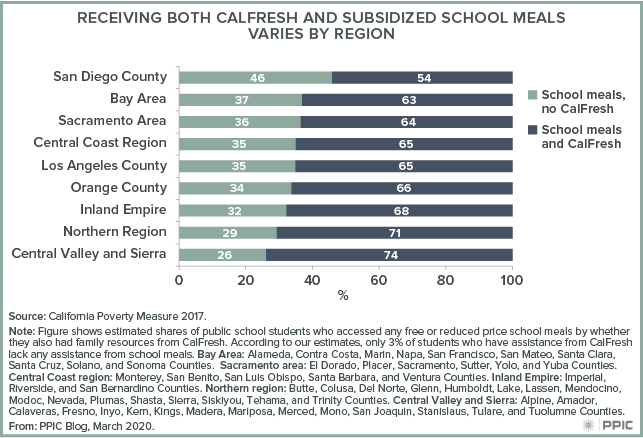
With pandemic EBT (P-EBT), ATM-like cards pre-loaded with funds for groceries, the federal government is also helping low-income students replace missed school meals. The cards will cover the expected number of days that schools will be closed. For students whose families already receive monthly CalFresh benefits on EBT cards, funds can readily be added. For low-income students who do not already receive CalFresh (34% statewide), families must complete some paperwork—mainly electronically—to obtain an EBT card.

Because the reach of CalFresh varies across the state, barriers to getting P-EBT funds to students will also vary. Fortunately, the state already matches student data with their CalFresh, CalWORKs, and Medi-Cal data to automatically determine students eligible for free and reduced-price school meals. If the state can use all existing sources of family income to provide P-EBT to students, they will reach more low-income students.

figure - Receiving Both CalFresh and Subsidized School Meals Varies by Region

Ready access to meals influences student health, learning, and economic wellbeing. Robust access to free and reduced-price meals can decrease the stress low-income families are facing as efforts to limit the spread of COVID-19 dampen economic activity.

Video: Understanding Poverty in California

[vc_row][vc_column][vc_column_text]

Despite a booming economy, millions of Californians live in or near poverty. In this video, PPIC research associate Tess Thorman gives an overview of poverty and child poverty in the state, using the latest figures from the California Poverty Measure (CPM).

The CPM is a joint research effort by PPIC and the Stanford Center on Poverty and Inequality that provides a comprehensive look at economic well-being in our state. By accounting for cost of living differences across the state as well as earnings and other family resources—including safety net benefits—the CPM offers valuable insights into the ability of Californians to meet basic needs and be financially secure.[/vc_column_text][/vc_column][/vc_row][vc_row visibility=”hidden-phone”][vc_column][vc_video link=”https://youtu.be/tPh4xE7QLGo” el_width=”70″ align=”center”][/vc_column][/vc_row][vc_row visibility=”visible-phone”][vc_column][vc_video link=”https://youtu.be/tPh4xE7QLGo”][/vc_column][/vc_row][vc_row][vc_column][vc_column_text]To learn more about poverty in California, visit ppic.org/poverty.[/vc_column_text][/vc_column][/vc_row]

Interactive: A Look at Child Poverty across California

[vc_row][vc_column][vc_column_text]Governor Newsom’s first budget proposal included notable efforts to address poverty—especially child poverty—by increasing CalWORKs cash assistance grants, expanding assistance to low-income parents pursuing higher education, and further expanding the state’s Earned Income Tax Credit (CalEITC, which he proposed renaming the Working Families Tax Credit).

California has a troublingly high child poverty rate of 21.3%, or about 1.9 million children, according to our latest estimates from the California Poverty Measure (CPM). The CPM is a joint research effort between PPIC and the Stanford Center on Poverty and Inequality that, unlike official poverty metrics, takes into account the cost of living and benefits from social safety net programs.

While poverty rates in the state are also high, child poverty rates tend to be even higher, particularly in the most populous counties. For example, in Los Angeles County, 24.3% of all residents—but 27.8% of children—live in poverty. Altogether, 17 counties, 29 congressional districts, 21 senate districts, and 42 assembly districts have child poverty rates of more than about 20%.

State and federal policies play an important role in lowering child poverty. Our estimates indicate that over a third (35.3%) of children would be in poverty, were it not for programs like CalFresh food assistance, the federal and state Earned Income Tax Credits, and CalWORKs cash assistance. PPIC research also shows that new policies could reduce child poverty even further, although effects vary across the state. We will continue to track and analyze poverty and child poverty to provide this critical information to policymakers and stakeholders.[/vc_column_text][/vc_column][/vc_row][vc_row][vc_column][vc_raw_html]JTNDZGl2JTIwY2xhc3MlM0QlMjd0YWJsZWF1UGxhY2Vob2xkZXIlMjclMjBpZCUzRCUyN3ZpejE1NDc4MjcxODU1NTglMjclMjBzdHlsZSUzRCUyN3Bvc2l0aW9uJTNBJTIwcmVsYXRpdmUlMjclM0UlM0Nub3NjcmlwdCUzRSUzQ2ElMjBocmVmJTNEJTI3JTIzJTI3JTNFJTNDaW1nJTIwYWx0JTNEJTI3JTIwJTI3JTIwc3JjJTNEJTI3aHR0cHMlM0ElMjYlMjM0NyUzQiUyNiUyMzQ3JTNCcHVibGljLnRhYmxlYXUuY29tJTI2JTIzNDclM0JzdGF0aWMlMjYlMjM0NyUzQmltYWdlcyUyNiUyMzQ3JTNCQ2glMjYlMjM0NyUzQkNoaWxkUG92ZXJ0eWJ5Q2FsaWZvcm5pYUNvdW50eWFuZExlZ2lzbGF0aXZlRGlzdHJpY3RfMCUyNiUyMzQ3JTNCQ291bnRpZXMlMjYlMjM0NyUzQjFfcnNzLnBuZyUyNyUyMHN0eWxlJTNEJTI3Ym9yZGVyJTNBJTIwbm9uZSUyNyUyMCUyRiUzRSUzQyUyRmElM0UlM0MlMkZub3NjcmlwdCUzRSUzQ29iamVjdCUyMGNsYXNzJTNEJTI3dGFibGVhdVZpeiUyNyUyMCUyMHN0eWxlJTNEJTI3ZGlzcGxheSUzQW5vbmUlM0IlMjclM0UlM0NwYXJhbSUyMG5hbWUlM0QlMjdob3N0X3VybCUyNyUyMHZhbHVlJTNEJTI3aHR0cHMlMjUzQSUyNTJGJTI1MkZwdWJsaWMudGFibGVhdS5jb20lMjUyRiUyNyUyMCUyRiUzRSUyMCUzQ3BhcmFtJTIwbmFtZSUzRCUyN2VtYmVkX2NvZGVfdmVyc2lvbiUyNyUyMHZhbHVlJTNEJTI3MyUyNyUyMCUyRiUzRSUyMCUzQ3BhcmFtJTIwbmFtZSUzRCUyN3NpdGVfcm9vdCUyNyUyMHZhbHVlJTNEJTI3JTI3JTIwJTJGJTNFJTNDcGFyYW0lMjBuYW1lJTNEJTI3bmFtZSUyNyUyMHZhbHVlJTNEJTI3Q2hpbGRQb3ZlcnR5YnlDYWxpZm9ybmlhQ291bnR5YW5kTGVnaXNsYXRpdmVEaXN0cmljdF8wJTI2JTIzNDclM0JDb3VudGllcyUyNyUyMCUyRiUzRSUzQ3BhcmFtJTIwbmFtZSUzRCUyN3RhYnMlMjclMjB2YWx1ZSUzRCUyN3llcyUyNyUyMCUyRiUzRSUzQ3BhcmFtJTIwbmFtZSUzRCUyN3Rvb2xiYXIlMjclMjB2YWx1ZSUzRCUyN25vJTI3JTIwJTJGJTNFJTNDcGFyYW0lMjBuYW1lJTNEJTI3c3RhdGljX2ltYWdlJTI3JTIwdmFsdWUlM0QlMjdodHRwcyUzQSUyNiUyMzQ3JTNCJTI2JTIzNDclM0JwdWJsaWMudGFibGVhdS5jb20lMjYlMjM0NyUzQnN0YXRpYyUyNiUyMzQ3JTNCaW1hZ2VzJTI2JTIzNDclM0JDaCUyNiUyMzQ3JTNCQ2hpbGRQb3ZlcnR5YnlDYWxpZm9ybmlhQ291bnR5YW5kTGVnaXNsYXRpdmVEaXN0cmljdF8wJTI2JTIzNDclM0JDb3VudGllcyUyNiUyMzQ3JTNCMS5wbmclMjclMjAlMkYlM0UlMjAlM0NwYXJhbSUyMG5hbWUlM0QlMjdhbmltYXRlX3RyYW5zaXRpb24lMjclMjB2YWx1ZSUzRCUyN3llcyUyNyUyMCUyRiUzRSUzQ3BhcmFtJTIwbmFtZSUzRCUyN2Rpc3BsYXlfc3RhdGljX2ltYWdlJTI3JTIwdmFsdWUlM0QlMjd5ZXMlMjclMjAlMkYlM0UlM0NwYXJhbSUyMG5hbWUlM0QlMjdkaXNwbGF5X3NwaW5uZXIlMjclMjB2YWx1ZSUzRCUyN3llcyUyNyUyMCUyRiUzRSUzQ3BhcmFtJTIwbmFtZSUzRCUyN2Rpc3BsYXlfb3ZlcmxheSUyNyUyMHZhbHVlJTNEJTI3eWVzJTI3JTIwJTJGJTNFJTNDcGFyYW0lMjBuYW1lJTNEJTI3ZGlzcGxheV9jb3VudCUyNyUyMHZhbHVlJTNEJTI3eWVzJTI3JTIwJTJGJTNFJTNDJTJGb2JqZWN0JTNFJTNDJTJGZGl2JTNFJTIwJTIwJTIwJTIwJTIwJTIwJTIwJTIwJTIwJTIwJTIwJTIwJTIwJTIwJTIwJTIwJTNDc2NyaXB0JTIwdHlwZSUzRCUyN3RleHQlMkZqYXZhc2NyaXB0JTI3JTNFJTIwJTIwJTIwJTIwJTIwJTIwJTIwJTIwJTIwJTIwJTIwJTIwJTIwJTIwJTIwJTIwJTIwJTIwJTIwJTIwdmFyJTIwZGl2RWxlbWVudCUyMCUzRCUyMGRvY3VtZW50LmdldEVsZW1lbnRCeUlkJTI4JTI3dml6MTU0NzgyNzE4NTU1OCUyNyUyOSUzQiUyMCUyMCUyMCUyMCUyMCUyMCUyMCUyMCUyMCUyMCUyMCUyMCUyMCUyMCUyMCUyMCUyMCUyMCUyMCUyMHZhciUyMHZpekVsZW1lbnQlMjAlM0QlMjBkaXZFbGVtZW50LmdldEVsZW1lbnRzQnlUYWdOYW1lJTI4JTI3b2JqZWN0JTI3JTI5JTVCMCU1RCUzQiUyMCUyMCUyMCUyMCUyMCUyMCUyMCUyMCUyMCUyMCUyMCUyMCUyMCUyMCUyMCUyMCUyMCUyMCUyMCUyMGlmJTIwJTI4JTIwZGl2RWxlbWVudC5vZmZzZXRXaWR0aCUyMCUzRSUyMDgwMCUyMCUyOSUyMCU3QiUyMHZpekVsZW1lbnQuc3R5bGUud2lkdGglM0QlMjcxMDAlMjUlMjclM0J2aXpFbGVtZW50LnN0eWxlLmhlaWdodCUzRCUyOGRpdkVsZW1lbnQub2Zmc2V0V2lkdGglMkEwLjc1JTI5JTJCJTI3cHglMjclM0IlN0QlMjBlbHNlJTIwaWYlMjAlMjglMjBkaXZFbGVtZW50Lm9mZnNldFdpZHRoJTIwJTNFJTIwNTAwJTIwJTI5JTIwJTdCJTIwdml6RWxlbWVudC5zdHlsZS53aWR0aCUzRCUyNzEwMCUyNSUyNyUzQnZpekVsZW1lbnQuc3R5bGUuaGVpZ2h0JTNEJTI4ZGl2RWxlbWVudC5vZmZzZXRXaWR0aCUyQTEuNzclMjklMkIlMjdweCUyNyUzQiU3RCUyMGVsc2UlMjAlN0IlMjB2aXpFbGVtZW50LnN0eWxlLndpZHRoJTNEJTI3MTAwJTI1JTI3JTNCdml6RWxlbWVudC5zdHlsZS5taW5IZWlnaHQlM0QlMjc3NTBweCUyNyUzQnZpekVsZW1lbnQuc3R5bGUubWF4SGVpZ2h0JTNEJTI4ZGl2RWxlbWVudC5vZmZzZXRXaWR0aCUyQTEuNzclMjklMkIlMjdweCUyNyUzQiU3RCUyMCUyMCUyMCUyMCUyMCUyMCUyMCUyMCUyMCUyMCUyMCUyMCUyMCUyMCUyMCUyMCUyMCUyMCUyMCUyMCUyMHZhciUyMHNjcmlwdEVsZW1lbnQlMjAlM0QlMjBkb2N1bWVudC5jcmVhdGVFbGVtZW50JTI4JTI3c2NyaXB0JTI3JTI5JTNCJTIwJTIwJTIwJTIwJTIwJTIwJTIwJTIwJTIwJTIwJTIwJTIwJTIwJTIwJTIwJTIwJTIwJTIwJTIwJTIwc2NyaXB0RWxlbWVudC5zcmMlMjAlM0QlMjAlMjdodHRwcyUzQSUyRiUyRnB1YmxpYy50YWJsZWF1LmNvbSUyRmphdmFzY3JpcHRzJTJGYXBpJTJGdml6X3YxLmpzJTI3JTNCJTIwJTIwJTIwJTIwJTIwJTIwJTIwJTIwJTIwJTIwJTIwJTIwJTIwJTIwJTIwJTIwJTIwJTIwJTIwJTIwdml6RWxlbWVudC5wYXJlbnROb2RlLmluc2VydEJlZm9yZSUyOHNjcmlwdEVsZW1lbnQlMkMlMjB2aXpFbGVtZW50JTI5JTNCJTIwJTIwJTIwJTIwJTIwJTIwJTIwJTIwJTIwJTIwJTIwJTIwJTIwJTIwJTIwJTIwJTNDJTJGc2NyaXB0JTNF[/vc_raw_html][/vc_column][/vc_row]

Child Poverty and California’s High Cost of Living

A quarter of young children in California live in poverty, yet the local variation in poverty rates is dramatic. Our recent report shows, for example, that the areas with the lowest and highest rates of child poverty in the state are less than 20 miles apart: child poverty is 4% in Redondo Beach, Manhattan Beach, and Hermosa Beach in Los Angeles County and 68% near southeastern LA City. (Data is for 2011–2014 combined, the most recent available).

Families adapt to California’s high cost of living in ways that vary across the state. The interactive map that accompanies our report allows stakeholders to investigate how their local area (defined to have a population of roughly 100,000) stacks up relative to other areas, their region, and the state as a whole.

For example, Selma, Kerman, and Coalinga make up a local area just west and south of Fresno. The area has a relatively high poverty rate of 30% among young children. Most of these children’s parents have limited education: 55% lack a high school degree compared with a statewide average of 37%. But for the most part they are working full-time (62% vs. 50% statewide). They also report the lowest annual housing costs ($5,888) of any area in the state. (We standardized this cost to represent a family of four.) This means they have a relatively low housing burden. Specifically, 18% of families living in poverty in this area use over half of their family resources to pay for housing, compared to the statewide average of 32%.

At the same time, 52% of poor children in this area live in overcrowded housing—about the same as in the state as a whole (55%) and higher than the regional average in the Central Valley (46%). Also, the share of working parents in these poor families who commute 60 minutes or more each way is relatively high at 14%, compared with 10% in the state as a whole.

In sum, the picture that emerges shows families of young children in poverty in this local area tend to have low housing costs relative to other parts of the state. Nevertheless, the cost of housing in inland California is still high compared to the rest of the country, and the data suggest poor families with young children in Selma, Kerman, and Coalinga are indeed making adaptations to cope with these costs—such as living in more crowded conditions and, in some cases, commuting long distances.

Child poverty is a difficult problem, both because it is so high in California and because the family circumstances that poor children experience can differ so much. Investigating varying patterns of housing and commuting across the state can help suggest how policies aimed at reducing the incidence—or severity—of poverty can be tailored to meet local and regional needs.

Measuring Child Poverty

At a well-attended briefing in Sacramento this week, PPIC research fellow Sarah Bohn described the findings in a newly released report, Child Poverty and the Social Safety Net in California, that she co-authored with PPIC research fellow Caroline Danielson, who also attended.

The authors found that about a quarter of California children live in poverty and an additional 26% live in “near poverty,” a threshold defined by incomes between 100 and 150% of the official poverty threshold (up to $46,000 annually for a family of four on average). The poverty analysis was based on the California Poverty Measure, developed by researchers at PPIC and the Stanford Center on Poverty and Inequality. Unlike the traditional federal measure, the new analysis considers regional cost-of-living differences, as well as assistance from government social programs, in measuring poverty.

Bohn also talked about the report and related issues today at an event titled Attacking Poverty by Connecting College Education & Workforce Development, hosted in Los Angeles by state senator Holly Mitchell.

Testimony: Poverty and the Safety Net

The Assembly Budget Subcommittee for Health and Human Services is considering the level of financial support to CalWORKs, California’s cash assistance program for families with children. The panel held a hearing on Wednesday that began with testimony from PPIC research fellow Sarah Bohn about recent poverty trends and the impact of anti-poverty programs. Here are her prepared remarks.


My name is Sarah Bohn. I am an economist and research fellow at the Public Policy Institute of California. I hope most of you are familiar with PPIC, but for those who are not, we are a nonpartisan, independent research institute focused on major policy issues in the state. I will present the most recent facts on poverty in California and discuss their implications.

In the midst of the slow recovery from the Great Recession, attention has turned to the causes, consequences, and possible solutions to growing poverty in California and the nation as a whole. These have been topics of importance to researchers for a long time. In fact, today’s economic realities are largely the result of long-term trends. But the recession and the 50th anniversary of the War on Poverty have brought these issues into focus for the wider community and offers an opportunity for reassessment. For example, last December, the PPIC Statewide Survey found that a record-high share of Californians—66 percent—believe the state is divided into “the haves and the have nots.” Well below a majority identify themselves as part of the “haves”—a much higher share did so a decade ago.

The latest official poverty estimates suggest that about 16 percent of Californians are poor, and that as many as 22.5 percent of children in the state are poor. These numbers are an improvement over the year before, and are the first sign of a turnaround since the beginning of the Great Recession. But poverty rates today are 50 percent higher than they were five decades ago, when the War on Poverty began. Do today’s high rates of poverty mean that public investments aimed at mitigating poverty have not had their intended effect?

Unfortunately, official poverty statistics don’t give us the information we need to answer this question. The official poverty measure is based on a very simple formula developed in the 1960s. This formula has a number of shortcomings. First, it does not account for many of safety net programs—so it entirely misses the poverty-reducing effect of SNAP (food stamps) and the EITC (Earned Income Tax Credit), for example. Second, the formula has not kept up with sweeping changes in the cost of living since the 1960s. It does not reflect the increase or variation in housing costs across different places. And it doesn’t account for the fact that many families face different sorts of expenses than they did in the 1960s—like higher medical out of pocket expenses and child care costs.

These shortcomings prompted a national effort to develop alternative measures of poverty, which began to coalesce in the 1990s. In 2011, this effort produced the Census Bureau’s Supplemental Poverty Measure, which provides detailed new estimates of poverty for the U.S. In 2013, a collaborative effort between PPIC and Stanford Center on Poverty and Inequality produced the California Poverty Measure, which provides similar detail for California. Both measures use the same underlying methodology to address the shortcomings I just described in the official poverty statistics. And I’d like to note that the creators of both measures are engaged in ongoing efforts to refine and improve the methodology, and for that reason—among others—their measures do not replace the official statistics but supplement them (hence the name of the Census measure).

Both the California Poverty Measure and Census’s Supplemental Measure account for the resources that families actually have to meet very basic needs and the actual costs of doing so. The California Poverty Measure finds that more Californians are poor than we thought, as of 2011. The California Poverty Measure estimate of 22 percent (or 8 million people) is higher than the official rate of 16.2 percent—this translates to an additional 2 million people in poverty. More people of all ages are poor under this new, better measure. Of particular interest is the child poverty rate, which is 25 percent, or 2 points higher in our measure. In other words, a quarter—or more than 2 million—of our children are poor.

These higher poverty rates stem from a combination of factors. Most important, the California Poverty Measure uses higher thresholds than the official poverty measure does—that is, a higher poverty line. This is because housing costs for the vast majority of Californians are significantly higher than what the federal poverty line accounts for. On average, a single parent with two kids needs $24,600 to be considered out of poverty and a four-person family needs $29,000 to be considered out of poverty under the California Poverty Measure. That’s about $6,000 above the federal poverty line, and about $4,000 more than a similar family would need to be above poverty level in other states under the Census Supplemental Measure. These higher costs of living explain in large part why California’s Supplemental Poverty Rate is higher than that of any other state in the country.

Cost of living differences also change the narrative about how poverty varies within California. As you can see from the map I’ve provided, in many ways our measure flips the official measure’s picture of poverty. The California Poverty Measure finds that coastal areas—where housing costs are generally higher—have among the highest poverty rates in the state, much higher than the official estimates. Our measure places inland areas like the Central Valley, where official poverty rates are typically the highest, in the middle to low range statewide. In some counties with relatively low costs of living, the California Poverty Measure estimates are lower than official poverty rates. In these areas, safety net benefits to low-income families more than offset the cost of living, driving down poverty rates. But the vast majority of Californians live in higher-cost counties, where safety net resources, despite playing an important role in family budgets, are not large enough to offset high costs of living.

The California Poverty Measure allows us to look closely at the role safety net programs play in mitigating poverty. And our research suggests that this role is powerful—especially for children. We find that without CalWORKs benefits the child poverty rate jumps 2.5 points—equivalent to about a quarter million more children in poverty. Similarly, without CalFresh benefits, the child poverty rate would jump 4 points—that is an additional 375,000 children. Of course, many families use both of these programs, as well as others that we’ve accounted for—including housing subsidies, SSI, school meals, and the EITC/CTC. When we look at the combined effect of all of these need-based safety net programs, we find that without them a stunningly high 39 percent—or 3.6 million—of California’s children would be poor. That is, the child poverty rate would jump nearly 14 points. This shows that low-income and poor families are making use of the social safety net and that it has a substantial effect on their poverty status.

These poverty-reducing effects could be even larger if changes were made to the safety net. For example, the USDA estimates that slightly more than half of eligible Californians participate in CalFresh—this is one of the lowest statewide participation rates in the nation. Participation also varies across California’s counties. This begs the question of how much lower poverty rates would be—would they still be the highest in the country?—if participation rates were higher. As this example shows, housing costs are not the only area in which California stands out. And, while policy clearly plays an important role in offsetting the higher cost of living in California (it more than offsets cost of living in families with children), it has the potential to move the needle on poverty even further.

As it stands, our estimates suggest that the safety net kept nearly 1.3 million children out of poverty in 2011. This matters a lot because research increasingly links poverty to adverse outcomes in many arenas—nutrition, health, education, even brain development—in addition to long-term economic opportunity and mobility. It’s my hope that our research can be used to inform the important decisions you make on policies that address family economic need and its consequences. Thank you for your time.
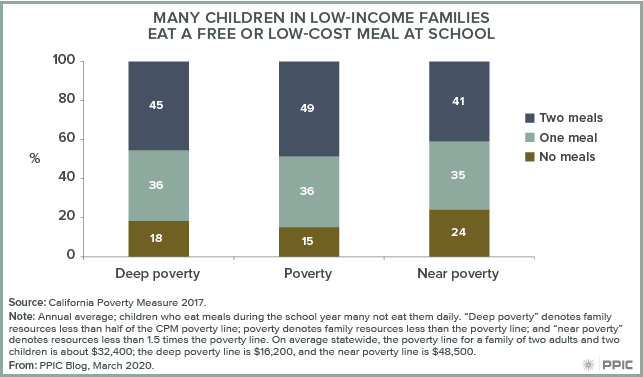
 

Chart source: The California Poverty Measure: A New Look at the Social Safety Net.

Refundable Tax Credits Ease Poverty in California

Poverty and income inequality have become hot topics in policy circles at the state and national levels. PPIC has been looking at these issues, too—recently analyzing the role that needs-based programs play in helping families make ends meet. In conjunction with researchers at the Stanford Center on Poverty and Inequality we measured poverty in California more comprehensively than the Census official poverty measure does. We found that the federal Earned Income Tax Credit (EITC) and refundable portion of the Child Tax Credit have the biggest impact in moderating poverty rates, relative to other safety net programs.

Both programs are aimed low- and moderate-income families with dependent children. Families must file tax returns to participate in these programs, which are funded by the federal government. (In addition, 25 states and the District of Columbia have their own smaller EITCs, although California does not.) The EITC is fully refundable, meaning that a family with earnings but no net tax obligation (after deductions) receives the full amount of the credit (based on their earnings) in the form of a tax refund. The Child Tax Credit is partially refundable.
Together, the EITC and CTC trimmed the 2011 poverty rate for working age adults from 24.0 percent to 21.4 percent. The child poverty rate dropped even more, from 31.1 percent to 25.1 percent. Put another way, an additional 600,000 California adults and 560,000 children would be considered poor without these programs.

Chart Source: The California Poverty Measure: A New Look at the Social Safety Net.

Testimony: Measuring Poverty in California

On the 50th anniversary of President Johnson’s declaration of a “War on Poverty,” the Senate Budget and Fiscal Review Committee held a hearing about California’s food stamp program, known as CalFresh. Although the hearing was called to explore federal complaints about high levels of fraud in the California program, it covered CalFresh more broadly, particularly the state’s very low participation rate in the program. PPIC research fellow Sarah Bohn was asked to testify about the impact of CalFresh on the state’s poverty rate. Here are her prepared remarks.


My name is Sarah Bohn. I am an economist and research fellow at the Public Policy Institute of California. I’m sure most of you are familiar with PPIC, but for those who are not, we are a nonpartisan, independent research institute focused on major policy issues in the state. I have been asked to discuss new measures of poverty in California to help set the context for your decisions.

The latest official poverty estimates suggest that about 16 percent of Californians are poor, and as many as 22 percent of the state’s children are poor. Official poverty statistics such as these are based on a very simple formula developed in the 1960s. The statistics have been useful for tracking trends and determining eligibility for many safety net programs. However, official statistics have not kept up with sweeping changes that have affected family budgets over the past five decades. Families now face higher costs of living and medical expenses, among others. And official statistics do not account for changes in public policy aimed at helping low-income people make ends meet—including programs stemming from the War on Poverty, which is having its 50th anniversary today.

With these shortcomings in mind, researchers have been developing alternative measures of poverty since the 1990s. These efforts culminated in the release of a new estimate of poverty by the Census Bureau in 2012 called the Research Supplemental Poverty Measure (SPM). It is called “supplemental” because is intended to supplement rather than replace official estimates. And it is called “research” because it is a work in progress, still being refined. It is that effort that researchers at PPIC and the Stanford Center on Poverty and Inequality have joined. We introduced our California Poverty Measure in October 2013. It uses basically the same methodology as the Supplemental Poverty Measure with a few refinements that make it a more accurate estimate for California that paints a much more detailed picture. (The Census Bureau’s measure for California is only a single number, averaging rates over three-year period).

Both the Census’ supplemental measure and our new California Poverty Measure provide a more comprehensive estimate of economic need today. For our California-specific measure we make adjustments to the poverty rate formula in three main areas. We use a more comprehensive estimate of family resources—including tax payments and credits (like the Earned Income Tax Credit) and in-kind benefits (like food stamps and housing subsidies). We also factor in nondiscretionary expenses like medical out-of-pocket, child care, and commuting expenses. Finally, our measure judges net family resources against a more up-to-date estimate of what it takes to maintain a basic standard of living (resources for clothing, food, shelter, utilities) and that accounts for geographic variations in housing costs, in particular. Whereas official poverty thresholds are the same for all states and counties, ours vary by county.

The Census supplemental measure and our California Poverty Measure produce similar results—but I will discuss our findings because they are more detailed. Under our measure, 22 percent of Californians were poor in 2011—about 8 million people. That is about 2 million more than the official estimate suggests. When we look at the findings we can see why the supplemental poverty measures are higher. Resources from safety net programs tend to push poverty rates down, while medical expenses and housing costs push poverty rates up. The net result is a higher statewide poverty rate. However, this is not the case in all places within California. Also, our findings vary across age groups. Child poverty under our measure is just a bit higher than the official measure—though still staggeringly high, at about 25 percent. As time allows I can discuss these findings further.

Among families with children, safety net resources play a prominent role in mitigating poverty. We calculate that without the CalFresh program, about 29 percent of California’s children would be considered poor—an additional 4 percent, or 375,000 children. I think it is worth noting that the impact of CalFresh on poverty is almost double the impact of CalWORKs.

If not for the full set of need-based safety net programs we include in our measure (CalFresh, CalWORKs, General Assistance, EITC and CTC, housing subsidies, SSI, and school meals), a stunning 39 percent of children—or 2.7 million—would be poor.

Under the Census supplemental measure and our California Poverty Measure, a higher fraction of California’s population is poor than in any other U.S. state. We know that housing costs are a major factor, because most Californians (70 percent) live in the most expensive counties, where the resources needed to maintain a basic standard of living are about $9,000 above the official poverty measure calculation. However, public programs also play a role. While CalFresh has a sizeable impact on family resources (as I mentioned), not all eligible families participate. In fact, according to the USDA, we have the second-lowest participation rate in CalFresh in 2012. This raises the question of how much more CalFresh could lower the poverty rate if participation increased. In our research, we find a correlation within California between access to CalFresh and the extent to which the program drives down poverty (the effect is about three times greater in counties with high access). More research is required to understand how the picture of poverty might change if the CalFresh program changed, but it is clear that the program plays a big role in mitigating poverty among Californians.