
High School Graduation during the COVID-19 Crisis

With schools closed for in-person instruction in California through the end of the school year, the state has asked districts to implement distance learning. As a result, many students—particularly high school juniors and seniors—are concerned about falling behind or failing to graduate.

Nearly half of students from low-income families do not have broadband access at home. Given this reality, along with the uneven distribution of learning opportunities within and outside of schools across the state, it will be important to address the equity implications of the shift to distance learning during the coronavirus pandemic.

In response to school closures, the California Department of Education is allowing districts to request waivers that exempt individual students from the state’s minimum graduation requirements, which include three years of English, two years of math and two years of science.

In addition, many districts have graduation requirements that exceed the state minimum. In the 2018–19 school year, 59% of districts required a third year of math, and 22% required a third year of science.

These requirements are prevalent across all types of districts—including high-need districts, in which more than 55% of students are low-income, English Learners, homeless, or foster youth; rural districts; and districts with high student-teacher ratios.
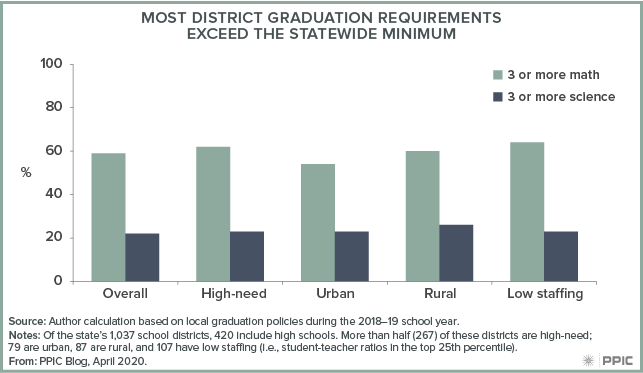
figure - Most District Graduation Requirements Exceed the Statewide Minimum

Moreover, students in six large districts—including Los Angeles Unified, San Diego Unified, San Jose Unified, and San Francisco Unified—must complete the entire A–G sequence required for admission to University of California (UC) or California State University (CSU) schools in order to graduate.

Districts with graduation requirements that exceed the state minimum will need to work with school boards to modify local policies. UC and CSU have already responded to school closures by temporarily suspending letter grade requirements for A–G courses completed in winter, spring, and summer 2020.

However, it will be challenging to help students stay on the A–G pathway. The waiver and temporary suspension of GPA requirements do not necessarily make it easier for students to take more A-G courses. PPIC research has shown that most students exit this pathway in the last two years of high school, and groups that are historically underrepresented in higher education are more likely to drop off at every stage. As districts develop distance learning plans and ways to provide flexibility to high school students, considerations of equity and access should be front and center.

Demand for UC and CSU Enrollment Remains Strong

The number of high school graduates has remained steady for several years, with no expectation of significant increases any time soon. And yet demand for admission to the state’s public universities continues to grow.

A quick look at trends among California’s high school graduates—in particular, their preparation for college—helps explain this paradox. Other sources of enrollment growth, including increases in transfer students and improved retention, also play an important role. Understanding these trends is critical, since annual state funding for the University of California (UC) and the California State University (CSU) depends partly on anticipated enrollment growth.

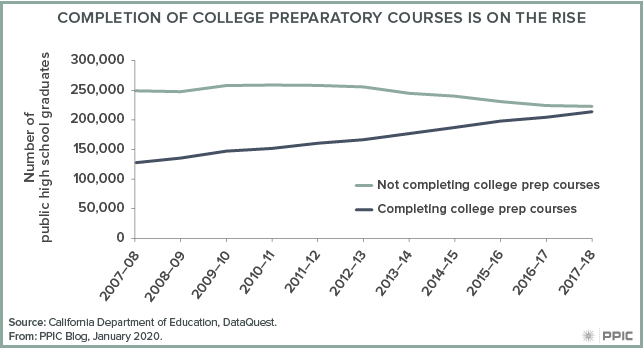
The good news is that more and more of California’s high school graduates have passed the college preparatory curriculum (known as the “A-G” courses) required by UC and CSU. Over the past five years, the number of high school graduates completing the A-G courses has increased 28%, even as the total number of high school graduates has remained largely unchanged.

By 2017–18 (the most recent data available), almost half (49%) of California’s high school graduates had completed the A-G courses, a remarkable increase from just ten years earlier when only about one-third (34%) did so. As a consequence, the number of high school graduates eligible for UC and CSU has reached record numbers.

figure - Completion of College Preparatory Courses Is on the Rise

Of course, enrollment demand depends on more than just new freshmen. The number of students that transfer from the state’s community colleges also adds to enrollment growth. Over the past five years, that number has also grown (up 25% at UC and 14% at CSU).

Improvements in persistence and completion also lead to greater enrollment, as fewer students drop out. At both UC and CSU, persistence and graduation rates are increasing. For example, at CSU the share of freshmen that graduate within six years has increased from 54% (fall 2008 entering cohort) to 62% (fall 2013 entering cohort).

Accommodating this enrollment growth is good for the state. College graduates are in high demand in the state’s labor market and—on average—earn far higher wages than less educated workers. PPIC has projected that demand for highly educated workers will keep growing as the state’s economy continues to change. Finding ways for California students to attend and graduate from college improves their well-being—and that of the state.

New Admission Requirements at the University of California?

The University of California (UC) is considering revising its eligibility standards for admission, focusing on requirements for science education. California changed its K–12 standards in this area five years ago, when the State Board of Education adopted the Next Generation Science Standards (NGSS). UC must decide whether and how to align the NGSS with the a–g requirements—a set of courses students must complete in order to be considered eligible for admission to UC. A change in science requirements was proposed by the UC Board of Admissions and Relations with Schools and was approved by the UC Academic Senate earlier this year.

The NGSS has profound implications for science curriculum and instruction in high schools. Currently, to meet the a–g requirements, students must take two science courses from three core disciplines: biology, chemistry, and physics. But the NGSS includes four science categories: physical sciences; life sciences; earth and space sciences; and engineering, technology, and applications of science.

Changes approved by the UC Academic Senate include increasing the minimum science requirement from two to three years. UC would continue to require two years of work in at least two of three disciplines: biology, chemistry, and physics. Students may take a third course within these disciplines or in other science disciplines identified by the NGSS.

If the UC Regents vote on and approve the recommendations of the UC Academic Senate, the change will take effect in the fall of 2023—meaning that students entering high school in the 2019–20 school year will be subject to the new requirements. (CSU is in the process of updating its science requirements—which are currently similar to those of UC—and may follow UC’s guidelines.)

Some high schools would need to make changes to align their curriculum with the NGSS. One area of concern is the relatively low number of course-offerings in science among small and rural schools. PPIC’s work has shown that not every high school offered the entire a–g sequence in science in 2016–17; small and rural schools were much less likely to do so. Another area of concern is staffing, as a teacher shortage has left California schools struggling with large class sizes for years. Finally, ensuring awareness of these changes will be important. Parents and students should be informed of the new requirements with adequate time and detail to be able to plan accordingly.

Under NGSS, science course sequencing in high school may affect whether and how students meet the proposed a–g requirements. PPIC researchers are examining early implementation of the NGSS in the K-12 system and will discuss findings in an upcoming report. Moving forward, more research is needed to understand the implications of any new a–g requirements for high school graduates’ eligibility for UC and CSU.