Without Testing, Challenges for School Districts Add Up

Distance learning due to COVID-19 is not going to be a temporary phenomenon. Now, with K–12 campuses closed since mid-March and likely to stay shuttered for the remainder of the school year, students will miss out on about a third of their 180 in-person instructional days. The timing of these closures means no statewide end-of-year standardized tests, posing significant difficulties for teachers and districts when schools reopen.

Even before most districts announced the end of in-person classrooms, most California public school parents expressed concerns over providing productive learning at home—70% say they are somewhat or very concerned, in PPIC’s April Statewide Survey.

And success at distance learning for some students is uncertain because access to the internet and devices, curriculum, the demands of home life, and learning needs—especially for English Learners and students with disabilities—can vary so widely. Differences are already being revealed—according to a survey of public school teachers in late April, 25% of students are not logging in or making contact with their teachers during distance learning. In districts where poverty rates exceed three-quarters of the student population, 36% of students are not in contact with their teachers.

When schools do reopen, teachers must determine how to accelerate the learning of students who fell behind—whether opening happens in July, as Governor Newsom has advocated, or through expanded summer school, or on planned fall start dates. And without results from spring 2020 standardized tests, helping students catch up may require a sustained effort.  Some local education agencies are making plans to use formative assessments to assist in reopening, given that California, like all other states, has received a waiver for the federally required statewide assessments.

Typically, students in grades 3–8 and in grade 11 take statewide standardized tests in the spring. These tests of English language arts, math, and science help measure student learning during the year and may be used to place students in fall math courses. Such end-of-year assessments to gauge student learning are essential to California’s accountability system.

The results can also give teachers more insight into the mix of students who show up in their classroom in the fall, as well as identify schools and districts in need of extra support.  For 11th graders, the assessments can signal how prepared they are for the rigors of college coursework: the results are later used to place students in English and math in the CSU system.

Furthermore, few districts completed the standardized tests that measure the English proficiency of English Learners before spring closures, tests that determine if students can exit English Learner status. In some districts, English proficiency test results determine the courses students take in the fall.

Given how rapidly the COVID-19 crisis unfolded, these test cancellations were unavoidable.  But the absence of test results compounds the challenges of reopening schools: teachers will lack vital knowledge about how distance learning has impacted their students.

Teachers and school staff will likely conduct plenty of assessing on their own, planning lessons for the diverse needs of their students. The hope is their efforts can smooth the way for students’ return to their classrooms; but we are at least a year away from understanding how the crisis has impacted our students systemwide.

Students Prepare for AP Exams during COVID-19

In response to disruptions from COVID-19, the 2020 AP exams will be open book/open note format and taken online at home, according to the College Board. The new exams are scheduled May 11–22. At 45 minutes each, the exams will be much shorter and cover less material—focusing on content covered prior to March school closures.

An increasing number of colleges, including those in the University of California system, have affirmed they will award college credit for 2020 AP exams that score a 3, 4, or 5. While these changes give flexibility to students still hoping to earn college credits, all students may not benefit equally.

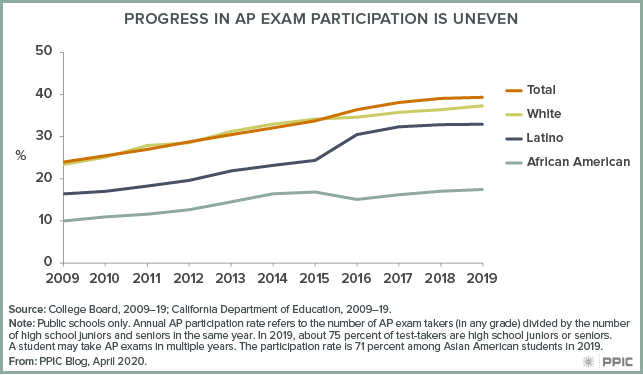
Nearly 380,000 students in California public schools took an AP exam in 2019, up 63% from a decade ago. Participation among Latino students grew from 16% in 2009 to 33% in 2019. However, participation by African American students plateaued in 2015.

figure - Progress in AP Exam Participation Is Uneven

For disadvantaged and vulnerable students, limited access to learning options at home may cause a dip in participation and performance. Nearly half of students from low-income families do not have broadband access at home; neither do a third of Latino or African American students. And broadband access remains problematic in rural areas, where 41% of school-aged children do not have access.

Students with special educational needs may face additional challenges. The pandemic and resulting school closures have had a disproportionate impact on this student population, with many losing access to special education support professionals and services.

Efforts to close these gaps are underway: the state Superintendent recently formed a new task force to close the digital divide, and the governor announced several cross-sector partnerships to support distance learning. The California School Board Association just announced its effort to push for a $2 billion broadband bond on the November ballot to address rural connectivity.

AP assessments begin in just a few weeks. The College Board has suggested that students without internet or a device contact them for assistance, but the scope of the organization’s ability to respond is untested. In addition, test preparation and participation may be difficult for students who are also caregivers at home and lack separate, quiet testing space.

It is unclear how many California students will take the 2020 AP exams, but they are still being encouraged to do so. In an April webinar, the College Board noted that 86% of AP teachers across the nation will still assign a letter grade to their courses during this school closure, with bonus points for completing an AP exam.

At 91%, the vast majority of AP enrollees still want to earn college credits. Schools and teachers across the state are helping students navigate the new system. As the state ramps up efforts to implement distance learning and maintain continuity of learning amid school closures, AP results should be closely monitored so that we understand the impact on socioeconomically disadvantaged students and special education students.

California’s Most Isolated Seniors

Seniors are especially vulnerable during the COVID-19 pandemic. First and foremost, of course, are health concerns. The latest data from the Centers for Disease Control and Prevention show that seniors are twenty times more likely to die of COVID-19 than are people younger than 65 (21 deaths per 100,000 compared to 1 death per 100,000 as of April 15). But seniors also face other significant challenges during this time of shelter-in-place, including social isolation. California’s efforts to support seniors through the pandemic can help counter these challenges.

Studies suggest that social isolation can lead to increased risk of mental and physical health conditions, including depression, cognitive decline, and elevated blood pressure.  Most immediately, isolated seniors might have an especially difficult time taking care of daily living tasks as they shelter at home.

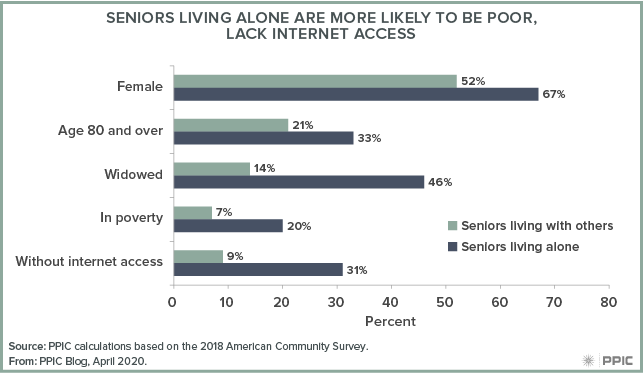
In California, 1.3 million seniors live alone (23% of 5.5 million seniors). They are disproportionately older, female, and widowed. Many have self-care limitations and a relatively large share live in poverty. Regionally, most live in the state’s large metropolitan areas, but many small rural areas of the state have very high shares of seniors living alone.

figure - Seniors Living Alone Are More Likely To Be Poor, Lack Internet Access

Of particular concern are those who do not have internet access. Among seniors who live alone, that’s 400,000 people. Another 40,000 have internet access but no smartphone, laptop, or tablet. They are perhaps the most socially isolated and vulnerable population in the state.

For these seniors, keeping up to date on the pandemic, ordering groceries and medicine from home, and connecting with others are all much more difficult. With libraries physically closed, a common access point to online services for many seniors is now unavailable, compounding the difficulty of overcoming social isolation.

Governor Newsom’s “Stay Home. Save Lives. Check In” campaign “urges all Californians to check in on vulnerable neighbors with a call, text or physically-distanced door knock” and is working with groups like AARP to reach out to older Californians. With many Californians now working from home, the time and opportunity to safely engage with older neighbors have never been greater—or the need more acute.

High School Graduation during the COVID-19 Crisis

With schools closed for in-person instruction in California through the end of the school year, the state has asked districts to implement distance learning. As a result, many students—particularly high school juniors and seniors—are concerned about falling behind or failing to graduate.

Nearly half of students from low-income families do not have broadband access at home. Given this reality, along with the uneven distribution of learning opportunities within and outside of schools across the state, it will be important to address the equity implications of the shift to distance learning during the coronavirus pandemic.

In response to school closures, the California Department of Education is allowing districts to request waivers that exempt individual students from the state’s minimum graduation requirements, which include three years of English, two years of math and two years of science.

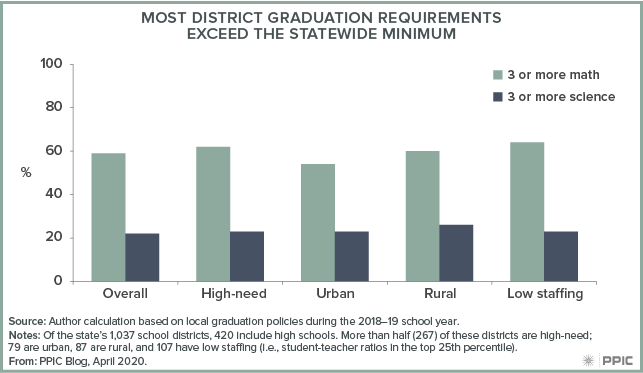
In addition, many districts have graduation requirements that exceed the state minimum. In the 2018–19 school year, 59% of districts required a third year of math, and 22% required a third year of science.

These requirements are prevalent across all types of districts—including high-need districts, in which more than 55% of students are low-income, English Learners, homeless, or foster youth; rural districts; and districts with high student-teacher ratios.

figure - Most District Graduation Requirements Exceed the Statewide Minimum

Moreover, students in six large districts—including Los Angeles Unified, San Diego Unified, San Jose Unified, and San Francisco Unified—must complete the entire A–G sequence required for admission to University of California (UC) or California State University (CSU) schools in order to graduate.

Districts with graduation requirements that exceed the state minimum will need to work with school boards to modify local policies. UC and CSU have already responded to school closures by temporarily suspending letter grade requirements for A–G courses completed in winter, spring, and summer 2020.

However, it will be challenging to help students stay on the A–G pathway. The waiver and temporary suspension of GPA requirements do not necessarily make it easier for students to take more A-G courses. PPIC research has shown that most students exit this pathway in the last two years of high school, and groups that are historically underrepresented in higher education are more likely to drop off at every stage. As districts develop distance learning plans and ways to provide flexibility to high school students, considerations of equity and access should be front and center.

Remote Learning for English Learners and Special Needs Students during COVID-19

[vc_row][vc_column][vc_column_text]For California’s most vulnerable students, including 1.2 million English Learners (EL) and over 700,000 students with special educational needs, remote learning in the wake of COVID-19 presents particular challenges. As districts across the state roll out distance learning plans to minimize disruption to K–12 students, educators must find alternate ways to meet all student needs.

English Learners and special education students typically require more in-person support, such as occupational and speech therapy, in their daily learning than students in general. Educators are struggling to devise and implement plans to address these requirements remotely. Access to internet and devices is one area of concern, but so is providing intensive learning experiences that can stand in for in-person services.

Most EL and special education students live in large urban areas with access to broadband, and school districts in these counties, such as in the Bay Area and coastal counties in Southern California, may be able to partner with philanthropy and technology providers to supplement households currently without broadband access. Rural areas, however, may not have the same supports.

In counties where broadband access is low—that is, over 18% of households with school-age children lack it—and where the share of EL or students with disabilities is high (over 26%), online learning is a hurdle. This includes Colusa, Yolo, Napa, San Joaquin, Stanislaus, Merced, Madera, Monterey, Kern, and Imperial, which together account for over 220,000 students who have special education needs or are English Learners.[/vc_column_text][/vc_column][/vc_row][vc_row max_width=”80″ visibility=”visible-desktop”][vc_column][vc_column_text][infogram id=”1p1qw10yewvk2dfmxmvky16prlb6pw1mvrm?live”][/vc_column_text][/vc_column][/vc_row][vc_row max_width=”80″ visibility=”visible-tablet-landscape”][vc_column][vc_column_text]

[infogram id=”1p1qw10yewvk2dfmxmvky16prlb6pw1mvrm?live”]

[/vc_column_text][/vc_column][/vc_row][vc_row visibility=”visible-tablet-portrait”][vc_column][vc_column_text]

[infogram id=”1p1qw10yewvk2dfmxmvky16prlb6pw1mvrm?live”]

[/vc_column_text][/vc_column][/vc_row][vc_row visibility=”visible-phone”][vc_column][vc_column_text]

[infogram id=”1p1qw10yewvk2dfmxmvky16prlb6pw1mvrm?live”]

[/vc_column_text][/vc_column][/vc_row][vc_row][vc_column][vc_column_text]There are an additional 50,000 such students in counties where we cannot estimate the share of families without broadband, but where concentrations of EL or students with special needs are disproportionately high. In these rural counties—which include San Benito, Mono, Tulare, Modoc, and Yuba—educators must determine how to compensate for lack of internet while offering intensive, though not in-person, instruction.

And it isn’t just students tested by the move to online instruction. In a typical school year, only 67% of teachers received professional development in using computers for instruction. Most received less than eight hours of training.

To fill the gap, more districts are providing training on how to teach students remotely. Courses cover online tools such as Zoom, Google Classroom, Canvas, and Seesaw; how to monitor and assess student learning; and how to manage and cater to student needs in an online environment. The California Department of Education also provided resources and idea banks to help districts accommodate students with varying learning needs, with guidance on options for delivering individualized education.

California continues to provide funding to districts to implement distance learning, through the governor’s executive orders and recent legislation. While distance learning cannot replace in-person instruction and services, educators are exploring alternatives, from reading assignments over the telephone to moving speech and occupational therapy online. Districts are also discussing extending the school year as they work to provide effective and equitable learning to the state’s most vulnerable students.[/vc_column_text][/vc_column][/vc_row]

Will Students without Home Internet Fall Behind During Coronavirus Shutdowns?

K–12 schools across California are preparing for closures due to the coronavirus outbreak, to protect students from unnecessary exposure and to sanitize facilities. As schools consider moving classes online to mitigate the disruption to student learning, broadband access at home presents a formidable challenge.

The good news is that K–12 schools have the means to deliver classes online. PPIC research has found that the overwhelming majority (90%) of California schools met the Federal Communications Commission’s (FCC) minimum threshold for digital learning in 2018, and 59% of schools met the FCC’s long-term targets.

However, internet access is a bigger problem for students in their homes. In 2017, close to 1 million (15.6%) school-aged children (ages 6–17) had no internet connection at home, while over 1.6 million (27.5%) did not have broadband access. About 9.5 percent of households with school-aged children reach the internet only via a cellular data plan, which can be slower and more expensive. For these same households, the devices available are limited as well, with 12.7 percent reporting no laptop, desktop, tablet, or other portable wireless computer at home.

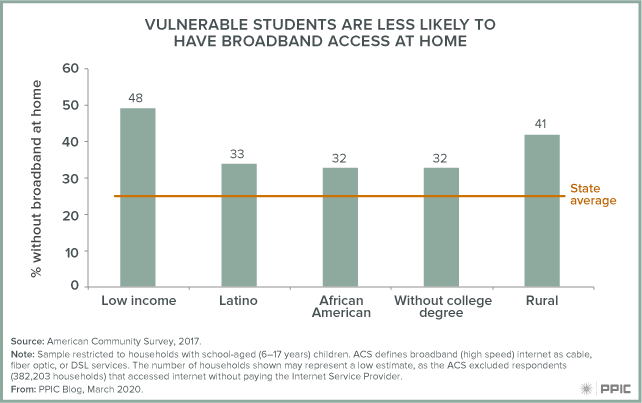
Underrepresented students are most at risk of falling further behind during school closures. About a third of Latino or African American students and students whose parents do not have a college degree lack a broadband subscription at home. Nearly half of low-income households with school-aged children have no broadband at home. Affordability remains a key barrier, as half of low-income households did not subscribe to broadband because of the cost.

In rural areas, access may depend on whether an area offers services. Forty-one percent of rural households with school-aged children do not subscribe to broadband at home, which is much higher than the state average (25%). For households with no internet access, 33.2 percent indicated internet was not available where they lived compared to 1.3 percent of respondents in metropolitan areas.

Households may not have internet or broadband for many reasons, including financial, technological, and topographical barriers.

figure - Vulnerable Students Are Less Likely to Have Broadband Access at Home

As the state and local authorities consider alternatives to in-person instruction, policymakers will need to consider how internet access will affect all students in the days and weeks ahead.

California’s Digital Divide and the 2020 Census

The 2020 Census will be the first decennial census with a fully online component. Rather than mailing forms to every household, the US Census Bureau will instead send out postcards asking households to take the census online, hoping to achieve a 55% online response rate. Then, as in years past, census workers will visit those who did not respond and conduct in-person interviews.

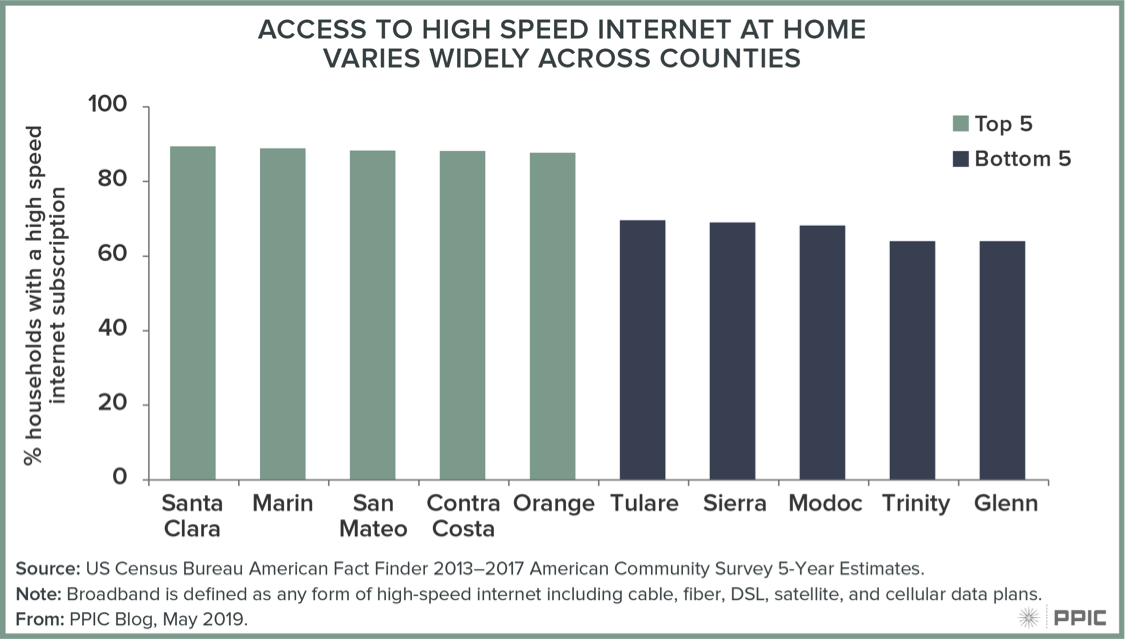
California’s size and diversity present unique challenges to this effort. One significant challenge lies in how many households report having reliable high speed internet—essential to completing the census online.

The contrasts across counties are stark. For example, according to the most recent estimates, more than 89% of households in Santa Clara County report having high speed access at home. In contrast, in Trinity, Glenn, Modoc, Sierra, Tulare, and Imperial Counties, more than 30% of households say they do not.

What’s more, these estimates actually understate the disparity. In the counties of Colusa, Sierra, Yuba, Tulare, and Plumas more than 15% of households report having high speed internet only through their cell phone data plans and no other source, and in 11 other counties at least 10% of households report the same.

Figure - Access to High Speed Internet at Home Varies Widely Across Counties

Of further concern is that these counties are the very ones that have been identified as being hard to count. In addition to sparse internet access, communities may be hard to count because they contain higher rates of historically undercounted groups, such as noncitizens and African Americans, or because large shares of their residents rent rather than own their households.

These challenges are real, but California is working hard to overcome them. State agencies were allocated over $100 million in 2018-19—with another $54 million proposed—so they may partner with the Census Bureau to help identify hard to count communities, encourage participation, and better ensure an accurate count of all Californians.